


2.11 U.S. Stock Market Review - The Worst Start in 31 Years, What Is the Market Afraid Of?

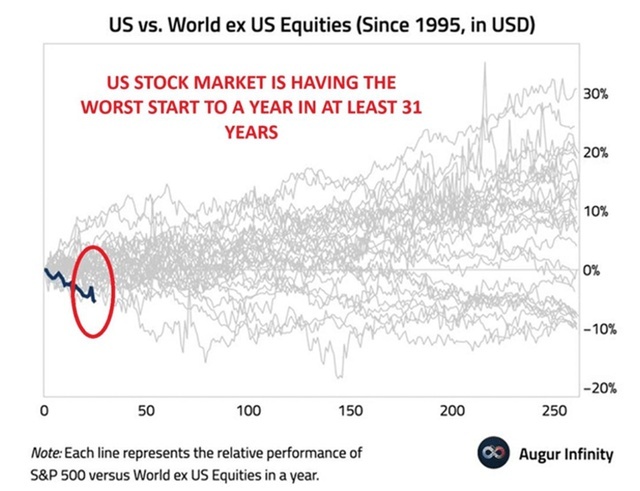
The US stock market so far in 2026 has actually performed relatively weakly. Taking the trading days of January 2026 as an example, it recorded the worst New Year start in the same period since 1995.
Actually, the main watershed moment is Wash's rise to power. He currently has an important policy inclination—to promote the separation of the Federal Reserve and the Treasury Department. This means that if the Treasury faces a debt crisis, the Fed will no longer take on the entire burden of rescue, making the Treasury more disciplined in issuing bonds, rather than having the central bank act as a backstop.
If things develop positively according to Wash's policy, with the Fed gaining independence and the Treasury becoming more disciplined in bond issuance, it would be good for everyone. However, in reality, there could be significant short-term shocks because this threatens many issues, such as potential short-term volatility in Treasury yields and whether Europe will establish its own liquidity framework.
In summary, this is a landmark policy event, and its future impact is unclear to anyone. The market is choosing to be cautious, especially regarding sectors and individual stocks sensitive to interest rates.
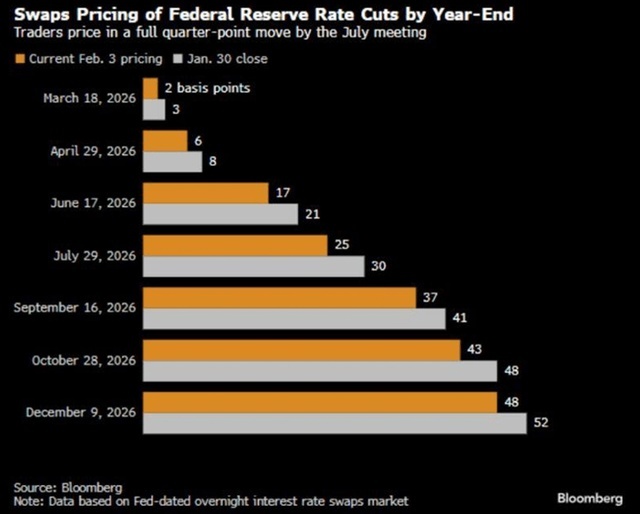
Furthermore, in the short term, investors are holding their breath awaiting this week's employment report and inflation data. If the data supports it, Powell might open the final window for interest rate cuts before his term ends.
But in the long run, the key determinants of long-term and consumer interest rates will no longer be the Fed's singular administrative directives, but rather the market's repricing of risk premiums.
In terms of specific operations, the main strategy in a volatile market is still to buy low and sell high. Currently, MSFT's valuation is not too high. If there is another small-scale, low-volume pullback, investors who like to buy on the left side (early) might consider buying low. The same goes for AMZN. Over the past five years, Amazon's stock price has risen less than 30%, significantly underperforming the S&P 500 index, making it one of the most sluggish tech stocks. Its current P/E ratio has dropped from nearly 80 times five years ago to 27.3 times now; its P/S ratio has dropped from 4.2 times to 2.8 times. The valuation has reached historically low levels. From a long-term perspective, building a position on the left side might also be considered.
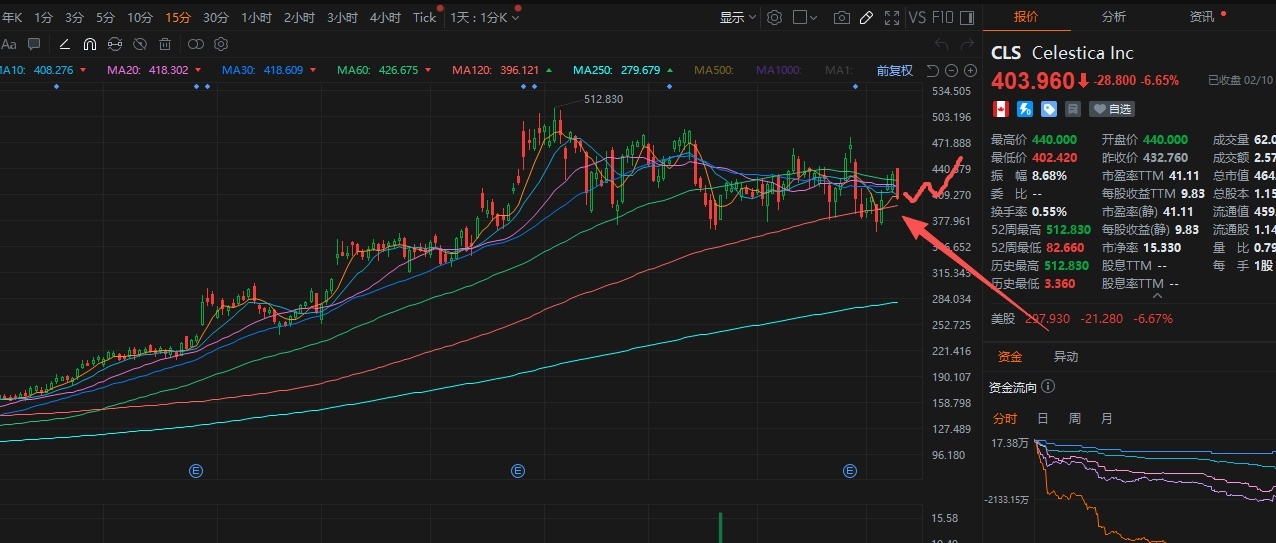
CLS has successfully transformed from a low-margin traditional OEM to a top-tier AI infrastructure supplier. The market is concerned about peak margins, but the increasing proportion of CCS (Connectivity and Cloud Solutions) in CLS's revenue structure ensures the stability of its profits. Media reports suggest Google might transfer TPU server assembly to other suppliers. But this rumor might be exaggerated. Technically, it has strong support at the 120-day moving average. If it doesn't break below this level in the short term and shows upward momentum on high volume, it might present a swing trading opportunity.
In the "Software Industry Battle Royale" triggered by AI, DDOG has become an extremely safe haven thanks to its "infrastructure nature" and "usage-based billing model."
DDOG charges based on data usage. The more AI applications are deployed and the more complex the backend architecture, the more data is generated, and the greater the demand for DDOG's monitoring services.
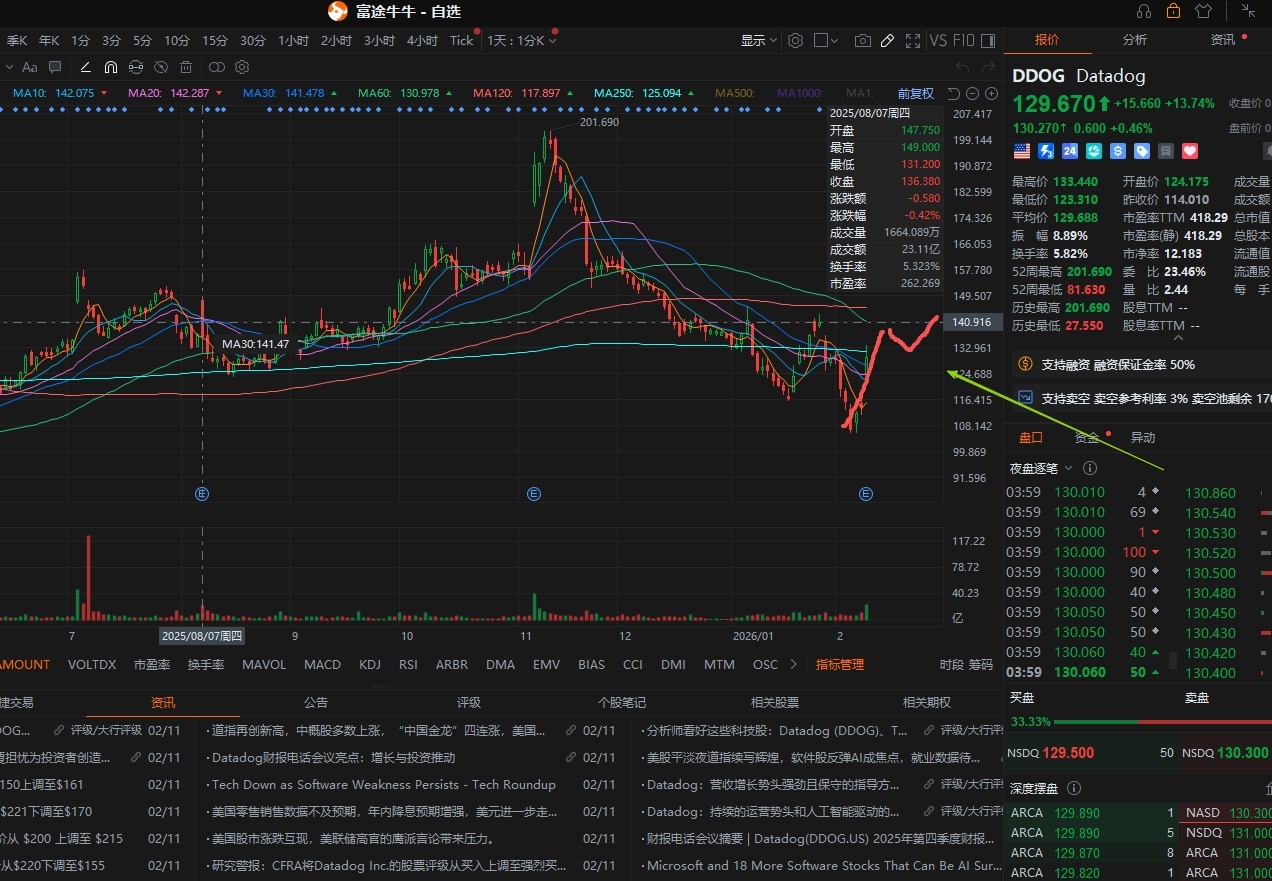
Technically, DDOG has broken through its 250-day moving average on high volume. After stabilizing, medium-to-short-term swing opportunities might also be worth watching.
$Datadog(DDOG.US) $Celestica(CLS.US) $Microsoft(MSFT.US)
The copyright of this article belongs to the original author/organization.
The views expressed herein are solely those of the author and do not reflect the stance of the platform. The content is intended for investment reference purposes only and shall not be considered as investment advice. Please contact us if you have any questions or suggestions regarding the content services provided by the platform.
