


Investment Analysis of the Storage Industry: Opportunities and Challenges in a Super Cycle

The market was rather uneventful yesterday, with narrow-range fluctuations. It basically followed the script from my weekly outlook, and it still depends on tonight's data. Gold once again reached the resistance level of 5050-5060 today, and there's still a possibility of another dip. Don't miss the chance to get on board if it comes. The crypto winter persists. Hood's earnings report yesterday fell short of expectations, mainly dragged down by the continued sluggishness of crypto. Recently, I wonder if you've noticed that crypto is appearing more frequently in the news. Not sure if there's any particular reason for that~
Today, I mainly want to discuss the storage sector, which offers higher certainty. As one of the hottest themes since the beginning of the year, I looked back at past articles and surprisingly found no dedicated piece on it. Plus, it has just entered a correction phase these past few days. So today, I want to discuss the future expectations for the storage industry, the supply-demand gap after capacity expansion, a breakdown of the core logic, and assess whether the cycle has peaked.
Price Trends and Supply-Demand Dynamics
Storage chip prices showed strong upward momentum in early 2026. DRAM contract prices surged month-on-month in January 2026, with PC DRAM contract prices rising about 98% and server DRAM about 90%. UBS points out that between 2025 and 2027, DRAM per-Gb prices could cumulatively rise by 289%, while NAND prices could rise by 144%. Although DRAM price increases are expected to slow to 20-25% quarter-on-quarter growth in Q2 2026, overall price levels will remain high.
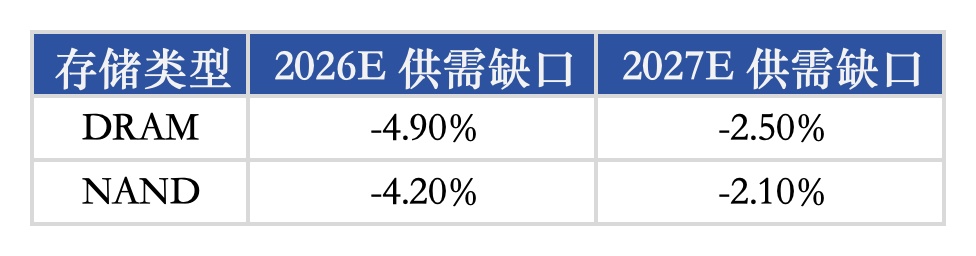
From a supply-demand perspective, the market generally expects the storage industry to face severe shortages. The supply-demand gap for DRAM in 2026 and 2027 is projected to be -4.9% and -2.5% respectively, while for NAND it's -4.2% and -2.1%. Among these, the 2026 DRAM shortage is considered the most severe in the past 15 years.
Table 1: DRAM and NAND Supply-Demand Gap Forecast (2026E/2027E)
Capacity Expansion and the Gap
Although storage manufacturers have begun increasing capital expenditures (Capex) to expand capacity, the pace of new capacity release is far from sufficient to meet the strong demand growth. The main reasons include:
1 Cleanroom Space Constraints: Existing cleanroom space is limited, especially with HBM (High Bandwidth Memory) capacity taking priority, constraining the increase in traditional DRAM capacity.
2 Long Lead Times for New Fabs: New fabs like Samsung's P5 and SK Hynix's Yongin are not expected to achieve mass production until the second half of 2027.
3 HBM Crowding-Out Effect: HBM production consumes 3 times the wafer input of traditional DRAM. This means even if total wafer output increases, the effective capacity available for traditional DRAM is significantly crowded out by HBM.
Morgan Stanley expects wafer capacity growth in 2026 to be only 7%. This limited capacity expansion stands in stark contrast to the explosive demand growth, further exacerbating supply tightness.
Core Logic Breakdown: AI Drive and Technological Bottlenecks
The core driver of this storage supercycle is the rapid development of artificial intelligence, particularly the huge demand for HBM and high-capacity DDR5 from AI servers. NVIDIA's Rubin platform and its ICMSP architecture are expected to bring massive incremental demand to the NAND market, with each GPU potentially requiring an additional 16TB of KV Cache storage. Goldman Sachs expects server-related DRAM demand (including HBM) to account for 53%-57% of global DRAM demand, making it the most important driver.
Meanwhile, the slowdown in DRAM scaling technology has also altered the industry's cost structure. As density improvements decelerate, the rate of per-bit cost reduction slows down. Storage product pricing is now more dependent on capacity allocation and supply-demand dynamics, rather than solely on cost reductions from technological progress.
Furthermore, strong demand from Cloud Service Providers (CSPs) is a key factor supporting current high storage prices. Even if demand weakens in the PC and smartphone markets due to rising storage costs, CSP demand remains robust and willing to pay a premium to secure supply. The share of storage costs in the server bill of materials has risen from 46% to 67%, highlighting the strategic importance of storage in AI servers.
Has the Cycle Peaked?
There is some divergence in the market regarding whether the storage cycle has peaked. The debate centers on whether the shortage can persist into 2027 or even longer. The main arguments supporting a continued cycle are:
• Sustained Explosion of AI Demand: As long as AI technology and applications continue to develop, demand for high-performance storage will not weaken.
• Lag in New Capacity Release: As mentioned, the release of large-scale new capacity takes time, making it difficult to effectively alleviate supply tightness before 2027.
• Low Inventory Levels: Current inventory levels for both producers and customers are generally low, making it hard to cope with sudden demand or supply disruptions.
However, potential risks cannot be ignored, including:
• Demand Destruction: Continuously soaring storage prices could lead to "demand destruction" in consumer electronics like PCs and smartphones, where consumers delay purchases or opt for lower-spec products due to high costs.
• Concentrated Release of New Capacity: If a large amount of new fab capacity is released in a concentrated manner after 2027, it could lead to oversupply again.
In summary, driven by strong AI demand, technological bottlenecks, and lagging capacity expansion, the storage industry's "supercycle" is expected to continue. In 2026, operating profit margins for DRAM and NAND are projected to reach historical highs, with Samsung's and SK Hynix's DRAM OPM potentially reaching 70%-80%. For investors, current valuations in the storage sector (like Micron) remain relatively low, leaving room for re-rating.
Conclusion
The storage industry is in a structurally growth cycle driven by AI, and the tight supply-demand situation is difficult to change in the short term. Although risks exist, such as demand destruction from high prices and future concentrated capacity release, the long-term trend of AI and existing capacity constraints mean the storage industry still holds high investment value in the coming years.
The copyright of this article belongs to the original author/organization.
The views expressed herein are solely those of the author and do not reflect the stance of the platform. The content is intended for investment reference purposes only and shall not be considered as investment advice. Please contact us if you have any questions or suggestions regarding the content services provided by the platform.
