


 CLF Return Rate
 Feed Explorer
The $81.5 billion cognitive blind spot: Why is Buffett's real ace in the hole not 'investment skills' at all?

Reflections on Chapter 4 of "The Psychology of Money"
Staring at the stock ticker every day, studying macro cycles, searching for the next ten-bagger... we always think the key to making big money is chasing the highest investment return rate. But in Chapter 4 of "The Psychology of Money," the author brutally wakes us up with harsh mathematical logic:
The human brain simply cannot process the utterly absurd power of compound interest.
We only need to see through the following three counterintuitive truths to completely reshape your investment perspective:
1. The Ice Age Principle: Creating miracles doesn't require earth-shattering power.
Scientists once thought that extreme volcanic eruptions or massive geological changes caused the Ice Age. But the truth is: the culprit was merely a slightly cooler summer. When summer temperatures are insufficient to melt winter snow, the remaining ice layer makes it easier for snow to accumulate the following winter, which in turn reflects more sunlight, leading to lower temperatures and more snow accumulation. If tiny growth can become fuel for future growth, an extremely small starting point can trigger astonishing results. In investing, you don't need to catch limit-up stocks every day; you just need to let your profits stay.
2. The Buffett Paradox: His greatest moat is longevity, not IQ.
Buffett's net worth is $84.5 billion. Here comes the extremely counterintuitive data: $81.5 billion of that was earned after his 65th birthday. Buffett started investing seriously at age 10. Imagine if, like an ordinary person, he started investing at 30, still maintaining his god-like 22% annualized return, and then retired to play golf at 60. What would his net worth be today? Not $84.5 billion, but a mere $11.9 million—a 99.9% shrinkage.
Why is the world's "best" investor 75% poorer than Buffett? The Quant King, Jim Simons, has achieved an annualized return of 66% since 1988, unmatched by anyone, almost three times Buffett's (22%). Yet, Simons' net worth is only $21 billion, 75% poorer than Buffett. Why? Because Simons didn't truly find his investment rhythm until he was 50. The time he had to let his wealth compound was less than half of Buffett's.
On the weaknesses of human nature:
"Linear thinking is much more intuitive than exponential thinking." (We can mentally calculate $8+8+8+8+8+8+8+8+8 in seconds, but if it's $8*8*8*8*8*8*8*8*8, our brains will crash.)
On the truth about Buffett:
"His skill is investing, but his secret is time. That's how compound interest works."
The ultimate investment strategy:
"There are many books on economic cycles and trading strategies. But the most powerful, most important book should be called 'Shut Up and Wait.'"
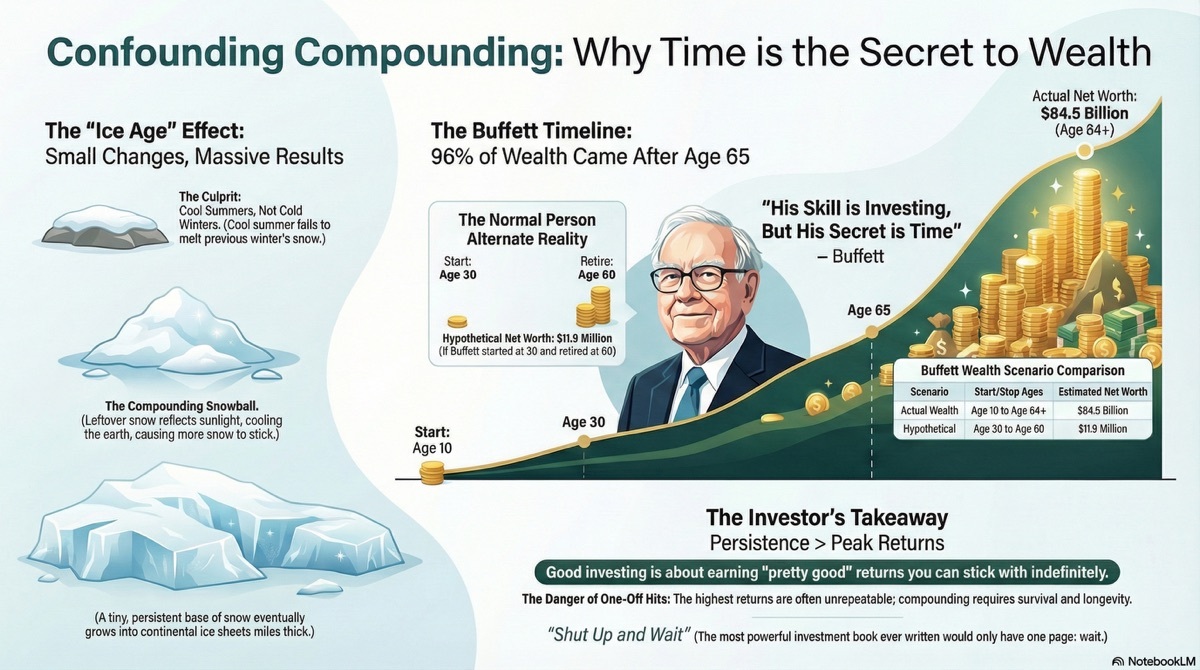
Stop exhausting yourself in pursuit of the so-called "highest return rate," because the highest returns are often unreplicable, one-time strokes of luck. Truly excellent investing is not about chasing the highest returns, but about achieving a "pretty good" rate of return that you can consistently repeat for the longest possible time. Only then will the magic of compound interest fully explode.
The copyright of this article belongs to the original author/organization.
The views expressed herein are solely those of the author and do not reflect the stance of the platform. The content is intended for investment reference purposes only and shall not be considered as investment advice. Please contact us if you have any questions or suggestions regarding the content services provided by the platform.
