


CRM: AI-replacement thesis sweeps; is the SaaS leader now a 'castoff'?---
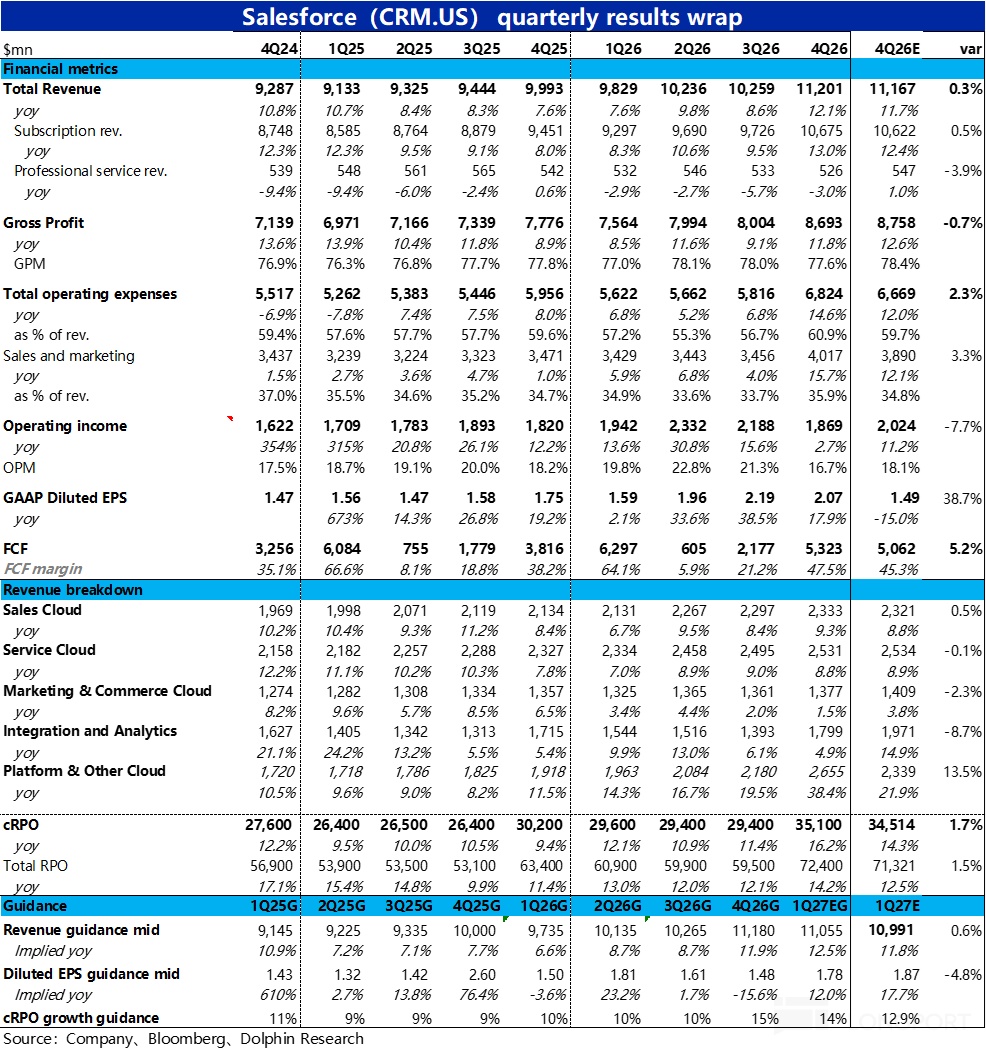
Amid the recent 'AI kills SaaS' narrative, one of the hardest-hit names, $Salesforce(CRM.US), posted FY26 Q4 (to Jan 31) after the US close. Overall, results were unexciting.
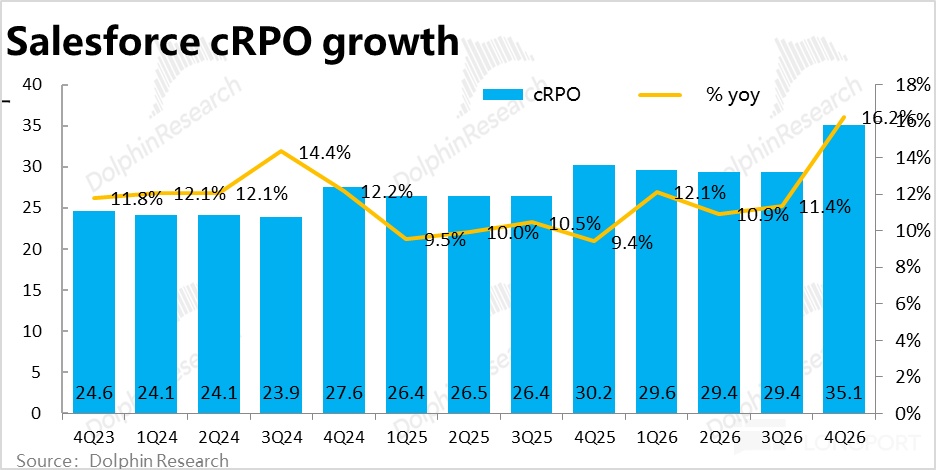
Revenue growth did tick up as guided, but largely on consolidation, with legacy growth soft. GPM kept compressing while opex rose across the board, driving a notable GAAP OP miss. Another key metric, cRPO growth, also came in below buy-side expectations, prompting a negative market reaction.
In detail. Key points follow.
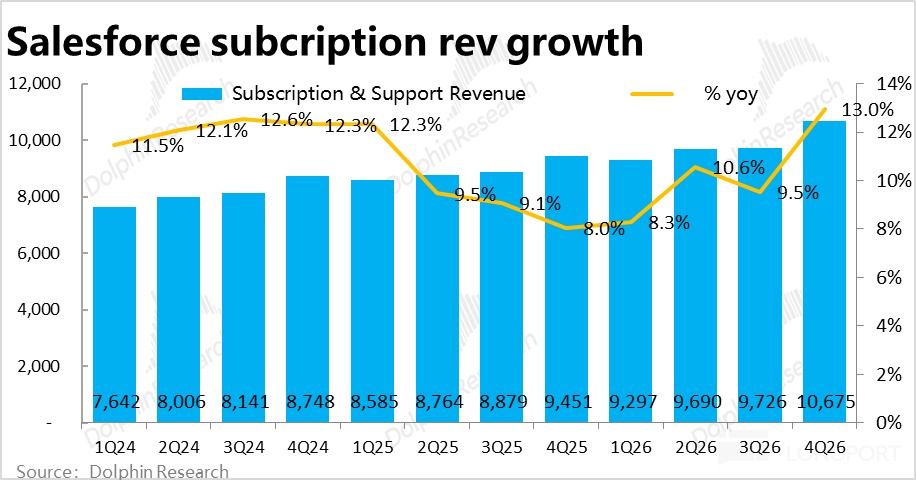
1) Apparent acceleration masks further slowdown: Core subscription revenue rose 13% YoY, or 11% in CC, up 2ppt QoQ. However, about 4ppt was contributed by the Informatica consolidation, implying underlying organic growth continued to decelerate.
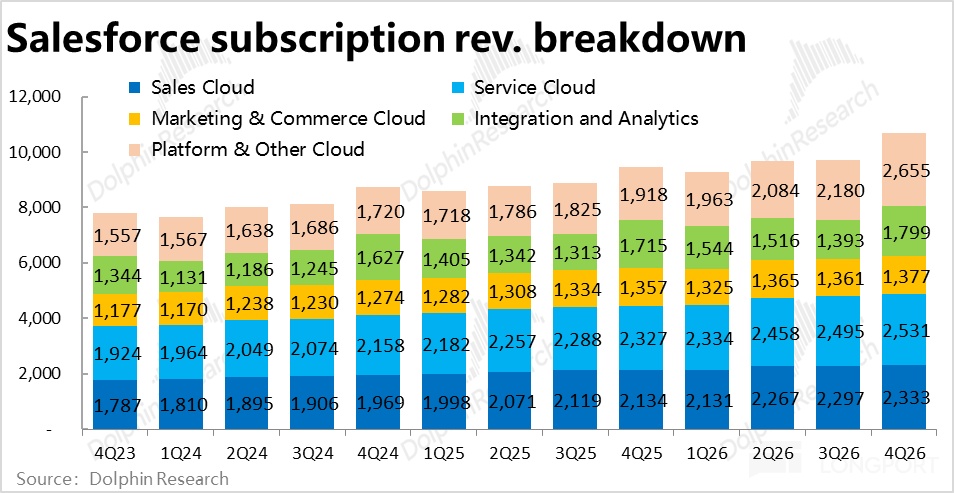
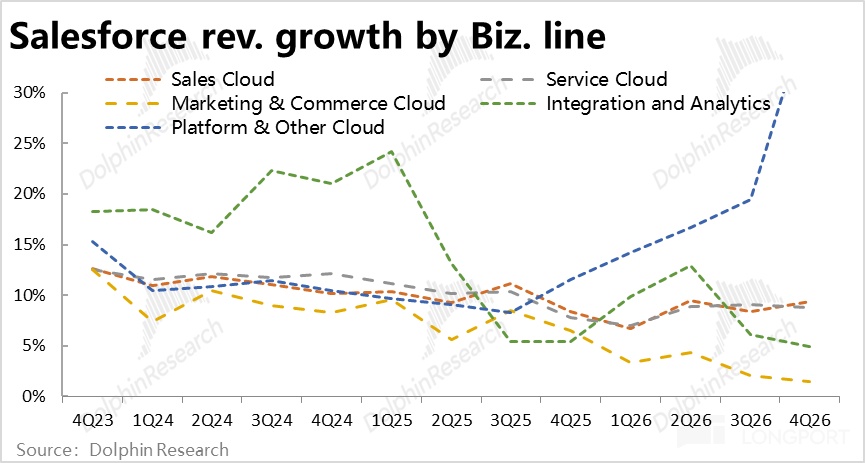
By line, aside from Platform Cloud, which was boosted by Informatica and saw a sharp step-up, other lines (in CC) generally slowed QoQ, with the best outcome merely flat. Despite prior guidance for a bottoming and recovery in revenue growth, there was little evidence of that by this quarter.
2) AI revenue edged up but remains nascent: Data & Agentforce ARR reached $2.9bn this quarter, but roughly $1.1bn was from consolidation. Ex-consolidation, AI-related revenue rose 29% QoQ, the fastest since the metric was disclosed.
Agentforce ARR hit $800mn, up nearly 170% YoY, showing a modest acceleration in the AI franchise. That said, AI still accounts for under 7% of total revenue, and Agentforce alone contributes under 2%, underscoring very early-stage adoption and trial activity; the 'acceleration' is off a small base.
3) Leading indicators also middling: Headline cRPO growth accelerated to 16% YoY, which looks solid at first glance. But in CC it was 13%, and again, about 4ppt of that came from consolidation. Ex-these effects, legacy cRPO growth slowed vs. last quarter.
Dolphin Research heard that more constructive buy-side expectations were at 14%–15%, so the print disappointed the bulls. There was similarly no clear sign of a growth re-accel.
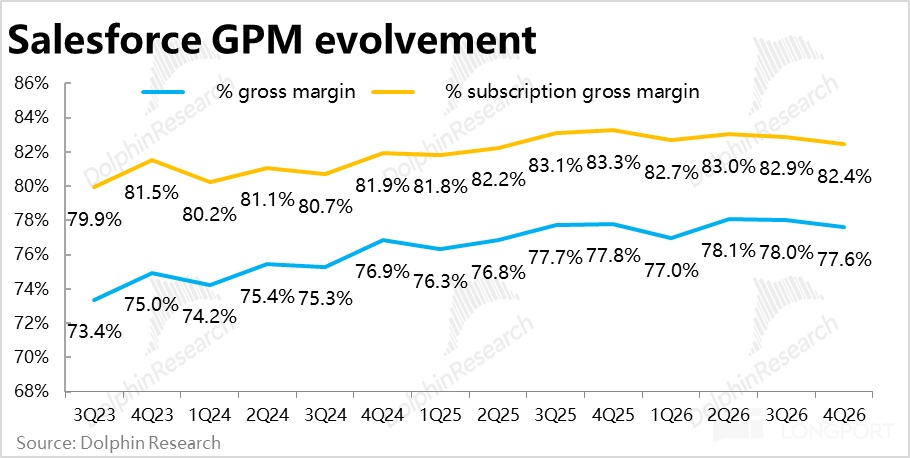
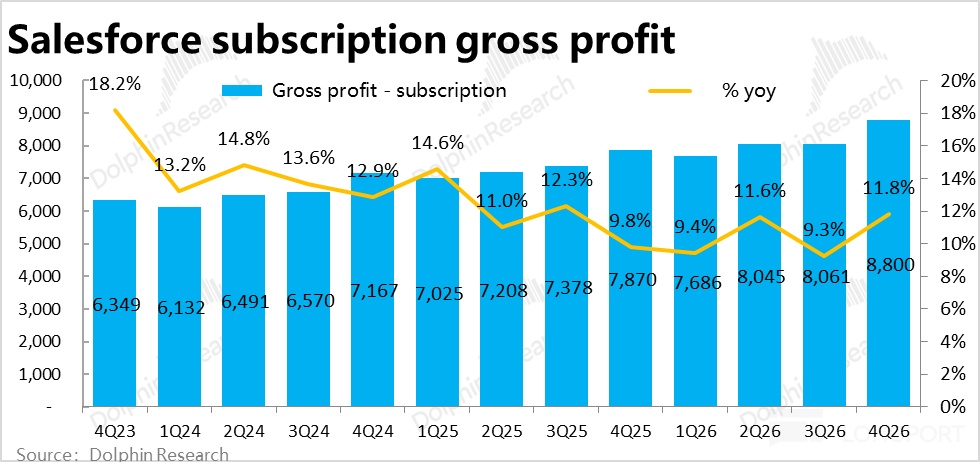
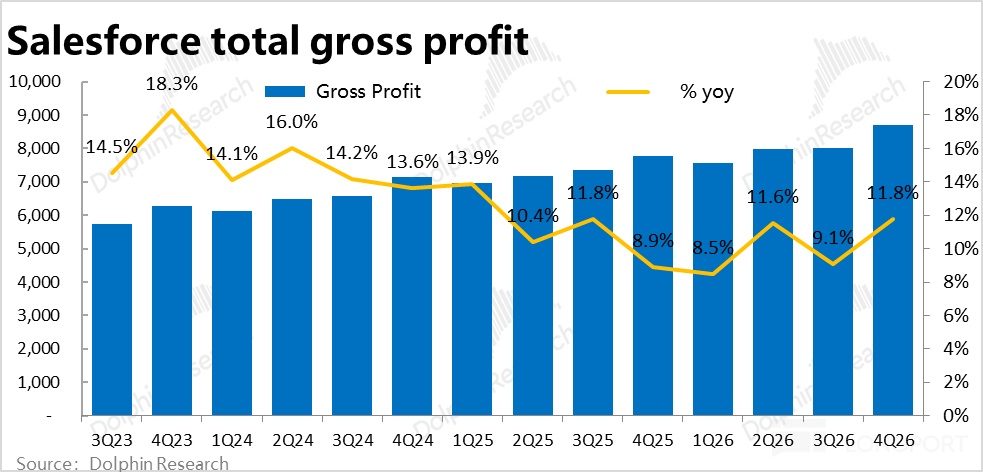
4) GPM under pressure amid AI spend: The downtrend persisted, with total GPM at 77.6%, down slightly both YoY and QoQ and below Bloomberg's 78.4%.
For core subscription, GPM was 82.4%, down about 50bps QoQ and nearly 100bps YoY. Dolphin Research believes lower-margin AI workloads such as Agentforce, with heavier backend compute needs, likely weighed on margins.
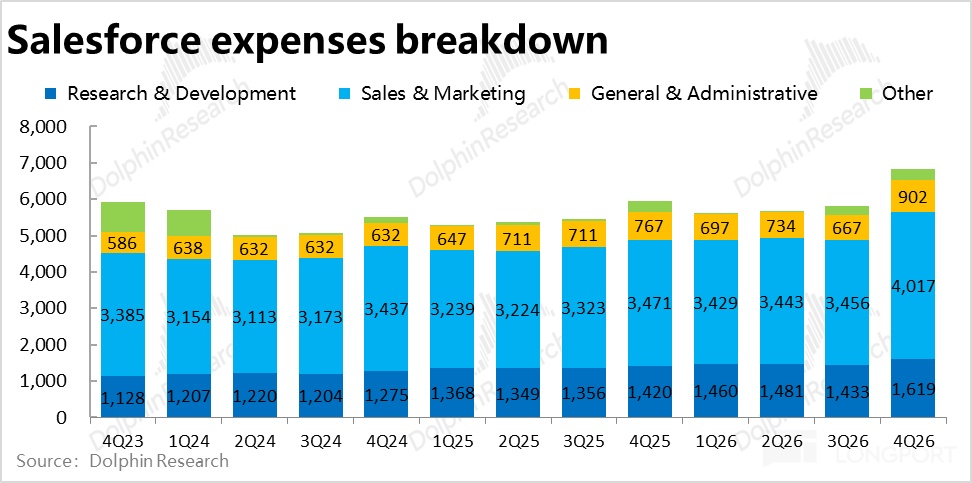
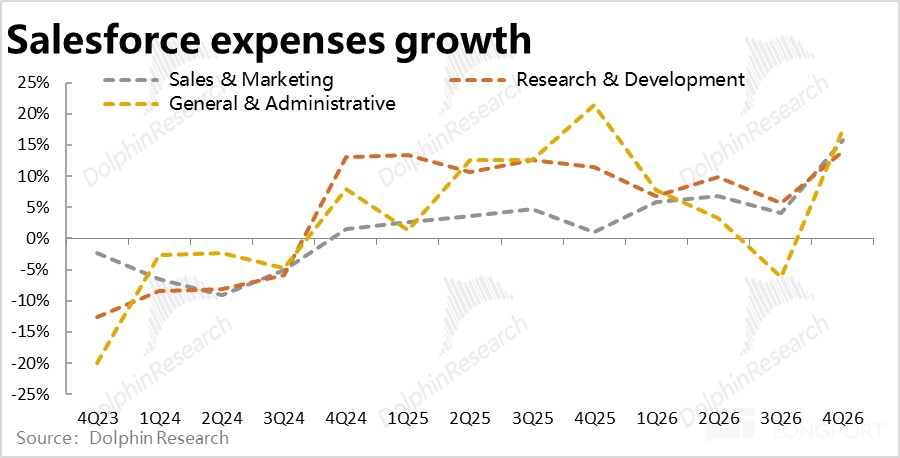
5) Opex growth accelerated materially: While revenue was lukewarm, total operating expenses rose nearly 15% YoY, a sharp step-up from years of mid-single-digit growth and above both street expectations and revenue growth.
R&D, S&M and G&A each grew around 15% YoY, indicating a broad-based ramp in investment. The company tightened costs last quarter but pivoted to heavier spend this quarter, suggesting management is keen to re-accelerate growth.
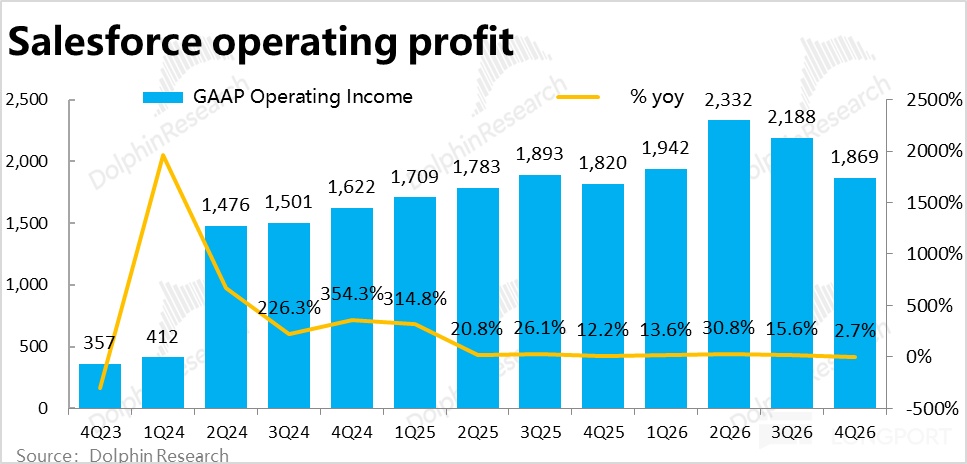
6) Margin compression plus opex expansion hurt profit: With growth mediocre, GPM down, and expenses up, GAAP OPM was 16.7%, down 150bps YoY, the first YoY decline since FY23 (CY22, the post-pandemic trough).
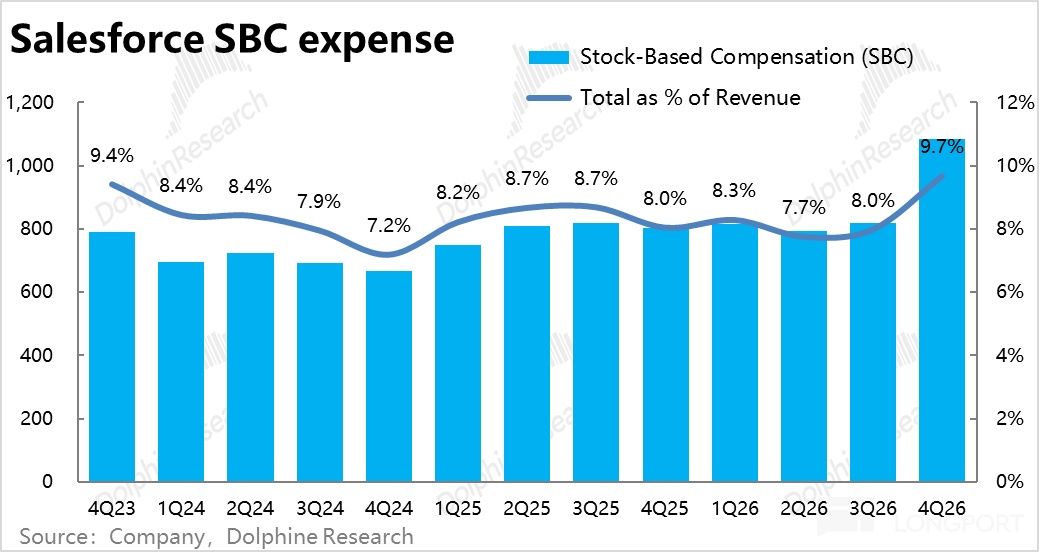
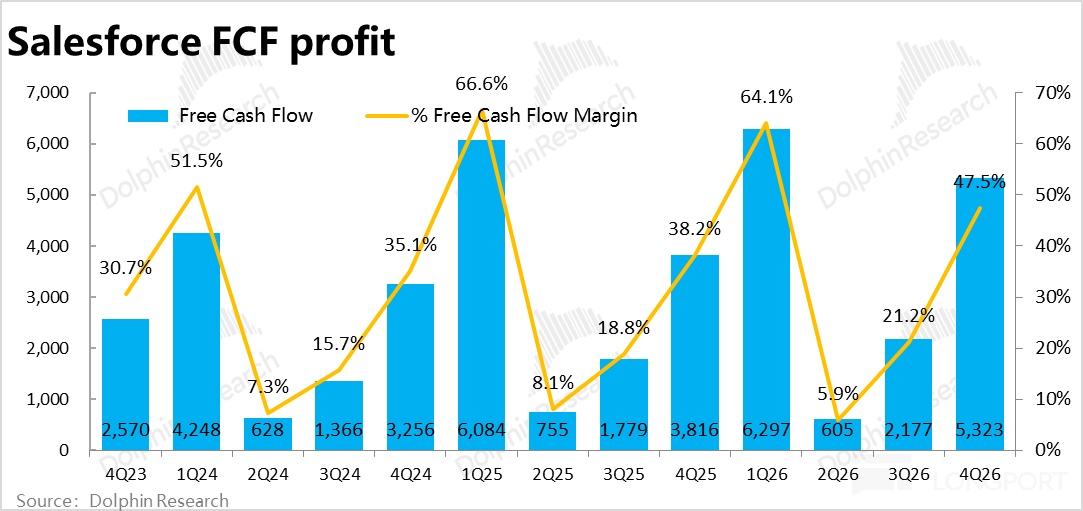
GAAP OP was $1.87bn, up less than 3% YoY and ~8% below Bloomberg consensus, which looked poor. Ex non-cash items (mainly SBC and working-capital movements), FCF was $5.32bn, beating both guidance and the street, driven largely by higher deferred revenue recognition on the BS.
7) Strong capital return: As pledged at Dreamforce, with growth limited, shareholder returns have become a key way to sustain equity appeal. In FY26, total capital return was $14.3bn, mostly via buybacks, equating to roughly an 8% yield on the current market cap, which is meaningful.
Additionally, the company unveiled a fresh $50bn repurchase authorization (replacing the prior program). It remains generous on capital return.
Dolphin Research view:
1) As shown above, CRM's quarterly print was clearly not strong. Stripping out consolidation and FX, legacy growth did not re-accelerate and instead continued to slow. The revenue bottoming-and-rebound signaled at year-end has not materialized this quarter. (Including FX and consolidation, total revenue growth did recover to >10%, but that has limited informational value.)
Despite a year-plus of promotion and iteration, AI revenue from Agentforce and related offerings is indeed accelerating, but still off a small base and not yet a meaningful driver of total revenue growth.
At the same time, AI businesses carry higher costs, and spend has been stepped up (whether to push growth or as a defensive response to AI disruption), pressuring profitability. Net-net, growth is so-so and profit is underwhelming.
As for guidance and outlook:
Near term, on a CC basis, next-quarter total revenue is guided to grow 10%–11% YoY, similar to this quarter with a slight uptick, with consolidation contributing 4ppt, broadly in line with Bloomberg. That implies a marginal improvement but still no clear re-accel in the legacy base.
cRPO is guided to grow 13% YoY (CC), matching this quarter; the consolidation contribution was not disclosed, but there is likewise no acceleration. On profit, diluted EPS guidance is ~5% below Bloomberg on a GAAP basis, while Non-GAAP is slightly above. Dolphin Research does not generally exclude SBC as a real expense, so on GAAP, the outlook is also uninspiring.
Overall, next quarter implies steady top-line without a clear step-up, and margins remain under pressure.
2) With Openclaw showcasing faster-than-expected progress in AI Agents and top models like Claude/Gemini iterating rapidly, the evolving narrative on how AI may reshape software and broader industries likely matters more for the stock than current results.
Frankly, Dolphin Research sees two opposing scenarios: a) incumbents possess sufficient industry know-how and proprietary data to keep their edge in the AI era, turning AI into a tailwind rather than a competitor;
b) AI slashes the cost for enterprises to build internal tools and automate workflows, undermining the value of 'expensive' SaaS, or Agents replace employees and materially reduce billable seats. Both could severely pressure SaaS economics.
Which path is more likely remains unresolved, and uncertainty is elevated. Greater uncertainty means higher risk, which likely grows as AI advances.
Therefore, similar to our stance on Uber before: current results are still stable with no clear signs of AI disruption yet, but given the non-trivial 'reset-to-zero' risk, we prefer to stay on the sidelines near term — better safe than sorry.
3) On valuation, per the long-term framework to FY30, GAAP net operating profit was guided at roughly $18bn. At a mature-state 15x PE, that implies a ~$270bn market cap, or about $290 per share, making sub-$190 today look inexpensive.
But that LT guide could not have anticipated how AI/Agents may disrupt the model and results (potentially additive or destructive). With limited visibility even into next year, FY30 targets are less meaningful.
Conservatively, using FY26 net income of about $7.5bn, the current market cap implies ~22x PE. Management guides FY27 GAAP diluted EPS to be roughly flat vs. this year, putting forward PE in a similar range.
All in, unlike many SaaS peers that still carry rich multiples and face de-rating risk even without true AI disruption, CRM already trades at a more modest valuation with robust buybacks. The scope for pure multiple compression is more limited.
Thus, existing holders need not fear a major leg down purely from de-rating, though there is also no clear catalyst to drive meaningful upside for now.
Core charts and a brief biz. overview follow:
I. Salesforce biz. & revenue overview
Salesforce is a pioneer of SaaS (software-as-a-service) in the US and globally within CRM (client relationship management). The model is cloud-delivered rather than on-prem, and subscription-based rather than license-based.
Accordingly, CRM has two main revenue streams: ① over 95% from subscription revenue across SaaS offerings; ② the remaining ~5% from professional services, such as project consulting and training.
Within subscriptions, revenue is split across five major SaaS categories of roughly similar size:
① Sales Cloud: the original and core CRM module for managing sales processes, such as lead/contact, quoting and closing.
② Service Cloud: another core pillar covering customer service workflows, including customer data management and online support.
③ Marketing & Commerce Cloud: marketing automation across search, social and email channels; and e-commerce capabilities such as storefronts, order management and payments.
④ Integration & Analytics: internal data platforms and BI tools, primarily MuleSoft and Tableau.
⑤ Platform & others: underlying services akin to PaaS that other Salesforce SaaS run on, including collaboration tools like Slack.
II. Revenue growth looks faster, but is only fair
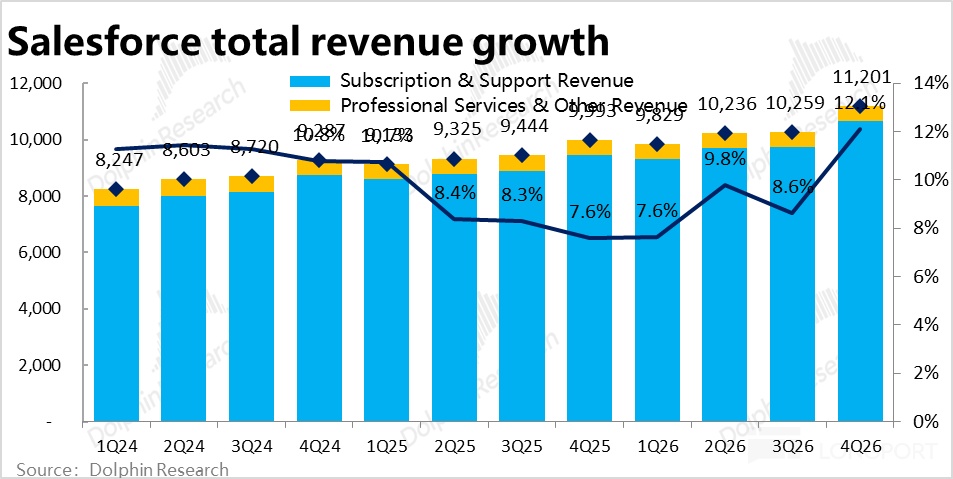
II. Leading indicators similar: strong-looking but slightly below expectations
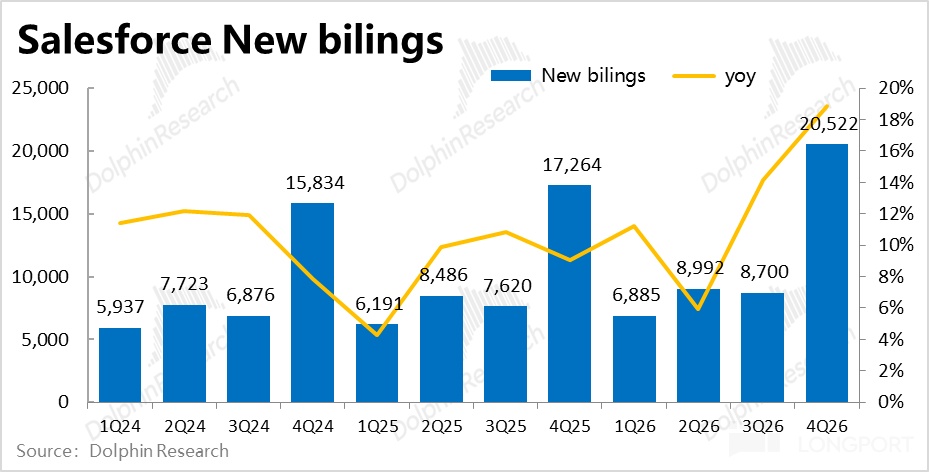
III. GPM under pressure
IV. Opex ramped up
V. Profit nearly flat
<End of text>
Past Dolphin Research on [Salesforce]:
Earnings reviews:
Sep 4, 2025 review ‘Salesforce: Is AI a savior or a death knell?’
Sep 4, 2025 transcript ‘Salesforce (Trans): AI is an assistant, not a killer; SMEs as the next growth vector’
May 29, 2025 review ‘Salesforce: AI agents — still a distant dream?’
May 29, 2025 transcript ‘Salesforce: SME demand strong; doubling down on Agentforce’
Feb 27, 2025 review ‘Salesforce: Agents must spend before they earn?’
Feb 27, 2025 transcript ‘Salesforce (Trans): the ‘holy trinity’ of apps, data and agents’
Deep dives:
Jan 15, 2025 initiation pt. 2 ‘Salesforce: Can a mature SaaS sprout new growth?’
Jan 7, 2025 initiation pt. 1 ‘Will ‘AI’ replace ‘human’? How much can Salesforce benefit?’
Risk disclosure and disclaimer: Dolphin Research Disclaimer & General Disclosures
The copyright of this article belongs to the original author/organization.
The views expressed herein are solely those of the author and do not reflect the stance of the platform. The content is intended for investment reference purposes only and shall not be considered as investment advice. Please contact us if you have any questions or suggestions regarding the content services provided by the platform.
