


LKNCY: Is China's coffee leader being held hostage by the delivery wars?---
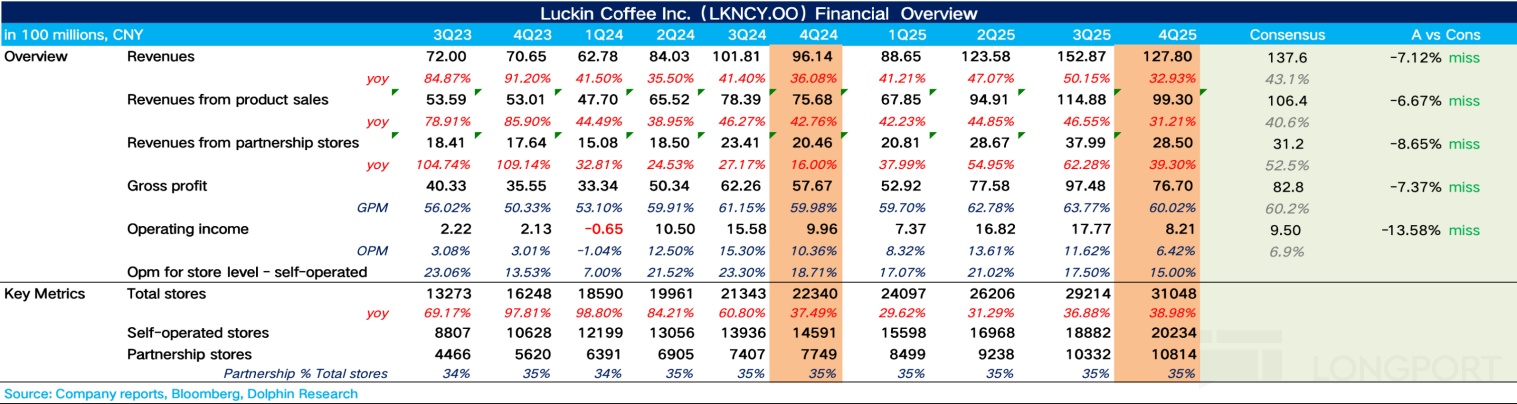
Luckin Coffee (LKNCY) released its Q4 FY2025 results (to Dec-2025) before the U.S. market open on Feb 26, 2026 Beijing time. Overall, with delivery-platform subsidies easing and Luckin tightening its own subsidies, revenue growth slowed meaningfully, while the ongoing 'delivery war' kept fulfillment costs elevated and continued to squeeze margins in Q4, leading to an underperformance vs. market expectations.$Luckin Coffee(LKNCY.US)
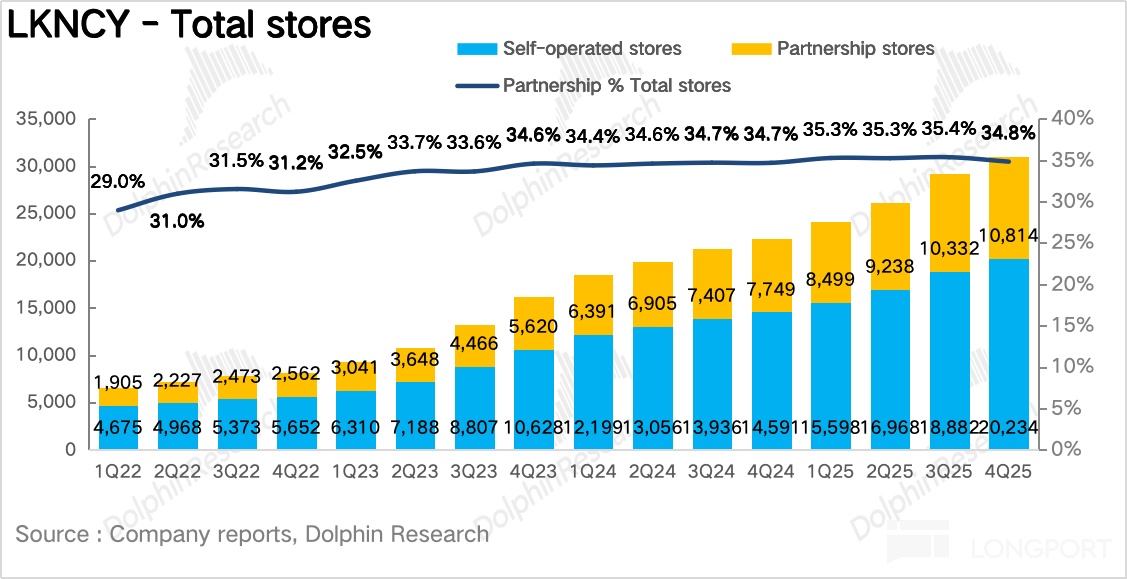
1) Store openings slowed. Luckin added a net 1,834 stores in Q4, with the pace decelerating QoQ. Dolphin Research believes the core driver is the surge in store-level fulfillment costs amid the delivery war, which compressed store OPM, prompting management to slow openings to protect unit economics. On the other hand, store expansion in Southeast Asia (Singapore, Malaysia) picked up.
2) Same-store sales growth weakened notably. The core indicator of organic unit growth, SSSG rose 1.2% YoY. As subsidies were cut and structural price adjustments implemented in Q4, the actual same-store performance suggests pricing power was limited, with high price sensitivity dampening cup volume vs. expectations.
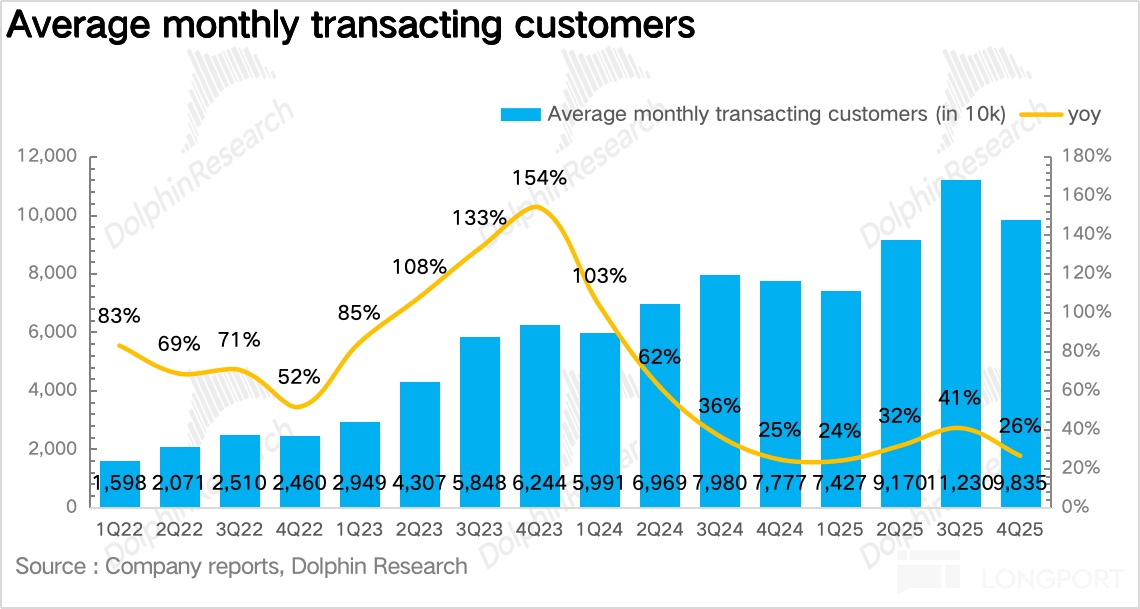
3) Monthly active paying users growth slowed QoQ. Q4 monthly active paying users rose 27% YoY to 98mn, but growth slowed vs. Q2 and Q3. Dolphin Research sees low private-domain conversion and retention for delivery users; as subsidies faded, repeat purchase intent dropped sharply.
4) Fulfillment costs stayed high, pressuring margins. Q4 GPM was broadly stable. The main issue remains the high share of delivery orders, keeping delivery cost ratio elevated at about 13% (vs. a normal 7–9%), which eroded profits, with Non-GAAP OP at RMB 0.96bn, down 13% YoY.
Core KPIs at a glance:
Dolphin Research view:
Q4 was similar to Q3 in essence: revenue growth with margin pressure. The market had expected that as delivery-war subsidies tapered, self-pickup mix would rise and margins would steadily recover without a sharp slowdown in same-store growth, but the pace has been slower than anticipated.
Despite multiple regulatory interventions, subsidy convergence was not strong in Q4. Subsidies fell from the Jul–Aug peak but remained well above pre-war levels, and per channel checks, Q4 subsidy intensity was roughly in line with May–Jun.
Platform commissions and delivery fees reduced Luckin’s margins by disrupting its low-cost, self-pickup-centric channel model and pulling it into a high-cost delivery model. This is why Luckin aggressively cut subsidies in Q4 to protect margins.
a) Shrinking the low-price range:
On one hand, Luckin reduced its RMB 9.9 product set from 8–10 SKUs in Q3 to just 2 (basic Americano and latte). It also cut back the frequency of 'buy 2 get 1' and large-value coupons, while discount rates on third-party channels such as 拼好饭 and 爆品团 were visibly reduced. On the other hand, promotions became more targeted rather than broadly price-led.
b) Enhancing product mix:
For core products (e.g., coconut latte, velvet latte), Luckin avoided direct price hikes, but expanded upsell options like 'extra large' and 'add an extra shot' to indirectly lift per-cup profit potential. In addition, co-branded Minions SKUs and winter-themed 'Five Nourishments Latte' were priced 30–50% above base items.
Combining a & b, Luckin can preserve its 'affordable' label at minimal cost to avoid share loss to ultra-low-price brands like Lucky Coffee. At the same time, differentiated pricing maximizes profit flexibility while defending the price-sensitive core and sustaining margins.
Although user-side subsidies were reduced, another noteworthy move was stepping up subsidies to franchise stores in Q4, especially those with low cup volume. Dolphin Research believes this both helps franchisees in lower-tier markets transition through their first low season in Q1 after rapid 2025 expansion, and signals that even at a 30k-store scale, Luckin still sees franchising as essential to capture lower-tier share.
Into 2026, although store openings slowed temporarily in Q4, with domestic coffee penetration still rising, leading brands are unlikely to slow expansion; share gains remain the main theme. The battleground will be operational excellence rather than a renewed price war.
On valuation, per Dolphin Research estimates, the current 2026E multiple is about 15x. With profit CAGR likely above 20% over the next three years, and ignoring OTC market discount, the current valuation is not demanding.
From a trading perspective, with Luckin’s mid- to long-term competitiveness intact, the delivery war’s impact on margins looks transitory. If the market imposes a punitive multiple compression in the near term, it could be a good entry point.
Below is the detailed analysis
I. Investment framework
Per disclosures, Luckin operates two lines: self-operated and franchise.
1) Self-operated refers to company-owned stores, now above 20,000 and concentrated in tier-1/2 cities, which are critical for brand building. Self-operated is the profit bedrock, contributing over 80% of profit.
2) Franchise revenue includes raw materials (coffee beans, milk, coconut milk), profit sharing (tiered by store GPM), equipment sales, delivery services and other services. Raw materials account for nearly 70% and are the core revenue driver. Franchise stores now exceed 10,000, contributing roughly 20% of revenue, focused on lower-tier markets; while opening faster, profitability trails self-operated.
II. Store opening pace moderated
Openings: Luckin added a net 1,834 stores in 25Q4, bringing total to 31,048. The pace slowed vs. Q3 but the full-year target of 8,000 new stores was achieved.
Overseas, Southeast Asia remains the primary expansion front. Singapore is 100% self-operated, replicating the mature domestic 'Pick-up + Relax' dual formats, prioritizing CBDs, campuses and transport hubs. As of 25Q4, Luckin operated 81 stores in Singapore, already profitable overall, making it the benchmark overseas market.
Malaysia uses a franchise model, with a 10-year exclusive master franchise signed with GASB, a subsidiary under local conglomerate Dazi Industrial (GASB runs end-to-end operations in Malaysia; Luckin provides brand licensing, digital systems, supply chain support, product standards and training). Stores are mainly in Kuala Lumpur and Penang, adopting a 100% pick-up format, totaling 70 by 25Q4, validating the franchise model in SEA and paving the way for Indonesia and Thailand.
North America, facing high rents and lower brand awareness, remains in single-store model refinement.
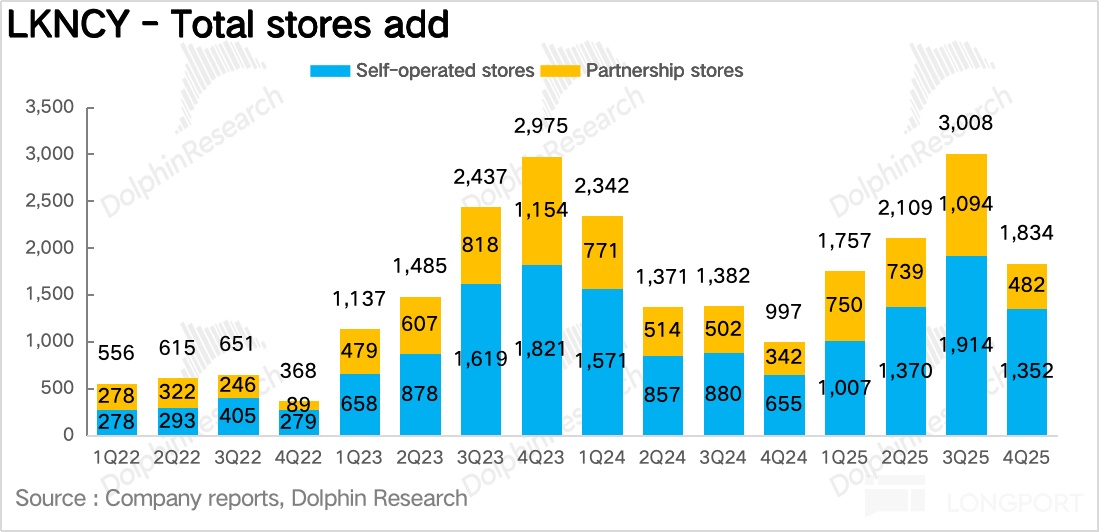
As the core indicator of organic unit growth excluding new stores, SSSG rose 1.2% YoY and fell QoQ; breakdown:
Cup price: as subsidies for RMB 9.9 basic items were further reduced in Q4 (now retained only for Americano and a few SKUs), most product prices reverted to the RMB 10.9–13.9 range. Meanwhile, per checks, upgrades to the membership system and stronger incentives on owned channels, together with precise pushes from Lucky AI 1.0, lifted paid-member mix to 28–30% (+300bps QoQ). Because paid members have 30–40% higher ticket vs. non-members, cup price increased.
Cup volume: with subsidy cuts and structural price hikes, actual same-store performance indicates pricing was challenging, and high price sensitivity led to weaker-than-expected cups.
On product, Luckin launched 20 new SKUs in Q4, at a higher cadence than last year. Coffee: the Samba dark roast series targeted heavy coffee consumers, and per checks, dark roast plus winter wellness limited series ('Five Nourishments Latte') contributed 35–40% of coffee cup growth.
Non-coffee: besides upgrading fruit/veg and light milk tea lines, Luckin accelerated IP collaborations (Honor of Kings & Minions), converting non-coffee users.
Monthly active paying users growth slowed. Q4 MAU paying users reached 98mn, up 27% YoY but slower vs. Q2/Q3. Platform subsidies during the delivery war attracted many price-sensitive users, whose activity fell sharply once subsidies receded, dragging overall growth and indicating low private-domain conversion/retention for delivery users.
- Fulfillment costs stayed high, eroding margin
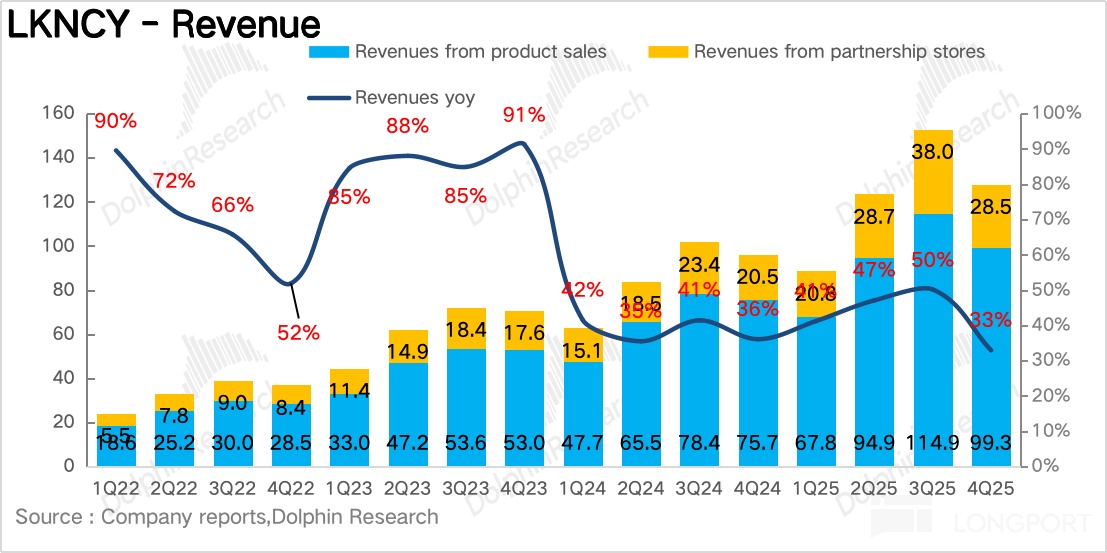
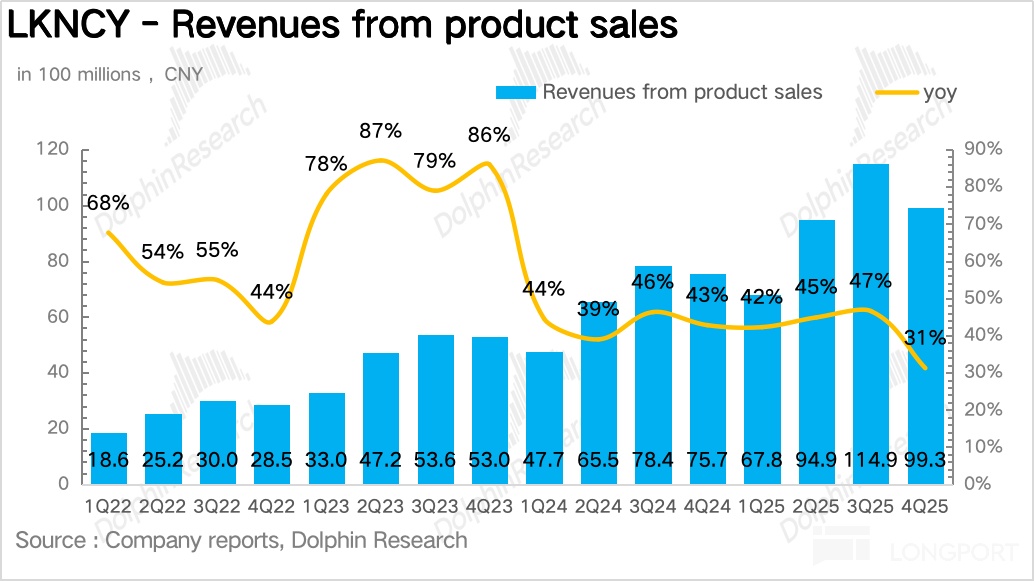
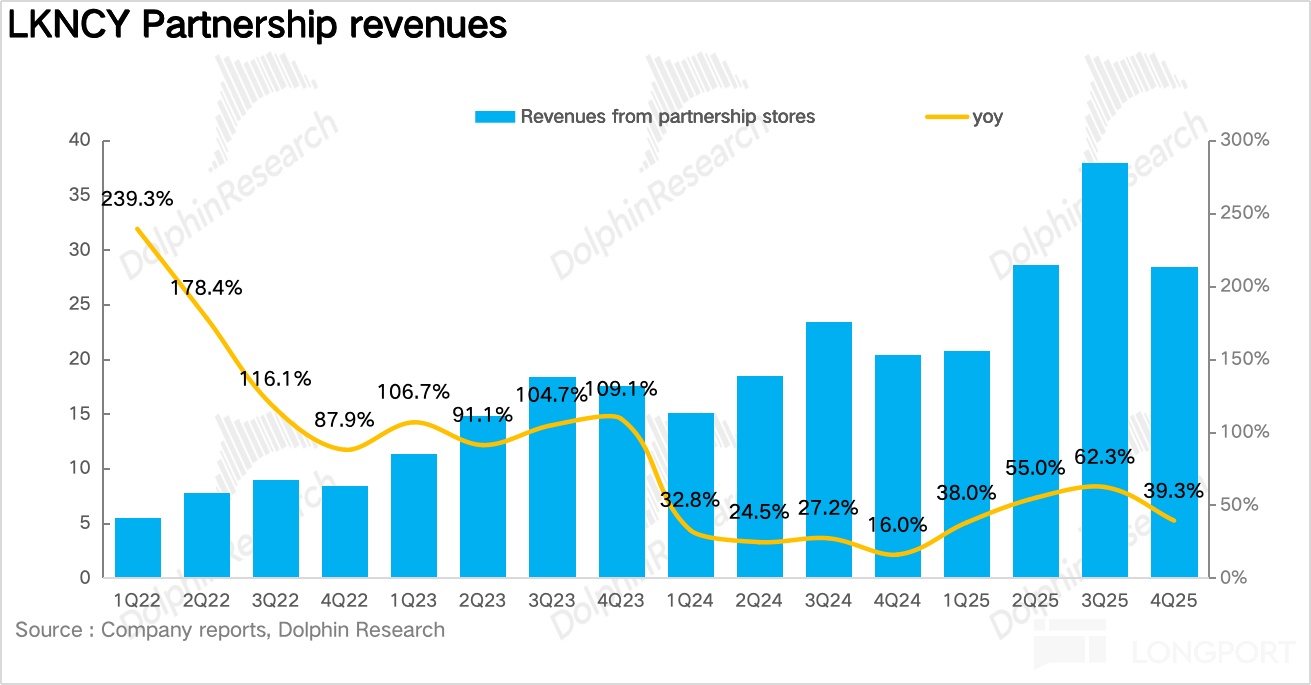
Q4 revenue was RMB 12.78bn (+32.9% YoY), below estimates. Self-operated stores delivered RMB 9.9bn (+31.2% YoY), while franchise revenue reached RMB 2.85bn (+39.3% YoY), outpacing self-operated growth as Luckin lowered franchise thresholds in 2025 to accelerate lower-tier site capture.
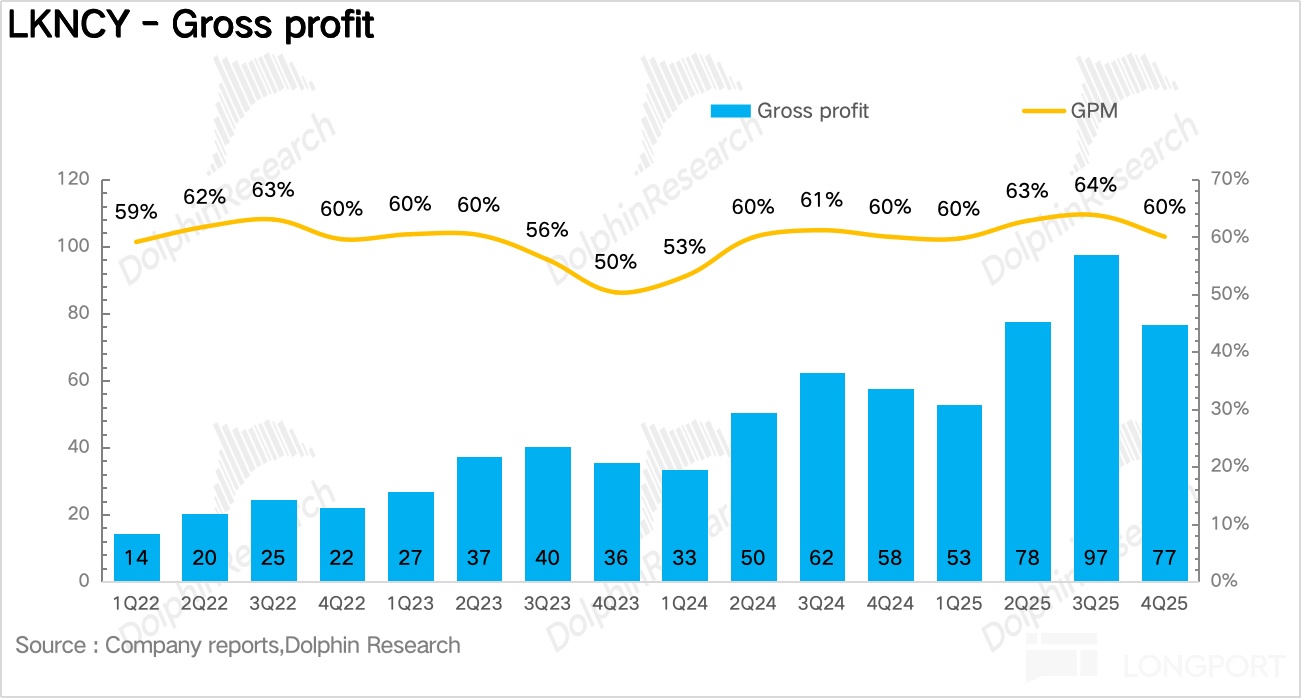
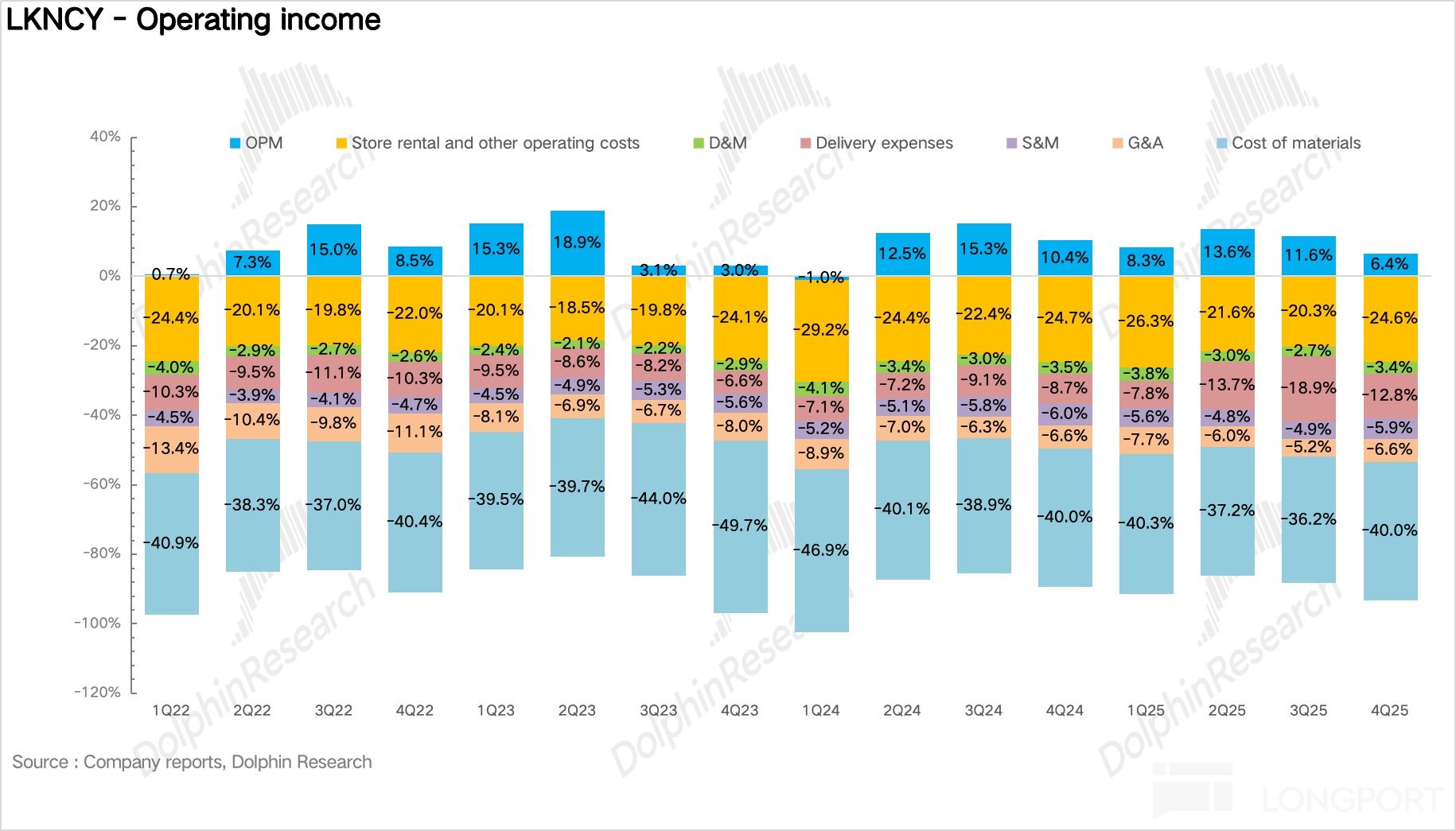
GPM was broadly stable in Q4, and on the expense side delivery costs rose to RMB 1.63bn (+94% YoY), with the ratio jumping from 8.7% a year ago to 12.8%, still the largest drag on margins. Medium term, delivery subsidies are unsustainable, so this spike is likely transitory; as self-pickup mix rises, delivery cost ratio should normalize below 10%.
Other expense ratios, including S&M and G&A, were stable. Non-GAAP OP came in at RMB 0.96bn, down 13% YoY.
The copyright of this article belongs to the original author/organization.
The views expressed herein are solely those of the author and do not reflect the stance of the platform. The content is intended for investment reference purposes only and shall not be considered as investment advice. Please contact us if you have any questions or suggestions regarding the content services provided by the platform.
