


DELL Trans: AI orders exclude Rubin; legacy biz still growing
Below is Dolphin Research's transcript of Dell's FY26 Q4 earnings call. For our earnings take, see 'DELL: AI Is Doubling, But Can It Ease 'Memory Tightness' Fears?'
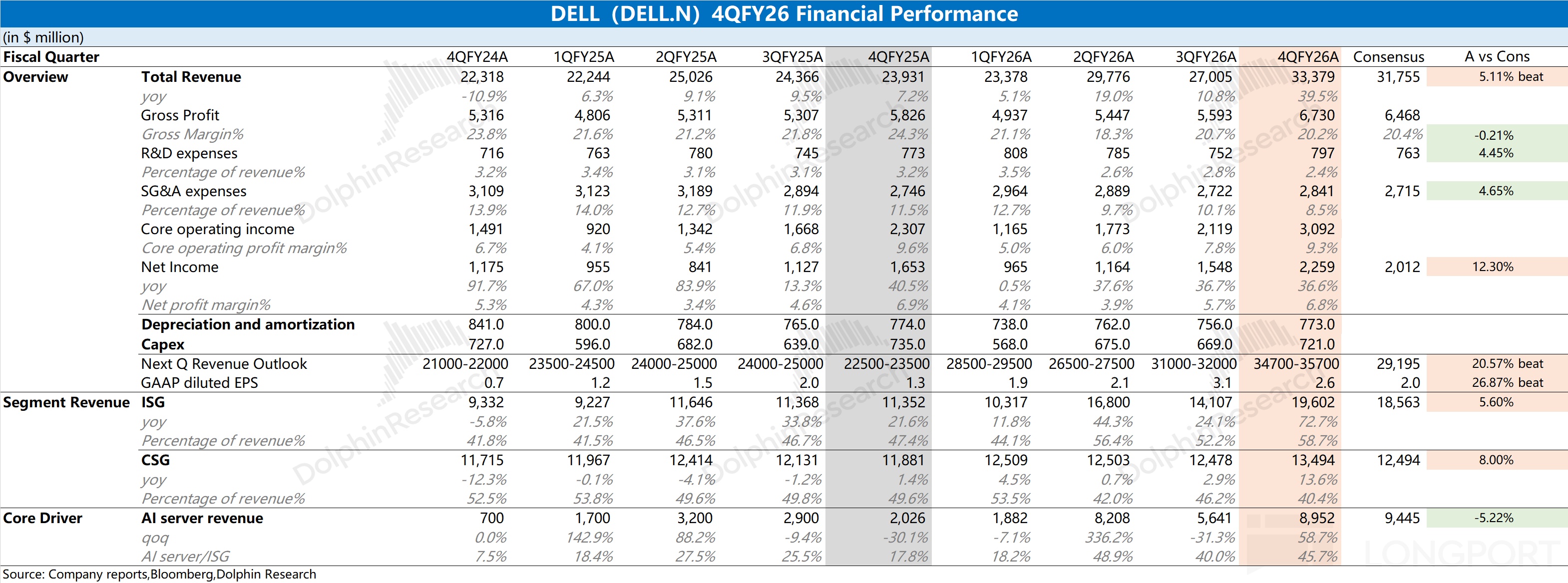
Key takeaways from Dell mgmt.:
1) Next-quarter guide: revenue of $34.7bn–$35.7bn (midpoint +51% YoY), with AI server revenue contribution at ~$13bn, up ~$4bn QoQ. Infrastructure Solutions Group (ISG) revenue to grow >100% YoY; Client Solutions Group (CSG) revenue to grow ~2% YoY.
2) FY27 full-year guide: revenue of $138bn–$142bn, with AI revenue of $50bn, doubling YoY.
3) AI progress: $34.1bn of new orders this quarter, ending backlog at $43bn. Nearly all of the $43bn backlog is Grace Blackwell, and it does not yet include Vera Rubin.
4) Memory supply response: Cost plans reflect market expectations, with LTAs and capacity agreements in place with partners. To mitigate cost volatility, Dell is simplifying products and optimizing its BOM mix.
5) Traditional servers: Demand is running ahead of supply, and the business delivered double-digit growth, with Q1 set to maintain strong double-digit growth. One 16G server can replace five older boxes, and 17G can replace seven. Customers prefer higher-CPU, higher-memory, larger-storage configs.
For FY27 (CY26) market outlook, mgmt. expects industry unit shipments to decline, but total value to rise on richer configs and higher pricing.
Overall, AI was the standout, highlighted by $34.1bn of new orders this quarter. Backlog reached $43bn by quarter-end, and mgmt. noted Rubin orders are not yet included. As Rubin ramps, orders should trend higher, underpinning high growth in AI.
Previously, the market worried that 'memory tightness' would hurt legacy businesses. Dell provided FY27 outlook, guiding full-year revenue of around $140bn. Dolphin thinks the guide is conservative: total revenue implies +$26.5bn YoY, with AI up roughly $25.5bn. That suggests little growth in traditional servers and other lines, yet mgmt. also pointed to low-single-digit growth in traditional servers and positive growth in CSG.
DELL screens relatively cheap, largely due to concerns over legacy businesses amid 'memory tightness'. Mgmt. reiterated legacy will remain positive and guided for rapid AI growth, which should boost investor confidence. With AI set to double, results and valuation have room to re-rate.
I. DELL earnings recap
1) Shareholder returns: repurchased ~54mn shares for the year (more than 2x last year). BOD approved an additional $10bn authorization and raised the annual dividend by 20% to $2.52/sh.
2) FY27 full-year guide:
a) Total revenue: $138bn–$142bn (midpoint +23% YoY).
b) EPS: $12.90 ± $0.25 (+~25% YoY).
3) Q1 outlook: revenue of $34.7bn–$35.7bn (midpoint +51% YoY), with AI servers at ~$13bn. ISG revenue to grow >100% YoY; CSG revenue to grow ~2% YoY.
II. DELL earnings call details
2.1 Mgmt. prepared remarks
1) ISG
a) AI (core incremental engine):
- Orders and backlog: FY26 AI orders totaled $64.1bn. $34.1bn of new orders this quarter, ending backlog at $43bn, showing strong durability.
- Revenue target: FY27 AI revenue expected to double to $50bn.
- Edge vs. peers: >4,000 customers (including sovereign clouds and enterprises); moats via TCO optimization, fast deployment, and DFS financing.
b) Traditional servers and networking:
- Refresh logic: Q4 demand materially exceeded supply, delivering double-digit growth. Mgmt. highlighted 7:1 consolidation (one latest platform replaces seven 14G servers), implying a large installed-base refresh opportunity.
- AI synergy: Traditional compute is essential for AI estates orchestration, data processing, and inference support.
c) Storage:
- Product mix: Proprietary IP (e.g., PowerStore) kept double-digit growth, and all-flash arrays grew for three straight quarters.
- New product: Parallel file solution 'Lightning' slated for 1H FY27.
2) CSG
a) Operations: Q4 revenue $13.5bn (+14%), with commercial PC +16% and up for six consecutive quarters; consumer flat, gaming solid.
b) Margin dynamics: Q4 OPM (4.7%) was modestly pressured by strategic customer acquisition to expand the installed base, and by elevated channel inventory delaying price resets.
c) Path to improve: Implemented price increases on Jan 6 to offset higher costs, and expect Q1 margin to improve QoQ. The 4–5 year PC refresh cycle is a structural tailwind.
3) Macro/ops
a) Tight supply: Strong AI demand is keeping components tight, lifting input costs and extending lead times.
b) Pricing: Shorter validity periods, tighter supply chain–sales–pricing linkage to navigate cost volatility.
c) Op leverage: Despite rapid revenue growth, AI-driven automation is simplifying processes. FY27 opex growth should stay in low single digits, showing strong scale benefits.
2.2 Q&A
Q: AI orders were robust this quarter. With memory price volatility, how are margins trending? As scale grows and mix broadens from CSPs to enterprises, what is the margin outlook and spillover to other businesses?
A: AI performed exceptionally well, with $34bn of orders. Importantly, our five-quarter pipeline did not deplete as orders converted; it actually grew. Growth spans CSPs, sovereign clouds, and enterprises, with enterprise demand particularly strong in Q4. We now have 4,000+ enterprise AI customers, and deployments are broadening across use cases.
On margins, we have maintained mid-single-digit OP margins over the past year and in the quarter. Based on demand and execution, we see no reason to change that guide, and we will scale at this margin level. We are excited about growth, and expect AI revenue next year to double. Order volume was up 6x last year, and inference is exploding token generation. Token growth drives compute capacity and intensity, translating into durable revenue streams.
Q: Given explosive AI server orders, how does profitability compare to prior quarters? What is the trajectory?
A: Even at today’s rapid pace, we continue to hold AI OP margins at mid-single digits. We are navigating a major tech transition while maintaining profitability. We have $43bn of backlog to deliver, all at mid-single-digit margins. With backlog, demand, and the visibility around the transition, we are confident in sustaining our margin targets.
Q: How are higher memory costs affecting margins in traditional servers (ISG/Infrastructure) and CSG (PCs)?
A: Execution has been very strong in managing rising inputs like memory.
1) Traditional servers: We moved fast, adjusting server pricing starting Dec 10. With pricing implemented, margins stabilized despite higher costs.
2) CSG: We were more deliberate, delaying price hikes to gain share. From Oct to Dec, the market grew ~10% while we grew 18%, lifting share by 1%. Pricing reset: With a rising mix of bid business and new-customer pricing in Dec, we implemented price increases on Jan 6. Since then, performance normalized and margins stabilized at expected levels.
In short, we can operate within our committed margin framework.
Q: Why isn’t traditional server growth higher? Also, is inference mainly on AI servers, or are traditional servers used for inference too?
A: Demand exceeds supply, and the business did deliver double-digit growth. Strength is broad-based across SMBs, mid-market, large multinationals, and all regions. Drivers are data center consolidation and modernization. Upgrading from 14G to 17G yields 6:1 to 7:1 consolidation, with major power, space, and thermal benefits. We expect this modernization to continue through FY27.
We also see significantly more AI workloads on x86 traditional servers. Leading enterprises we call 'AI Forward' are deploying AI on traditional servers for software dev, scientific computing, and advanced trading algos. So inference is not limited to AI servers.
Q4 reflected demand far exceeding supply, and Q1 guidance carries that momentum with strong double-digit growth. We are prudent for 2H given supply/demand uncertainty and the need to secure more supply. If demand holds, upside remains.
Q: Entering the Vera Rubin cycle, how will transition smoothness, margin volatility, and revenue variability differ vs. Blackwell?
A: We are excited about Vera Rubin. We learned a lot from Grace Blackwell and expect a smoother Rubin transition. We have embedded those learnings into manufacturing and test for the next-gen architecture, enabling faster scale-up. Early engineering samples are done, and we are co-developing advanced designs with customers.
On revenue cadence, with a diversified customer base and a healthy backlog, and Rubin shipments expected in 2H, the rhythm should be more controlled. On margins, our view is unchanged: we expect AI to sustain mid-single-digit OP margins, consistent with guidance. Engineering advances and deeper front-line engagements should further smooth the transition.
Q: What is the FY27 FCF outlook?
A: FY26 cash flow was very strong, with $11.2bn in operating cash flow ($4.7bn in Q4 alone). This supported >54mn shares repurchased and a return of >80% of Adj. FCF to shareholders. While we do not guide cash flow specifically, FY27 should be another strong year. Net income to Adj. FCF conversion should meet or exceed our long-term framework.
We also announced a 20% dividend increase, the fourth straight year of double-digit growth. Combined with buybacks, we are confident in working capital stability.
Q: What underpins the storage rebound? With higher component costs, does a richer storage mix help sustain company-level GPM?
A: We are encouraged by storage. Proprietary IP portfolios delivered double-digit growth across PowerMax, PowerStore, PowerScale, and Data Protection. All-flash saw double-digit demand, and we added new customers in every region. PowerStore has grown for eight straight quarters, seven of which were double-digit, with half of customers new to PowerStore and ~30% new to Dell storage.
Unstructured data demand is very strong, driven by AI inference and expanding AI apps. Dell IP as a share of mix is up materially YoY, and we expect FY27 to outpace FY26 with storage mix rising further. That is a core driver of our margin outlook.
Architecture matters. PowerStore delivers 5:1 leading data reduction, boosting effective capacity, while Data Protection offers up to 75:1 compression and dedupe. Amid rising memory prices and tight supply, this lets customers back up data with fewer servers and drives. The architecture advantage should power storage growth into FY27.
Q: What memory inflation assumptions are embedded in the FY27 outlook?
A: While we will not disclose internal procurement mix, DRAM spot is up ~5.5x over six months (~$2.39/GB), and NAND is up ~4x (~$0.20/GB). Analysts see Q2 up 20%–50% QoQ, with single- to double-digit increases in Q3–Q4. We have budgeted costs accordingly and signed LTAs and capacity agreements with partners. We are simplifying products, optimizing BOMs, aligning what we sell with near-term inbound inventory, and designing for flexibility to fit available parts.
Q: What is different this cycle in protecting margins?
A: We reapplied COVID-era best practices, moving faster than ever. In traditional servers, we reset pricing starting Dec 10 within days. In PCs, on Jan 6 we repriced tens of thousands of undelivered orders in a single day. Historically, we aimed to recover two-thirds of incremental costs within 90 days; now, the response is immediate.
Tactically, we raised list prices, deployed intelligent pricing with margin floors, shortened quote validity to record lows, and cut promos and special pricing. Results are visible: server margins stabilized quickly despite rising costs. In PCs, we delayed increases to win share (growing 18% while the market grew ~10%), and margins normalized on Jan 6 when pricing took effect.
Q: Can you split AI server orders among enterprise, emerging cloud, and sovereign cloud?
A: We closely track the health and growth of emerging cloud, sovereign cloud, and enterprise. We cannot disclose exact mix on the call, but indicators show strong enterprise momentum. AI customers now exceed 4,000, and Q4 enterprise revenue hit a record. Usage models are broadening, and enterprise demand is accelerating.
Q: When will enterprise AI demand spill over to storage and kick off a new storage cycle?
A: At Dell, two years ago we deployed coding assistants that consumed some GPU capacity. Since mid last year, we started deploying agents that code directly to architects' specs, which spiked compute and token consumption. Many leading enterprises see similar potential and benefits post-deployment, which will drive sustained enterprise AI scaling. In our five-quarter pipeline, enterprise is the fastest-growing component, now outpacing other segments.
This compute surge naturally pulls storage, setting up the next storage cycle.
Q: Why did inventory rise meaningfully on the balance sheet?
A: Inventory reflects scale and growth velocity. Even with higher inventory, cash conversion cycle stayed strong at -32 days, improving by one day YoY. We guided $13bn of AI shipments in Q1, meaning we are moving several billions of dollars of hardware through Feb and Mar. Current inventory supports that delivery cadence.
Q: How did customers react to price increases? Did shorter quote validity spur early pulls?
A: ISG and CSG behaved differently. In ISG, after the initial price shock, focus quickly shifted to supply assurance. Top, sophisticated customers moved aggressively to protect build schedules. This held across AI servers, traditional servers, and storage.
In CSG, channels still had some low-cost inventory, delaying pass-through. We delayed price hikes to win share, but as large bids kicked off in 1H, customers accepted rising costs and tighter supply. There was some pull-forward as buyers recognized 'today’s price likely beats tomorrow’s'. Hard to quantify now, and early-year IT budgets can be fixed, so some pull-forward may extend refresh cycles later.
Our guidance reflects prudence around these budget dynamics.
Q: Within the $43bn AI backlog, what is the split between Blackwell and Vera Rubin, and what does it mean for shipment cadence?
A: Backlog is overwhelmingly Grace Blackwell, with no Vera Rubin included yet. Rubin sits in our five-quarter pipeline. The pipeline is led by Grace Blackwell plus Blackwell, with a rising share of x86 Blackwell, driven by enterprise deployments. Air-cooling is a primary requirement, and x86 air-cooled solutions are also favored in scientific computing and high-frequency trading.
Q: You guided $50bn of AI revenue. If demand proves higher, how quickly can you scale supply?
A: The $50bn guide reflects, four weeks into the new FY, our assessment of customer deployment readiness (facilities, power, infra), key component availability (DRAM, E1/E3 drives), and our own delivery capacity. Ops teams are sourcing more parts. Our job is to convert pipeline to orders and fulfill on time. As supply dynamics evolve, we will keep pushing conversion speed and execution scale.
Q: Why is there a ~$0.5bn gap between $9.5bn AI shipments and $8.95bn AI revenue?
A: It is normal accounting timing, primarily 'goods in transit'. Typically the two numbers are close intra-quarter, but some of the ~$9.5bn shipped by late Jan had not yet reached customers to be recognized. Those revenues slip a few days into the next quarter. This is routine.
Q: For low-single-digit full-year growth in traditional servers, how do units vs. ASPs break down?
A: We see real demand expansion. Customers are migrating to 16G and 17G with heavy DRAM and storage configs. The consolidation is clear: a 16G can replace five older units, and a 17G replaces seven. Buyers favor higher-CPU, higher-memory, higher-capacity boxes.
For FY27 (CY26), we expect industry units to decline, but total value (TRUs) to rise on richer configs and higher prices. We are cautious on 2H given supply/demand uncertainty. Q1 demand far exceeds supply with strong double-digit growth, and we are guiding to what supply we have line-of-sight to. If demand stays strong, we will source more parts globally.
Q: What is the attach rate around AI server shipments? What else can you sell into AI customers?
A: Three core attach areas:
- Storage: Enterprise AI momentum is lifting storage attached to AI servers.
- Networking: Networking continues to grow and is critical to AI infra.
- Services: Our key differentiator. Includes install/deploy and break-fix. Dell’s ability to deliver complex AI architectures is unmatched, with industry-leading uptime. We use our own employees for on-site support to resolve issues quickly.
Attach is rising across these areas, and we are constructive on sustaining this into FY27.
Q: On CSG, can Dell gain structural share in a parts-constrained market through pricing agility, demand steering, and supply-chain advantages vs. smaller rivals, in FY27–FY28? If industry units fall double digits, what drives share gains?
A: Historically, Dell excels and gains share in supply-constrained periods, especially in PCs. Longstanding partnerships and supply agreements position us well to take share across businesses. This is why we did not rush to raise prices in Q4 and stayed aggressive at a pivotal moment for our trajectory.
After three years of share losses, we have turned the corner. Q4 showed it: revenue +14%, and per IDC, units +18% in the calendar Q4. This momentum expands our customer base and signals we are retaking leadership.
We see structural share gain potential over the next few years, driven by our supply-chain strategy. That advantage extends beyond PCs to servers and storage. We are confident we can outperform in a down market via superior supply-chain execution.
<End>
Risk disclosure and disclaimer:Dolphin Research Disclaimer & General Disclosures
