


CATL: Capacity Maxed, Back in Force for the AI Infra Era
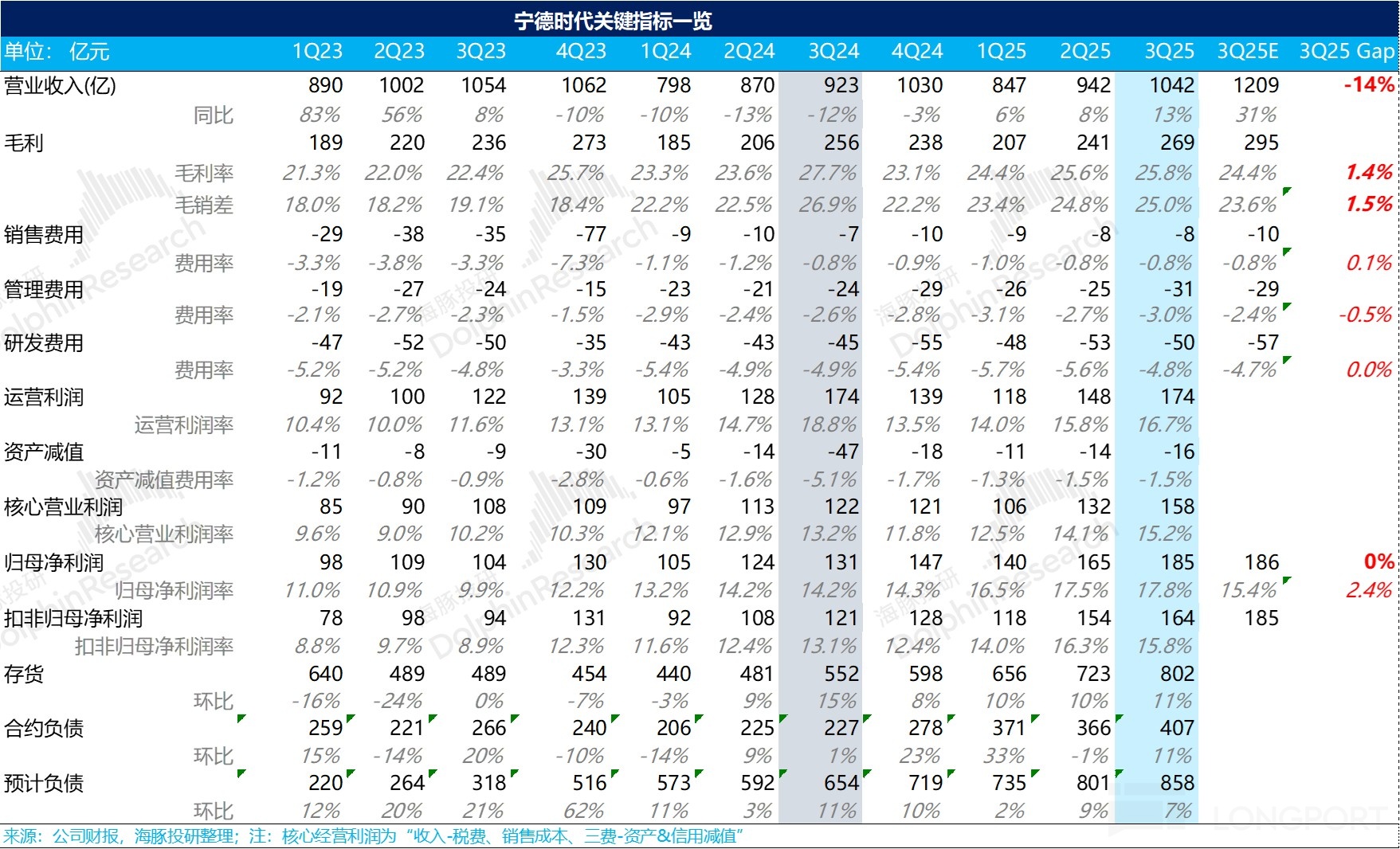
On the evening of Mar 9, 2025, $CATL(03750.HK) released Q4 2025 results. Key takeaways:
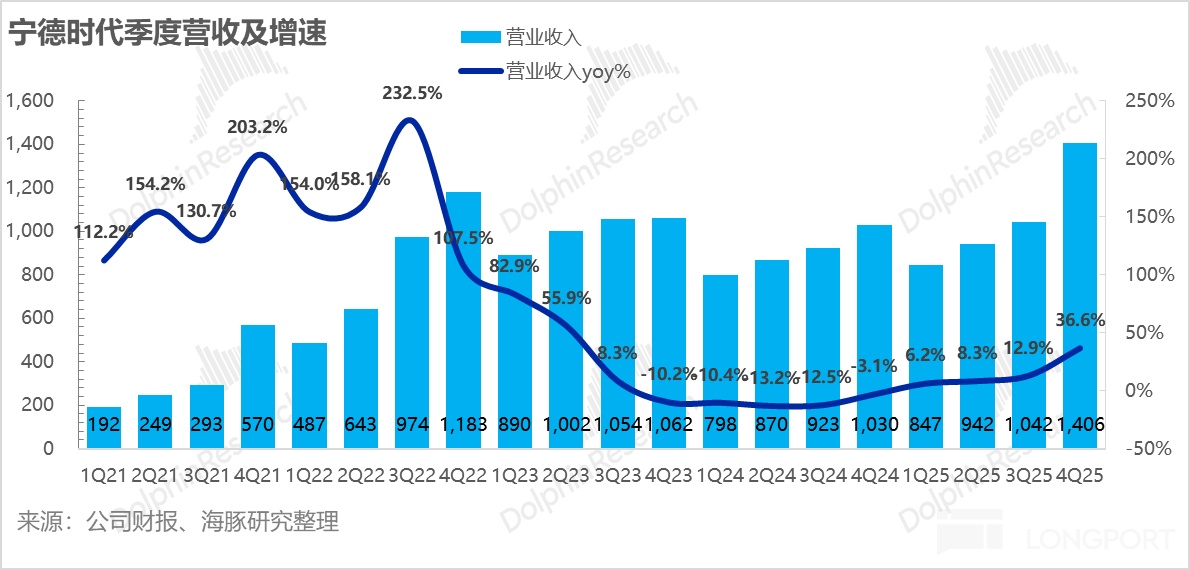
1) Revenue: Q4 revenue was RMB 140.6bn, well above the Street’s RMB 125.3bn, up 37% YoY.The beat was driven by shipments, while battery ASPs were largely flat QoQ.
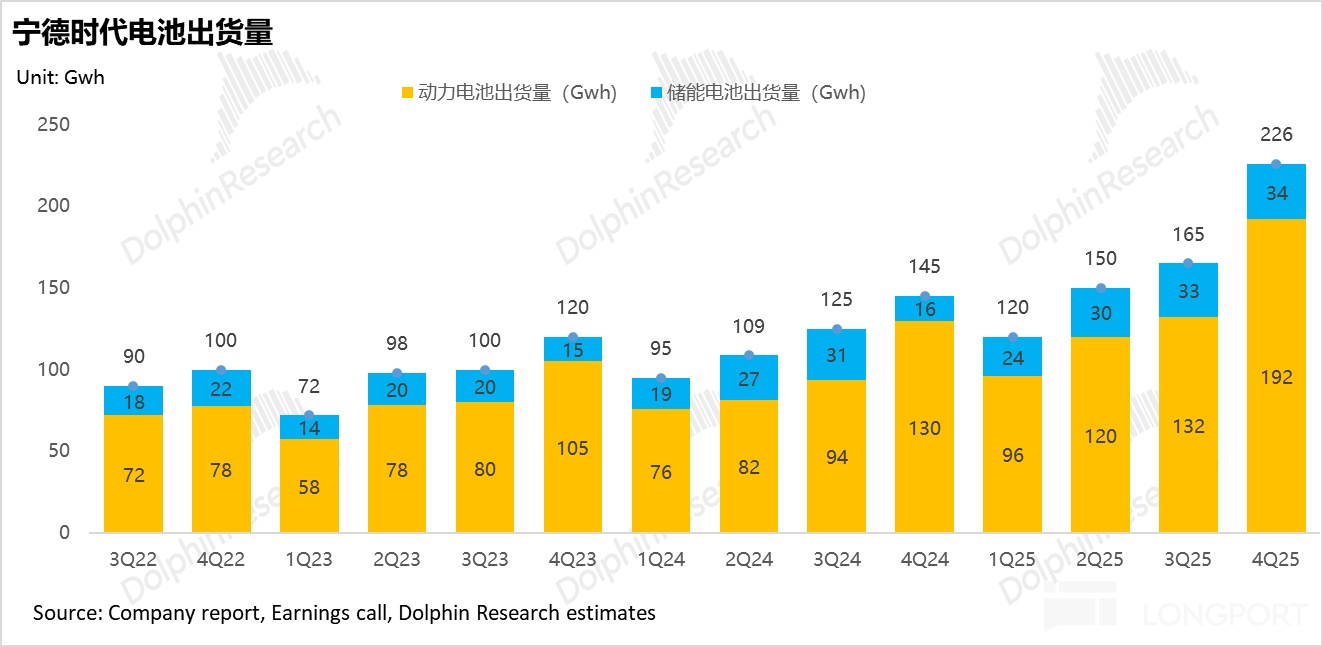
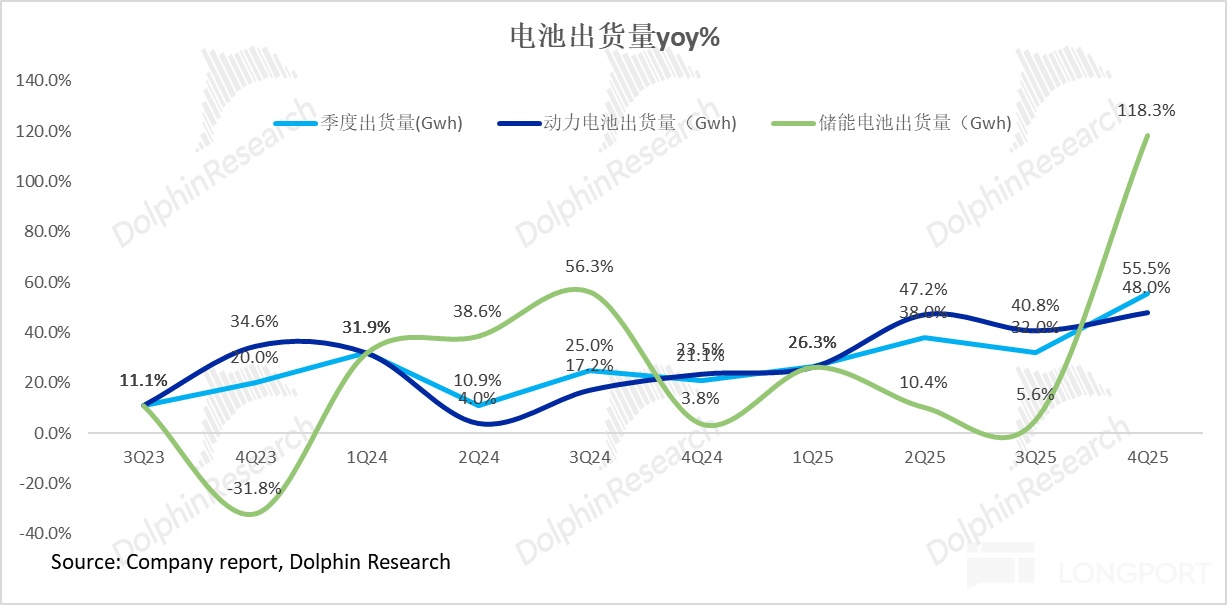
2) Shipments surged: Q4 shipments reached 226 GWh, up 56% YoY, well ahead of the Street’s 176 GWh and optimistic buy-side expectations of ~200 GWh.
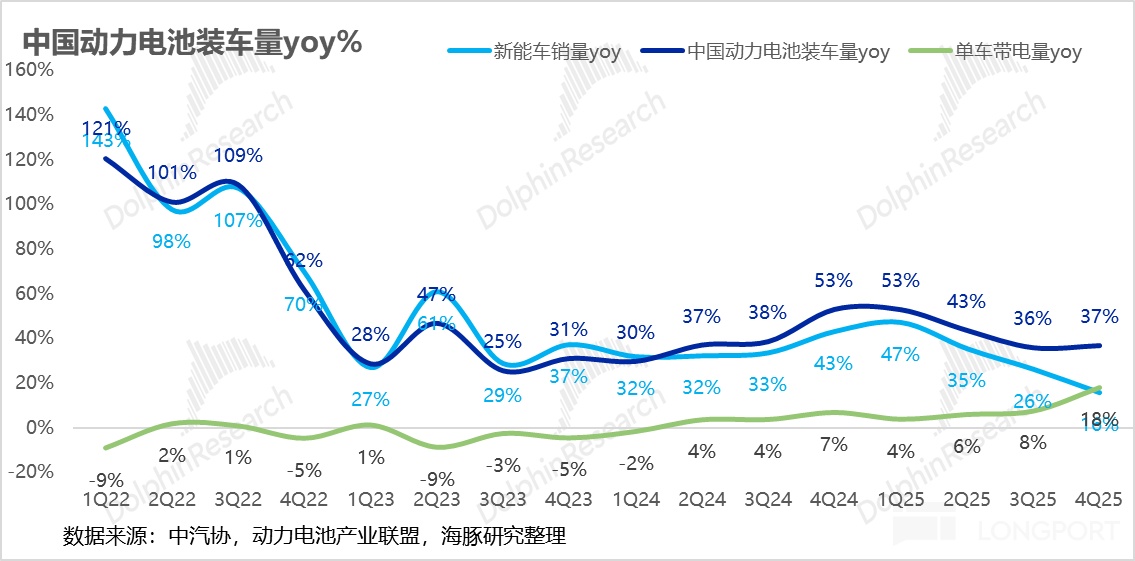
By split, traction battery shipments were the swing factor, hitting 192 GWh in Q4, up 48% QoQ.Even as NEV unit sales growth slowed to 23% QoQ, traction battery shipments outpaced volume growth, driven by OEM inventory build and, more importantly, rising kWh per vehicle.
Energy storage shipments were 34 GWh with almost no QoQ growth.Dolphin Research believes this reflects not demand weakness but capacity timing: the Jining (Shandong) base (>100 GWh planned) to ease ESS bottlenecks had not yet ramped (slated for Q1 2026), and a large amount of ESS systems have shipped but not yet recognized as revenue, which underpins continued topline growth ahead.
2) Battery pricing stabilized QoQ: Despite lithium carbonate rising from RMB 70–80k/t in Q3 to RMB 80–100k/t in Q4, blended ASP was ~RMB 0.55/Wh, roughly flat QoQ.Dolphin Research attributes this to: ① mix shift toward lower-priced domestic sales and LFP; ② pricing pass-through lags of 1–2 months mean orders signed before the lithium upturn shipped in Q4, dragging blended ASP.
4) GPM held up and improved QoQ: Q4 2025 consolidated GPM rose 240bps QoQ to 28.2% (from 25.8%), with both traction and ESS margins improving QoQ.
Dolphin Research believes that with ASPs flat QoQ and lithium costs still rising, CATL’s per-Wh GP and GPM still moved up QoQ mainly due to: ① inventory carryover of low-cost materials: inventories were RMB 80.2bn at Q3-end, implying use of lower-cost stock in Q4; ② scale benefits.
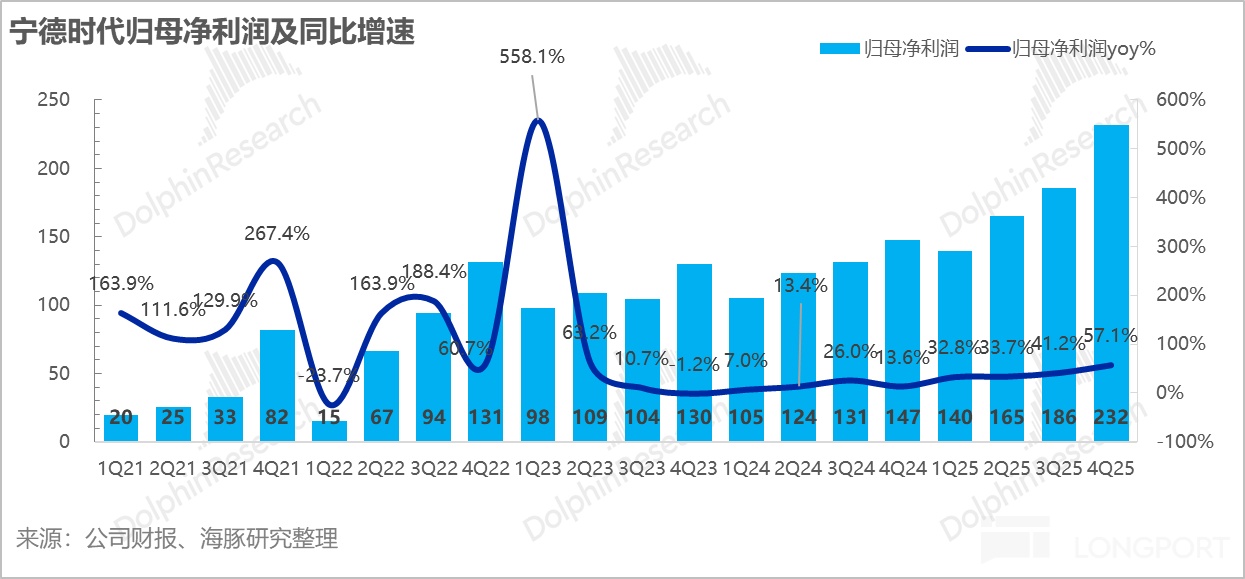
5) Net profit also beat: Q4 attributable NP was RMB 23.2bn, above the Street’s RMB 20.7bn, on stronger shipments driving revenue and GP.This came despite higher R&D (RMB 7.1bn, +RMB 2.1bn QoQ, well above market est. RMB 5.8bn) and higher impairments, which pressured NPM (per-Wh NP fell from RMB 0.11/Wh in Q3 to RMB 0.10/Wh). In an upcycle, the market should look through this.
6) Highlight: Full utilization in 2H! For 2025, capacity utilization reached 96.9%, up 20.6ppt vs. 2024’s 76.3%.In 2H alone, utilization hit an eye-catching 102.6%, indicating full-throttle operations.
Dolphin Research view:
Overall, Q4 was another major beat: shipments surged, margins rose QoQ, reaffirming the new upcycle in lithium batteries and CATL’s outstanding execution in this phase.With full utilization, accelerating capex, record contract liabilities, and inventories still rising, visibility into 2026 looks very high.
① Full utilization: 2H utilization has reached 102.6%, indicating full capacity mode.
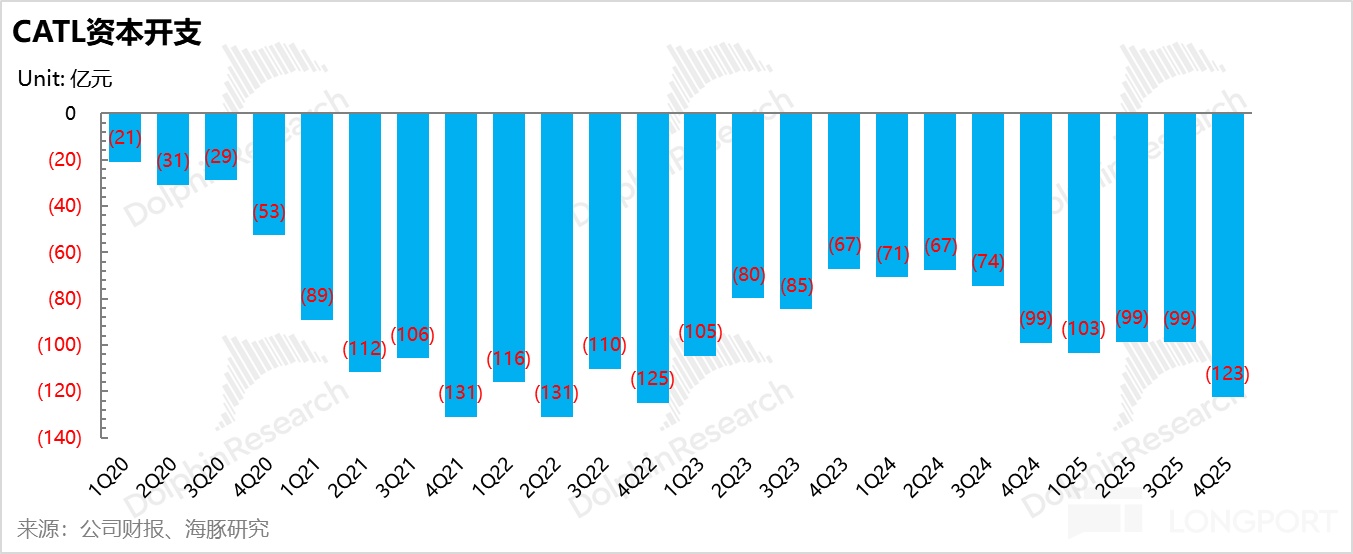
② Capex acceleration: Since Q4 2024, capex has been rising, and Q4 2025 capex reached ~RMB 12.3bn, near the prior peak-expansion level, signaling further acceleration.CATL has lifted 2026 output plan to 1.1–1.2 TWh (2025: 0.772 TWh; ~400 GWh new capacity) and will raise 2026 capex by 50%.
As a result, market share in both traction and ESS, constrained by capacity in 2025, should rebound across 2026.Given the ramp schedule, overseas volume upside looks stronger in 2026.
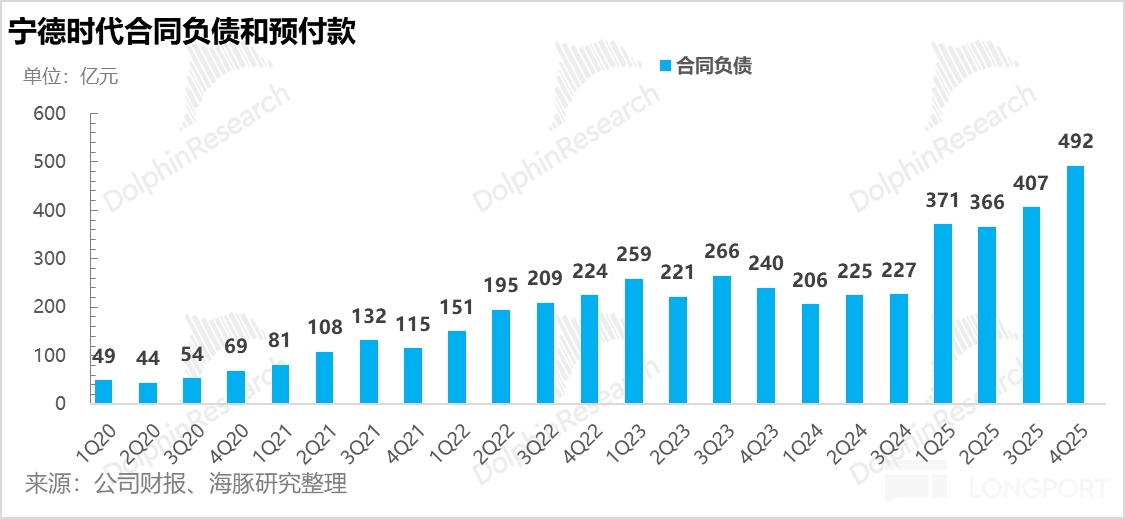
③ Contract liabilities at record highs: Contract liabilities stood at RMB 49.2bn, up RMB 8.5bn QoQ, a new high, indicating robust near-term order backlog.
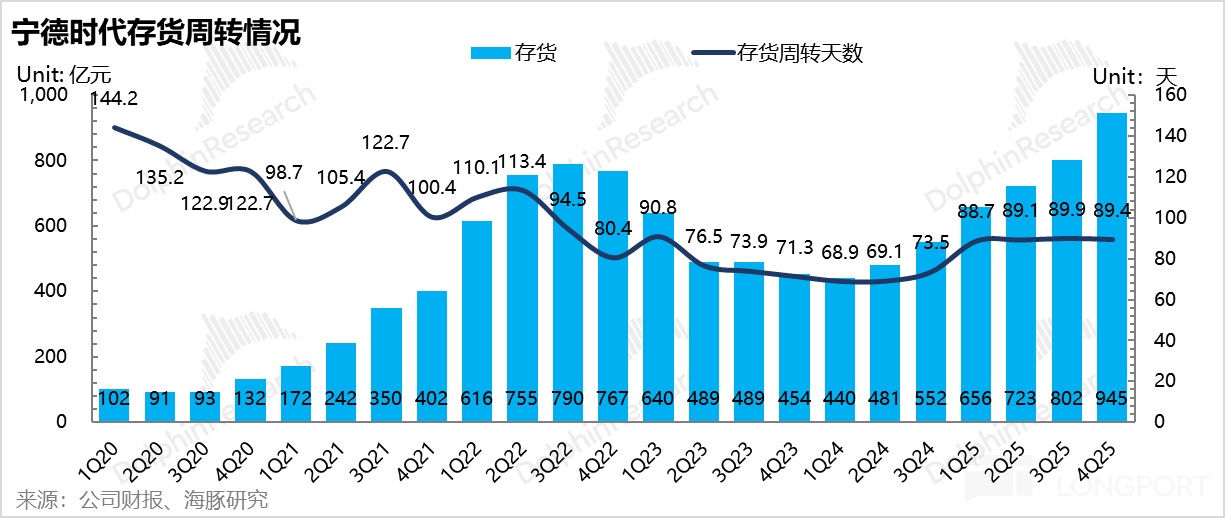
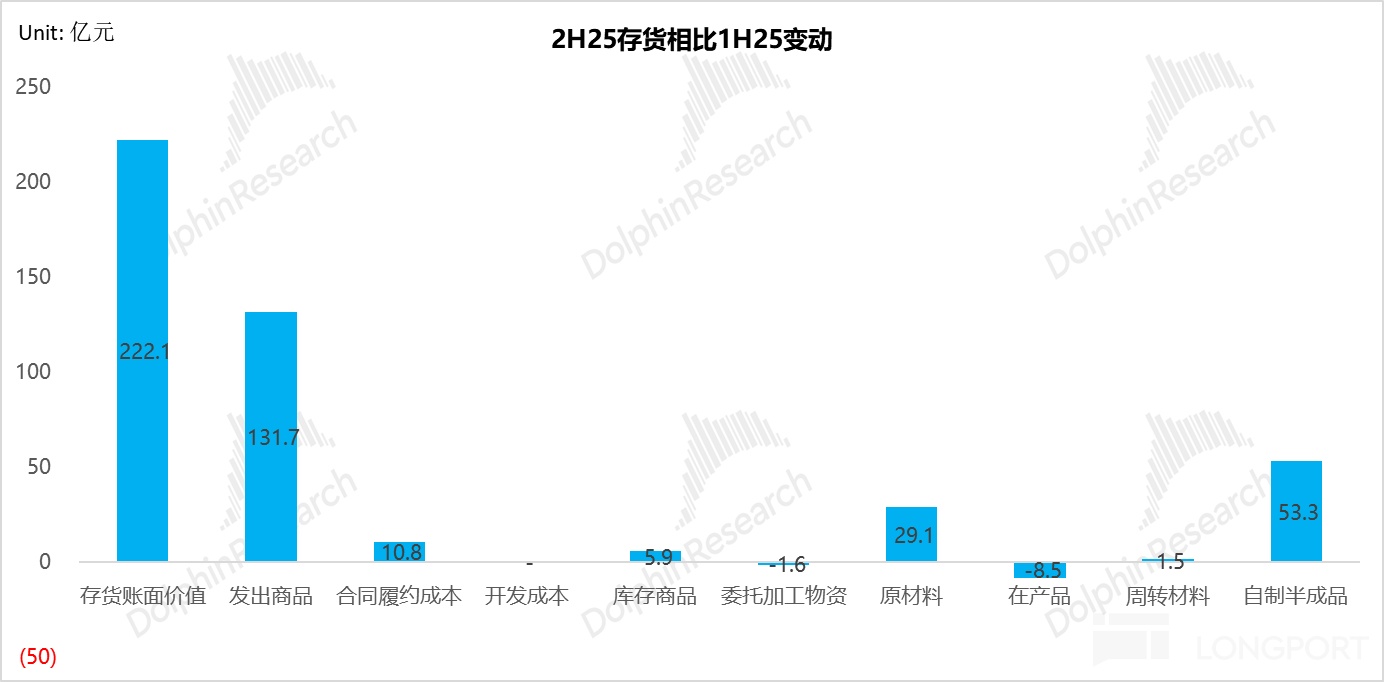
④ Inventories still rising: pre-buy into the lithium upcycle + shipped-not-recognized ESS systems: Inventories jumped to RMB 94.5bn, up ~RMB 14.3bn QoQ, a record high.Of the RMB 22.2bn inventory increase in 2H 2025, ~60% was ‘goods shipped’ (in transit), largely due to higher ESS system delivery share, implying substantial shipped-but-unrecognized revenue.
CATL is also pre-stocking raw materials to hedge cost inflation in lithium and other inputs, using lower-cost inventory to offset rising materials in an upcycle.Yet, despite fundamentals turning in Q3 2025, investor divergence lingered. Since peaking at RMB 2.5tn mkt cap last Oct, the stock pulled back ~18%, hovering around RMB 2.0tn.Debate has shifted to three deeper concerns:
① NEV growth deceleration dragging 2026 shipments: With further step-down of purchase tax incentives and other subsidies in China, domestic EV sales growth may slow structurally, weighing on 2026 traction shipments guidance.
② Raw-material inflation eroding per-Wh profitability: Since Q3 2025, lithium carbonate, copper, electrolyte and other inputs have rallied.The market worries CATL cannot fully pass through costs downstream, compressing per-Wh profitability.
③ Fear of a ‘price up → demand down’ negative loop: Even if costs are passed on, higher end-prices for EVs/ESS could curb fragile demand.For ESS, higher costs lower project IRR and may dampen investment appetite, creating a ‘cost up → price up → demand down → shipments down’ loop.
Based on the print and latest supply-chain checks, Dolphin Research addresses and rebuts the three concerns:
① Rising kWh per vehicle offsets slower auto unit growth:
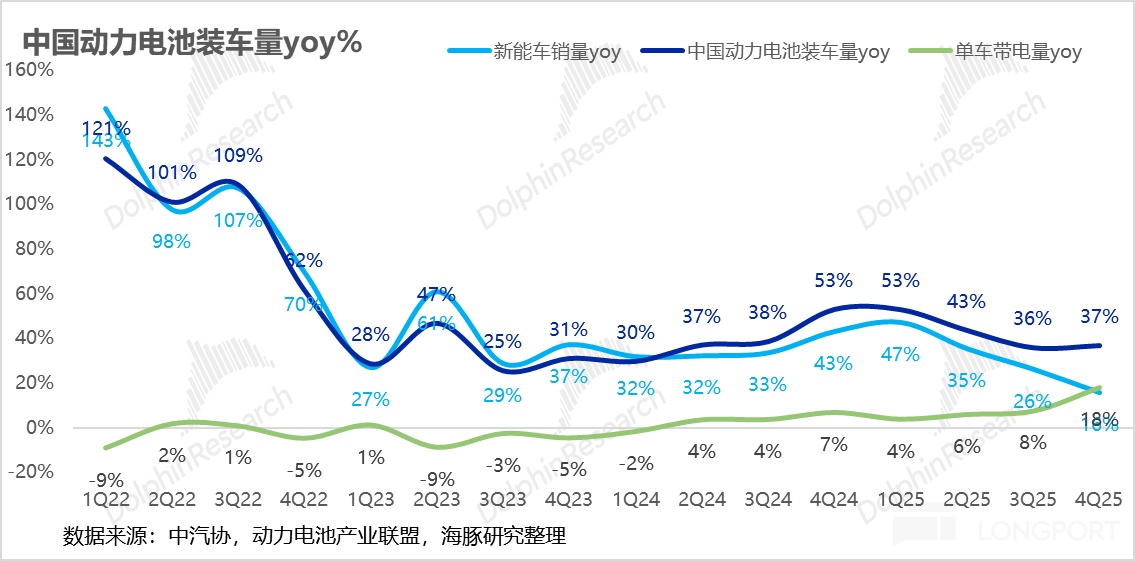
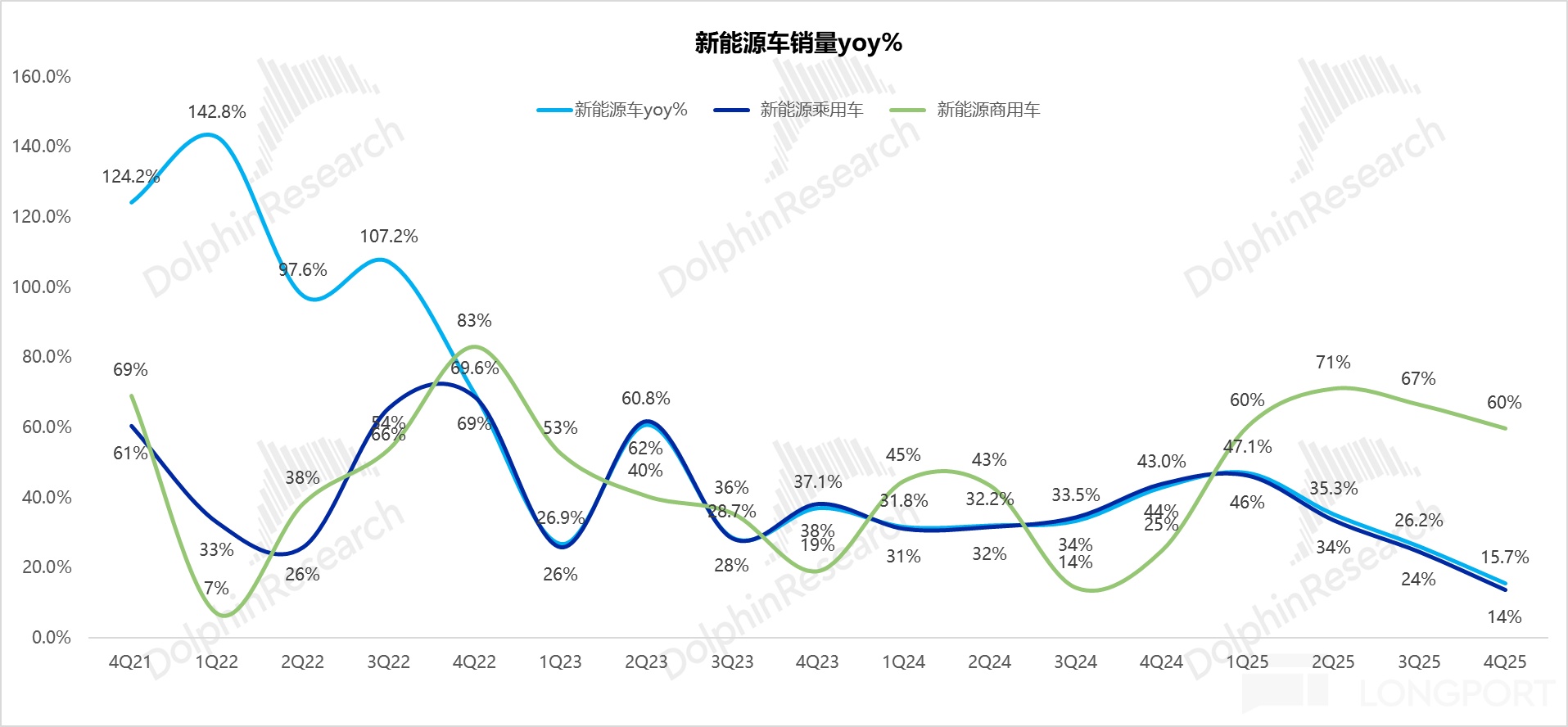
Markets underappreciate a key trend: traction battery installations are increasingly decoupled from NEV unit growth, with a widening ‘scissors gap’ between the two.Since Q2 2024, installation growth has outpaced NEV sales growth, and the gap widened in Q4 2025 as NEV YoY growth slowed to ~16% amid subsidy roll-offs and 2026 tax-policy expectations.
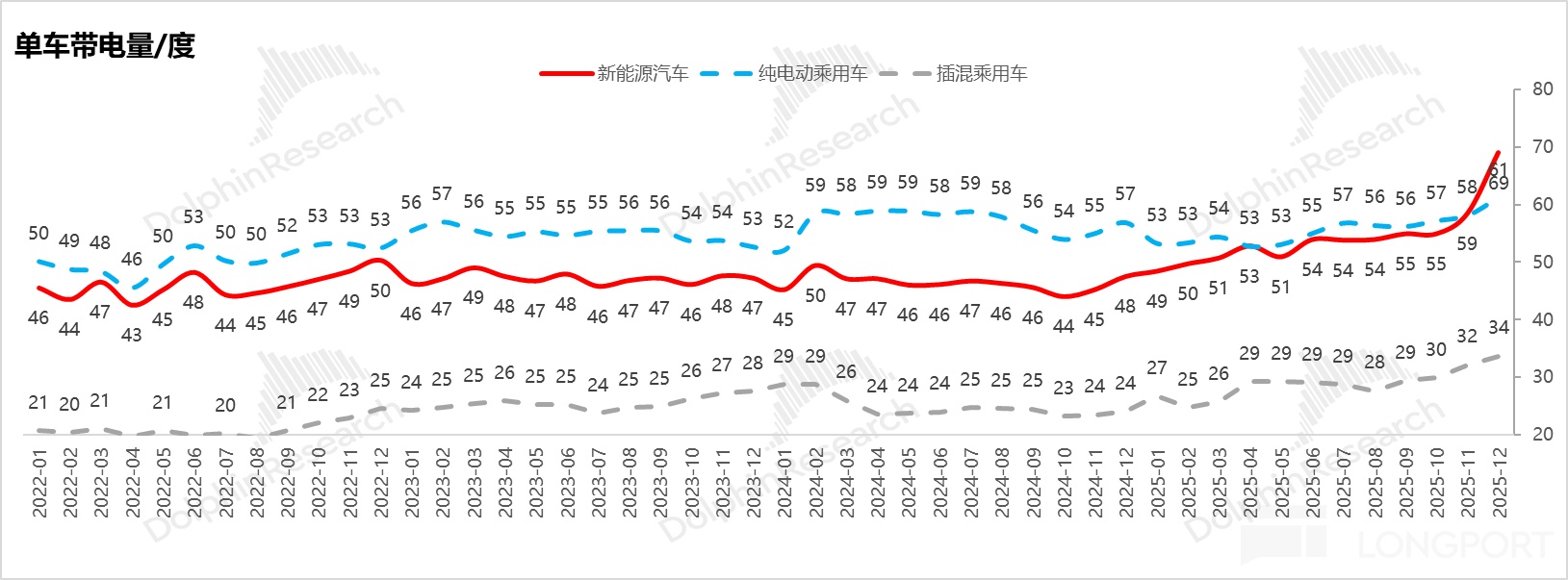
Traction shipments hit 192 GWh in Q4, +48% YoY (+46% QoQ), far ahead of the ~16% YoY growth in domestic NEVs.Beyond OEM pre-buy, the bigger driver is higher kWh per vehicle (Q4 2025 +18% YoY, lifting full-year by ~10%).
a. Passenger car ‘arms race’: long range as standard and premium for AD
With BEV/PHEV mix relatively stable, pack size per car continues to rise; we estimate avg. kWh/vehicle will still grow ~4% in 2026.Drivers include:
BEV big-pack proliferation: To ease range anxiety and elevate premium positioning, OEMs are moving to larger packs.For instance, Nio now sets 100 kWh as the baseline across the lineup, and Xiaomi SU7 mid/high trims use ≥96 kWh, shifting from ‘optional long range’ to ‘long range as standard’.
EREV ‘electrification’ of daily usage: To improve pure-electric commuting, EREV pack sizes are moving from ~40 kWh to 60–80 kWh (e.g., Leapmotor D19 at 80.3 kWh).
Higher-power AD (L2+ and above) hidden consumption: With higher compute and more sensors, advanced AD raises vehicle power draw.To preserve real-world range, L2+ models typically need 15–20% larger packs.
b. Rising commercial-vehicle mix adds demand leverage
Thanks to better TCO from falling battery costs, road-access advantages, and purchase-tax preferences, NEV commercial vehicles (esp. heavy trucks and light logistics) inflected in 2025.
Penetration rising fast: Commercial vehicles grew from ~4.5% of NEVs in 2024 to ~6% in 2025.
Demand leverage (1:4 effect): In the first 10 months of 2025, avg. pack per BEV commercial vehicle jumped to 175.8 kWh (vs. 118 kWh a year ago), far above BEV passenger cars at ~50–60 kWh.Every 1 incremental BEV commercial vehicle equates to the battery demand of ~3–4 BEV passenger cars.
Dolphin Research expects domestic NEV commercial vehicle wholesale to grow 29% YoY in 2026 (vs. +69% in 2025), with battery demand up ~44% on sustained pack upsizing.
c. Europe likely to grow >20% YoY
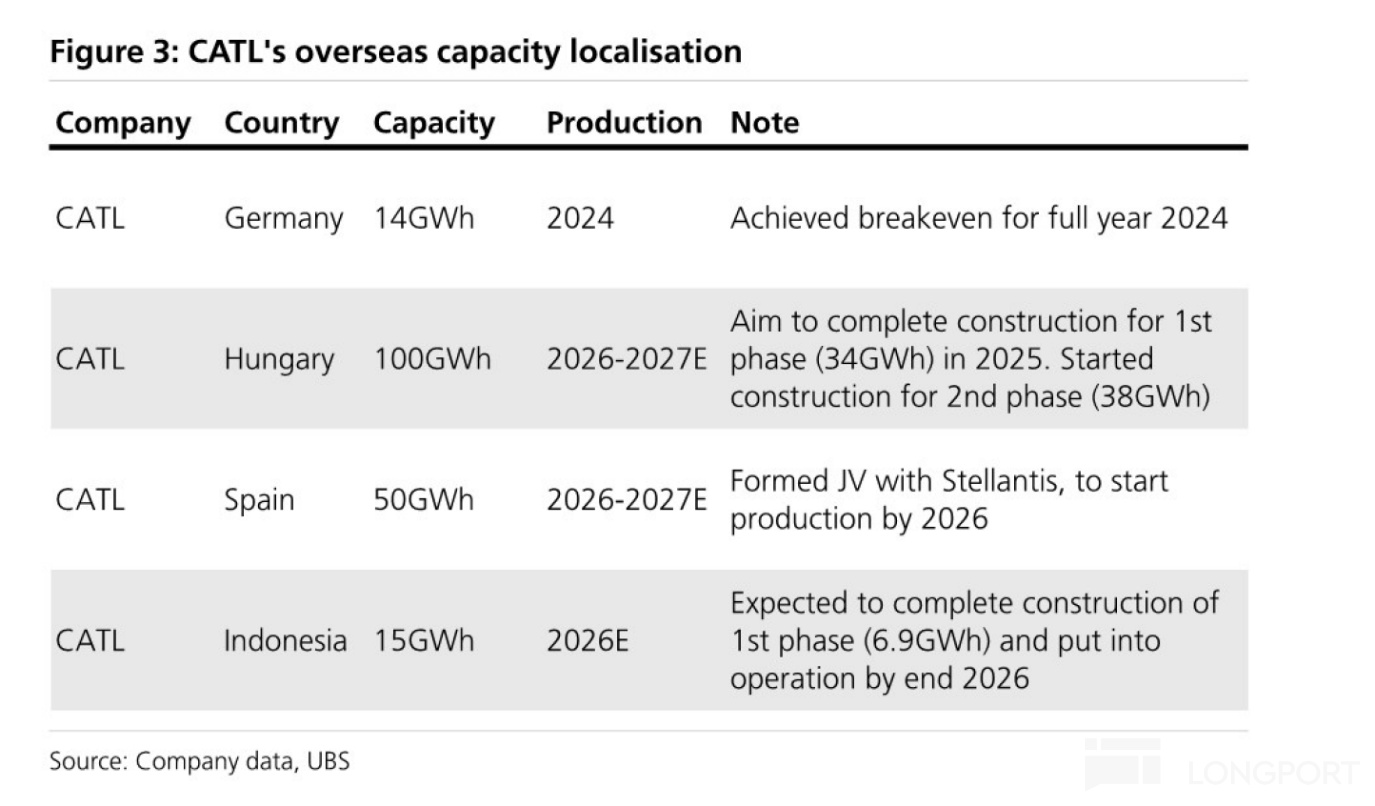
Key countries (Italy, Spain, France) reinstated or raised EV subsidies from Q4 2025, aiding sequential recovery.CATL’s share in Europe is rebounding (from ~37% in 2024 to ~44% in 1H 2025), and with local capacity (e.g., Hungary) scaling in 2026, we see >20% sales growth in Europe in 2026.
d. CATL share likely to rise further:
In Q4 2025, CATL’s domestic share resumed sequential gains; ex-BYD, share reached 56%.Earlier traction share loss from capacity bottlenecks (full-year 2025 share down 1.7ppt) is largely resolved, though ESS deliveries were still constrained by capacity.
Looking to 2026, the company plans to lift capex by 50%, adding ~300–400 GWh of capacity.The expanding swap ecosystem (targeting 3,000 ‘chocolate’ swap stations for passenger cars and 1,000 heavy-truck swap stations, covering 600k vehicles) should deepen customer stickiness.With new products such as Feifan super hybrid packs (passenger) and Tianxing packs (commercial), both traction and ESS shares should recover further in 2026.
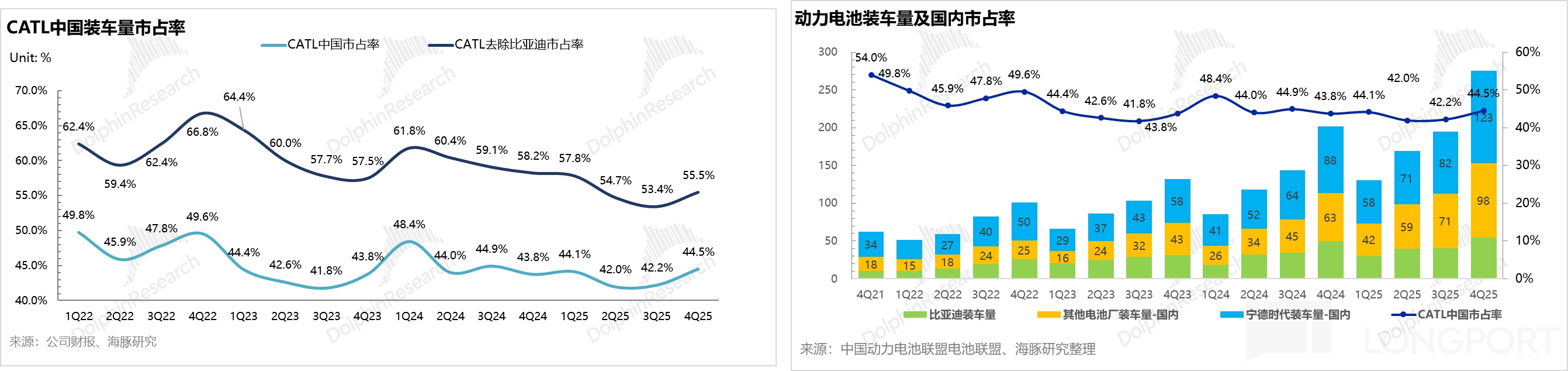
Thus even if China’s NEV retail growth slows to ~10% in 2026, ‘bigger packs in passenger cars + higher commercial mix’ and ‘CATL alpha (Europe ramp + domestic share gains)’ should still support ~20% growth in traction battery demand for CATL in 2026.
e. ESS growth could exceed expectations further:
On demand, sell-side models point to global ESS cell demand up 57% YoY to 693 GWh in 2026, driven by:
China capacity payment mechanism: From early 2026, China will implement a unified capacity payment for ESS, directly compensating available capacity.This should lift project IRR, stimulate investment, and favor leaders with long-life, low-degradation tech.
AIDC data-center ESS demand:
On the generation side, higher wind/solar penetration requires ESS to raise effective capacity factors.On the load side, ESS helps smooth millisecond-level pulses from AI workloads and provides peak-shaving benefits, while ISOs (e.g., PJM, ERCOT) now require large new loads to self-modulate, making ESS a fast-track enabler for data-center interconnection. AIDC ESS demand should keep growing strongly.
US market still has entry room: Despite tariff headwinds (US ESS battery tariffs lifted to 17.5–48.4% on China in 2026), Chinese cells can still meet IRA foreign-content thresholds (≤45%/40% in 2026/2027) to qualify for tax credits.
On supply, CATL started mass delivery in Jun 2025 of its 587Ah large-format ESS cell, core to the next-gen TENER system.Versus the mainstream 314Ah cell, it offers higher energy density (cell-level 434 Wh/L; system +25%), lower system cost, and longer efficiency/cycle life, lowering LCOE for customers.
Together with substantial shipped-but-unrecognized ESS inventory, Dolphin Research expects CATL’s ESS demand to rise 50% YoY to 182 GWh in 2026.
② Per-Wh profitability likely stable
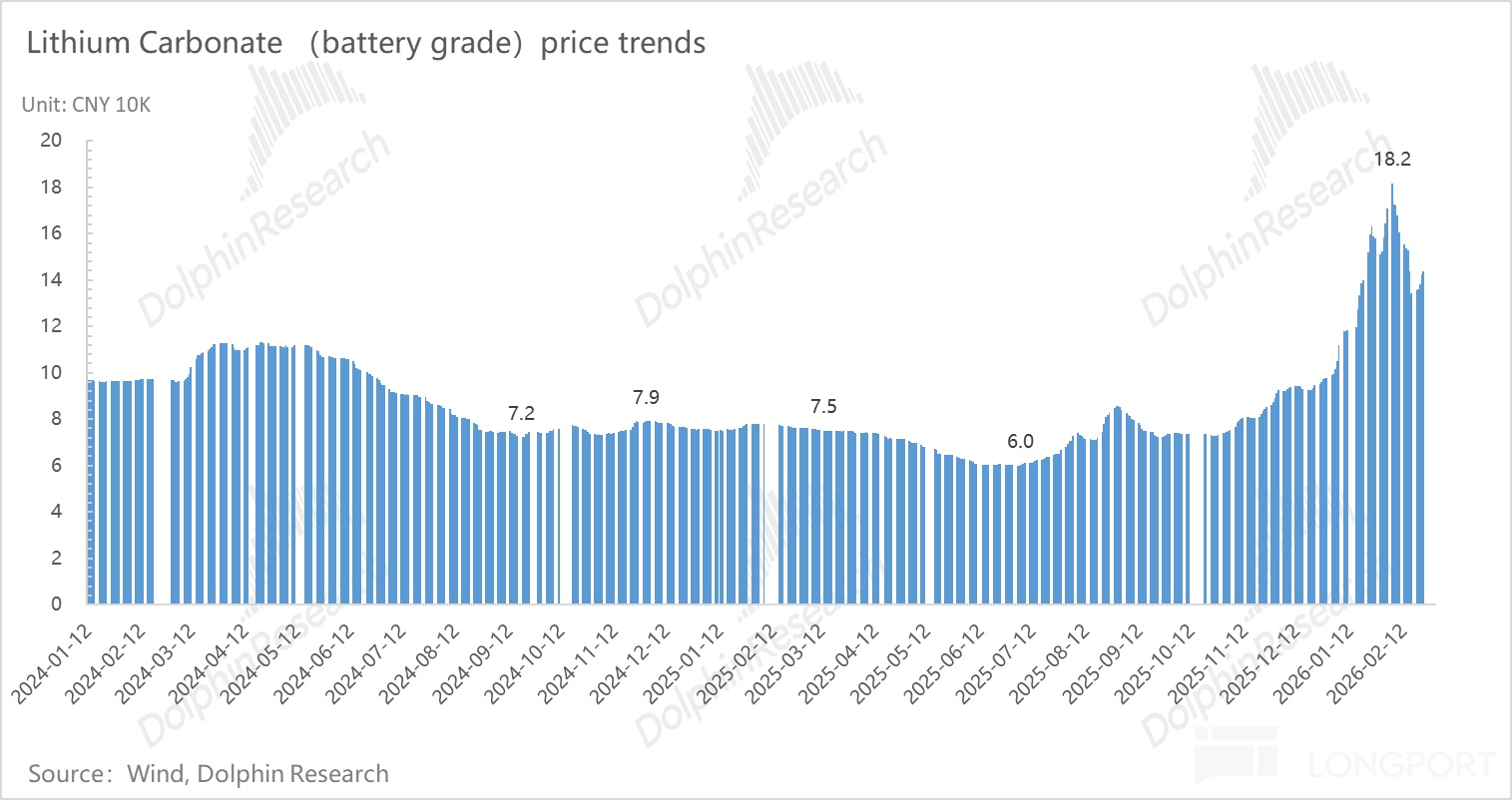
Since Q3 2025, lithium carbonate, copper, electrolyte and other inputs have rallied; lithium carbonate moved from RMB 70–80k/t in Q4 2025 to RMB 90–100k/t, and spiked to ~RMB 180k/t in Q1.
While the market fears margin erosion, Dolphin Research expects CATL to hold per-Wh NP near RMB 0.11:
a. Pass-through of lithium cost inflation downstream:
Since 2021, EV battery contracts include 1–2 month pass-through clauses, allowing cost increases to be passed to OEMs.ESS is project-based without fixed pass-through, which may squeeze margins near term when inputs spike. But China’s ESS bid-to-install cycle is short (1–2 months), allowing rapid price resets.
b. Superior upstream vertical integration hedges costs via equity/owned resources:
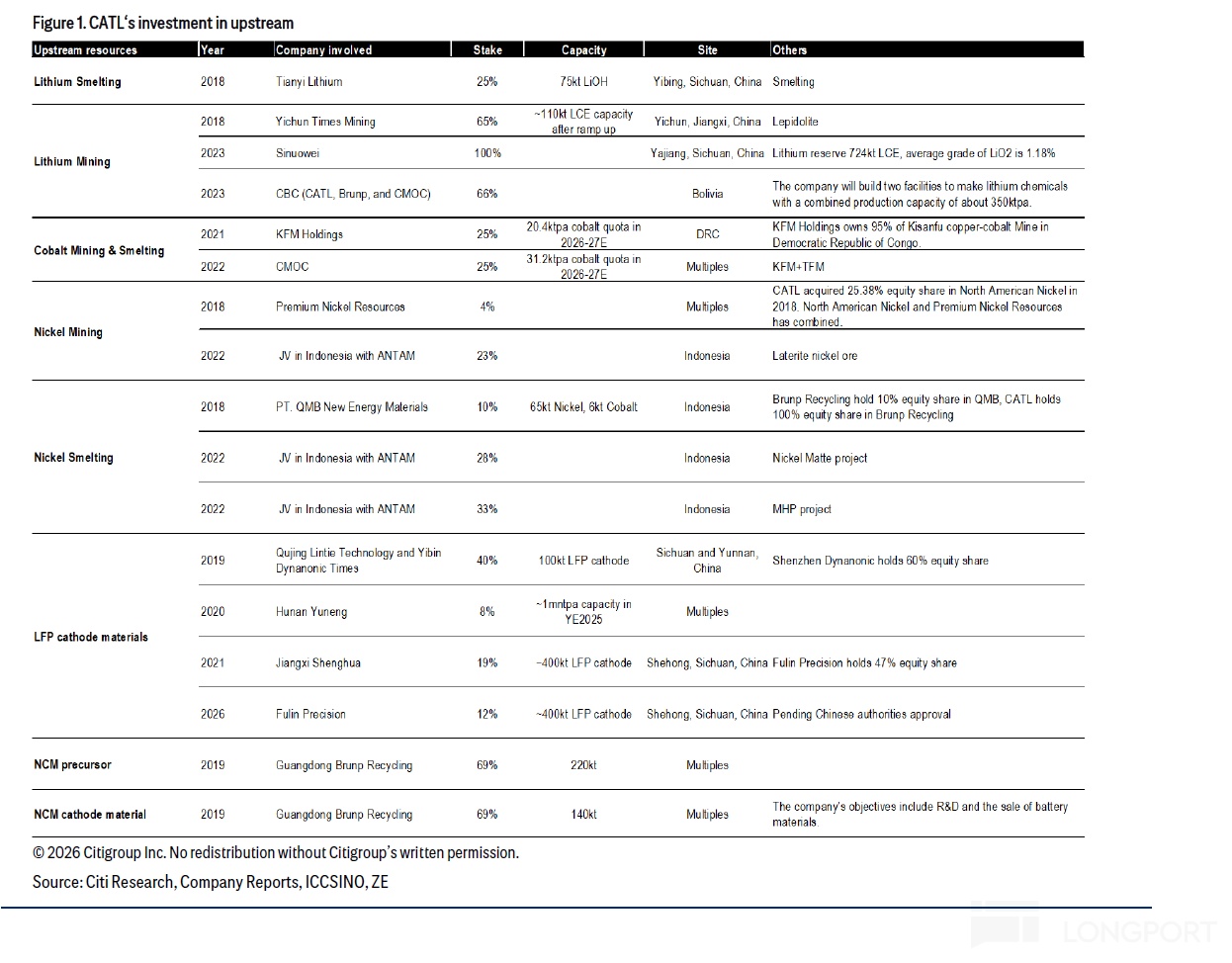
CATL owns ~25% of CMOC and holds the JXW lithium mine in Jiangxi, which may restart in 2026, effectively providing low-cost ‘inventory’ to hedge spot lithium spikes.
In the 2021–2022 lithium supercycle (RMB 40k/t to 500k/t), CATL’s per-Wh NP stayed around RMB 0.11 while many Tier-2 peers swung to losses or volatile profits.In this print, per-Wh GP still rose QoQ, helped by pre-stocked low-cost inputs.
③ Self-correction of supply/demand and demand rigidity
The feared ‘cost up → price up → demand down’ loop is unsustainable in the current structure:
‘High costs’ and ‘weak demand’ cannot coexist for long. As the chain leader, if end-demand truly weakens from price hikes, CATL would cut procurement, forcing upstream lithium/copper to oversupply and correct, relieving cost pressure; if upstream stays firm, it signals strong end-demand that digests price hikes.
AI-driven ESS demand is highly inelastic: for AIDC/data-center customers, the opportunity cost of outages or delayed interconnection dwarfs a few extra cents per Wh.This ‘on-time interconnection’ and ‘power stability’ requirement is inflation-resistant and should not retreat on near-term price moves.
With capacity expansion, Europe ramps, ESS scaling, and capex re-accelerating (2026 plan raised to 1.1–1.2 TWh), Dolphin Research expects total 2026 shipments at 830 GWh (traction 648 GWh, +20% YoY; ESS 182 GWh, +50% YoY).
Assuming per-Wh NP of RMB 0.11 holds, 2026 NP is estimated at RMB 91.2bn. Applying 25x PE for 2026 in an upcycle implies a target mkt cap of ~RMB 2.3tn.
Given CATL’s scarcity value as foundational infrastructure for NE and AI-driven ESS (plus potential A/H liquidity premium), Dolphin Research believes the current ~RMB 1.6tn A-share and ~RMB 2.0tn H-share valuations offer a strong margin of safety and an attractive left-tail entry.
Details below:
I. Another perfect score: revenue and GP both up strongly
1. Topline beat driven by shipments
Q4 2025 revenue was RMB 140.6bn (+37% YoY), confirming the lithium upcycle and beating the Street’s RMB 125.3bn.The upside came from continued shipment growth, with ASPs stable.
a. Battery shipments: traction outperformed and lifted total
Q4 shipments were 226 GWh, +56% YoY, beating the Street’s 176 GWh and optimistic ~200 GWh.Within that, traction was 192 GWh (+48% YoY; +46% QoQ), far ahead of domestic NEV unit growth of ~16% YoY.
Dolphin Research sees two drivers: ① tight supply prompting OEM pre-buy; ② rising kWh per vehicle: larger passenger-car packs (e.g., Nio base 100 kWh, Xiaomi SU7 ≥96 kWh trims) and a higher mix of high-kWh commercial vehicles driving leverage.
ESS shipments were 34 GWh, +118% YoY on a low base (late-2024 domestic policy changes on mandatory storage and overseas shipment/REBATE timing), but flat QoQ.Likely reasons:
① The Jining (Shandong) ESS base (>100 GWh plan) was slated to start releasing capacity in Q1 2026, creating a Q4 2025 ‘tight bridge’ with supply constraints rather than demand issues.② ESS systems (esp. overseas utility scale) involve months from cell shipment to system integration, installation, commissioning and revenue recognition (within 180 days). With higher system share in shipments, ‘goods shipped’ rose to ~39.3% of inventory in 2H 2025 (+~6ppt QoQ), implying sizable shipped-but-unrecognized revenue that supports future topline.
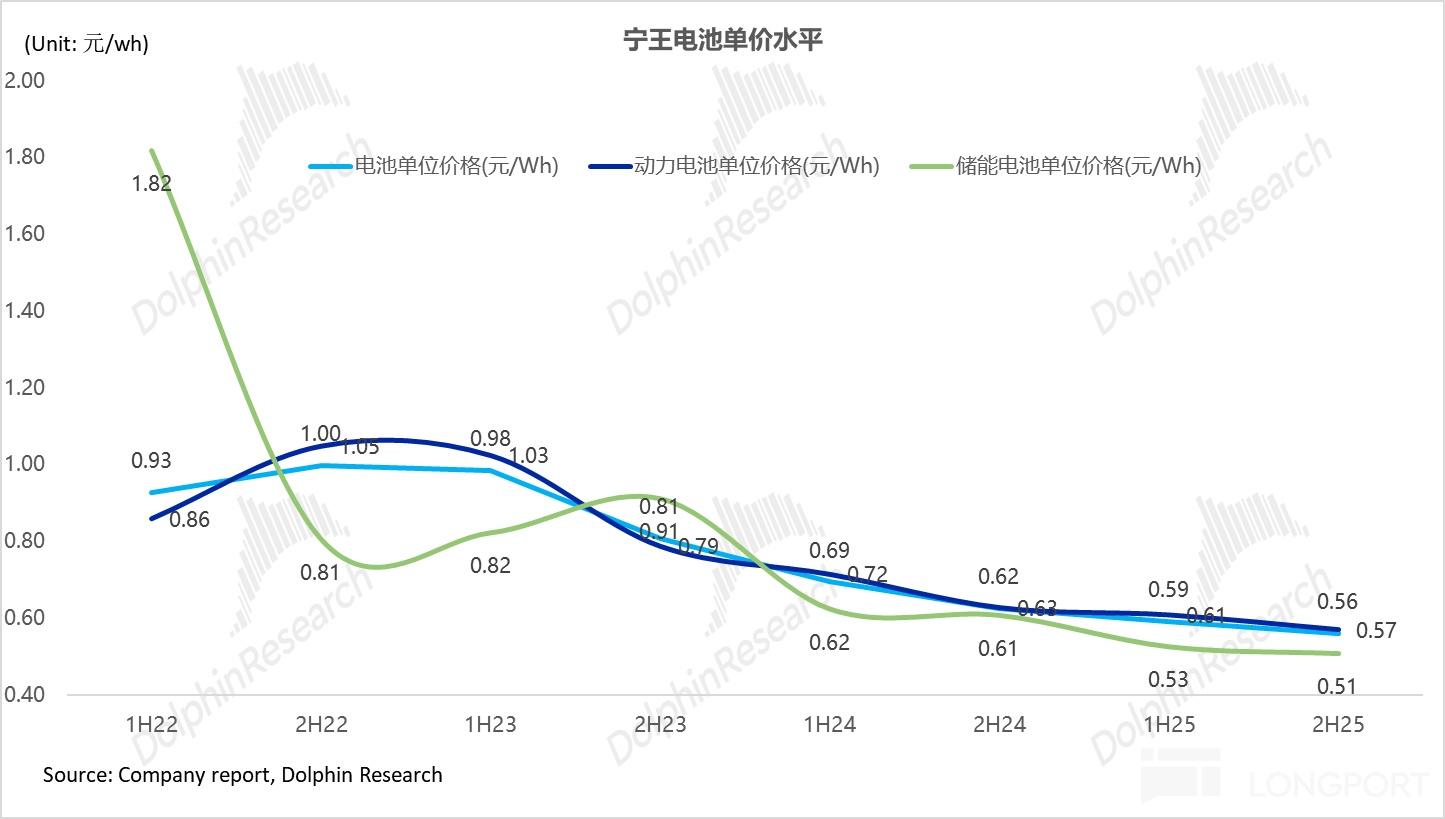
b. Battery ASP flat QoQ in Q4
With lithium carbonate rising from RMB 70–80k/t in Q3 to RMB 80–100k/t in Q4, blended ASP was still ~RMB 0.55/Wh, roughly flat QoQ.Reasons include:
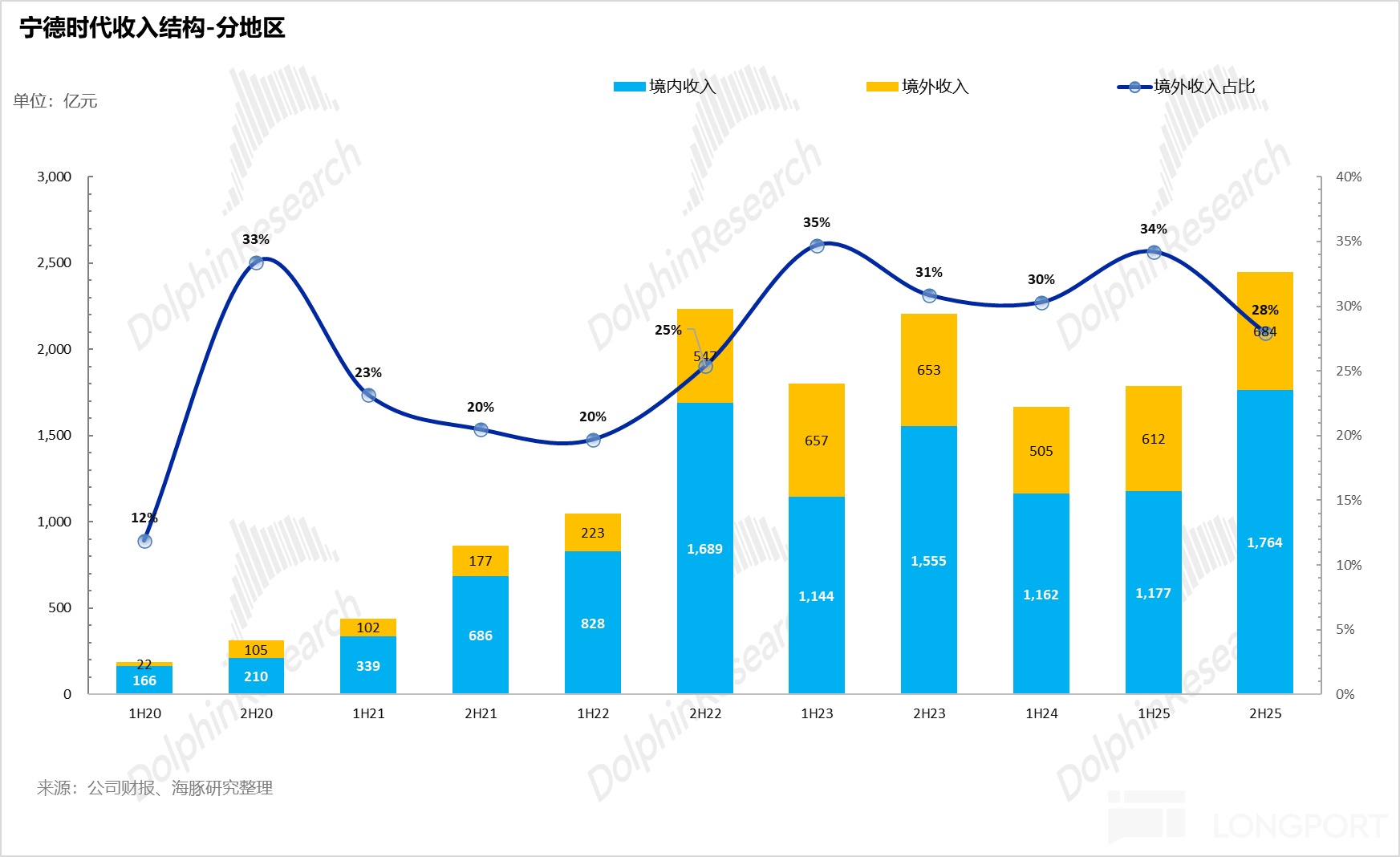
① Mix shift to China and LFP: overseas revenue share fell ~6ppt QoQ to 28% in 2H 2025, likely due to ESS recognition timing overseas and higher domestic traction share; LFP mix likely rose as well.② 1–2 month price pass-through lag with customers: Q4 prices reflect Q3 or earlier costs, so pre-upturn orders shipped in Q4 diluted blended ASP.
2. Margins rose QoQ, likely aided by inventory carryover
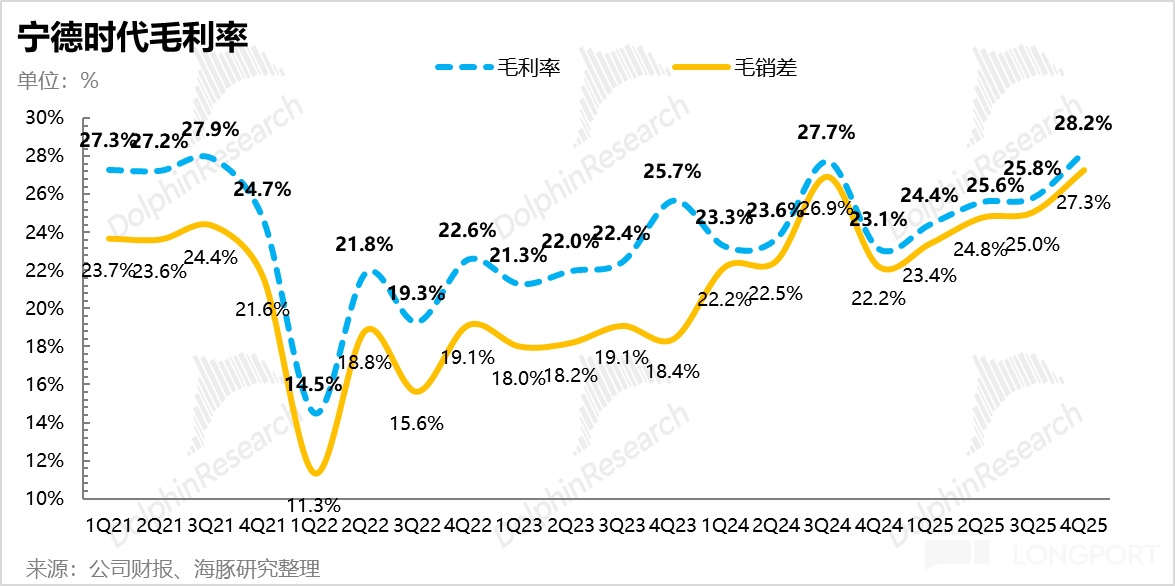
Q4 2025 consolidated GPM rose 240bps QoQ to 28.2%; the GP-to-sales-spend spread also widened 230bps QoQ to 27.3%.Per-Wh GP improved from RMB 0.16/Wh in Q3 to RMB 0.18/Wh in Q4.
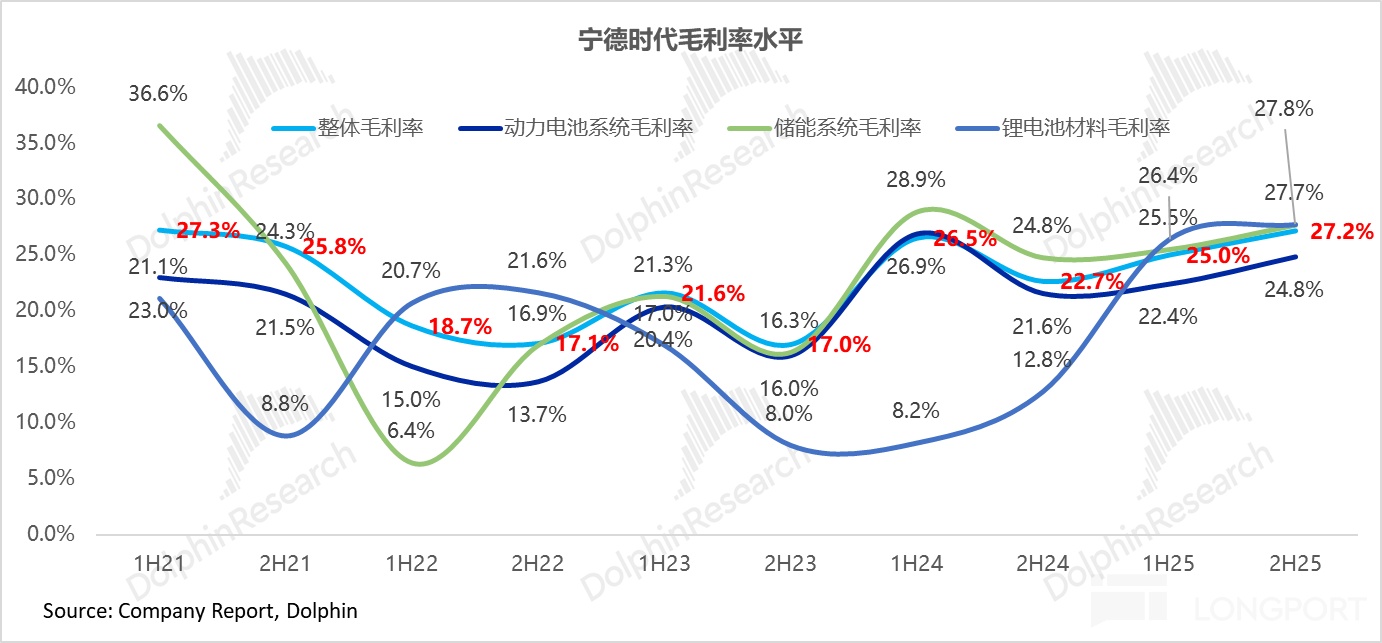
2H 2025 traction GPM reached 24.8% (+2.4ppt QoQ). ESS system GPM was 27.7% in Q4 (+2.2ppt QoQ).With ASPs flat QoQ and lithium costs rising, per-Wh GP and GPM still rose QoQ due to:
① inventory carryover: Q3-end inventory was RMB 80.2bn (~77% of revenue), covering roughly a quarter’s inflation; Q4 drew on lower-cost stock; ② scale benefits: full utilization and 226 GWh shipments cut fixed-cost absorption per unit.
II. CATL is in a full upcycle
① Utilization up sharply; full in 2H
Full-year 2025 utilization hit 96.9%, up 20.6ppt vs. 2024’s 76.3%.2H reached 102.6%, indicating full capacity mode.
2) Capex re-accelerating; expansion back in high gear
After the 2021–2022 investment peak, capex trended down amid competition/overcapacity, reaching a trough of RMB 6.7bn in Q4 2023.Since Q4 2024, CATL has been lifting capex, with Q4 2025 at ~RMB 12.3bn, near prior peak-expansion levels.
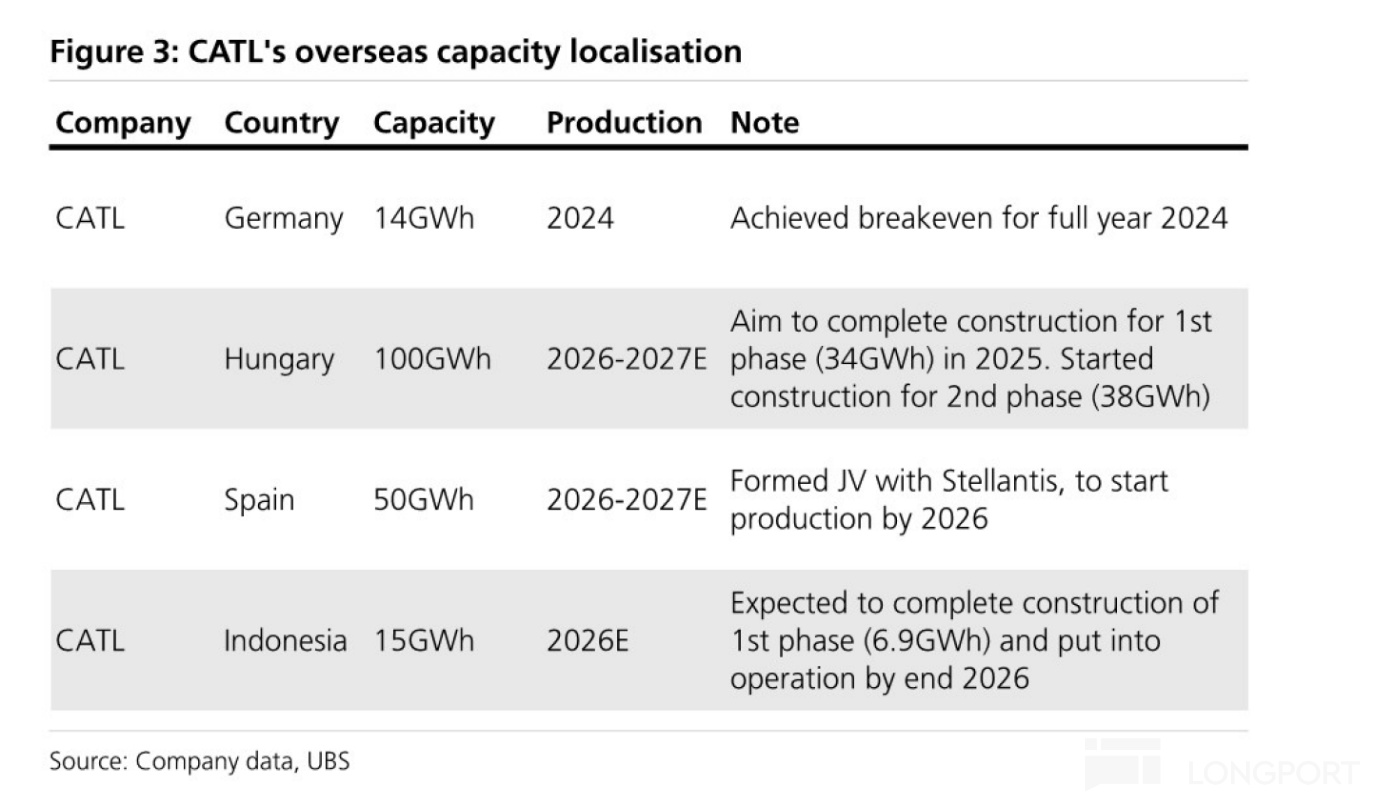
CATL lifted its 2026 output plan to 1.1–1.2 TWh (2025: 0.772 TWh; +~400 GWh new capacity) and will raise 2026 capex by 50%.Domestic bases (Jining, Ruiqing/Guangdong, Yichun/Jiangxi, Xiamen/Fujian, Qinghai, Ningde/Fujian) are all expanding. Jining ESS capacity is planned to start ramping in Q1 2026.
Overseas, Germany (14 GWh) was onstream in 2024 and profitable. Hungary (100 GWh) Phase 1 cell lines are in commissioning, with ~34 GWh expected by end-2025. Spain (60 GWh) JV set up with approvals in place, targeting 2026 build start; Indonesia value-chain projects aim for 1H 2026 start.Thus capacity constraints that capped 2025 share should ease in 2026, with greater overseas ramp potential.
3) Inventories continue to rise
Inventories reached RMB 94.5bn, up ~RMB 14.3bn QoQ, a new high, with days up to ~90.Of the RMB 22.2bn increase in 2H 2025, ~60% was ‘goods shipped’, reflecting longer ESS project cycles, more distant overseas markets (beyond Europe to Middle East), and higher ESS system mix versus cells, implying substantial shipped-but-uninvoiced revenue.
To hedge rising lithium and other inputs, CATL pre-stocked ~RMB 3.0bn in raw materials and RMB 5.3bn in WIP in 2H 2025, cushioning cost inflation with lower-cost stock.
4) Contract liabilities hit a record high with strong QoQ gains
As a B2B business, CATL records customer prepayments before delivery; contract liabilities serve as a proxy for order backlog.Q4 contract liabilities rose to RMB 49.2bn, +RMB 8.5bn QoQ, a record high, signaling robust near-term orders.
5) Higher impairments this quarter due to pre-stocking and mine suspension
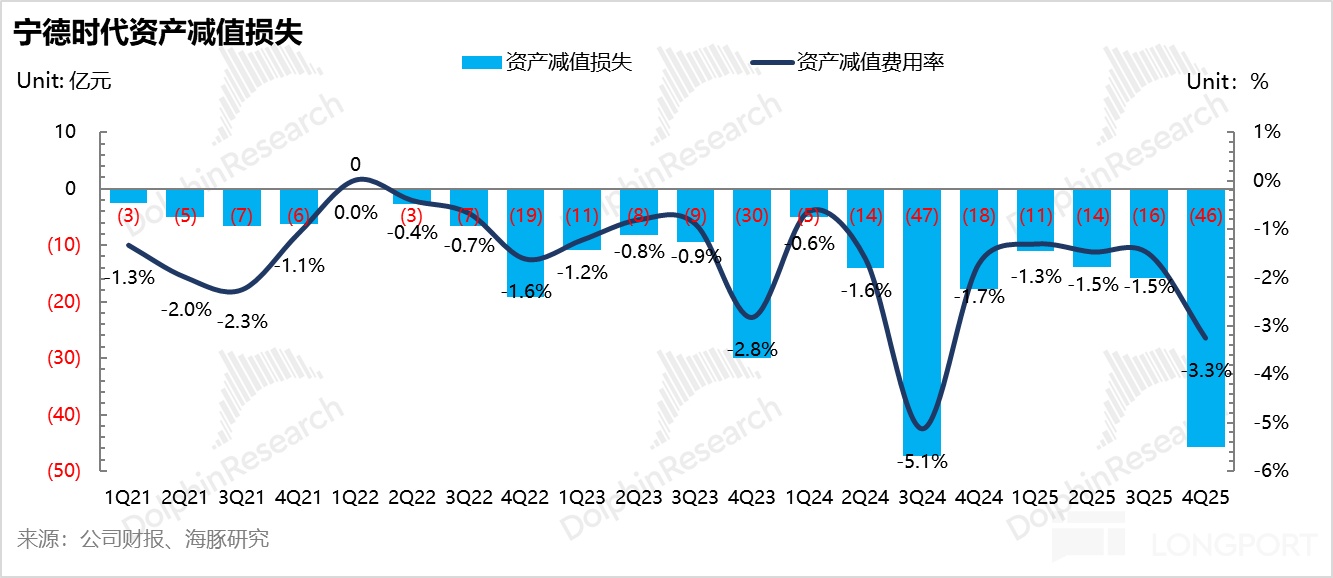
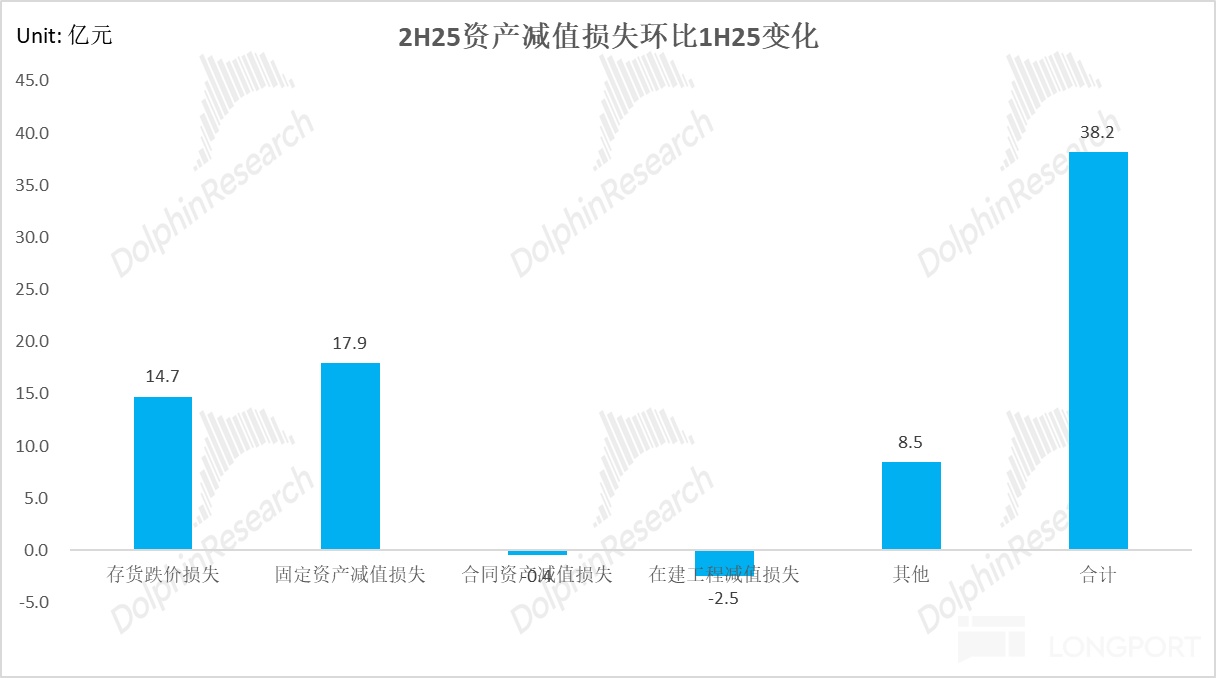
Q4 2025 asset impairments were RMB 4.6bn, up RMB 3.0bn QoQ (from RMB 1.6bn), reaching ~3.3% of revenue and weighing on bottom line.Breakdown:
① Inventory write-downs: rose RMB 1.5bn in 2H to RMB 3.3bn, as lithium and other input prices rose sharply in Q4 from Q3 lows, creating valuation impacts on previously procured low-cost stock. This reflects upcycle pre-stocking and is not concerning.② Long-term asset impairments: mining-related rose RMB 1.8bn in 2H to RMB 2.2bn. CATL’s JXW lithium mine suspended in Aug 2025 pending license renewal; despite higher lithium prices in Q4, timing/approvals remain uncertain. The market had expected this, so the impact is limited.
Q4 attributable NP was RMB 23.2bn vs. Street RMB 20.7bn, driven by shipments and GP, despite higher R&D (RMB 7.1bn vs. Street RMB 5.8bn) and impairments that pulled per-Wh NP from RMB 0.11/Wh to RMB 0.10/Wh.In an upcycle, the market should tolerate this ‘blip’.
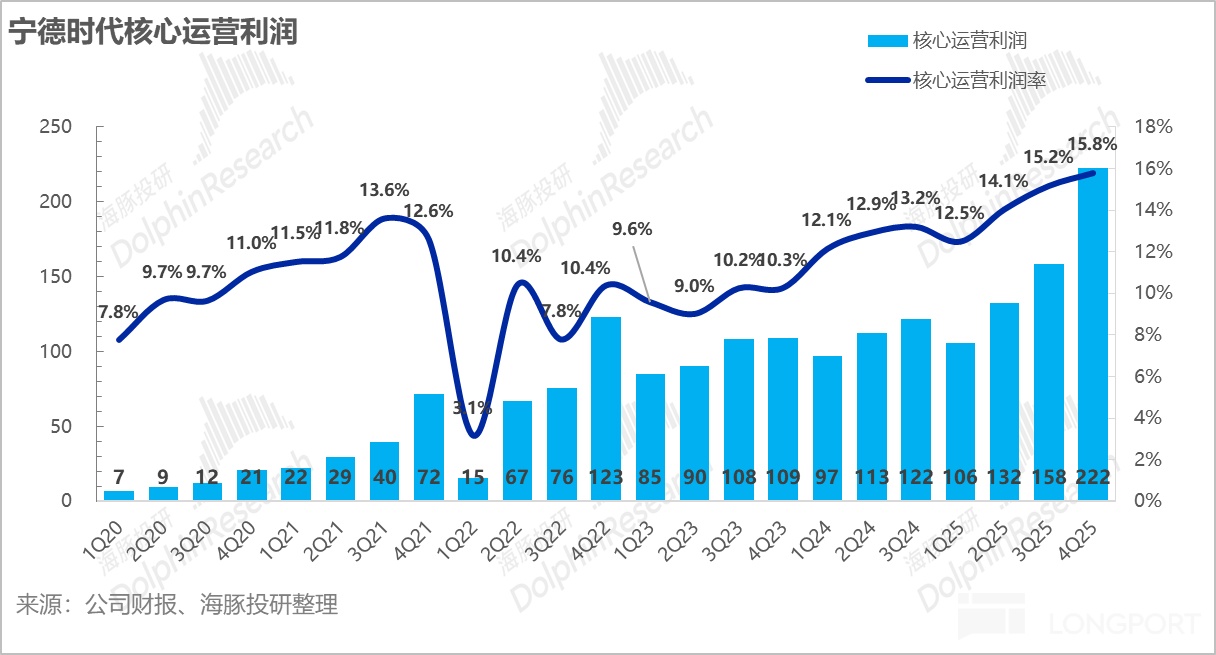
Dolphin Research focuses on core OP trend (GPM – Opex – asset/credit impairment rate): Q4 core OP was RMB 22.2bn, +83% YoY, with core OPM at 15.8%, up 60bps QoQ.
Deep dives:
Jul 5, 2025: ‘CATL: >20% H-share premium — time for a value re-rating?’
Jan 23, 2025: ‘Reading CATL through TSMC: an inescapable cycle’
Earnings trackers:
Jul 31, 2025 Trans: ‘CATL (2Q25 Trans): EU NEV growth continues; local capacity ramps’
Jul 31, 2025 note: ‘CATL: price wars — hard to escape the squeeze’
Apr 14, 2025 Trans: ‘CATL (1Q25 Trans): limited tariff impact; active client negotiations’
Apr 14, 2025 note: ‘CATL: tariff ‘bandit’ strike — tough crossing’
Mar 16, 2025 Trans: ‘CATL (4Q24 Trans): Shenxing/Kirin mix to 60–70% in 2025’
Mar 16, 2025 note: ‘Another deep dip — is it really that bad?’
Oct 21, 2025 note: ‘CATL 3Q24 earnings call Trans’
Risk disclosure and statement: Dolphin Research disclaimer and general disclosure
The copyright of this article belongs to the original author/organization.
The views expressed herein are solely those of the author and do not reflect the stance of the platform. The content is intended for investment reference purposes only and shall not be considered as investment advice. Please contact us if you have any questions or suggestions regarding the content services provided by the platform.
