


CATL (4Q25 Trans): Optimistic on stable unit net profit in 2026---
Dolphin Research summarizes the FY25 earnings call transcript for CATL $CATL(03750.HK). For our earnings take, see 'CATL: Capacity Maxed, Back to Lead in the AI Infra Era'.
- Key Financials Recap
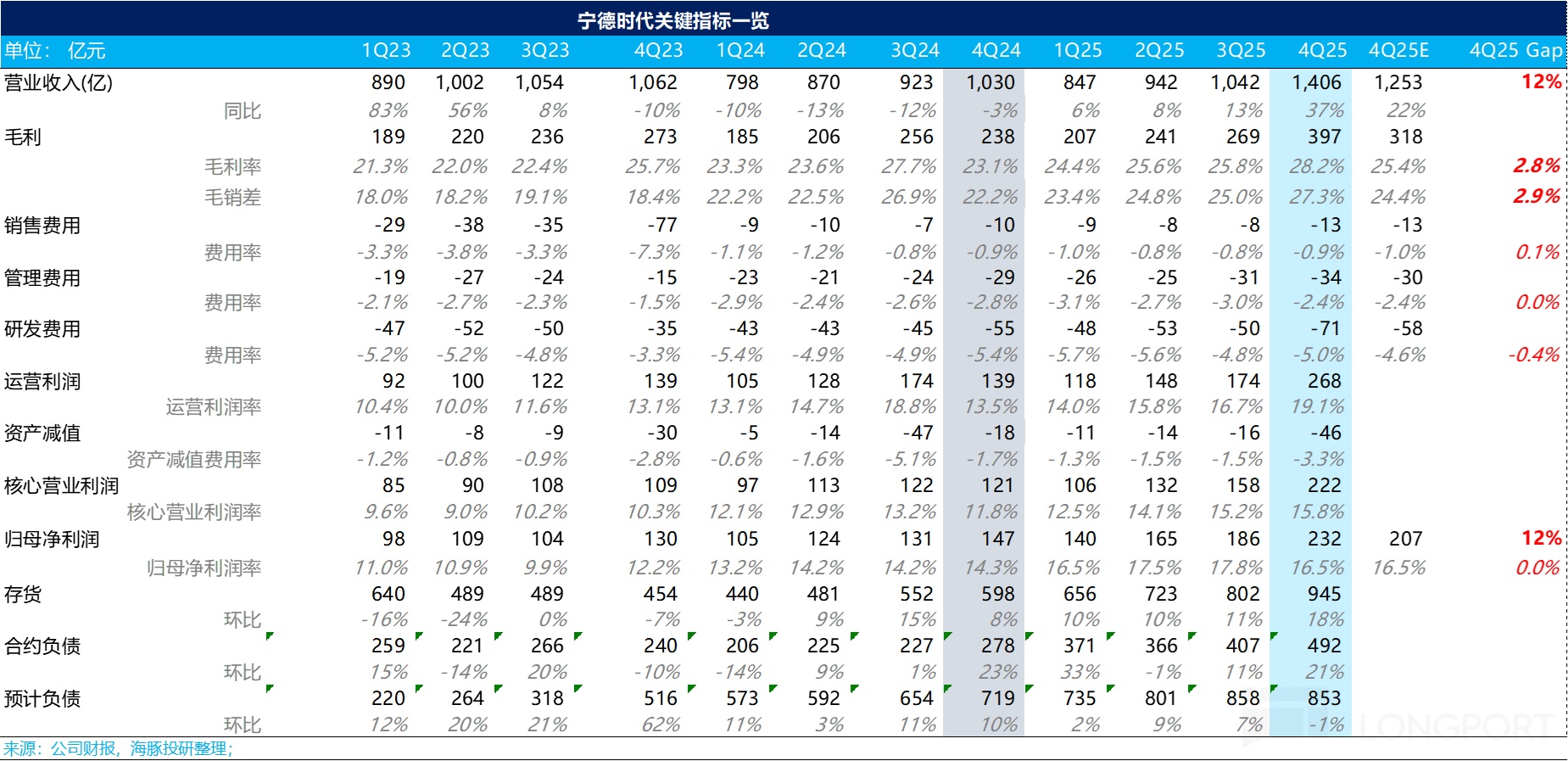
- Shipments: Lithium-ion battery shipments reached 661 GWh in 2025 (+39.2% YoY). Of which, EV battery shipments were ~540 GWh (+41.9%), and storage batteries were ~121 GWh (+29.1%).
- Revenue: Full-year revenue was RMB 423.7bn (+17% YoY).
- Profit: Net profit attributable to shareholders was RMB 72.2bn (+42.3% YoY).
- Cash flow: Net operating cash flow came in at RMB 133.2bn (+37.4% YoY).
- Liquidity: Cash plus trading financial assets totaled RMB 392.5bn at year-end, indicating strong reserves.
Market Position
- EV batteries: Global share rose 120bps to 39.2%, a record high, ranking No.1 worldwide for nine straight years.
- Storage batteries: Global shipments ranked No.1 for five consecutive years. Overseas share topped 30%.
- R&D and patents: Total patents held and filed reached 54,538 at period-end.
Shareholder Returns
For 2025, the dividend proposal is cash of RMB 6.957 per 10 shares (pre-tax). This marks a third straight year of paying out 50% of net profit in cash, with cumulative payouts approaching RMB 100bn.
Earnings Call Details
2.1 Management Highlights
1) EV Battery Biz.
Frontier tech and product rollout:
- Shenxing Gen-2 ultra-fast charge: The world's first cell combining 800 km range with peak 12C fast charge.
- Shenxing Pro: Built on advanced NP30, offering 1 mn-km lifetime and 12C fast-charge versions tailored for Europe.
- Xiaoyao dual-core: Cross-chemistry pack design combining different cells within a pack to elevate overall performance, enabling customer-specific configurations.
- Sodium-zinc battery: Strong low-temp and safety performance, reducing reliance on lithium resources.
- Ultra-hybrid battery: Materials-level hybrid innovation beyond single chemistries to meet passenger car value-for-money needs.
Market position and customer collaboration:
Deeper strategic ties: Strengthened partnerships with FAW Jiefang, BAIC Foton and Dongfeng Commercial Vehicle, advancing electrification and unmanned scenarios (autonomous logistics, unmanned mining) for a green transition.
Overseas: Offshore share kept rising (now >30%). The company continues to win customized orders from Volkswagen, BMW, Volvo and other international customers.
2) Energy Storage Biz.
Product innovation:
- China: Delivered and grid-connected a 6.25 MWh liquid-cooled container using 587Ah high-capacity cells.
- Overseas: Launched the first mass-producible 9 MWh ultra-large storage system globally. Introduced the NH container for high-temperature sites to cut auxiliary power and lift project IRR.
Ecosystem synergy and partnerships:
- Signed long-term strategic partnerships with HyperStrong and CRRC Zhuzhou Institute.
Delivered GWh-scale system integration projects overseas and secured system orders across major offshore markets.
3) New Biz. and Ecosystem
Battery swap network:
- Chocolate swap stations: 1,000+ sites across 45 cities, first profitability achieved in Chongqing.
- Qiji swap stations: 300+ sites across 26 provinces.
- Ops data: 1.15 mn+ swap services, with total swapped energy of ~80 mn kWh.
Low-altitude economy: Affiliate Autoflight developed the world's first ton-class eVTOL with all three airworthiness certificates.
Electric vessels: Rolled out the 'Ship-Shore-Cloud' zero-carbon integrated ops solution, with nearly 900 electric vessels in safe operation.
2.2 Q&A
Q: First, outlook on quarterly profitability. Since late last year, we have seen rising lithium carbonate and material/product prices; how is CATL managing price-cost moves? Second, the US and Europe have rolled out storage-related acts and drafts. What is the impact on our biz., and how do you see the trend this year?
A: On your two questions, a brief response first. Since Q4 last year, we observed price increases in certain materials, including lithium carbonate. Looking back at our playbook during the last commodity cycle, we used customer-linked pricing and upstream resource hedging. This time, we are more comfortable managing supply chain inflation. Even with upstream volatility, we can pass on part of the costs through linkage and absorb some internally, and scale benefits are more evident as we grow.
Therefore, the impact is smaller than last time. We also assessed downstream effects. While higher lithium carbonate could affect some marginal storage projects or niche use cases, overall impact is limited. From Doc. No.136 to No.124, policy shifts have given storage a strong policy footing and commercial outlook. Thus, even with higher lithium carbonate, domestic storage demand continues to grow.
Second, we have seen large M&A proposals overseas, including in Europe, and the US Supreme Court's tariff decision. The overseas situation is more complex with many legislative changes. Our current sales exposure to the US is relatively low. After close reading, the act's impact on us is not as large as perceived. In Europe, it is still early-stage and will take prolonged discussion, and we will closely track draft progress. In any case, as a leading Chinese battery maker with real overseas capacity on the ground, we have more advantages than many peers in this competition.
Q: On Europe-related experience, some drafts frequently raise public project equity requirements. Is this part of our actual project execution?
A: We have preliminary drafts that include certain intent-based clauses. These aim at quasi-international-agreement terms with specific countries, which is feasible for some; for non-signatory countries, certain bid restrictions may apply. We are engaging with stakeholders to clarify details. The language remains principle-based and coarse for now, requiring further interpretation. Objectively, our locally invested and built entities should qualify as localized enterprises, but we need more time to fully interpret the act and respond. For projects under construction vs. new builds, we do handle them differently. Given this is an early draft with high uncertainty, distinctions still exist but are preliminary.
Q: On profit per unit, can we expect unit net profit to be relatively stable this year given cost pass-through and internal absorption? With material inflation and lower export VAT rebate, will unit GP face pressure, but scale helps keep unit profit stable?
A: We have discussed unit GP often; it is volatile and driven by multiple factors. Unit net profit better captures overall ops performance. Barring extreme events, we are constructive on stable profitability next year. Over the past 25 years, our performance and unit net profit have been relatively stable. For 2026, despite export rebate changes and external shocks (e.g., Middle East), we still see the year as relatively resilient. If we execute on production and sales plans, we expect profits to stay solid. Global demand continues to rise with electrification penetration, across both storage and EVs.
Q: On export VAT rebates after Apr 1, for prior contracts where we may need to absorb, can we pass through to customers in the next negotiation?
A: In practice, friendly negotiations have enabled pass-through in most cases. When rebates fell from 13% to 9% last year, we communicated well and signed multiple agreements to pass through most of the impact. We also acknowledged customer pressures and shared part of the burden. We anticipated a gradual rebate cut and built an effective communication mechanism last year, which we will continue this year to ensure smooth transmission.
Q: On lithium price pass-through, could OEM pressure impede pass-through even with contracts, given domestic passenger car headwinds and broader cost pressures? Might clients ask for rebate renegotiations?
A: The current mechanism is rational, and we maintain strong relationships with customers from the last cycle. Lithium carbonate increases are milder than the last cycle, and expectations for further hikes are limited. We have also improved performance and reduced costs. Battery pricing is better than before, and communications with customers are normal. Unless extreme events occur, such as abnormal lithium spikes, things look manageable.
Since last year we rolled out sodium-based cells, and we plan more customer engagements this year. Some clients have begun using our sodium cells. The prior lithium spike catalyzed sodium R&D, and with maturing tech and growing acceptance, we remain ahead in energy density and performance despite followers. If raw material prices run too high, it increases resistance for battery users.
Q: On full-year sales and production planning, have we adjusted from the plan set at year-end given recent price or policy changes? Is the adjustment up or down?
A: No. Year-end was a transition. The Two Sessions just concluded, and many national policies are being implemented, so we continue to observe. We remain confident in the market growth outlook and see no signs to adjust plans.
Q: Follow-up on the volume gap since 2024 between production and revenue-recognized shipments. With a higher mix of storage and systems, how should we model this gap going forward?
A: Two angles. First, the gap between revenue recognition and production is not only about storage installations, though it is a factor. The biggest driver is goods in transit forming inventory during logistics. Our inventory cycle has been stable at a little over 80 days for many quarters. As monthly volume grows, an ~80-day inventory cycle expands the absolute gap. Think of shipments today becoming revenue in ~80 days.
For autos, revenue arrives ~80 days later. Storage adds installation and commissioning time, so cycles are longer. Thus, the larger gap is mainly from higher inventory as volumes rise, and the ~80-day inventory and in-transit items lift the absolute sales gap.
Also, a rising share of system-level storage sales widens the gap, but less so. Selling cabinets or cells recognizes faster, while full systems can take 6+ months; cabinets are shorter. You can approximate based on storage growth. For an ~80-day cycle, turnover days may extend by a few days; for passenger vehicles it is lower and calculable. Overall, the ratio has been broadly stable despite absolute swings over the years.
Q: On volumes, any guidance on overall growth and split between EV and storage? Also, Q4 storage looked flattish QoQ, which differs from our market read; any color?
A: On Q4 QoQ, two drivers. First, storage delivery: systems take longer to recognize vs. traditional EV or cell sales. Second, very high utilization last year constrained some storage and EV deliveries, leading to some slippage. We ramped capex since last year. By year-end, capacity under construction exceeded 320, and some will come on stream this year.
On sales scale, as capacity ramps, deliveries will improve. For annual guidance, we stick to a medium- to long-term view: a 20–30% CAGR over the next five years is a high-probability, resilient path as electrification continues. We plan ahead to deliver this. Our global share has been steadily rising, and Jan data already shows a new high in market share, implying this year's shipments and revenue are trackable.
Q: On industry production plans and market structure, checks suggest multiple firms, including CATL and Tier-2 players, plan much higher 2026 output, with YoY increases ranging from 50–60% to even 80–100%. Could this cause overproduction, intensify competition and trigger a price war, hurting market structure?
A: We cannot comment on Tier-2/3 capacity plans, but they must have their own market logic. Across EVs (passenger and commercial) and storage, growth remains strong. Some of our capacity is equipment-constrained, resulting in overflow orders to Tier-2/3, who see opportunities and expand accordingly. Expansion is based on their assumptions. From our standpoint, winning does not hinge on capacity, but on technology and product quality.
That is why we emphasize sodium-based cells and next-gen products like Shenxing and Qilin. As Robin noted at the Two Sessions, high-quality development and products are the real scarcity. Lithium capacity is not scarce; high-quality products are. Hence we are not overly worried about excessive competition.
Q: On the newly reported results, we saw a sizable Q4 impairment. Excluding it, Q4 profit would be ~RMB 3bn higher. Why the large Q4 impairment? Is it a one-off due to equipment retirement, rather than normal inventory impairment?
A: We did record impairments in Q4 per our routine. Each quarter-end, especially at year-end audit, we test current and long-term assets for impairment indicators and decide if provisions are needed. In Q4 last year, both inventories and fixed assets were impaired, especially older lines. Inventory amounts increased as finished goods, WIP and raw materials rose with scale, so we provided per accounting rules. The ratio is slightly lower vs. book, but total provisions rose due to scale.
Though the absolute impairment looks large, as a proportion of total assets it is not high and is trending down vs. prior years. Impairments are mainly two buckets: equipment assets and inventory.
For fixed assets, we test annually. Some older equipment no longer meets current production needs; if new equipment delivers better returns, the residual value of old lines may not justify carrying value, so we impair them. For inventory, under prudence, even with an ~80-day turnover, cyclical volatility exists. We therefore took provisions; as inventory sells through, write-downs can reverse against realized prices.
Q: On fixed-asset investment, despite cautious depreciation treatment, capacity growth outpaced fixed-asset growth, and depreciation is trending down. What is this year's capex plan given ~350 GWh equivalent of projects under construction? Can you quantify added capacity?
Second, given our cautious approach, can current order visibility support this expansion? Will utilization stay high and market share hold or rise?
A: Your analysis is right. By year-end, we had established 321 baseline units. We also signed new projects after the holiday and continue to add, so this year's online scale will be somewhat higher. Our prudence means we do not decide lightly. Capex follows a strict process from market analysis to customer order confirmation; we only invest with high confidence. Our long-built process is robust, and order visibility is a reliable indicator. With no extreme events and stable production plans, we are confident in managing the full-year outcome.
Second, capex will rise with higher online scale this year. That said, with the large-scale application of PSL, capex per unit capacity has improved significantly; total capex will be up, but not as much as capacity scale.
Q: Overseas investment costs are higher. For Hungary and future Spain investments, roughly how many times vs. domestic? 2x or 2–3x?
A: Not as high as 3x. Costs vary by country and even by city within a country, including land and line certification. In places like Hungary or Spain, investment ROI can reach 1x to even 2x relative to domestic benchmarks, depending on specifics.
Q: Thoughts on Zimbabwe's ban on lithium ore exports and our response?
A: Lithium supply is closely watched, and we have addressed this before. Globally, lithium resources are not scarce. The last cycle saw demand spike faster than supply due to ramp timing and elasticity. As prices rose to RMB 80k–100k per ton, many resources turned profitable, spurring mining activity domestically and abroad. The market is roughly balanced now, with some supply-side concerns.
We view those concerns as stemming from interim export restrictions rather than permanent processing stops. Local work continues. We are engaging locally and investing in processing lines there. Given fast build times and the relative simplicity of lithium sulfate lines, exports should resume post-ramp. Zimbabwe's share of global supply is small versus Australia, South America and China, so marginal impact is limited. With our upstream hedges and resource layout, volatility has limited impact on us.
Q: Update on overseas plants: are we only cooperating, or already making cells? Any color on yield and margin progress?
A: We are working closely with partners and ramping cell production, with yield and margin improving. The first phase in Hungary, one of the H-share IPO use-of-proceeds projects, has a planned capacity of 30+ GWh. By year-end, the plant had largely completed commissioning, with some lines still tuning. Once ready, we will ramp quickly; overall progress is on track. Building at this scale in Europe is not easy, and we are pleased with Hungary's financial support and the local team's execution. Yields are still climbing and may need a few months to stabilize; with solid orders, we are not concerned about ramp scheduling.
Q: Progress on solid-state batteries: status of pilot lines and when to move to mass production?
A: This is a frequent topic, and we attach great importance to solid-state, with over a decade of investment and a leading team. For various reasons we cannot disclose too much, but our progress is well recognized by the industry and experts.
The market expects new models this year. We have two pilot lines now, and before SOP we will consider scaling appropriately. Solid-state still faces engineering challenges despite strong theoretical promise; the path from lab to commercialization takes time and rigor. We will approach it rationally and avoid overpromising.
Q: On storage, two questions. Has recent geopolitical conflict catalyzed overseas demand? And as more players enter, how will pricing competition evolve? Do we have new strategies, especially in Europe and EMs, beyond our cell advantage? Any target market share for storage in Europe?
A: Your read on storage is right. We are not only focused on cells, and progress is solid. We secured dozens of projects last year. More entrants are coming because the economics are attractive. Doc. No.136, Doc. No.14 and domestic capacity tariffs highlight profitability; seeing this, many want in.
The best solutions will drive the industry forward. Leveraging deep cell know-how, plus downstream capabilities in cabinets, power conversion and grid-side integration, we aim to deliver optimal solutions across the stack. We keep an open stance on partnerships across the value chain, and have signed multiple agreements. Building a flexible and open ecosystem remains our focus.
Q: On large-format storage cells, system vendors say bigger cells accelerate cost-down. For our 587Ah cell, what is the cell-level cost reduction and system-level impact?
A: We have emphasized that larger cells lift system energy density and cut costs by simplifying structures. That said, bigger is not always better. 587Ah is currently an optimal solution. We are ramping quickly this year with strong customer acceptance. Cost-down has a materials-accounting side and a commodity-price side, such as lithium carbonate; large cells help lower total costs now for us, customers and storage plants.
We have also raised lifetime discharged energy. Vs. 314Ah, 587Ah increases this by nearly 50%, lifting project IRR by 2–3ppts for developers/owners. It is not just unit price or cost; storage is about delivering an integrated solution that maximizes owner returns under the same operating conditions.
Q: On system capability buildout, there were rumors we might acquire peers in power equipment. Any comment?
These are market rumors. As a listed company, we follow disclosure rules; if a deal is confirmed, we will announce it promptly. Absent an official notice, please treat it as speculation.
Q: Lastly on sodium batteries. For large-format sodium batteries and related products like anodes and cells, will use cases skew to storage or EV, or both with structural/technical tweaks?
A: There will be adjustments by use case. Automotive demands tighter energy density and energy management; storage optimizes for cost. Design must follow the scenario. Thanks to materials cost advantages, sodium can serve both spaces, offering broad prospects. It performs well in low temperatures and supports fast charging in northern and other fast-charge scenarios.
<End of text>
Risk disclosure and statement: Dolphin Research Disclaimer and General Disclosure
