


BYD (4Q25 Trans): 2026 overseas sales target 1.5mn+ units
Below is Dolphin Research's Trans of the FY25 Q4 earnings call for $BYD COMPANY(01211.HK). For our earnings take, see 'BYD: Losing the Crown—Will the Future Be a Toyota-Style Export Play?'.
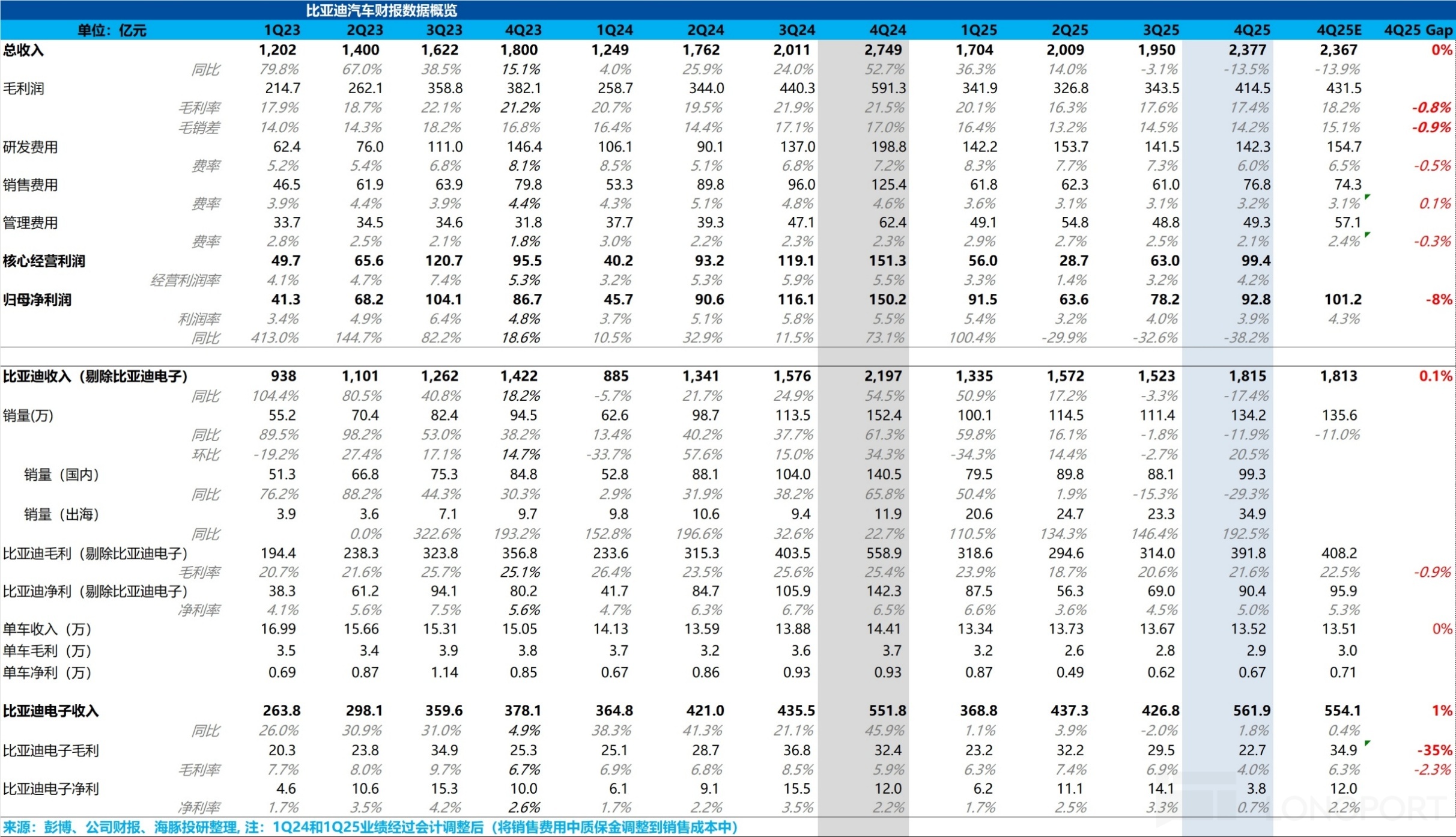
I. Key Financials Recap
Earnings Call Details
2.1 Management Highlights
On electrification, BYD formally kicked off its large-battery PHEV roadmap at the start of the year, while rolling out 2nd-gen ultra-fast charging and launching the 'Flash-Charge China' network plan. The goal is 5 km coverage in 90% of urban areas and 2,000 highway flash-charge stations.
Flash charging is far hotter than expected. Its core value is resetting consumer perceptions of BEV refueling, putting NEVs on par with ICE in product experience. It is not only about faster charging speed but a systemic rebuild of replenishment efficiency—compressing queuing time, avoiding the need for massive station counts, land, and countless plugs. Home chargers also cannot match professional third-party sites on safety and fire protection.
Crucially, BYD binds flash charging with integrated wind–solar–storage–charge stations. This solution targets China and global markets, especially regions with weak grids such as SE Asia. In these areas, BYD's setup can deliver charging without relying on the grid.
Over time, new-energy generation costs will sit well below traditional grid tariffs. Leveraging wind–solar–storage synergy, BYD expects power costs as low as RMB 0.2/kWh, potentially with zero service fees, cutting dependence on legacy grids. The company frames this as taking an extreme technology to an extreme cost, underpinned by the advantages of Chinese entrepreneurs, manufacturing, and institutions, and believes China's contribution will be remembered globally.
Currently, output is constrained by battery capacity. From Mar to year-end, monthly production will ramp by an incremental 30k–50k units, steadily boosting deliveries.
Exports are particularly strong this year. Tensions in the Middle East have pushed up oil prices, indirectly improving NEV competitiveness. In Australia, New Zealand, and the Philippines, a single day's sales now match prior two-week levels, and exports are poised to hit a record high.
On intelligence, the latest LLM-powered 'Tianshen Eye 5.0' has been rolled out. Smart features address core user pain points, and BYD avoids gimmicks to solve real problems.
Insurance data show driver-assist systems have already reduced accidents meaningfully. BYD expects driver assistance to become a safety baseline like seatbelts and airbags, improving safety, lowering accidents, and easing fatigue. Longer term, the company targets L4 autonomy (subject to regulation), which could reshape taxi and ride-hailing models, integrating end-to-end algorithms, models, and hardware to enable safer driving and replace humans in defined scenarios.
Notably, BYD will unveil a 'Smart Driving for All' strategy in May. The company has a distinct philosophy and roadmap to drive the industry toward sustainability. It draws confidence from a deep engineering bench and full-stack vertical integration from semis to complete vehicles.
In energy storage, core edges lie in cost and cycle life. With high vertical integration, BYD not only designs products but also builds full production lines. This year, it developed the world's largest cell—a 2,710Ah blade ESS cell—and scaled it to mass production. In 2025, BYD shipped 60 GWh of ESS globally, with the 'Haohan' system achieving 52.1% volume utilization and ranking No.1 worldwide on both metrics. This year it will start large-scale replacement with 2nd-gen blade cells, and while cell shipments are not No.1 globally, system shipments are. BYD believes true innovation starts from a systems mindset to design cells, enabling greater room and faster iteration.
On external strategies for power batteries, management noted limited effort in solar today and no fundamental efficiency gap between in-house and external manufacturing. BYD expressed respect for Chinese PV entrepreneurs who have pushed costs and efficiency to the extreme.
BYD Electronics has a clear, steady roadmap for the next few years:
• Key ex-China accounts: stable into 2026. • Premium Android: volume stable with category expansion.
• Smart cockpit: steady ramp in 2026, deep participation in flash-charge projects, supplying control systems and core mechanisms, and expanding overseas customers. • AI compute: server shipments climbing with rapid growth. Liquid-cooling products are shipping to a major overseas client and entering mass production, with current revenue in the several-bn-RMB range.
By plan, high-end power and high-speed interconnect products will be developed by 2027 with revenue targeting the RMB 10bn level, and post-2028 should enter a high-growth phase.
2.2 Q&A
Q: Mr. Wang, in Mar-24 you called for a three-year elimination round in China's NEV market. How do you see it now?
A: Markets are survival of the fittest, but autos are huge and involve government and society, so pure Darwinian elimination is unlikely. The timeline may extend, yet the competitive drive forged over 45 years of reform and opening, plus the ambition of Chinese entrepreneurs and employees, remains unchanged across industries. China's unique edge is relentless outperformance. What looked like three years may now proceed more gradually: last year's anti-irrational-competition policy was strictly followed by BYD—no price war, but a war of innovation, product, and ecosystem—addressing industry pain points for a healthier sector. Competition will stay intense, but it will be product-led and at a higher level.
Q: How do you see BYD in 5–10 years, and which new businesses could develop?
A: Overseas is a different world and a key priority. We aim for a 50/50 split between overseas and domestic, making the company more resilient, and overseas operations must be localized. The first-gen blade (2020), followed by DM-i, and now the second-gen blade launching in Mar-26, set us up for healthy growth over the next five years. We want to win consumers' hearts and peers' respect; overseas we get more respect, while at home there is too much negative PR and we lack experience and teams for that. In the next five years, we plan for solid growth driven by innovation.
Q: Can overseas earnings improve further, and how do you view unit profits?
A: Overseas is less cutthroat than China, so pricing and GPM are better. Flash charging abroad is mainly via Denza and will scale next year, lifting the moat. Localization is required, and some markets have tariffs, but localization is fine—production has started in South America and Europe, Indonesia begins mass production in Mar–Apr, and Thailand is already ramping. Local manufacturing and a global flash-charge network will build a deep moat, supporting both profits and volume growth. We target 1.5 mn units this year, possibly higher, though batteries are the bottleneck; the Gen1-to-Gen2 transition will temporarily trim capacity.
Q: Any guidance for storage batteries and PV?
A: Flash charging fully leverages solar: SE Asia has ~2,000 hours of sunlight, enabling payback within a year. Transport is a major PV cost, and we can save around 60% of power delivery costs. Technology iteration helps many developing countries secure abundant energy and equitable access.
Q: R&D spend and future technology pipeline?
A: Most R&D was expensed last year. Autos require heavy investment—flash charging, intelligence, and more—and China has abundant engineers. Our high R&D investment strategy will not change; future technologies will address industry pain points, and in the second half of the intelligence race we will keep nurturing differentiated tech. We are long-term oriented and all-in on this business, and we will sustain the investment.
Q: Targets for external battery and EV supply?
A: First we will secure internal capacity, then accelerate external supply to support a healthier industry. BYD is an international company and aims to scale the flash-charge ecosystem globally. China's 4.3 mn fast chargers will need replacement, while overseas markets can leapfrog directly.
Q: Post flash-charge launch, what is the domestic volume outlook?
A: This year is mainly constrained by battery capacity. The first step is the launch event; the second is owners trying charging; the third is crowds gathering to watch flash charging in action. We are now in the second stage with limited users, and stage three should materially shift consumer behavior. We are confident Gen2 blade will take volumes to a new high by converting the remaining 50% of ICE users—the core prize. From next year, we will globalize flash charging and leap straight to a '5G' equivalent, with new technologies such as advanced plugs and frictionless payment. The car is a digital base, so users should not need QR codes, only the vehicle's intelligence.
Q: Capex plans for the next 2–3 years?
A: Last year capex topped RMB 100bn (approx. RMB 150bn), with RMB 70bn for batteries; spend will be slightly lower over the next two years. Flash charging may become a new capex item, and we may expand battery capacity. We target a steady state around RMB 100bn, broadly matching depreciation, to support operating cash flow.
Q: How sustainable is the memory price upcycle?
A: We focus on high-end products and have exited many low-end lines. In Q1, low-end smartphone volumes fell across the market, so everyone is concentrating on premium models—flagships are each firm's calling card. This year's Q1 volumes were affected by multiple factors, not just price hikes.
Q: Which data center products have a technical edge?
A: Our data center focus is thermal, power, and interconnect. We are co-developing with NVIDIA and expect results this year, for example in thermal. Power used to be low-voltage; next we will move into high-voltage (1,000V), leveraging BYD's HV expertise. Thermal architectures are changing significantly, with mass production and deliveries starting this year. The next big shift is in high-speed interconnect, which can scale from bn-level to RMB 10bn-level over 3–5 years.
Risk disclosure and disclaimer:Dolphin Research Disclaimer and General Disclosures
