


Mingming Busy (Trans): 2026 same-store performance to beat 2025
Below is Dolphin Research's transcript of Mingming Busy FY25 earnings call. For our earnings take, see Mingming Busy: 10k Stores Are Easy, 10k Winning SKUs Are Not — Can the Rich Valuation Hold?.$BUSYMING(01768.HK)
I. Key Takeaways
1. Guidance: At least 5,000 store openings in 2026, with SSS performance for the full year expected to exceed 2025. Management cautioned against extrapolating the strong CNY holiday trend linearly across the year.
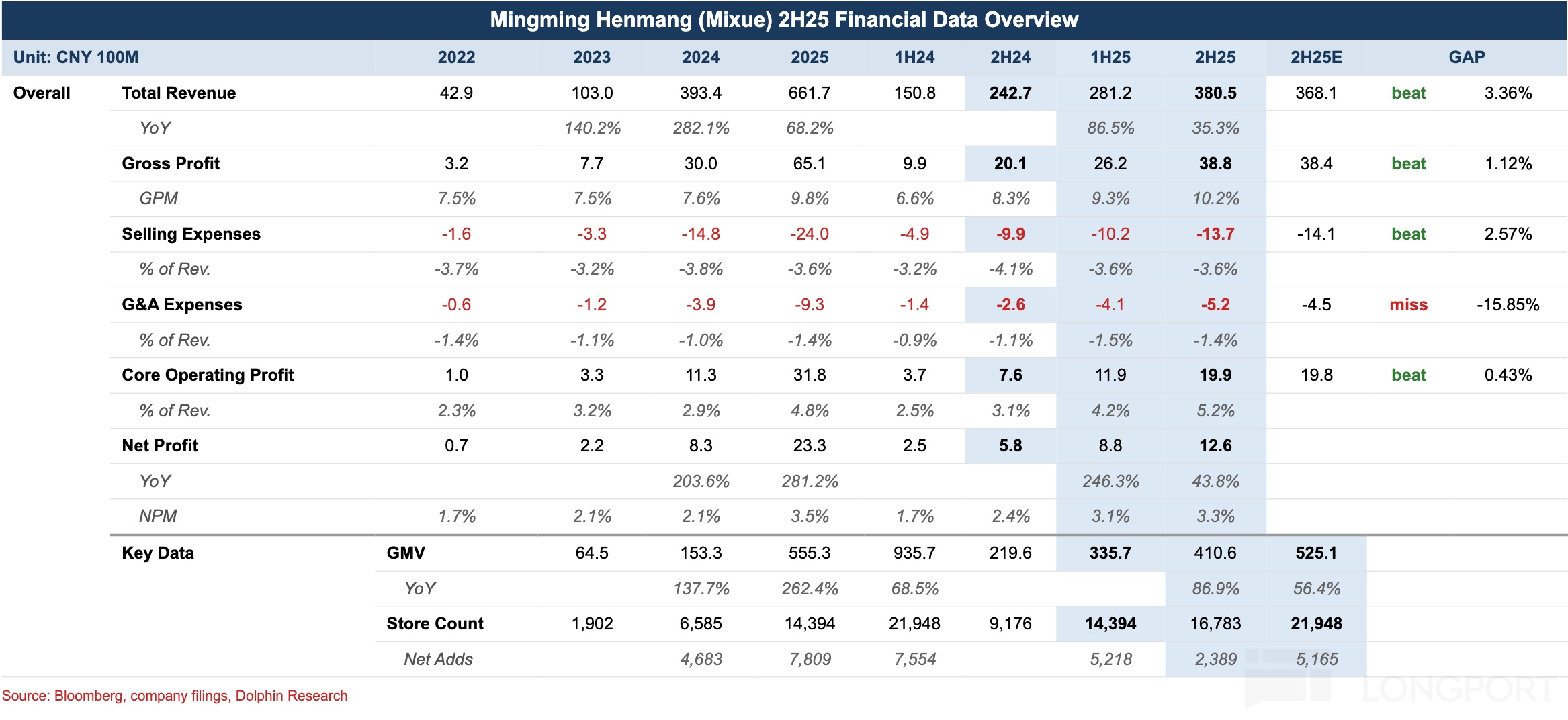
2. Core financials: 2025 GMV RMB 96.1bn (+68% YoY), revenue RMB 66.1bn (+68% YoY), GPM 9.8% (+220bps YoY), net margin 4.1%, net profit RMB 2.69bn. Margin expansion was driven by scale benefits and a sharp drop in competitive subsidies in 2025.
3. Opex structure: Expense ratio remained broadly stable, while absolute spend rose with store expansion and investments in headcount and digitalization. This is not yet a full cost-down phase, and there is still room for optimization.
4. Store economics: Capex per store RMB 0.8–1.0mn, cash payback ~2 years. Avg. store GPM ~19%, rent-to-sales 3–4%, labor 3–4%, utilities 1–2%, store-level EBITDA margin ~8–10 pts. Store profitability in 2025 reached the best level in the company's history.
5. Balance sheet: Management emphasized payables turnover days and other BS metrics. The company adheres to low payable days to boost end-to-end efficiency and maintain the lowest prices online and offline.
II. Earnings Call Details
2.1 Management Remarks
1. Store expansion
a. 7,813 net new stores in 2025, bringing total to 21,927 as of Dec 31, broadly in line with 8,083 openings in 2024.
b. Despite a steep reduction in subsidies, franchisee enthusiasm and store quality did not decline, and store profitability improved meaningfully.
c. The company follows 'open good stores to open more stores', with no hard store-opening KPI.
2. Operations uplift
a. Organizational revamp: set up over a dozen regional subsidiaries to empower frontline teams to resolve local franchisee and store issues more nimbly, while HQ focuses on process, systems, and standardization.
b. Rolled out the 'Protect White Horse' strategy (stock full, stock complete, place right), which should significantly support SSS in H2.
c. More effort will go into store operations going forward.
3. Product strategy
a. Store newness rate has risen notably, adhering to the 'tasty and affordable' principle.
b. Built a product middle platform to enhance supplier collaboration and S&OP.
4. Talent
a. Hired 40–50 top performers from large tech firms in 2025, who have adapted to the company's culture after a year.
b. They are expected to create greater value in 2026.
2.2 Q&A
Q: How do you view competition within the value snack channel and cross-format competition?
A: China is a vast market with many regions and cities, and Mingming Busy is among the few retail formats capable of nationwide coverage. As a pioneer and first mover over the past nine years, we have built ecosystem moats across store count, scale, and operating capabilities.
Industry competition is very clear and stable, leaving little room for new entrants. For example, in Mar, we were able to open stores across dozens of provinces and municipalities, whether in strongholds or highly competitive areas. The market is large enough that since H2 last year we have paid far less attention to competitive moves.
On cross-format competition, only about 20% of our assortment overlaps with other retail formats; 80% is different, so there is essentially no direct competition. Traditional offline retail competes mainly on efficiency and price, while our direction is to enable a happier life and deliver emotional value.
Snacks inherently carry a 'joy' attribute—holiday gatherings, family get-togethers, spring outings, camping, and binge-watching are all core occasions. Shoppers spend an average of ~6 minutes in a 150–200 sqm store, with a strong 'browsing' mindset and no fixed shopping list, seeking abundance and variety, which is fundamentally different from traditional retail's target-driven, quick transactions.
Entry ticket is very low—RMB 10 can buy 5–8 items, even RMB 2 can buy something—hence bigger opportunities in lower-tier markets. More importantly, by changing supply, we have created incremental demand: about 80% is incremental rather than a 20% shift from stock demand. We do not intend to be dragged into traditional retail price wars.
Q: What is the overall approach and key initiatives in digital management and supply chain?
A: With over 10,000 employees, we must use digital tools to solve collaboration at scale; this is not just about efficiency but about making things work. New hires help us avoid detours through better underlying architecture.
On digitalization, first, we decomposed it into centers and modules and set up product-owner-like roles to serve specific functional needs. Second, we build from business scenarios: for instance, we developed an in-house site selection system that digitizes planning end-to-end, tracks site assessments, landlord info, and A-class site recommendations, and uses heat maps to spot new locations. The number of viable locations surfacing from this system alone is already significant.
In project management, we digitized the entire journey from franchising to opening to post-opening management, allowing franchisees to see each store's progress, owners, and overdue items. On operations, we are piloting an AI store-audit system to detect empty shelves, hygiene compliance, and polite language usage, and we have begun AI-enabled checkout. We also completed a comprehensive clean-up of product master data to improve inventory accuracy and turns.
In supply chain, the core is shifting from experience-based ordering to forecast-based ordering, complemented by planning discipline. The whole company now runs on plan-driven operations, which will further improve inventory turns. We are learning from best-in-class retailers and tailoring methods to fit our model.
Q: How do you view medium- to long-term store potential for the company and the sector? What are this year's development strategy and key regions?
A: China is large enough. Geographically, we have stores from Sanya in Hainan to Tibet in the west, from East China to Heilongjiang-Jilin-Liaoning in the north, proving nationwide feasibility. By city tier, we have ~100–200 stores in Shanghai, 300–400 in Guangzhou, 300 in Shenzhen, and stores down to townships—wherever there are people, we can open.
Take Hunan, our earliest market: since 2017, we have ~2,500 stores under a single brand, and 5,000–6,000 including other brands, covering ~50mn people, or roughly one store per 10,000 people. Jiangxi is becoming like Hunan, as are Guangdong and Jiangsu, and even northern provinces are converging, showing the model travels. We roughly estimate market capacity at over 100,000 stores, and we can reach 40,000–50,000 stores in the long term.
By population distribution across city tiers, our store mix matches China's population structure, validating nationwide compatibility.
On this year's strategy, we stick to 'open good stores to open more stores', with no hard KPI. If good stores help franchisees make money, more stores will follow; we are very confident and see no issue opening 5,000 stores in 2026.
Q: Can you share single-store economics including ticket size, transactions per store, GPM, and regional differences?
A: This is a scale-economy business; gross margins correlate with scale, and we expect steady GPM expansion over time. The sector still has ample room for margin improvement.
Store model: RMB 0.8–1.0mn per store investment, ~2-year cash payback. Avg. store GPM ~19%; rent-to-sales 3–4%; labor 3–4%; utilities 1–2%; store-level EBITDA margin ~8–10 pts. Early cohorts paid back faster; ~2 years now is a healthy normalization.
Regional differences are modest. Avg. ticket ~RMB 30, slightly higher in tier-1 cities like Beijing/Shanghai/Shenzhen but with correspondingly higher rents, so gross margin contribution is adjusted. Guangdong has the most stores, with ~600 daily transactions per store and slightly lower tickets, but sales above the national avg.; typical stores do 400–500 transactions per day.
In H1 last year, as store density rose, consumer behavior shifted from stock-up to immediate purchase, increasing frequency while stabilizing tickets at ~RMB 30, which is healthy. We care more about store-level retention than a single-visit ticket. New user M1 and long-term retention have been stable without cliff-like declines, and with ~8,000 openings in 2025, store profitability reached a record high.
Q: Which new categories will you prioritize? What is the plan and cadence for own brands? Any overseas plans?
A: We tested several categories last year, including household chemicals, plush IP, and hot/cold foods. Key takeaways:
We will not pursue household chemicals for four reasons: first, we cannot outcompete incumbents to build sustainable advantage; second, data performance is mediocre and modern trade penetration in China is already high with limited upside; third, it is a traditional retail battleground of price and efficiency; fourth, franchisee margin is low and it does not deliver 'joy'.
Strategic priorities: first, the hot-warm layer—grilled sausages and egg tarts performed especially well after a year of testing and will be systemically rolled out in 2026. Second, cold chain (chilled + frozen): on chilled, consumers are demanding healthier, low-additive, short-shelf-life foods, and we will build daily distribution infrastructure.
For frozen, we will 'snack-ify' frozen SKUs such as Southeast Asian durian and chestnuts. On own brands, 80% of our assortment is already distinct from the market, so we do not need own-brand pricing power. Uniform own-brand design could also hurt the 'browsing abundance' experience.
We also do not want food manufacturers to become OEMs only; we want to give them a showcase window. We will selectively create own-brand items where the market lacks good supply, but this is not a current strategic focus. On overseas, we may explore and observe, but it is not a priority; China is still in the early-to-mid stage with ample growth and massive operational upside.
Q: How did SSS trend last year, and what are this year's SSS drivers?
A: H1 2025 SSS faced challenges due to years of rapid expansion and intense competition in 2024, which diverted attention from store operations, compounded by subsidies and price wars creating a high base. We recognized this in H2 2024 and refocused on capabilities and core operations.
With improvements across operations, newness, and site selection, SSS recovered in Q4. CNY performance was indeed better than in prior years, supported by warmer weather and a longer holiday.
We also took proactive steps: more effective New Year inventory planning, longer operating hours, and helping franchisees pre-order more goods. However, management does not want investors to extrapolate the holiday trend for the full year.
Full-year SSS will improve vs. last year. The levers are not gimmicks but a return to retail basics: fully stocking shelves, ordering what needs to be ordered, placing items in the most appropriate positions, and avoiding DC stockouts.
The hot-warm layer (grilled sausages/egg tarts) will be scaled after a year of research, and cold chain will be a long-term build. The core is to grow store revenue and ensure franchisee profitability.
Q: Can you share closure rate, new vs. existing franchisee profitability, and multi-store penetration?
A: The market remains large and at a relatively early stage, with no new entrants and a long runway for steady growth. From day one, our model enforced a 500m protection radius; whether contracts specify 400m or 500m, we have never cut a single meter.
Hunan and Jiangxi are our densest markets yet also the most profitable, showing that density does not conflict with space. Closure rate last year was just over 1%, a good level, and we aim to do better this year.
Through nationwide digital network planning—down to A-class sites in each county—we are lifting site-selection success rates and reducing closures at the source. Franchisee mix is ~60% existing and ~40% new. Since H2 last year, many who explored other franchise sectors have returned, concluding that demand for Mingming Busy is real and durable—stores opened in 2017 are still operating.
Today's franchisees are highly professional and mature, with better information symmetry to assess formats objectively, which is positive for us.
Q: What are the plans for GPM and opex ratios, and the long-term financial goals?
A: GPM should trend up steadily over time. There is no clear ceiling from a direct comp since we are not a traditional retailer, and we do not intend to push margins up too quickly at the expense of suppliers; margins will climb modestly with natural scale.
On expenses, this is also a scale business without a model that inflates CAC as we grow. In the past two years, high opening density and an immature service infrastructure led us to add many operations staff (~4,000 supervisors nationwide), raising absolute travel and other costs without lifting expense ratio; this is not yet the time for broad cost cuts, and we see room for optimization ahead.
Management recommends shifting focus from the P&L to the balance sheet—watch turnover efficiency and payable days. We keep payable days low to enhance end-to-end efficiency, source supply-chain resources through efficiency gains, and maintain the lowest prices across the web without over-earning.
Q: What is the franchisee profile and admission criteria, and how do you empower and manage franchisees?
A: Franchisee profile evolves by stage: early on, we preferred compliant newcomers; during the land-grab, we wanted all-terrain operators with expansion spirit and risk resilience. Now criteria are higher: first, stronger cultural alignment; second, higher operating capability; third, long-termism over six-month payback. Admission thresholds will rise in 2025–2026.
On enablement, first, we are landing standardized systems. The 'Protect White Horse' (stock full), 'Department Store' (stock complete—ensure all 2,000 SKUs are on shelf), and upcoming 'place right' (best sellers on the first tier) are being rolled out through regional subsidiaries.
Second, digital infrastructure: fix inaccurate inventory that prevents auto-replenishment recommendations. With very rich SKUs, franchisees currently spend ~2 hours daily on manual orders; system upgrades will boost efficiency materially.
Third, category enablement: HQ funds all infrastructure for hot and cold categories (subsidies and capex), without requiring franchisee retrofits. We prioritize long-term store competitiveness over short-term gains.
Fourth, the '10k Store Revamp' program: for older stores opened 3–4 years ago, we intervene to fix layout issues and optimize operations down to lighting and shelving, implemented via the regional subsidiary system.
Q: What are the consumer profile and membership operations? How are repeat rates and new member retention?
A: As of Dec 31, 2025, members reached ~210mn (vs. ~120mn at end-2024), with substantial growth yet still far from 400–500mn seen at other franchise chains. This underscores our model's broad appeal—almost anyone walking into a store can buy something, yielding a very large addressable base.
Repeat purchase rate is ~76%. Month-1 and long-term retention are ~40–50%, with no sharp declines over time and surprisingly strong vs. e-commerce benchmarks.
Member ticket is 70–80% higher than non-member, showing significant upside when membership operations are done right. Management acknowledges membership ops are not yet robust, with stores being the only touchpoint; we will invest more in 2026–2027 to add touchpoints, build brand affinity, and deliver emotional joy beyond products to cement user mindshare.
<End of text>
Risk Disclosure & Statement:Dolphin Research Disclaimer & General Disclosures
