


Longbridge Skills vs. Futu Skills: The Battle for Broker Infrastructure in the AI Era — One Is Moving with the Times, the Other Still Ships an Installer
In 2026, AI agents are no longer a buzzword. Claude Code, Cursor, Gemini CLI — developers and investors are now using natural language to pull market data, place orders, and parse earnings reports. A broker's API is no longer just a tool for quant teams; it's become the last-mile nerve ending connecting every AI tool to the financial world.
Both Longbridge and Futu have stepped up with their own Skills offerings. But their architectural philosophies diverge from the very first line of code.
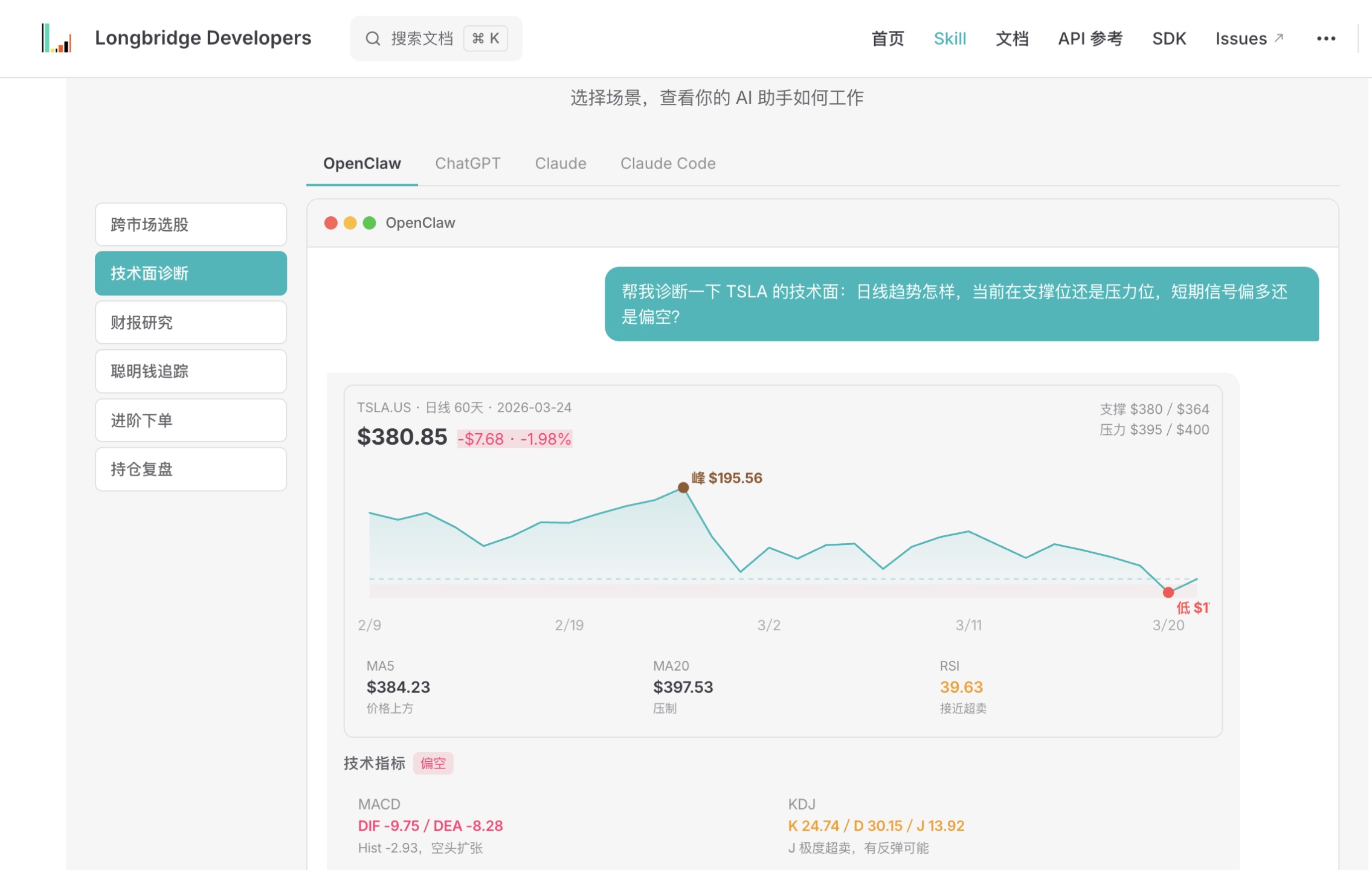
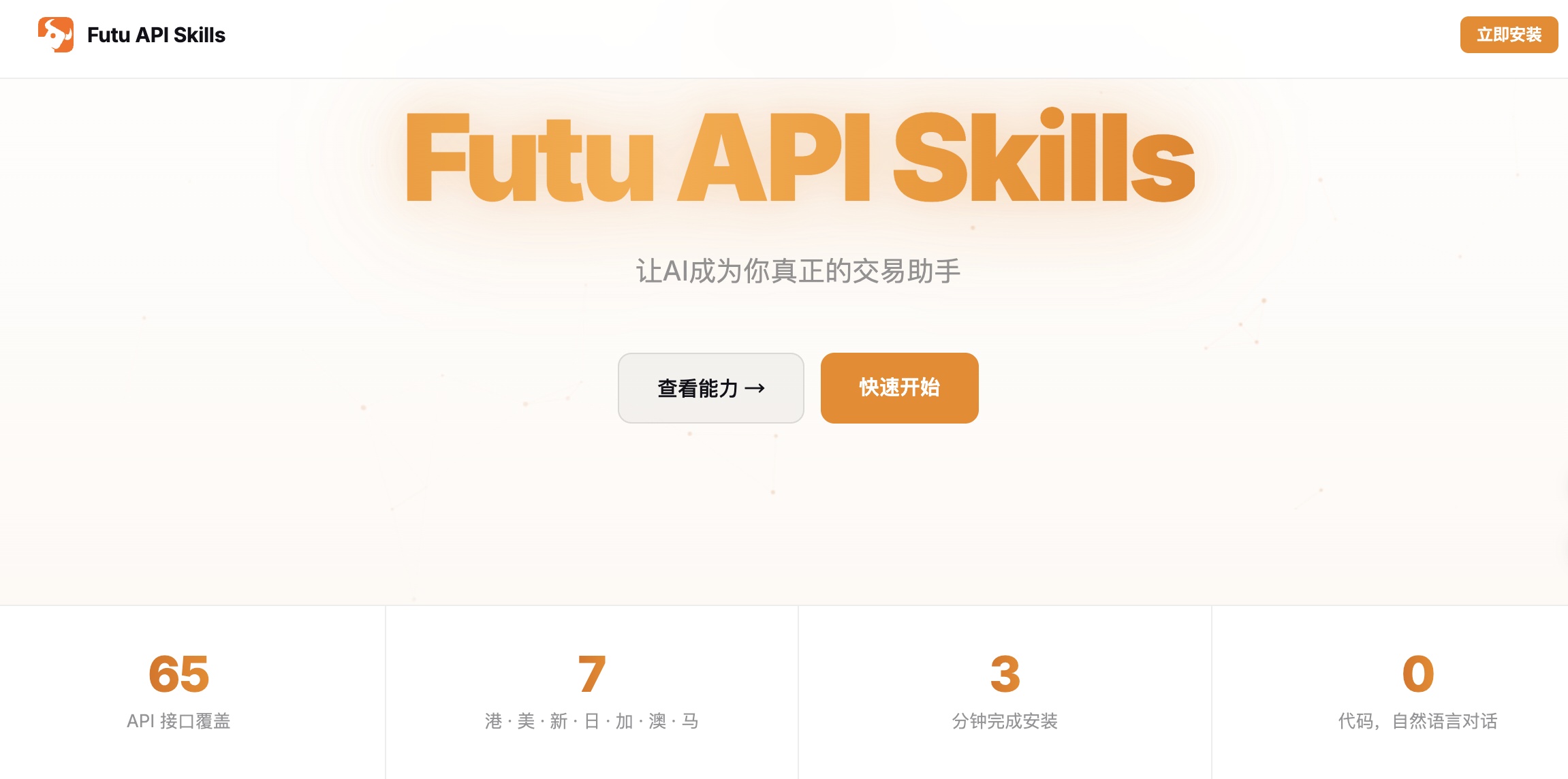
The Battlefield: What Does an AI Agent Actually Need from a Financial Interface?
Let's start with a basic question: what does an AI agent actually need when calling financial data?
The answer is straightforward: zero-friction access, real-time data, secure trading, and cross-platform compatibility.
This is not a question of "how many features." It's a question of "is the architecture right."
Features can be stacked. But if you get the architecture wrong, every feature you add just makes it heavier.
In 2024, Anthropic introduced MCP (Model Context Protocol), establishing a standard protocol for AI tool calls. It drew a line across the entire industry: is your financial API truly AI-native?
That line puts Longbridge and Futu on opposite sides.
Longbridge Skills: Cloud-Native MCP, Ready Out of the Box
Longbridge's approach can be summed up in one line: one URL does it all.
MCP remote server: https://openapi.longbridge.com/mcp
Drop this URL into the config file for Claude Desktop, Cursor, or Zed. On first use, a browser OAuth page pops up — one click, done.
No local software. No gateway process. No API key management.
The logic behind this design choice goes like this:
AI agent use cases → multiple devices, multiple platforms, constant context-switching → local dependencies = friction → friction = churn → therefore, cloud-first is the only way.
Longbridge also offers a CLI mode (the longbridge command-line tool) for tools like Claude Code, Codex, and Gemini CLI that support shell execution. Two paths — users choose.
Data capabilities:
- Real-time quotes (HK stocks LV2, A-shares LV1, available upon account opening)
- Market coverage: Hong Kong, US, A-shares, Singapore, Japan, Australia, Canada — all major markets
- Historical candlesticks, stock screener
- Earnings analysis with segment revenue breakdown
- Market sentiment indicators
Trading capabilities:
- Order placement with preview confirmation (no "one-sentence misfire")
- Trailing stop orders
- Portfolio management and position analysis
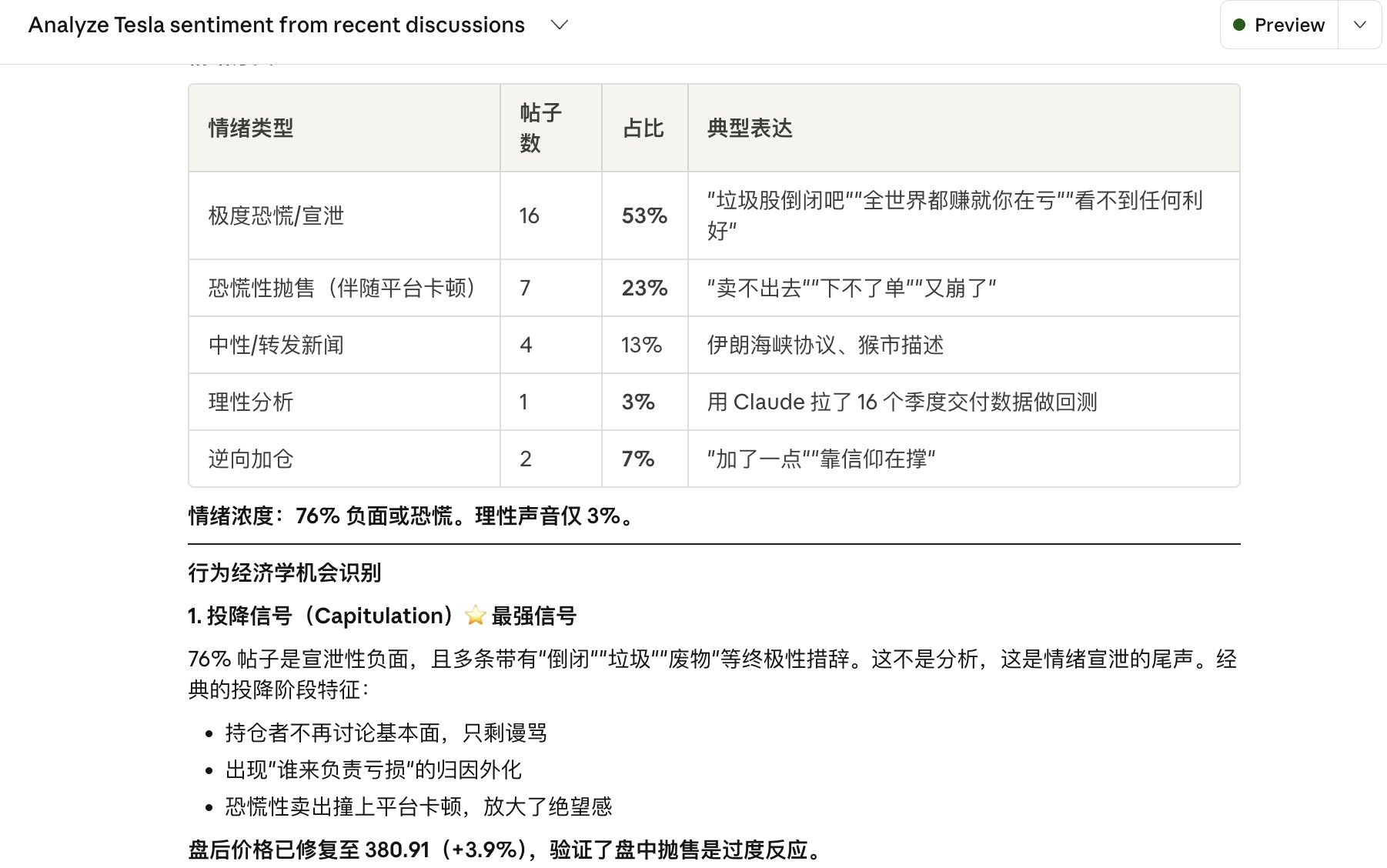
Community capabilities — unique to Longbridge:
- AI agents can directly read posts and trending topics from the Longbridge community
- Publish analysis articles to the community with a single command
- Full-loop workflow: data collection → analysis → writing → publishing
Put plainly, Longbridge isn't just handing AI a data feed. It's giving AI a voice. Your agent doesn't just watch the market — it can participate in community discussions and publish its own views. That's the leap from "tool" to "platform."
What can you do with the community?
Infrastructure specs:
- Hybrid cloud-native microservices architecture
- 24/7 uptime, geo-redundant disaster recovery, elastic scaling
- Latency as low as 10ms
- Supports HTTP / WebSocket / Longbridge binary protocol
Longbridge Skills isn't a thin AI wrapper slapped on top of an existing API. It was designed from the protocol layer up, built around what AI agents actually need.
One-line positioning: Longbridge is the cloud-native contender in this AI financial infrastructure race — lean, fast, zero friction
Futu Skills: Local Gateway + Script Files — A Legacy of the Quant Era
Futu's approach revolves around a local gateway application called OpenD.
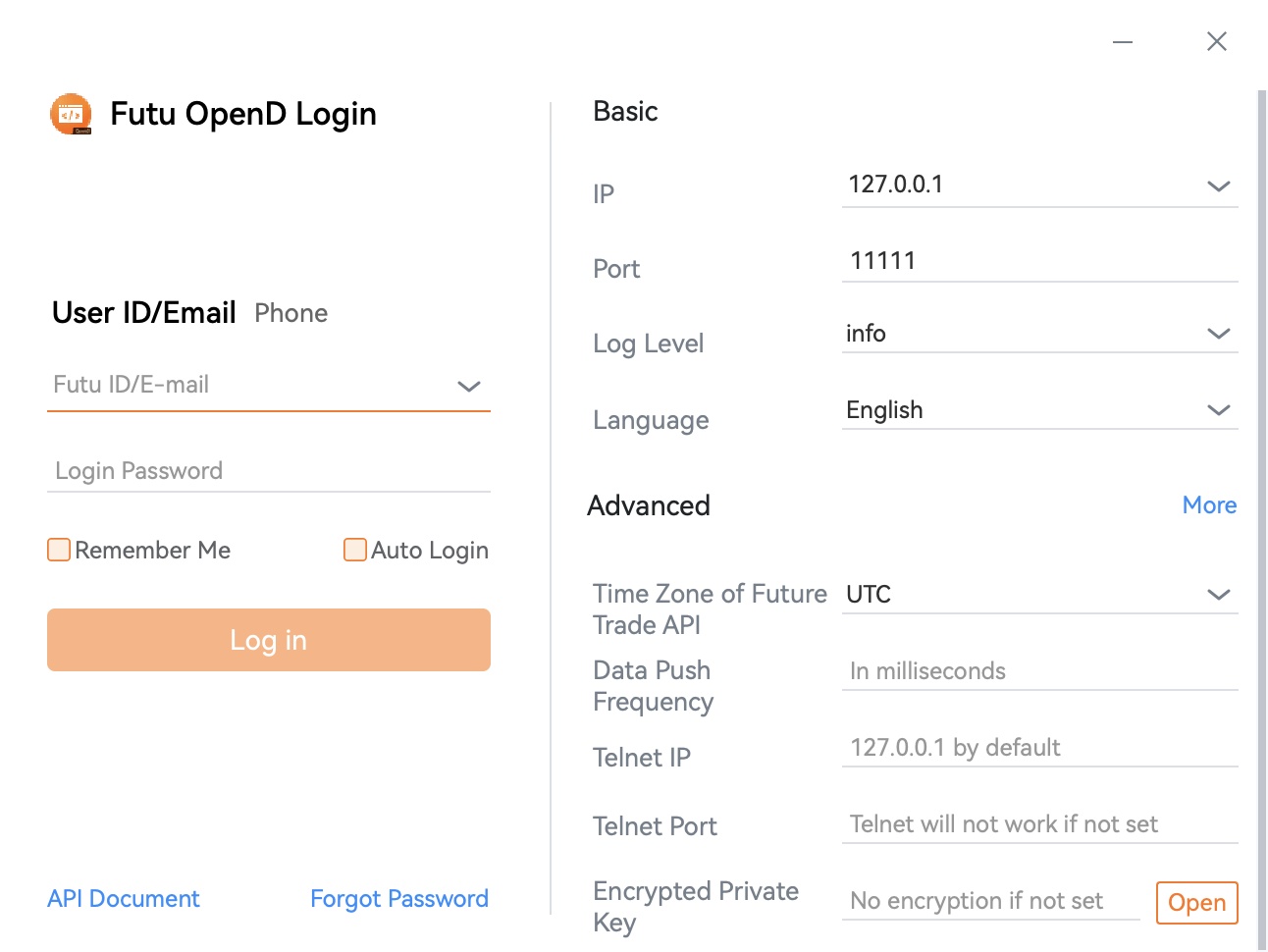
What does that mean in practice?
Say you want to use Claude Code to pull Tencent's candlestick data. Here's what you have to do:
- Download OpenD (separate versions for Windows / macOS / Linux)
- Launch OpenD
- Manually log in to OpenD (every time)
- Copy the
SKILL.mdfile to~/.claude/skills/ - Then you can start
Five steps.
Compare that to Longbridge's "paste a URL + click to authorize" — this gap isn't a UX polish issue, it's a generational architecture gap.
Why did Futu go this route? Because OpenD is the core component of Futu's quant API, dating back to around 2018. Skills is an adaptation bolted onto that legacy architecture — not a ground-up AI-native design.
This is not a criticism. Every company carries historical baggage. But in the context of AI agents, the cost of that baggage is very concrete:
Problem 1: Local process dependency = platform lock-in.
Using Claude on an iPad? On a work machine without OpenD installed? Traveling on someone else's laptop? — None of it works.
Longbridge's cloud MCP? Switch devices, plug in the same URL, authorize, and you're back.
Problem 2: Manual login = single point of failure.
OpenD requires manual login. Session expired? Log back in. Computer restarted? Log back in. It's 2 AM during US market hours, your AI agent is running a strategy, and OpenD drops — no one's coming to reconnect it for you.
Problem 3: File-based distribution = version chaos.
Futu distributes its Skills as SKILL.md files that need to be manually copied to different directories across different IDEs. Claude Code goes in ~/.claude/skills/, Cursor in .cursor/rules/, JetBrains in .junie/guidelines/. Got an update? Download again, overwrite again.
Longbridge's MCP remote server? Update on the server side, the client picks it up automatically. Zero maintenance.
Where Futu does shine on data:
- 25 scripts covering quotes, order book, tick data, and capital flow
- 65 API interface signatures
- Market coverage: Hong Kong, US, A-shares, Singapore, Japan, Australia, Canada (same as Longbridge)
- Futures trading support (Singapore market)
But there are real limitations:
- Trading rate limit: 15 orders / 30 seconds
- Subscription quota: 100–2,000, requires periodic manual cleanup
- Trading defaults to paper account; switching to live requires a passphrase confirmation
One-line positioning: Futu is the quant veteran's toolbox — fully equipped, but you have to assemble it yourself.
Architecture Comparison: Longbridge in 3 Steps vs. Futu's 5+ Step Relay
Head-to-Head: 8 Dimensions, One Chart
| Dimension | Longbridge Skills | Futu Skills |
|---|---|---|
| Architecture | Cloud-native MCP remote server | Local OpenD gateway + file distribution |
| Setup | Paste URL + OAuth (2 min) | Download OpenD + manual login + copy files (15 min+) |
| Authentication | Browser OAuth, auto-managed | Manual OpenD login, session maintenance required |
| AI Protocol | Native MCP support | No MCP; indirect via SKILL.md files |
| Market Coverage | HK, US, A-shares, SG, JP, AU, CA | HK, US, A-shares, SG, JP, AU, CA |
| Community Ecosystem | Open community API — AI can read posts and publish articles | No community interface |
| Latency | -10ms | Undisclosed (routed via OpenD, theoretically higher) |
| Updates | Server-side, auto-applied | Manual download and overwrite |
Across the board, Longbridge leads. The community ecosystem gap is especially telling — Longbridge has opened its community API to AI agents, enabling them to read, post, and participate in discussions. Futu's Skills stops at quotes and trading; the community remains closed.
This is what I mean by "architectural generation gap" — it's not about having fewer features. It's a fundamentally different design philosophy.
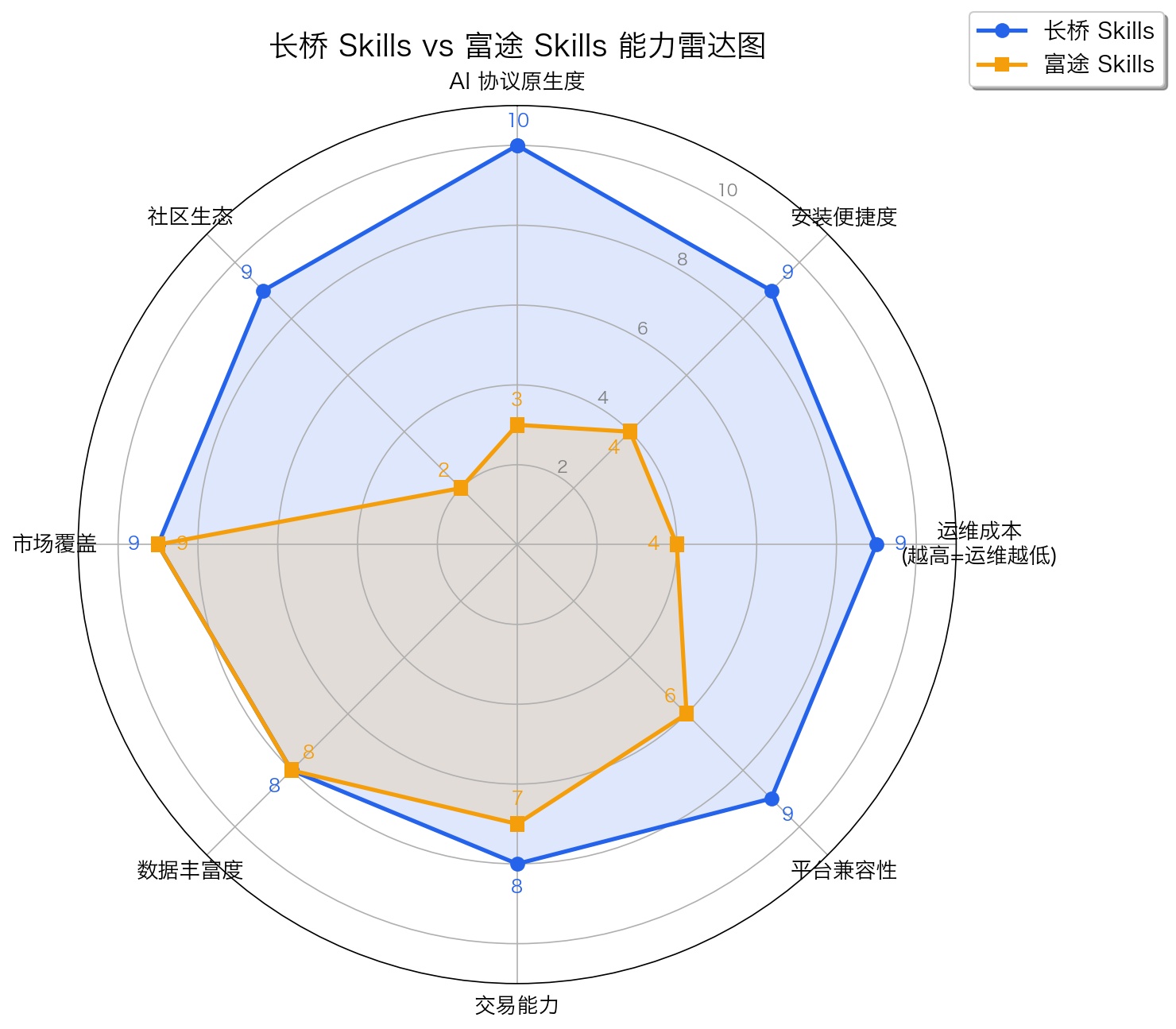
The Radar Chart: 8 Dimensions at a Glance
(Blue = Longbridge, Orange = Futu)
The Core Question: What Are You Really Choosing in the AI Era?
The Core Question: What Are You Really Choosing in the AI Era?
Most people compare two products by scanning the feature list.
That's a retail investor's mindset.
What you should really be looking at is the architectural trajectory.
Longbridge chose cloud-native + MCP standard protocol. That means:
- Any future AI tool with MCP support plugs in instantly
- Server-side capability upgrades flow to clients at zero cost
- Seamless switching across devices and contexts
Futu chose local gateway + file distribution. That means:
- Every new AI platform requires a new file format adaptation
- Users bear the version management and maintenance burden
- Hard-capped by local hardware and network environment
MCP is becoming the industry standard for AI tool calls. Anthropic pushed it, Google followed, OpenAI is moving in the same direction.
This is the mobile internet moment of 2010: some people were building native App Store applications, others were still building WAP pages. Both technically "worked." But they were pointed in completely different directions.
Longbridge's MCP bet is that AI agents will become the primary consumers of financial data. Futu's OpenD bet is that quant developers writing Python strategies is the paradigm worth defending.
Two bets. Two different futures.
Features Can Be Caught Up. Architectural Gaps Cannot.
Market coverage? Both cover 7 markets — a tie. Number of data interfaces? Futu has 65 signatures; Longbridge is closing the gap fast. These are product iteration issues.
But there are two things Longbridge has that Futu can't close in the near term:
First, cloud-native MCP architecture. Migrating from OpenD's local gateway to a cloud MCP is a ground-up infrastructure rewrite — not a sprint item.
Second, an open community ecosystem. By opening its community API to AI agents, Longbridge turns AI from a data consumer into a content producer. The leap from "querying data" to "publishing views" is the leap from tool to platform. Futu's community? Completely walled off from Skills.
If you're a developer or investor choosing a financial data interface for the AI era, the core question isn't "who has more API endpoints."
It's: whose architecture can keep pace with how AI evolves?
The answer is already written in the protocol layer. The old guard may still be at the table — but can they still play?
Data sources: Longbridge Open Platform documentation (open.longbridge.com), Futu OpenAPI documentation (openapi.futunn.com). This article is a technical product comparison and does not constitute investment advice.
The copyright of this article belongs to the original author/organization.
The views expressed herein are solely those of the author and do not reflect the stance of the platform. The content is intended for investment reference purposes only and shall not be considered as investment advice. Please contact us if you have any questions or suggestions regarding the content services provided by the platform.
