


See if we can find it

🚀If SpaceX's IPO materializes, this is not just "a company going public", but the beginning of the entire space industry chain being repriced.
What's truly worth watching is not SpaceX itself, but the entire "shadow beneficiary chain" it brings forth.
If you missed out on
$Rocket Lab(RKLB.US)
$AST SpaceMobile(ASTS.US)
back then, this time, the structure is much clearer than before.
First, my own judgment:
Once SpaceX IPOs, it's not just a financing event, but a "validation event".
The market will reconfirm one thing:
The space economy is no longer a story, but an industry that is scaling and landing.
And once this consensus forms, capital won't just flow to SpaceX.
It will diffuse across the entire ecosystem.
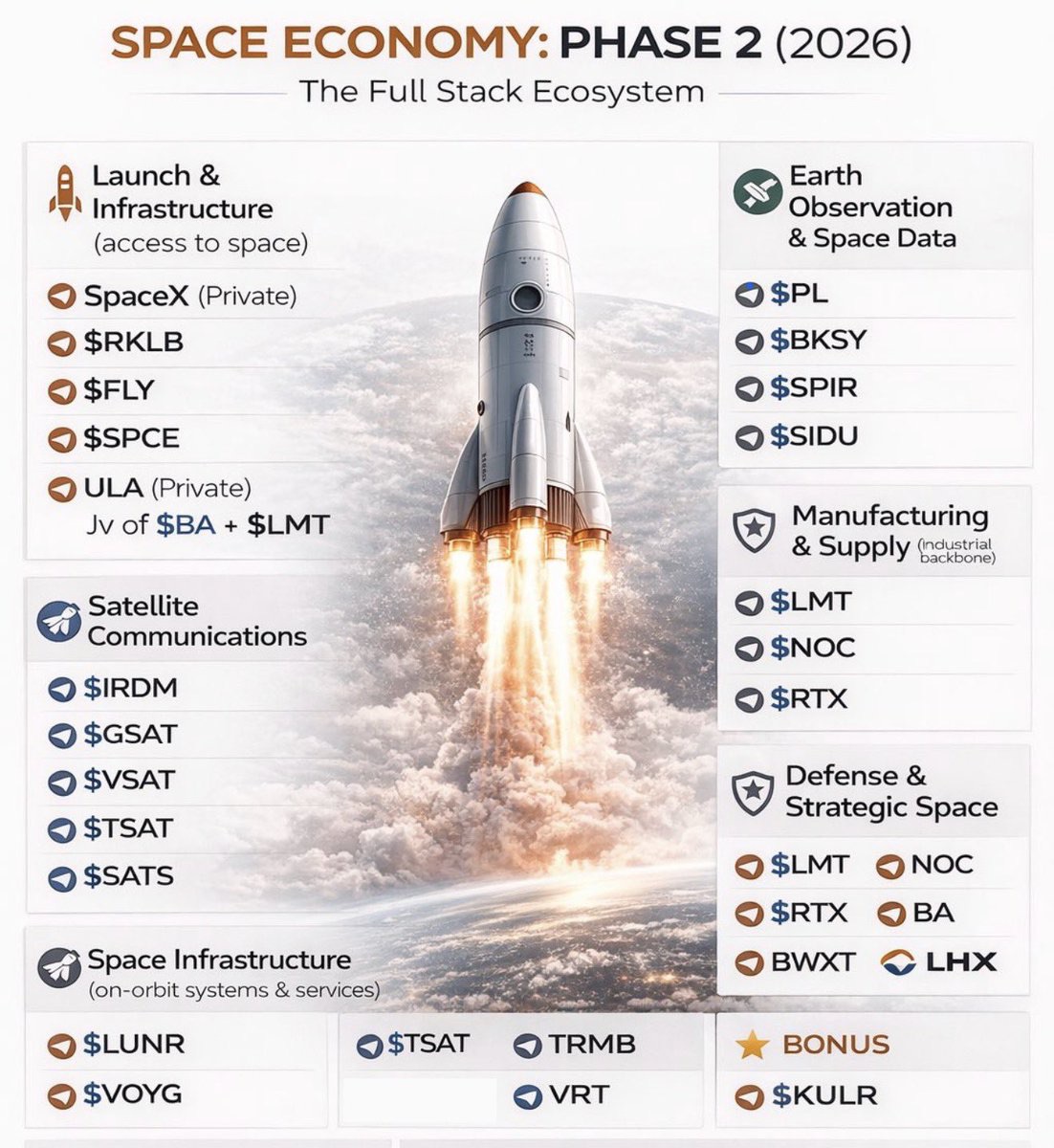
First layer: The most direct beneficiaries — Launch capability.
$Rocket Lab(RKLB.US)
$Firefly Aerospace(FLY.US)
This layer is "SpaceX's counterparts + alternatives + fillers".
When the market starts giving SpaceX a higher valuation, these companies will be re-evaluated for comparison.
History has already validated this once:
The surge in $Rocket Lab(RKLB.US) was essentially "the market using it as an analogy for SpaceX".
Second layer: The most certain demand — Satellite communications.
$AST SpaceMobile(ASTS.US)
$Iridium Comm(IRDM.US)
$Globalstar(GSAT.US)
$ViaSat(VSAT.US)
$Telesat(TSAT.US)
$Echostar(SATS.US)
The logic here is simple:
SpaceX builds the "infrastructure",
these companies handle the "monetization of traffic".
Especially $AST SpaceMobile(ASTS.US), which essentially connects phones directly to satellites.
If Starlink proves the business model, this layer will be repriced.
Third layer: Data layer — The real long-term value.
$Planet Labs(PL.US)
$BlackSky Tech(BKSY.US)
$Spire Global(SPIR.US)
Many overlook this layer, but I think it's the most likely to be underestimated.
In the future, the real money might not be in launching, but in:
who is using this satellite data to make money.
Agriculture, climate, defense, energy — these are all long-term needs.
Fourth layer: Orbital infrastructure — The core of the next phase.
$Intuitive Machines(LUNR.US)
$Voyager Tech(VOYG.US)
$Redwire(RDW.US)
If the current phase is "getting stuff up there",
then the next step is:
how to operate, maintain, and provide services in space long-term.
This is the second phase of the Space Economy.
Fifth layer: Traditional defense — The most stable capital recipients.
$Lockheed Martin(LMT.US)
$Northrop Grumman(NOC.US)
$RTX(RTX.US)
$Boeing(BA.US)
$BWX Tech(BWXT.US)
$L3Harris Tech(LHX.US)
$Teledyne Tech(TDY.US)
$Honeywell(HON.US)
Many only watch the new companies, but the real big money often flows here first.
Because they have:
Orders.
Cash flow.
Backing from defense budgets.
When a theme heats up, this layer is usually "the first to rise and the most stable".
Finally, some more volatile targets:
$KULR Tech(KULR.US)
$Sidus Space(SIDU.US)
This category often explodes when sentiment is strongest, but also has the highest volatility.
My own thinking is actually very simple:
If a SpaceX IPO really happens, it's not about choosing "which company",
but about choosing "which layer you stand on".
Are you more bullish on:
The revaluation of the launch segment,
or the commercial explosion of communications,
or the long-term compounding of the data layer,
or would you rather take the most stable defense stocks to ride this wave of capital rotation?
The copyright of this article belongs to the original author/organization.
The views expressed herein are solely those of the author and do not reflect the stance of the platform. The content is intended for investment reference purposes only and shall not be considered as investment advice. Please contact us if you have any questions or suggestions regarding the content services provided by the platform.
