


SPOT (Trans): User retention steady after price hikes; GPM affected by new investment
Dolphin Research's recap of $Spotify(SPOT.US) FY26 Q1 earnings call. For our take, see 'Spotify: Sell-off on expectations gap; streaming is yesterday's love.'
I. Key takeaways
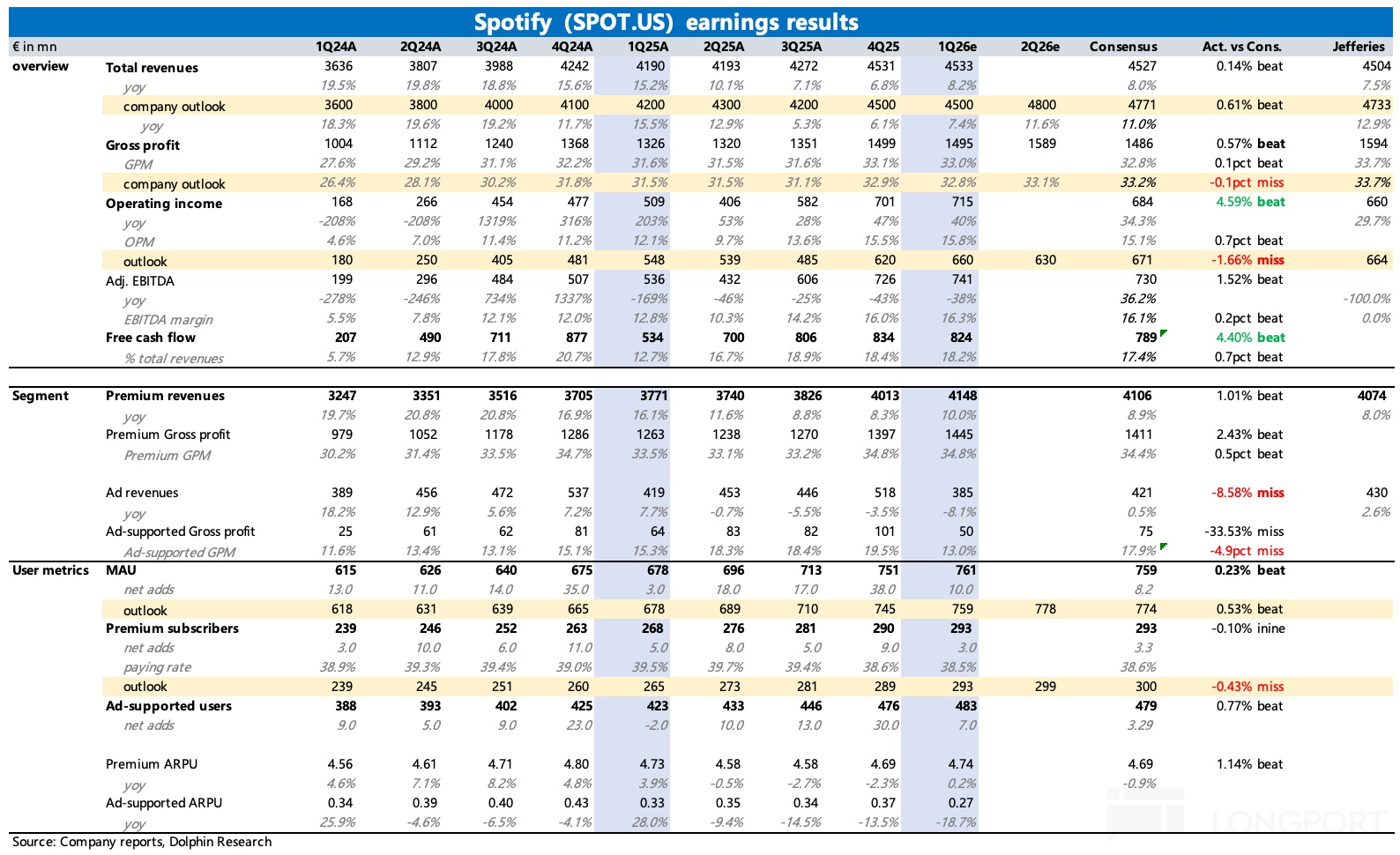
1. Shareholder returns: Repurchased $361 mn of shares in Q1, continuing to offset SBC dilution via buybacks. Repaid the $1.5 bn convertible at maturity in cash with no new equity issued.Cash and equivalents were $8.8 bn at quarter-end, with no debt excluding lease liabilities.
2. Outlook: Q2 revenue of approx. $4.8 bn (+15% YoY), MAU of 778 mn, Premium subs of 299 mn (+6 mn net adds), GPM of 33.1% (+160 bps YoY), and OP of $630 mn. ARPU to grow 7–7.5% YoY.Full-year GPM and OPM are expected to improve YoY, and FCF to post meaningful YoY growth.
3. Q1 highlights: Revenue of $4.5 bn (+14% YoY, accelerating vs. +13% in Q4). Premium revenue +15% YoY, ARPU +5.7% YoY, and Ad revenue +3% YoY.GPM was 33% (+133 bps YoY), beating guidance by ~20 bps. OP was $750 mn, beating by ~$55 mn, with ~$49 mn tailwind from stock-price-driven payroll tax.FCF was $824 mn.
4. Opex outlook: Opex will run slightly elevated over the next 1–2 quarters due to AI investments (compute, not headcount) and new feature marketing. Full-year OPM still seen improving YoY.
5. Accounting update: Minor segment reclass for non-Ad activities this quarter, moving some revenue and GP from Ad-Supported to Premium (Q1 last year baseline: €12 mn revenue, €7 mn GP).
II. Call details
2.1 Management remarks
1. User growth and retention
a. MAU reached 761 mn, beating guidance by 2 mn, up 12% YoY vs. +11% in Q4. Growth was driven by Rest of World and N. America, helped by the three-tier paid framework.
b. Premium subs net adds were 3 mn to 293 mn, in line with guide. U.S. churn after the Jan price increase tracked as expected.
c. Three key retention drivers: more active days per month, more devices/touchpoints, and more content formats. AI is lifting all three.
d. Following the global rollout of the new personalized Free tier, monthly usage days and views rose in core markets like the U.S.
2. Content and creator ecosystem
a. Over $11 bn to rights holders in 2025, a record, with growth outpacing the industry.
b. Launched Song DNA and About the Song to surface the creative backstory of tracks.
c. Partnered with Bad Bunny for his Asia debut in Tokyo with a global livestream, showcasing cultural amplification.
d. Rolled out Fitness Hub, aggregating Peloton premium content and creators like Yoga with Kassandra and Chloe Ting. Premium users get an ad-free experience, and 70% of them engage in exercise monthly, with 150 mn+ fitness playlists already created.
3. AI and product innovation
a. AI DJ has been used by 94 mn Premium users, driving billions of hours of engagement.
b. Song DNA reached 52 mn users within four weeks of launch.
c. Taste Profile (test): lets users view and directly edit Spotify’s personalization model preferences.
d. Prompt to Playlist expanded materially, enabling NL-generated playlists across music and podcasts.
e. Social feature Jam chat usage doubled YoY, with monthly listening time exceeding 100 mn hours.
f. Training an in-house Large Personalization Model ('taste model'), fine-tuned from open-source and powered by proprietary data, creating a unique moat.
g. AI is shifting the platform from passive recommendations to active user interaction. This means moving from single-user to multi-user modes and from static to adaptive experiences.
4. Advertising
a. Biddable now exceeds one-third of Ad revenue and is scaling fast. Active advertiser counts are rising.
b. The end-to-end rebuild of the ad tech stack is complete, creating near-term pressure but unlocking a larger TAM.
c. Traditional direct channels remain choppy. Management expects Ad growth to improve in H2.
5. Strategy
a. On the 20th anniversary, Investor Day will be held in NYC on May 21 to outline the next leg of growth.
b. Headcount broadly flat (net -65 in Q1), with AI driving higher output per employee, and development efficiency metrics (pull requests, completed definitions, etc.) roughly doubling.
c. Testing the 'Good/Better/Best' three-tier value framework in multiple markets, with early signs of structural ARPU uplift.
2.2 Q&A
Q: Q1 saw higher spend on marketing, cloud, and AI. How should we think about the investment cadence for the year and what defines success?
A: We did not add headcount; it actually declined slightly, but compute per employee increased. That is because the productivity payoff is large.We flagged faster product velocity last fall, and it is only accelerating. We are simply shipping more and earning solid returns, but to realize those returns, we must make users aware of new features, which drives higher marketing spend.
I often compare this to the 2009 iPhone/App Store moment. I was at Spotify then, and it was a massive opening.Some companies waited; Spotify did not. We seized the moment and sharply accelerated Premium conversion and Free user growth.
We believe today’s opportunity is at least as big, if not bigger, and we are leaning in. But we are highly prudent and disciplined in investing. DJ is nearing 100 mn users, and Song DNA reached 52 mn in just four weeks.Feature traction and ROI are tracking as hoped. Usage is a strong proxy for retention, and retention is a strong proxy for long-term revenue.
Q: After heavy ad tech investment in 2025 and absorbing changes from Premium podcast ads, Ad growth is still slowing. Why hasn’t higher engagement translated to faster Ad revenue?
A: The Ad biz has been making steady progress. About 18–24 months ago, we saw a gap: we had missed the wave of programmatic, automated selling, and biddable exchanges.We made the tough call to rebuild the entire stack. That created near-term pressure but opens a far larger market. The transition is now done; the focus is execution and patience.
The core thesis is that gaps between high-quality time spent on Spotify and monetization eventually close. This holds at the category level and within the company.It is primarily a matter of time.
The rebuilt stack enables things we could not do before, and our measurement/effectiveness data underscores the brand value of Spotify. Advertisers come to us for three reasons: a popular brand they want to associate with, high engagement, and quality content.
Q: Premium GPM was very strong in Q1, even with only one month of U.S. pricing. What drove the beat, and how should we read the Q2 GPM guide with investment factors?
A: We are pleased with GPM progress, not just this quarter but over the past three years. The foundation is a healthy core biz across music, podcasts, and audiobooks.Over the last 3–4 years, we built the muscle to reinvest with discipline, using COGS and GPM to balance growth investments with margin expansion. Our track record shows a good balance.
On Q2 GPM: Q1 expanded +133 bps YoY, and Q2 is guided +160 bps YoY. There is no sequential expansion in Q2, similar to last year, and we have said quarterly volatility is normal as we invest when we see opportunities.We are improving for the year as a whole, with both Q1 and Q2 up YoY and the full year up too. Some smaller Q2 investments relate to items you will see today, at Investor Day, or later. We evaluate these every week on our bets board with rigor.
Q: Updates on AI enabling new content creation and derivative works from existing music? What are the main hurdles, and any impact on cost structure or margins?
A: Generative music splits into two things. First, net-new music, which is already scaling fast and broadening catalogs, a net positive for an aggregator because it makes recommendations more critical.When I joined in 2008, there were ~2 mn tracks; now ~250 mn. Catalog growth is not new.
We think the unique opportunity is that existing creators are largely excluded from AI today. Many make new music with AI, but artists cannot participate due to complex rights issues and attribution.We like hard problems and want to solve this, bringing derivative creation opportunities to existing creators. We have the capabilities and tech, and we are the right company to tackle it.
Q: Many companies trade off headcount vs. rising AI costs. How does Spotify manage this, and how do you measure productivity?
A: We are seeing major productivity gains. You can turn that into cost savings and layoffs, keep headcount flat and ship more, or invest heavily because the opportunity is large.We are taking the middle path: broadly stable headcount, doing more, and delivering more value to users.
For measurement, there are several proxies: on the tech side, pull requests and code output. More importantly, we track what we actually ship using DODs (definitions of done) per feature.These metrics are doubling, not growing 10%. We are now seeing launches convert into usage, like Song DNA and DJ. Usage predicts retention, and retention predicts revenue. We monetize through three levers: the Free tier for reach, subscription bundles, and paid add-ons like audiobooks, giving us confidence.
For context, we reorganized a few years ago and have not added headcount since. We have managed headcount with discipline for three straight years, with net -65 last quarter.
Q: Spotify is integrated into ChatGPT and Claude. What traffic patterns are you seeing, how do users engage via AI apps, and what is the impact on MAU and time spent?
A: Think about this through our three pillars: freemium, personalization, and ubiquity. This is an extension of ubiquity: unlike competitors who prefer closed ecosystems, we show up wherever users are, including ChatGPT and Claude.We rigorously track usage, engagement, and cost, and the data is in line with expectations.
More deeply, for the first time we are getting natural-language signals about user intent. Traditional ML used clicks and plays; now users tell us they are going for a run and want certain BPM and tempo.We are building a unique edge by training on this unprecedented dataset. Our in-house 'taste model' is built on open-source but trained with proprietary data. It is not rented; it is built in-house.
Why does this matter? Taste is not a fact but an opinion. It varies by person, market, and context, and it changes weekly.This is exactly what we see in Prompt to Playlist and AI DJ, which provides a new class of data we never had before.
Alex adds: personalization is the No.1 reason for more engagement on Spotify. If AI boosts engagement, it usually means better personalization.Higher personalization and engagement are the best leading indicators of retention, which drives LTV and ultimately enterprise value. That is our investment logic.
Q: Which platforms and product initiatives are driving opex higher, and how should investors think about OPM ahead?
A: Opex is up due to a mix of compute and marketing, not headcount. Compute has several angles: we leverage tools like Cloud Code and Codex to speed development, while building our own systems.We are training larger in-house models because we have unique data, for example the large personalization model, which you cannot buy or rent. You need 700 mn+ users’ daily behavior to know what is trending in an Indian region today.
Some costs are training (front-loaded before monetization), and some are direct productivity investments.Once features prove PMF, we can scale them with compelling marketing stories, hence higher marketing spend. Opex will run slightly above current levels for the next two quarters, but we reiterate full-year OPM improvement YoY.
Q: How do you evaluate the higher cost of the new Free tier versus conversion and LTV? How does performance compare with the Sept launch expectations?
A: I focus on the number of days per month a user engages with Spotify. I prefer more days per month over many hours per day; we call this the lifeline of the system.Since the enhanced Free tier launched, we have seen a sustained increase in monthly active days among Free users.
We had a steady uptrend through 2021–2023, but the global rollout created a step-up, showing users prefer the new Free experience. This should flow through to more conversion and higher LTV downstream.It has frankly exceeded my expectations.
Christian adds: you may have noticed a rare YoY dip in Ad GPM this quarter, as higher engagement temporarily raised content costs faster than Ad revenue. The positive is that we can monetize that engagement over the coming quarters.This is a short-term issue and a future tailwind.
Q: Fitness content will lift video engagement, especially on TV screens. What is the impact on video ads, and what are the cost implications for Premium?
A: View the fitness rollout as doubling down on an organic trend already happening on-platform, similar to podcasts and audiobooks. Data shows 70% of Premium users exercise monthly, with hundreds of millions of playlists created for yoga and gym.About 18 months after we launched SPP (ad-free video for Premium), many trainers started uploading fitness videos to Spotify.
Our platform connects creators and users, and we bridge supply and demand via three engines: ads, subscriptions, and paid add-ons.Fitness is scaling within this framework.
Q: Any unusual reactions to recent price increases? What are the tools to further lift ARPU?
A: We raised prices globally in Q4 last year and in the U.S. this quarter, with nothing unusual observed.On ARPU levers: as engagement rises and verticals broaden, we can monetize on top. The paid add-on model in audiobooks has already proven it can drive incremental subscription monetization, and we will keep exploring similar models.
Gustav adds a useful framework: usage in consumer products follows a power-law, not an average. There is a long tail of light users and a small head of heavy users.Free captures the tail, Premium captures the middle, but before audiobooks as an add-on, we lacked a tool for the head—users consuming hundreds of hours a month. We long hypothesized we could cover the entire power curve, and we have now proven it.With three tools in place, the path is to grow usage and monetize across all three.
Q: Does Spotify believe in a paid AI music creation tier? If so, what are the sticking points with partners, and how would you price it for Premium users?
A: We see a big opportunity in AI tools for creators, but the unsolved piece is existing artists. They should not be excluded from AI, which is arguably the most interesting part of music.In other industries, existing IP is the most valuable. But the way AI music works today, that area is out of reach, which is what we want to solve. Expanding the catalog is good, but unlocking derivative creation for existing artists is the white space.
Q: Strategic considerations for the Peloton partnership? Cost structure, and will monetization mirror audiobooks?
A: We will not discuss terms, but this is ad-free, high-quality content that typically sits behind a much higher retail price.We are bundling it within Premium’s fitness category, similar to the audiobooks model.
Q: Higher engagement among Ad-supported users is encouraging. What is needed to turn that into a positive GPM driver?
A: Continue to execute on the new ad tech stack, not just the fast-growing programmatic sales but the whole system including direct.The small Q1 dip in Ad GPM is a short-term issue. We have said for six months that H2 is when Ad growth really shows through.
Q: You recently launched Good/Better/Best bundles in some markets. Any early learnings, and how will you scale to mature markets?
A: Glad you asked; it is one of my favorite projects. It is very early, so details are limited.Early signs point to structural ARPU uplift when we deploy this value framework. But it is still too early for specifics.
Q: How will Free-to-Premium conversion in 2026 compare with prior years? How much of the higher marketing spend ties to the Free tier vs. other features?
A: I have said many times that engagement—especially in Free—is our best leading indicator. If you have more engagement and a thriving, fast-growing Free tier, it leads to higher retention, more conversion to subscriptions, and higher LTV for the company.Marketing spend is spread across many features. We are focusing on promoting differentiated features, many of which target Premium rather than Free, which tends to promote itself by being free.
Q: Investors worry about AI disruption. What are Spotify’s key advantages vs. (1) low-cost free AI music apps, (2) big platforms’ free AI music, and (3) AI-first competitors integrating label content?
A: I do not love the word ‘moat’; I think in terms of earned advantages. We have nearly 20 years of listening history.Facts are easily commoditized by LLMs, like ‘what is the capital of Texas.’ Taste is not, because it is opinion, varies by person, region, and context, and shifts weekly.
So we are investing heavily in the large personalization (‘taste’) model. We train in-house on core data, not via third-party services, which should yield durable advantages in serving users.Even if someone snapshotted all our data and trained a model, two to three weeks later culture would have moved on. You must operate at scale continuously to keep these models valuable.
On low-cost free AI music, you might be thinking of China’s Soda-like services. That is a fundamentally different market where paywalls are created via content access and AI challenges those paywalls.Spotify has never paywalled content that way, and most Western services do not either, so we do not face the same risk. That does not mean we cannot benefit from AI, whether by expanding the catalog or empowering existing creators.
<End>
Risk disclosure:Dolphin Research disclaimer and general disclosures
