


BIDU (Trans): Full-Stack AI Edge—Cost Efficiency & Deployment Stability
Below is Dolphin Research's transcript of$Baidu(BIDU.US) FQ1 2026 earnings call. For our earnings take, see '百度:其他没指望,全靠昆仑芯'.
I. Key takeaways
1. Shareholder returns: Last quarter BIDU announced a new share repurchase plan and its first dividend policy. Management reiterated it will balance long-term AI investment with shareholder returns and is committed to creating sustainable value for shareholders.
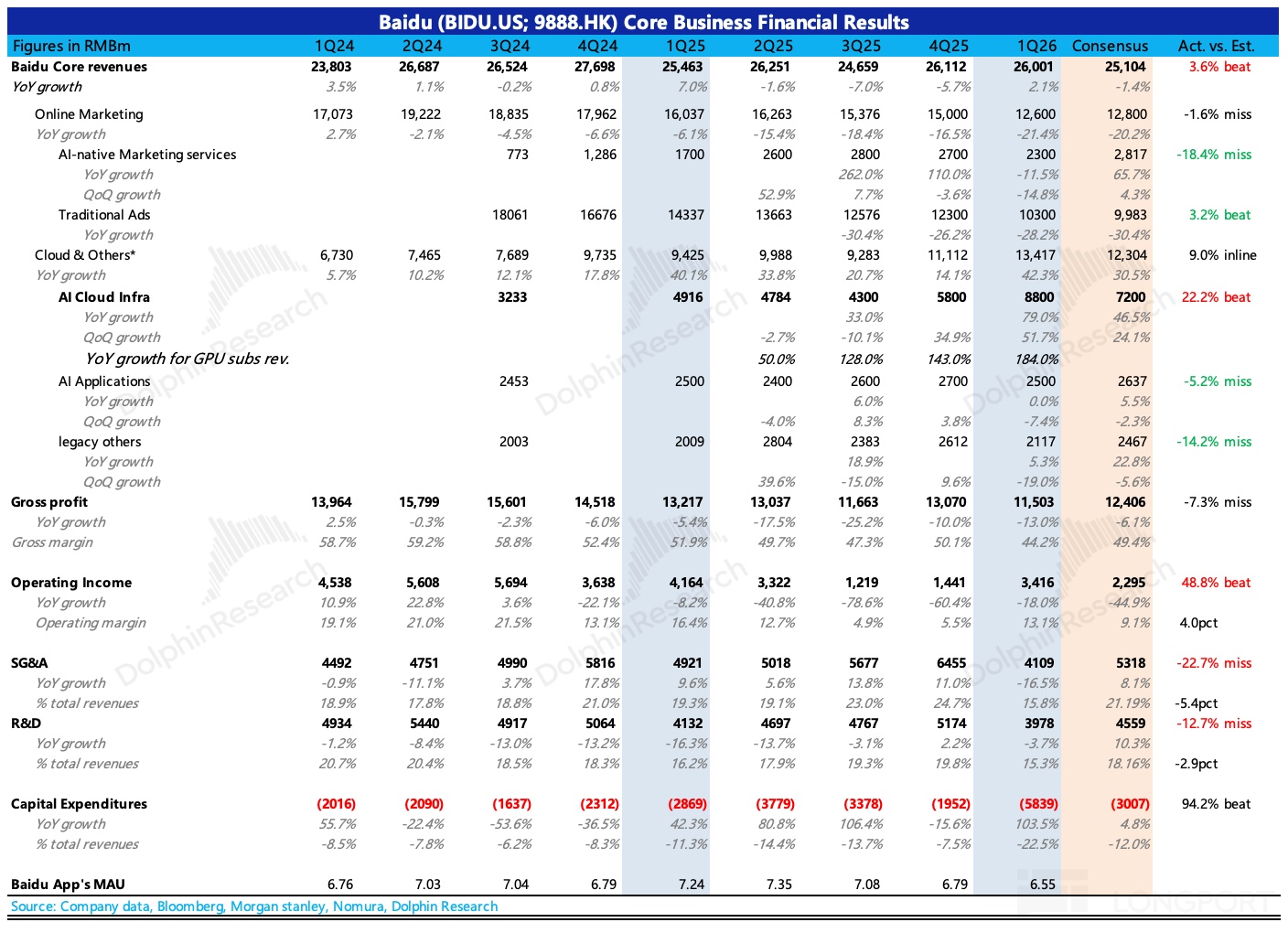
2. AI Core surpassed 50% of revenue for the first time: In Q1 2026, AI Core revenue exceeded RMB 13.6bn, up 49% YoY, and accounted for 52% of Baidu Core revenue. This marks AI as the company's primary revenue driver.
3. Earnings and margins: Non-GAAP OP was RMB 3.8bn with OPM of 12%. Non-GAAP net income was RMB 4.3bn with a 14% margin, and non-GAAP diluted EPS per ADS was RMB 12.06 (vs. market est. RMB 11.43, +5.5%). Baidu Core non-GAAP OP rose 39% QoQ to RMB 4.0bn, while operating cash flow was RMB 2.7bn, positive for the third straight quarter.
4. Capex strategy: Maintain strategic investment intensity with financial discipline, using diverse funding such as operating leases, finance leases and low-cost bank loans to support AI capex. Total cash and investments stood at RMB 279.3bn, providing ample liquidity.
5. Hong Kong dual-primary listing: Management continues to assess options, including capital-markets actions, to unlock value, weighing market conditions, regulation and shareholder interests. Any material progress will be communicated in a timely manner.
II. Call details
2.1 Management highlights
1. AI Cloud Infra
a. AI Cloud Infra revenue grew 79% YoY, while GPU Cloud revenue rose 184% YoY, accelerating from 143% last quarter. GPU Cloud has become a major contributor to AI Cloud Infra, and business quality continues to improve.
b. The edge lies in full-stack AI: BIDU has in-house components from chips to applications, ensuring reliable compute supply. It can optimize end-to-end across the stack to boost performance and lower costs, delivering compelling TCO for customers, and this advantage is growing as AI apps scale.
c. Customer base keeps expanding: BIDU AI Cloud is the infra partner for leading players across internet, gaming, embodied AI, autonomous driving, smartphones and financial services. New marquee customers were added this quarter, including top model companies, while existing key clients such as Unity, Honor, Opel and vivo deepened engagement and scaled usage.
d. MaaS platform ramping: The model library is expanding fast, now supporting DeepSeek, Gemini and MiniMax in addition to ERNIE. In Mar 2026, external customers' daily token consumption was nearly 7x that of a year ago, with MaaS revenue scaling quickly. As Agents and the AI app ecosystem evolve, MaaS still has significant untapped potential.
2. Kunlunxin
a. Among the first domestic AI chips to achieve large-scale commercial deployment of over 30,000 accelerators within a single AI compute cluster. It offers industry-leading cluster performance and stability, with a full software stack across models and frameworks to ensure strong compatibility and ease of use in enterprise environments.
b. Inference support keeps expanding: Optimized and validated for the latest ERNIE versions and mainstream base models, with new support for DeepSeek V4, GLM 5.1 and MiniMax M2.7.
c. Growing market recognition: The customer roster spans internet, gaming, embodied AI and autonomous driving, underscoring confidence in Kunlunxin's stability, efficiency, compatibility and versatility.
3. Foundation model (ERNIE)
a. ERNIE 5.1 was launched with improved text and reasoning capabilities in a more compact scale. It ranks No.1 among Chinese models on LM Arena's text leaderboard and No.4 globally on search, the only Chinese model on the list, with progress in code generation, Agent capability and deep search.
b. Staying application-driven: Each ERNIE generation is guided by real product needs and business scenarios. Focus areas ahead include better user-intent understanding and content-quality assessment in AI Search, stronger text and multimodal capability for Digital Humans, enhanced code generation for vibe coding, and improved optimal-decision finding in complex real-world scenarios for the 'Famou agent'.
c. The model team was reorganized and will keep evolving to support the app-driven R&D direction.
4. AI applications
a. DuMate (all-in-one assistant): A general-purpose AI Agent for daily productivity that autonomously executes multi-step workflows across apps and files. It handles end-to-end, long-horizon tasks on both PC and mobile, runs 24/7 in the background, and users simply state goals then check outputs. Its edge is deep integration with BIDU's native capabilities including AI Search, enabling broader office scenarios as the ecosystem expands.
b. Digital Humans: Ultra-realistic Digital Human tech keeps iterating, with performance gains and improved readiness for scale deployment. Costs fell about 80% over the last two quarters, lowering adoption barriers, while internationally an overseas Digital Human platform was launched at Baidu Create, supporting 24 languages including Spanish, French and Thai with cultural localization, and partners such as TikTok. It enables always-on, locally styled live commerce via Digital Humans, and multiple partners are deepening collaboration.
c. Vibe coding (秒哒): MAU in Mar 2026 grew ~70% MoM, and the domestic paid-user rate was about 3x the level at the start of the year. 秒哒 3.0 debuted at Baidu Create with an Enterprise edition and a mobile app, now supporting generation of standalone mobile apps to broaden creation for individuals and enterprises.
d. 'Famou' agent: A self-evolving Agent for complex enterprise operations. Version 2.0 lowers the entry bar so domain experts can interact via natural language without coding, and it has gone live at Qingdao Port, one of the world's leading ports, autonomously optimizing berthing, equipment allocation and cargo priority across thousands of interdependent variables to unlock incremental efficiency on an already optimized base.
e. AI Search: The AI overhaul continues with emphasis on planning, structure and output quality, improving content-quality assessment, boosting distribution of quality information and curbing low-quality content. ERNIE Bot's Mar 2026 DAU nearly doubled YoY, with daily dialogue turns up over 3x and next-day retention markedly higher, showing stronger stickiness.
5. Apollo Go (Robotaxi)
a. Q1 completed 3.2mn fully driverless rides, maintaining triple-digit YoY growth, and over 22mn rides cumulatively by Apr 2026. Safety performance remains industry-leading.
b. International push: In Europe, open-road tests in Switzerland are progressing well, the first cars are in place in London, and tests with Uber and Lyft will start soon. In the Middle East, Dubai has launched fully driverless services in several areas and rolled out an independent Apollo Go app, the first and only standalone Robotaxi app locally, and right-hand-drive experience from Hong Kong supported the London entry.
c. Exploring use cases beyond classic ride-hailing: In Hainan, a top tourist destination in China, fully driverless cars are deployed directly in airport drop-off zones with partners to provide tourist rental services, piloting commercialization in travel scenarios.
d. As scale grows, the system meets a wider set of complex edge cases. Management will focus on integrating Apollo Go more naturally into public transit, city ops and daily life, aiming to be a more convenient and trusted mobility service.
2.2 Q&A
Q: What drove the sharp acceleration in AI Cloud Infra revenue this quarter? Is compute supply sufficient for future growth, and how do GPU Cloud margins compare with traditional CPU Cloud over the long run?
A: Enterprise demand for AI infrastructure is very strong, with inference particularly robust. That signals customers are not only training models but deploying AI more broadly into their businesses.
In parallel, MaaS is also growing strongly, as we expanded beyond ERNIE to include high-demand models like DeepSeek, Gemini and MiniMax, and external token consumption keeps rising. Fast support for new models is not plug-and-play; high-throughput inference and efficient model serving are required to run them reliably at scale with fewer compute resources and to meet higher token demand.
Demand spans AI-native apps, autonomous driving, embodied AI, gaming and advanced manufacturing. It is not just existing customers upping spend; we are winning new ones in traditional sectors like retail and IP consumer brands that historically did not use AI or cloud, and the TAM continues to expand. With strong demand and relatively tight supply, we are actively adding capacity and improving utilization to better serve growth.
On margins, business mix is the key driver. GPU Cloud typically carries better margins than traditional CPU Cloud for several reasons: first, higher technical complexity and a much higher entry bar, and BIDU was among China's earliest at-scale GPU Cloud builders and remains on the frontier; second, demand is strong and high-quality supply is scarce, so customers prioritize stability and availability over price alone; third, Kunlunxin and our full-stack capability give us more room to optimize costs, and a steadily improving customer mix supports margin expansion. As GPU Cloud grows as a share of infra revenue, we expect structural margin improvement in cloud, a lasting long-term trend that underpins our confidence in cloud profitability.
Q: In an increasingly competitive model landscape, how does BIDU position ERNIE, and what are the investment plans and iteration roadmap?
A: The model landscape is evolving rapidly in China and globally, with active players releasing new models. We expect fast capability progress to continue, and strong internal foundation-model capability remains essential, so we will keep investing in ERNIE.
Each ERNIE iteration is guided by real product needs and business use cases. The newly released ERNIE 5.1 topped LM Arena's Chinese text leaderboard and ranked fourth globally in search, validating continued advances in text, reasoning and search.
Looking ahead, we will iterate ERNIE around core applications, namely AI Search, Digital Humans, 秒哒 and the 'Famou' agent, which we see as the highest-value directions. For AI Search, we will strengthen user-intent understanding and content-quality assessment to deliver more accurate, higher-quality and smarter results; for Digital Humans, we will enhance text and multimodal ability to make them more lifelike and effective in driving live-commerce conversion; for vibe coding, we will improve code generation so users can build apps via natural language; and for the 'Famou' agent, we will boost optimal-solution finding in complex real-world scenarios to drive enterprise efficiency.
Beyond ERNIE, we have a portfolio of smaller, faster and more efficient models, plus model combos optimized for specific scenarios. Different use cases have different needs for capability, cost, latency and deployment efficiency, and our goal is to deliver the best outcome for each. Over the long run, frontier AI potential remains far from fully realized, and as more applications emerge, the value of an app-driven approach will become clearer and ERNIE will grow stronger and more valuable.
Q: With AI Cloud Infra scaling rapidly and AI passing 50% of revenue, how do you view the long-term OPM and its drivers?
A: AI Core, which mostly excludes traditional online marketing, surpassed 50% of revenue for the first time. That is a key milestone showing rising AI contribution and a more diversified revenue base.
These high-growth businesses are still scaling. As their mix increases, we expect not only revenue growth but margin expansion, providing diversified and sustainable profit uplift drivers.
By line: first, AI Cloud Infra — GPU Cloud has structurally higher margins than CPU Cloud, driven by stronger demand, tighter supply, higher technical barriers and greater pricing power. As GPU Cloud mix rises, it will be a key engine for margin improvement. Second, AI applications — inherently high-margin, driven by sticky subscriptions with operating leverage as scale builds. Third, Apollo Go — since reaching UE breakeven in Wuhan, unit economics have kept improving; it is still in the investment phase, but scaling is making the path to profitability clearer.
At the company level, additional levers include ongoing cost optimization and efficiency initiatives across the org, broad AI deployment to raise internal productivity, and higher server utilization at the infra layer, which directly lifts margins.
Overall, a revenue mix shift toward higher-margin, faster-growing businesses, cost-efficiency from full-stack AI, and company-wide productivity gains together give us confidence in an attractive and sustainable medium- to long-term margin trajectory.
Q: Please update on Apollo Go's overseas scale and the onshore vs. offshore revenue mix outlook. How do margins compare, and what is BIDU's long-term role in the ecosystem — operator, technology provider or platform?
A: On scale, Apollo Go remains a global leader in Robotaxi services, with over 22mn cumulative rides by Apr 2026. China is one of the most open markets, so domestic scale is currently well ahead of overseas.
We also see more markets globally opening to autonomous mobility and a favorable regulatory trend. Domestic operating experience has laid a strong foundation for international expansion.
We established a foothold in key markets across Europe, the Middle East and Asia within just a few quarters, reflecting the scalability of our tech and ops under varied conditions. Years of fully driverless operations in complex Chinese road environments built deep experience handling edge cases and systemic complexity that emerges only at scale, which continuously hardened our algorithms and standards. As we go global, those learnings transfer and help us move faster, and right-hand-drive experience in Hong Kong directly supported our entry into London.
On profitability, Apollo Go achieved UE breakeven in its largest domestic city despite very low local fares. Overseas pricing is more attractive, so as scale builds, we believe profitability abroad can surpass domestic levels, and ex-US/China international markets are also larger than China's.
As for our long-term role, it is too early to lock it in, as the industry, value chain and business models are still forming. Our focus is to keep scaling, deepen tech and ops advantages, and maintain global leadership. With that foundation, as the ecosystem matures, we will have strategic flexibility to define our role and capture long-term value.
Q: How do you view 2026 capex, and how will you prioritize between AI investment and shareholder returns?
A: Our approach is to maintain strategic investment intensity while keeping financial discipline. AI remains BIDU's most important long-term opportunity, and we will continue investing in foundation models and broader full-stack AI to stay at the frontier.
Financially, we have the capacity to support this. Operating profit and operating cash flow are healthy, and total cash is at solid levels, with Q1 operating cash flow of RMB 2.7bn, positive for three consecutive quarters since turning positive in Q3 last year.
Meanwhile, we are using diversified financing, including operating and finance leases and other low-cost bank borrowings, to fund AI investment while maintaining a robust cash position, a healthy balance sheet and a long-dated funding structure.
On shareholder returns, the new buyback plan and inaugural dividend policy announced last quarter remain in place. We will continue to balance long-term AI investment with returns and uphold our commitment to creating sustainable value.
Q: Any update on the Hong Kong dual-primary listing?
A: We continue to evaluate measures that help unlock long-term value, including capital-markets actions. We see substantial intrinsic value at BIDU and will proactively and flexibly explore ways to surface it.
We will balance market conditions, regulatory requirements and shareholder interests. Any material progress will be shared with the market in a timely manner.
Q: Entering the Agent era, what is BIDU's AI app and Agent strategy, and how do you view monetization — token-based, subscriptions or project-based?
A: As noted at last week's Baidu Create, the biggest AI moments over the past three years were model breakthroughs, but this year is different — for the first time, a single Agent and a single AI app captured global attention. That shift validates our view that value in the AI era is realized at the application layer.
AI apps have long been a strategic priority. We have built a diversified portfolio across AI-native products and AI-enablement of existing products, serving consumers, enterprises and verticals.
Within this, several directions are especially valuable:
First, Search — our largest consumer product and the core business we keep upgrading with AI, delivering a more intelligent, structured and helpful experience to hundreds of millions of users.
Second, Digital Humans — costs keep falling, driving broader merchant adoption at scale, with rising live-commerce effectiveness that can match or exceed human anchors in many cases.
Third, 秒哒 — capabilities keep advancing to support broader use cases and are lowering the barrier for users and enterprises to build AI apps via natural language. Fourth, the 'Famou' agent — focused on complex enterprise scenarios, handling more complex workflows across more industries, self-optimizing and delivering meaningful efficiency gains.
On monetization, Search is clearly ad-driven, while the other three rely more on subscriptions, usage-based or token-based billing. Search is widely seen as a major AI-native app market, and 秒哒 has overseas comps.
For Digital Humans and the 'Famou' agent, this is our own conviction rather than an industry consensus, and we believe both represent huge market potential with relatively few committed players today. We are also exploring new AI-native product forms; DuMate is a recent example, a general-purpose Agent that embeds AI into daily tasks and retains extensive user context, which should make it highly sticky.
Globally, monetization is still at an early stage and models are evolving. Today, token-based billing is more common and essentially pays for the foundation model, but over time, AI apps and Agents will increasingly complete substantive tasks like humans. Monetization will broaden and become more outcome-driven, with users paying for productivity, time saved, better experiences and concrete results, and ultimately paying the Agent or app itself, a market far larger than tokens.
Q: How do you view growth and competition in China's domestic AI chip market, where does Kunlunxin fit, and what are recent demand trends?
A: China's domestic AI chip market is early but growing fast. Compute demand is shifting structurally from training-centric to a mix of training and inference, and as Agentic apps, vertical use cases and new app forms proliferate, inference is becoming increasingly important.
The open-source model ecosystem is a prime example, driving high-frequency, real-time and more diverse inference demand. On supply, domestic AI chips face near-term challenges in capacity and supply-chain maturity, with demand growth outpacing supply.
Longer term, supported by strong manufacturing and supply-chain foundations, China's semiconductor industry is advancing quickly. Domestic supply will rise, and competition will hinge more on whether chips run stably and efficiently across diverse real workloads rather than merely being 'delivered'.
In some frontier training scenarios, domestic chips still trail the most advanced global products, but inference is a highly relevant and competitive area for domestic chips, and this edge will become more pronounced as inference grows.
For enterprises, peak chip specs are not the most critical. What truly matters are stability at cluster scale, compatibility with mainstream models and frameworks, migration costs and friction, support for large-scale cluster deployments, and overall cost efficiency. We expect the market to concentrate on players who deliver across all these dimensions.
Kunlunxin is well positioned on all of the above. More importantly, it is not a standalone chip but part of BIDU's full-stack AI, enabling continuous cross-layer optimization from infra to apps to raise model efficiency and lower inference cost, building a more cost-effective, stable and easy-to-deploy AI infra.
We see strong and rising cross-industry demand for Kunlunxin and believe it is ready to capture the opportunities ahead.
Risk disclosure and disclaimer:海豚研究免责声明及一般披露
