


BILI: Sell-down False Alarm, Margin Erosion? Games to the Rescue.
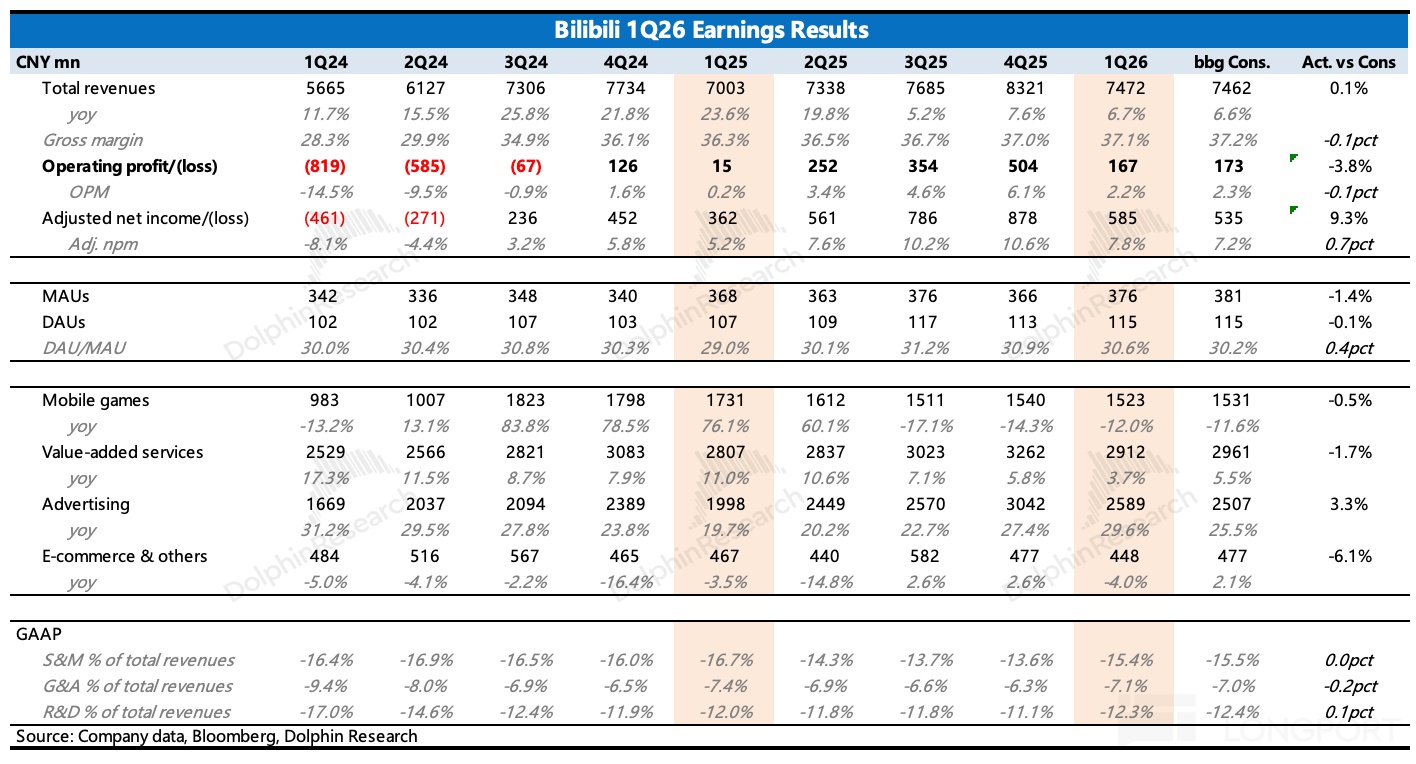
After Hong Kong close on May 19 Beijing time, $Bilibili(BILI.US) reported Q1 2026 results. Ads once again carried the print, broadly in line with expectations.
Specifically:
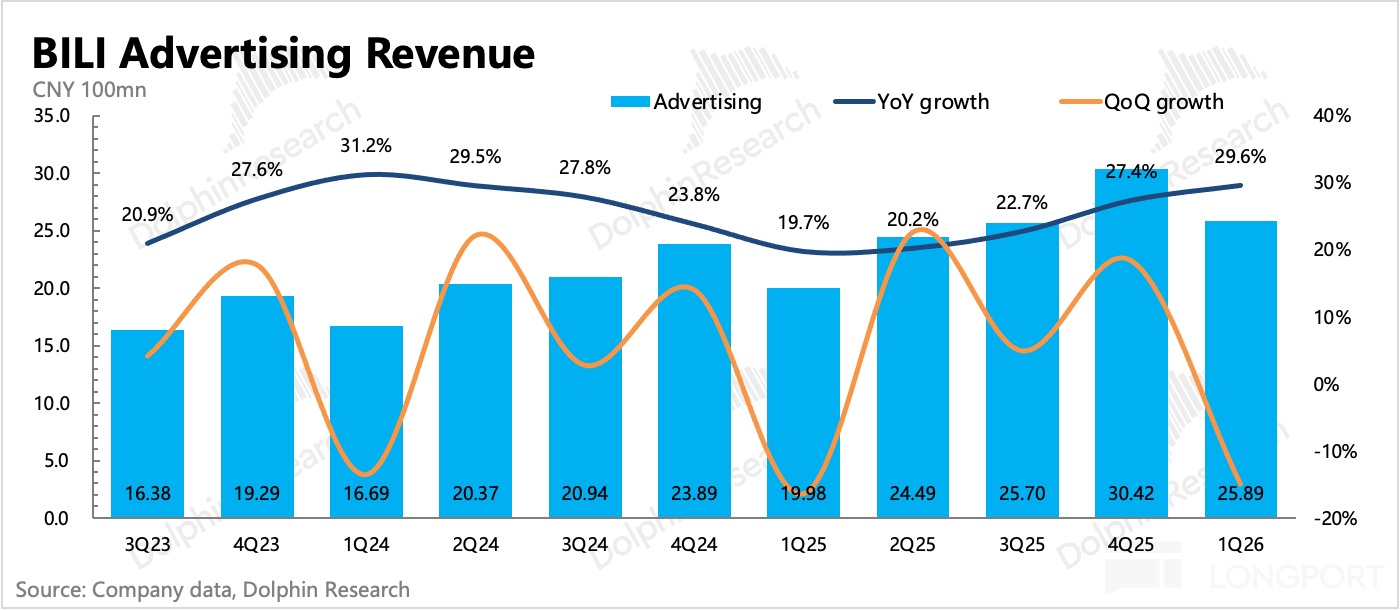
1. Ads in a clear sweet spot: Q1 ad revenue rose 30% YoY, a small beat despite a weak industry backdrop. Benefiting from robust demand in AI and gaming, Bilibili clearly captured meaningful tailwinds.
This high-growth phase should persist for a while, as end-market momentum and competition intensity remain elevated. Ad inventory on Bilibili is also still ramping.
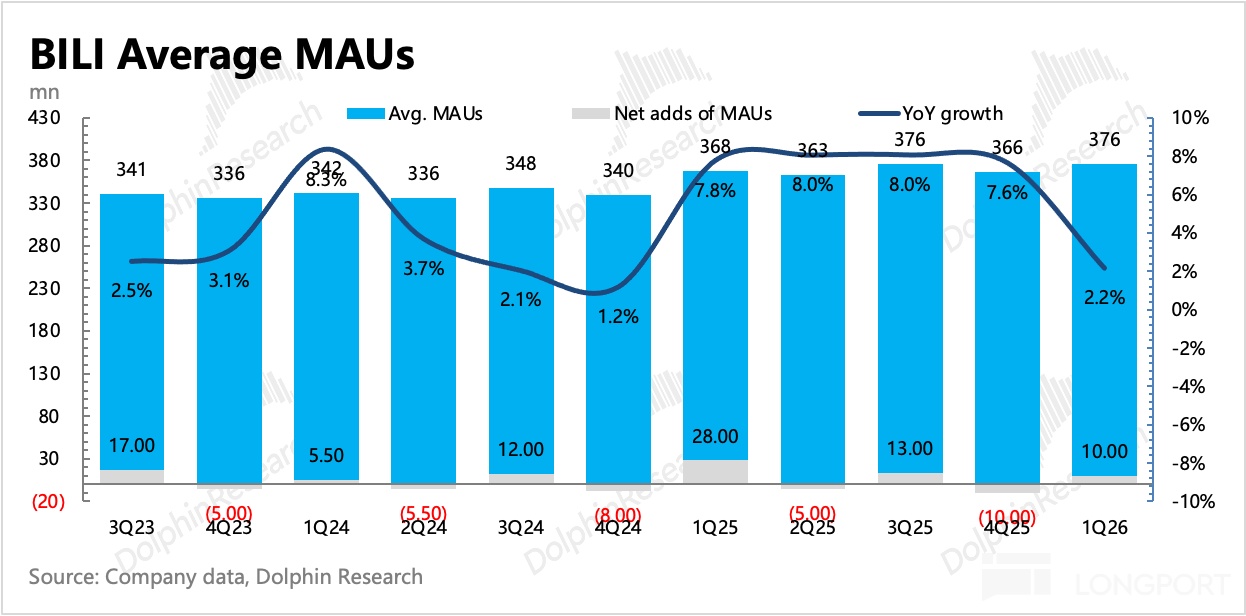
2. User growth slowed, stickiness improved: MAU rose by 10mn QoQ to 376mn, roughly back to last Q3’s level, missing a fresh seasonal high in Q1. Holiday timing around CNY and winter break may have played a role; the call may provide color.
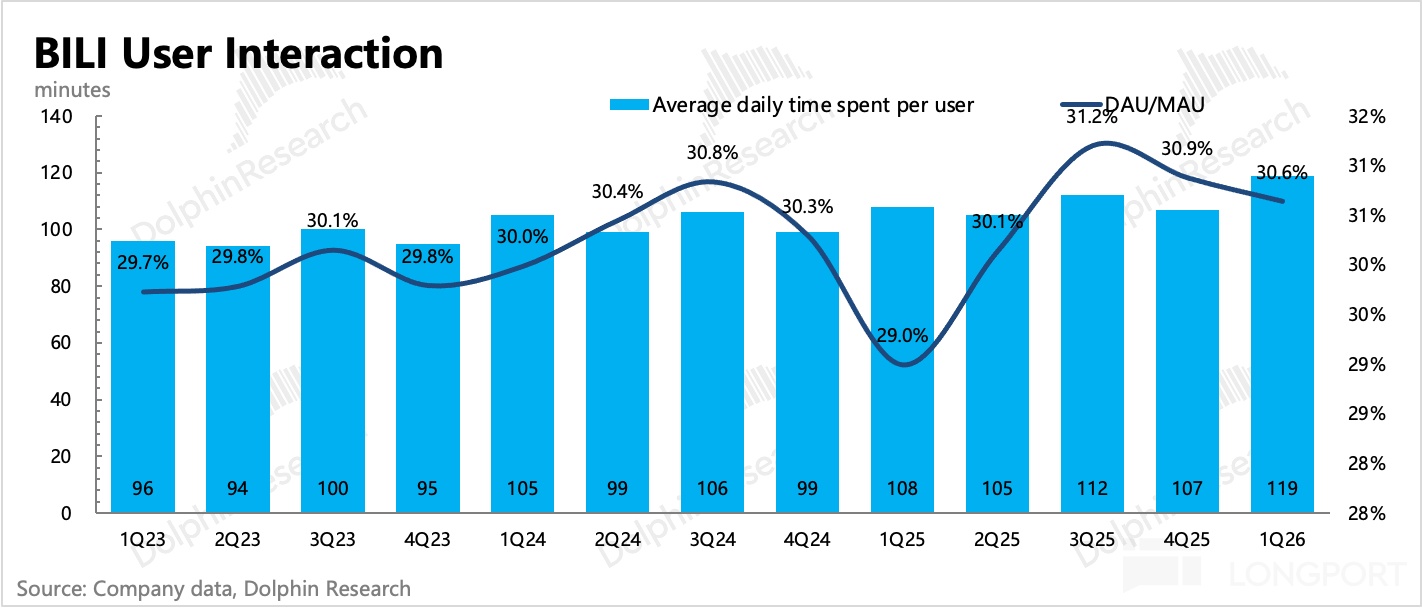
Engagement improved YoY. DAU/MAU reached 30.6%, and Avg. daily time hit a record 119 minutes.
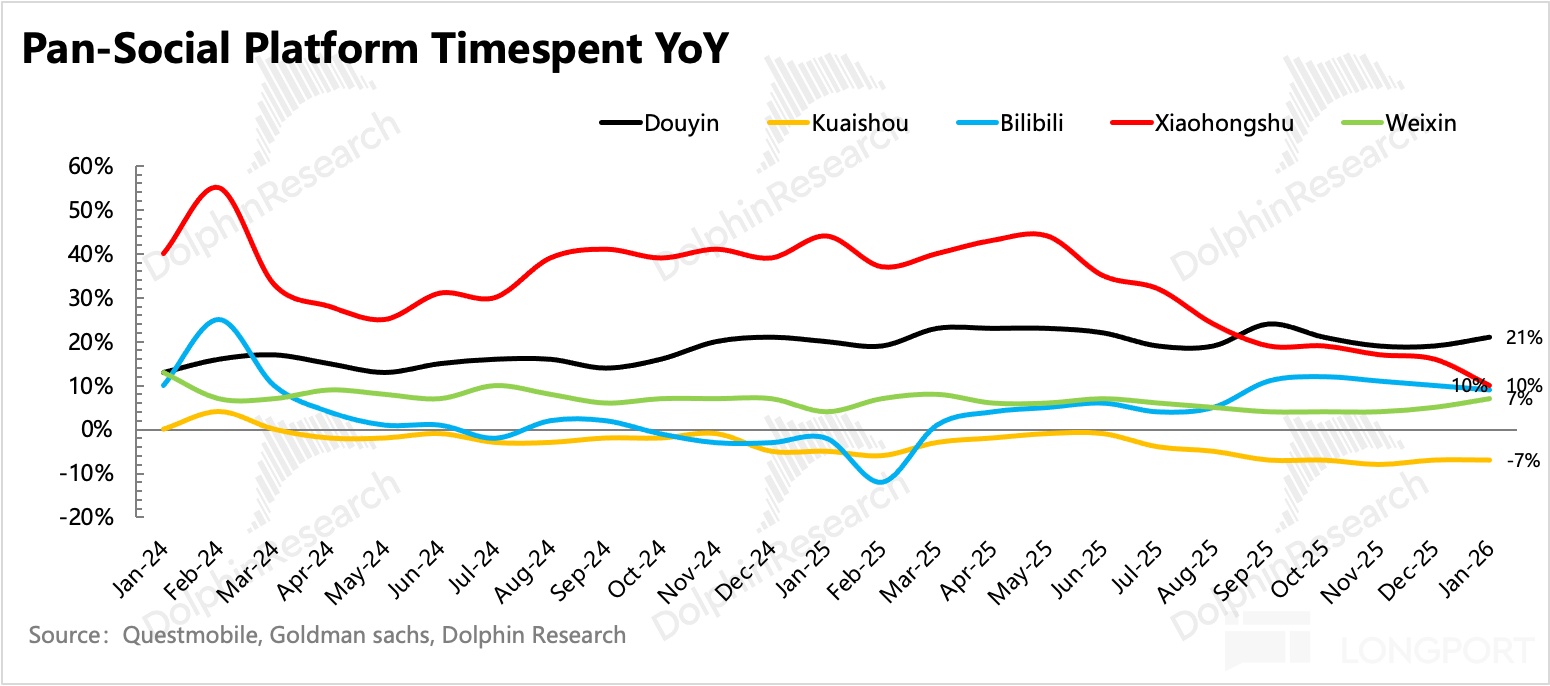
Per QuestMobile, total user time in Jan ticked up vs. Q4, and the prior-year Q1 base was not high, implying a broadly stable trend. Relative to social and long-form peers, Bilibili looked decent, with Douyin still running away and WeChat slightly rebounding. Xiaohongshu has slowed notably, while Kuaishou keeps slipping.
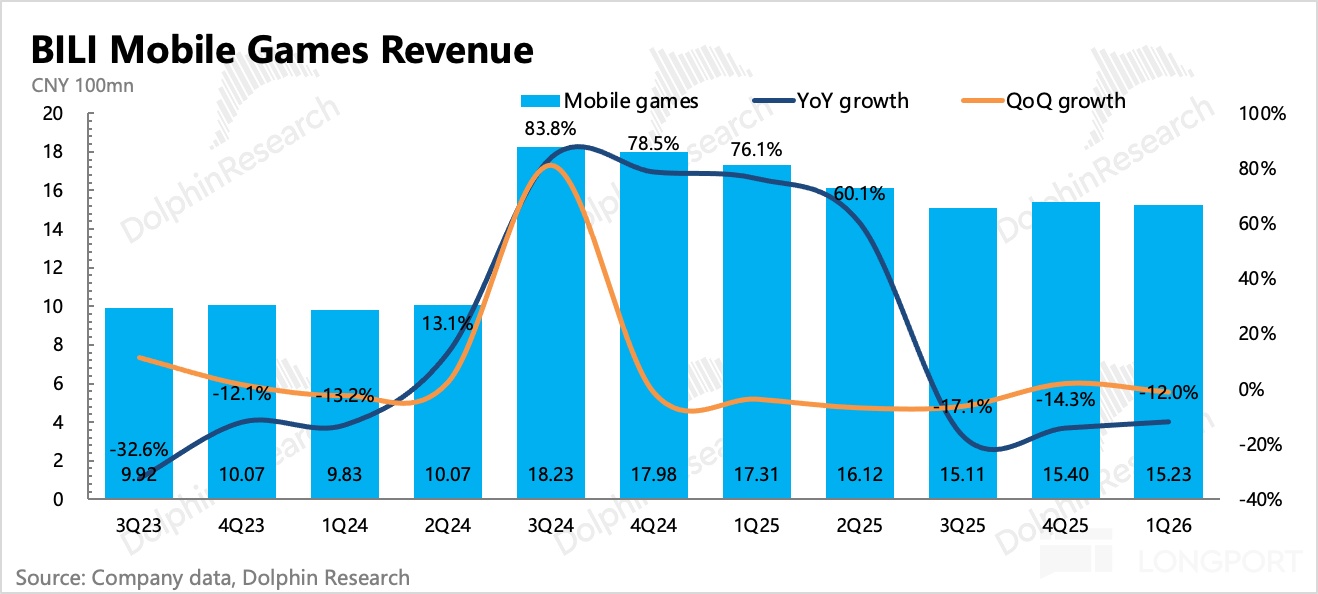
2. New game cycle nearing: Q1 was still pressured by a high base, with game revenue down 12% YoY. The quarter mainly saw the HK/Macau/Taiwan launch of 'Sanmou' in a smaller market, with stable performance. With 'Three Kingdoms: Hundred Generals Cards' planned for late Q2 and two more titles in H2, the new game cycle is drawing closer.
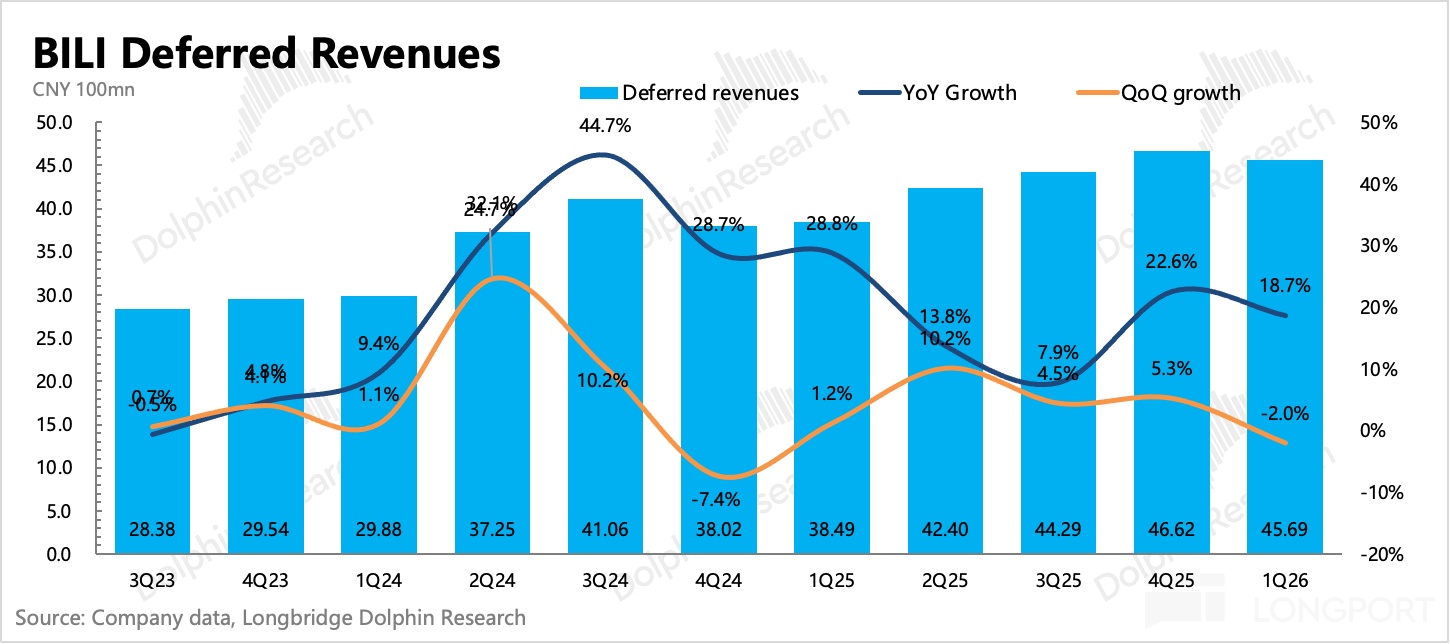
Deferred revenue was up 19% YoY at end-Q1 but down slightly QoQ, likely given last quarter’s boost from the strong sales of 'Escape from Tarkov'.
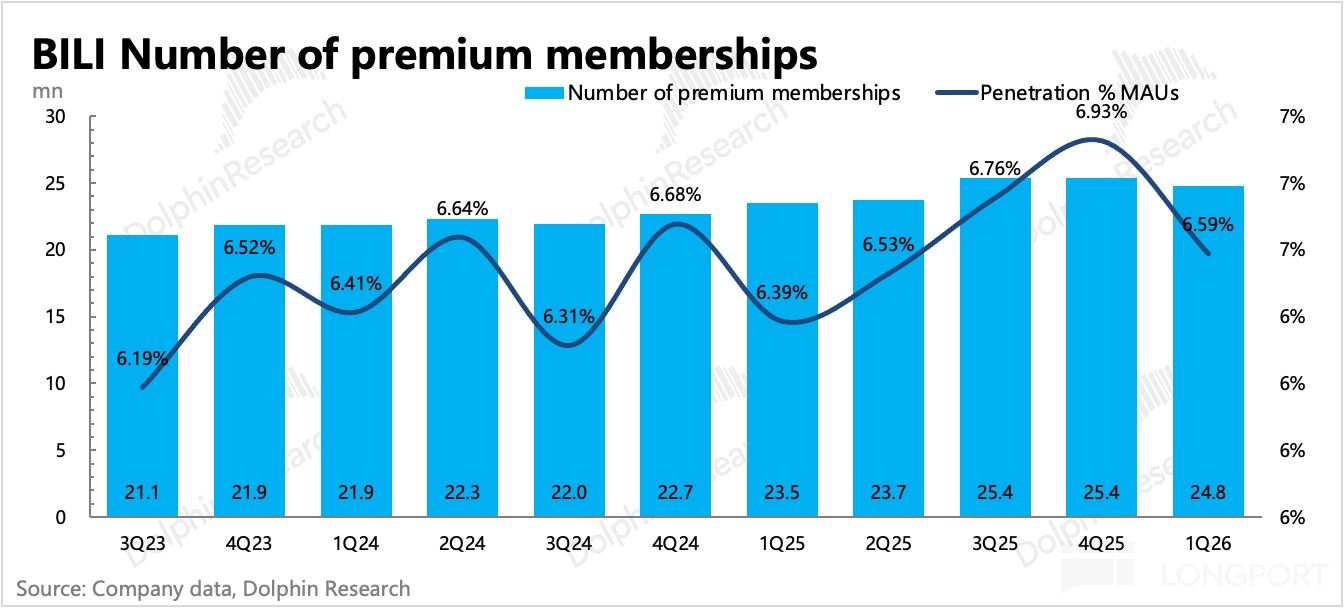
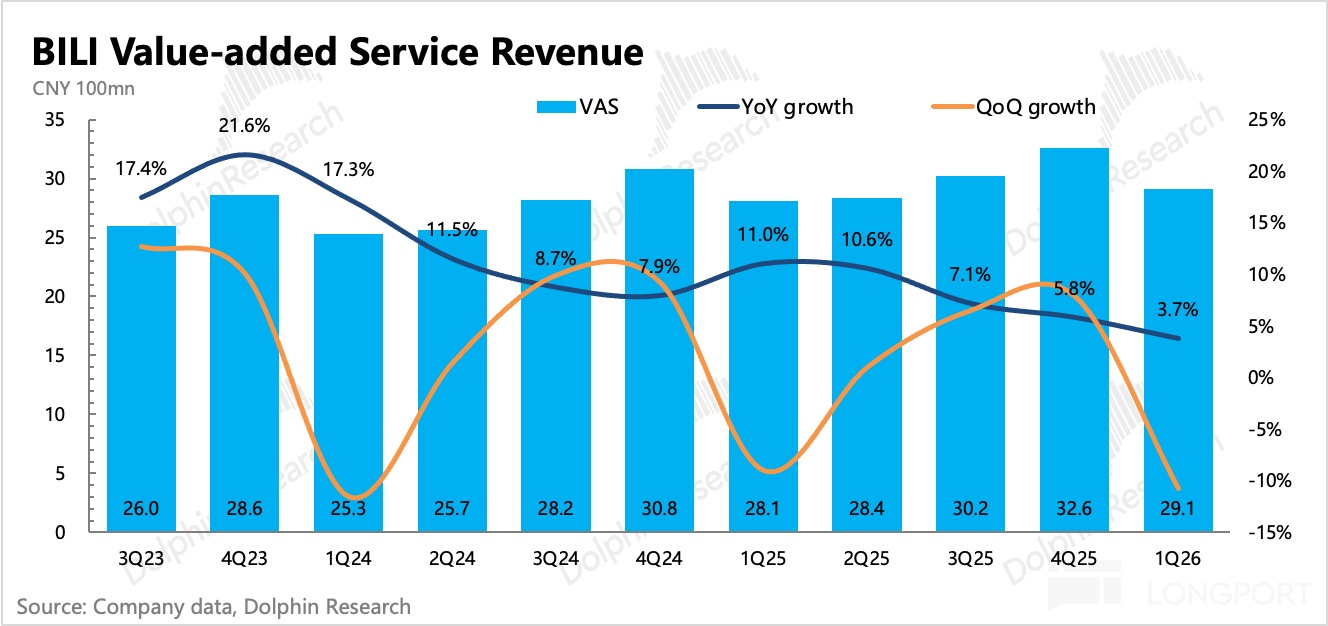
3. Live-streaming still under pressure; long-form also weaker: Value-added services (VAS) growth slowed further to 3.7% YoY. Both live-streaming and premium memberships softened, with members down nearly 0.5mn.
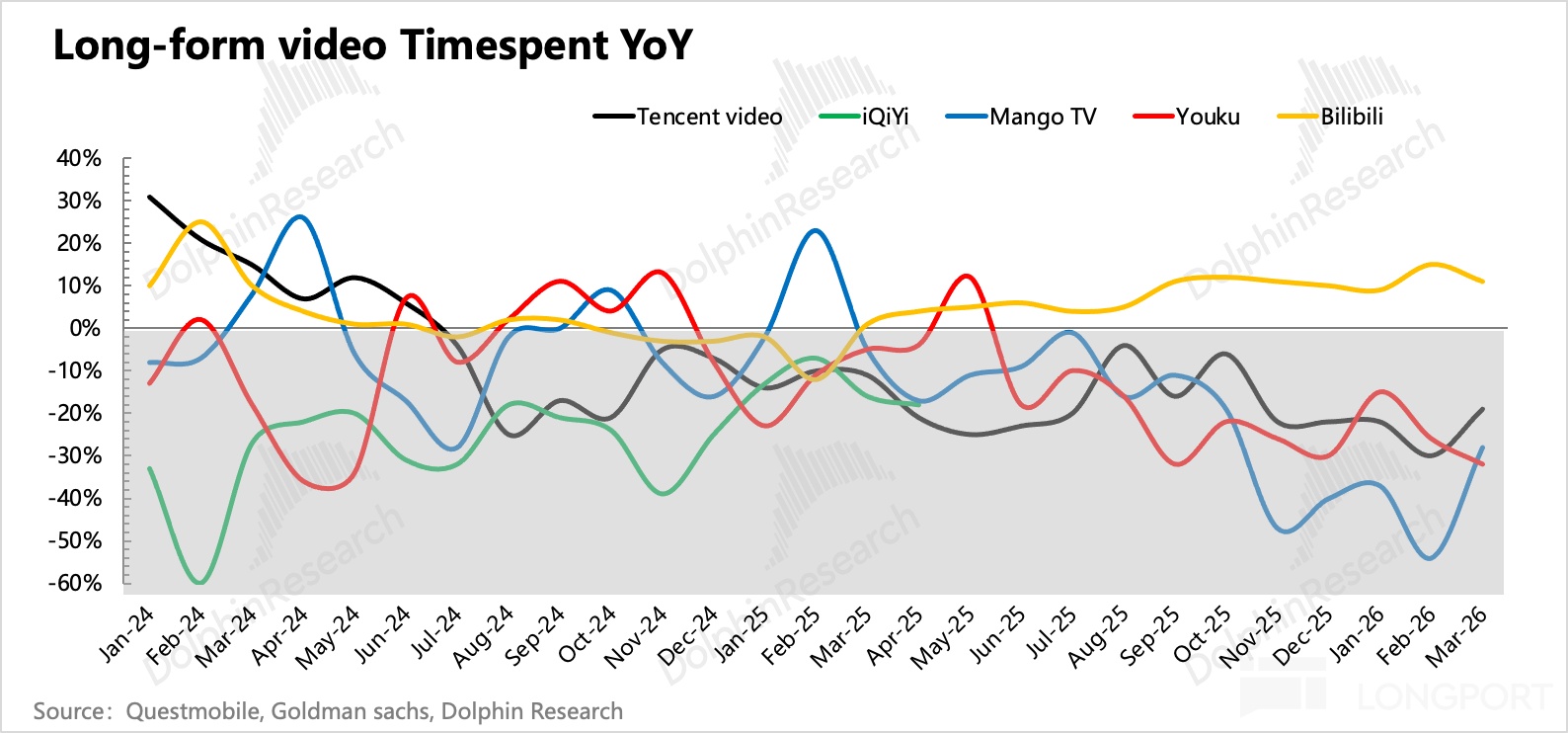
QuestMobile indicates iQIYI, Tencent Video, and Youku saw total time decline in Q1. Long dramas were hit by AI comics, short-form dramas, and short video, while the CNY film slate disappointed, pushing total Q1 box office down 51% YoY vs. last year’s 'Nezha' high base.
That said, Bilibili’s premium content selection differs from those platforms. It relies on a steady UGC supply from creators and mainly licenses global classics, using comments and bullet-chat data to mine preferences and buy lower-cost catalog. By contrast, iQIYI/Youku/Tencent Video depend on new drama IP; when fresh content dries up, users churn.
4. Heavier AI spend showing up: OP came in at RMB 170mn with OPM of 2.2%. Q1 margins usually dip QoQ on e-comm ad seasonality, heavier marketing, and year-end comp, but the QoQ step-down was larger this year, mainly due to increased AI investment. R&D rose 9% YoY after three years of tightening (previously via cutting game R&D).
Adj. net profit reached RMB 590mn with NPM of 7.8%, down nearly 3ppt QoQ. Management previously guided that incremental AI spend this year, even with offsets elsewhere, would still cut profit by RMB 0.5–1.0bn.
5. Buyback expired; watch for a new plan: In Q1 the company repurchased 2.5mn shares for $60mn at an Avg. price of $24. As of end-Q1, the 2024 repurchase plan ($200mn over two years) has been completed.
Net cash stood at RMB 19.3bn (Approx. $2.8bn), leaving room to extend buybacks; watch the call for the shareholder return roadmap. The market was spooked by Tencent’s plan to monetize higher-valued investment assets to fund its own buyback, which hit the stock; Tencent holds about 10% of Bilibili.
6. Scorecard
Dolphin Research View
Ads remained the standout in Q1, but AI investment started to bite before the new game cycle arrives. Management had guided a RMB 0.5–1.0bn profit impact this year, and trends this quarter suggest roughly RMB 50–100mn so far. That tracks the prior playbook.
While management also stressed disciplined, phased investment, the market chose to sell first. That is understandable: with Bilibili around $11bn at the time, the stock was trading near 25x adj. earnings on prior profit expectations, above China internet peers. Investors had been pricing a 15–20% long-term OPM path over the next three years.
New AI spending disrupted that script, and it is clearly not a one-off. The revenue lift is less visible than cloud or LLM subscriptions, making ROI harder to gauge, and short-term margin drag likely extends the timeline to target OPM. That warrants a higher risk discount.
However, on current reads of AI’s profit drag, we see some changes vs. last quarter’s view, and a further pullback could present opportunity:
(1) New game cycle approaching: Revenue growth is the best antidote to concerns over heavier spend eroding profit, and Bilibili today leans on games to drive growth. Key launches are getting closer: 'Three Kingdoms: Hundred Generals Cards' around mid-year, 'Shine, Rumi' in Q3, and possibly 'Romance of the Three Kingdoms: Road to Dominion' by year-end. While these may be less likely blockbusters than 'Sanmou', the lower H2 base and incremental pipeline should ease AI-spend pressure on earnings.
(2) Rich valuation partly digested: On its call, Tencent said it would support buybacks by rotating its investment portfolio, i.e., monetizing certain investment assets. Management noted it would compare investee valuations with its own (ex-investments, core biz. at ~10x PE) to decide where to sell.
Given Bilibili’s historically higher multiple in China internet, the stock fell 15% across Thu–Fri on fears it might be on the list. Tencent trimmed its Bilibili stake from 13.5% to 10.5% during 2020–2022, with little activity since 2023.
Dolphin Research believes Bilibili is unlikely to be a disposal target for Tencent this time:
On one hand, Bilibili’s market cap has mostly ranged $8–10bn over the past year, with a neutral near-term fair value just above $10bn and upside to ~$15bn in a risk-on tape (cf. last quarter’s valuation ranges under different scenarios). Selling the full 10% would raise under HKD 10bn, and at Tencent’s current ~HKD 500mn/day buyback pace, that funds less than one month.
On the other, as a key pan-entertainment channel and a lead AI partner, Bilibili has strategic value. A large block sale would run counter to that cooperation logic.
Hence, at least in the ST/MT, these concerns look overdone. With a market cap of $8.1bn at yesterday’s close, and assuming AI spend reduces profit by RMB 800mn, Bilibili trades at ~21x 2026 adj. PE (Est. adj. net profit RMB 2.6bn). While not cheap, 2026 is a tough year for games; as the new cycle starts in H2 and growth recovers, valuation could be further digested.
Detailed Analysis Below
I. User expansion slowed; stickiness improved
MAU rose by a seasonal 10mn QoQ in Q1, but the platform did not post a new seasonal high. Stickiness kept improving, with DAU/MAU at 30.6% and Avg. daily time at a record 119 minutes, up 11 minutes YoY. QuestMobile shows Bilibili’s time-spent growth ranking in the upper-mid range among social peers in Q1.
II. Ads the standout again
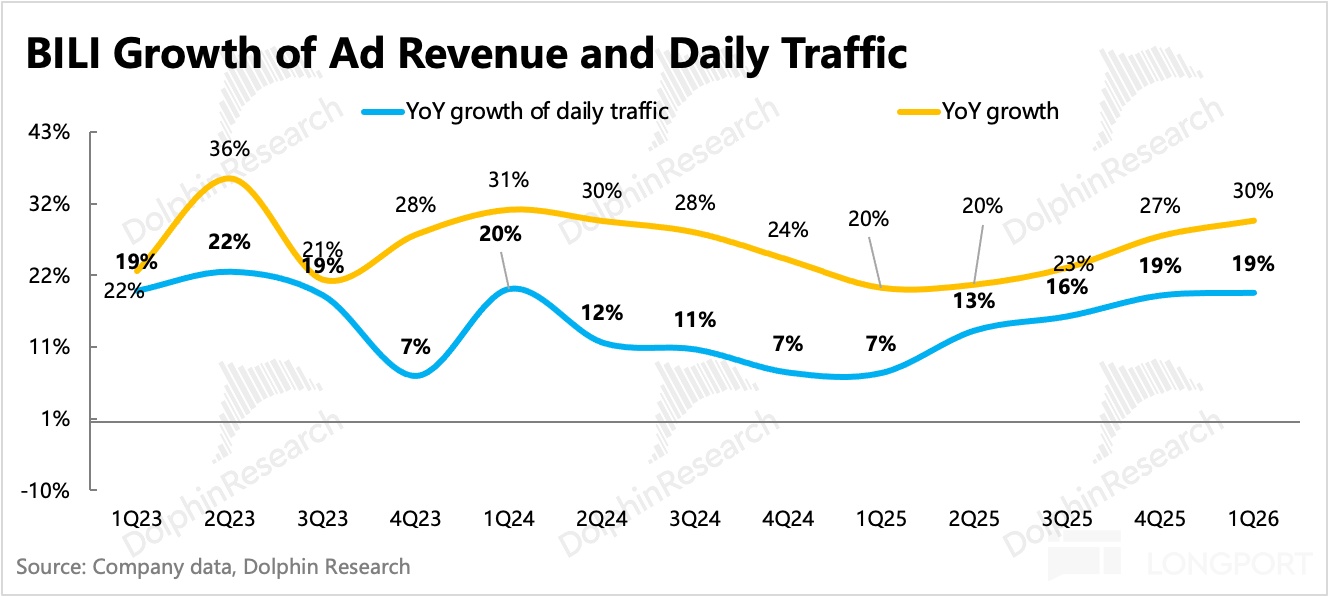
Q1 ad revenue was RMB 2.6bn, up 30% YoY, modestly accelerating and slightly beating expectations. Growth was driven by total user time (+19% YoY, slightly above Q4’s 18.6%) and higher ad load.
Ad load is still only 7–8%, leaving room to rise vs. peers. In early Apr, the company introduced a new 'pause ad' slot on the playback page that autoplays an ad when users manually pause, though both users and creators can opt out.
III. New game cycle nearing
Game revenue stayed under a high base and pipeline gap, down 12% YoY in line with expectations. Q1 featured the HK/Macau/Taiwan rollout of 'Sanmou', a smaller market with steady results. Deferred revenue declined QoQ against the grain, likely reflecting softer VAS and a subdued games slate.
Pipeline ahead: Beyond prior disclosures for mid-year 'Three Kingdoms: Hundred Generals Cards' and a global Q4 launch of 'Shine, Rumi', a new co-published title 'Romance of the Three Kingdoms: Road to Dominion' has been added, slated for Q4.
'Romance of the Three Kingdoms: Road to Dominion' was revealed on Mar 18 with full-platform pre-registration and opened its 'Taoyuan' first test on Mar 28. It is a 3D sandbox SLG based on the classic IP that helped popularize the SLG genre.
Beyond core strategy mechanics, it emphasizes immersive role-play and progression, skewing more single-player. The title also follows a grind-light, pay-light approach, simplifying interactions and focusing on core strategic gameplay.
One institution expects first-12-month revenue of RMB 1.7bn, or ~40% of 'Sanmou'. Dolphin Research views that as somewhat aggressive and notes potential cannibalization with 'Sanmou' given the shared theme, but the approaching pipeline still points to an inflection for Bilibili Games.
IV. VAS under heavy pressure
VAS revenue, mainly live-streaming plus premium subs, grew 3.7% YoY in Q1, with growth continuing to slow. Premium members fell by 0.5mn QoQ to 24.77mn, and given structural pressure in long-form video, Bilibili is not immune.
Outside premium membership, within the fan economy and live-streaming, live likely remained the laggard.
V. AI spending starts to show
While profit still grew strongly YoY in Q1, AI spend began to weigh.
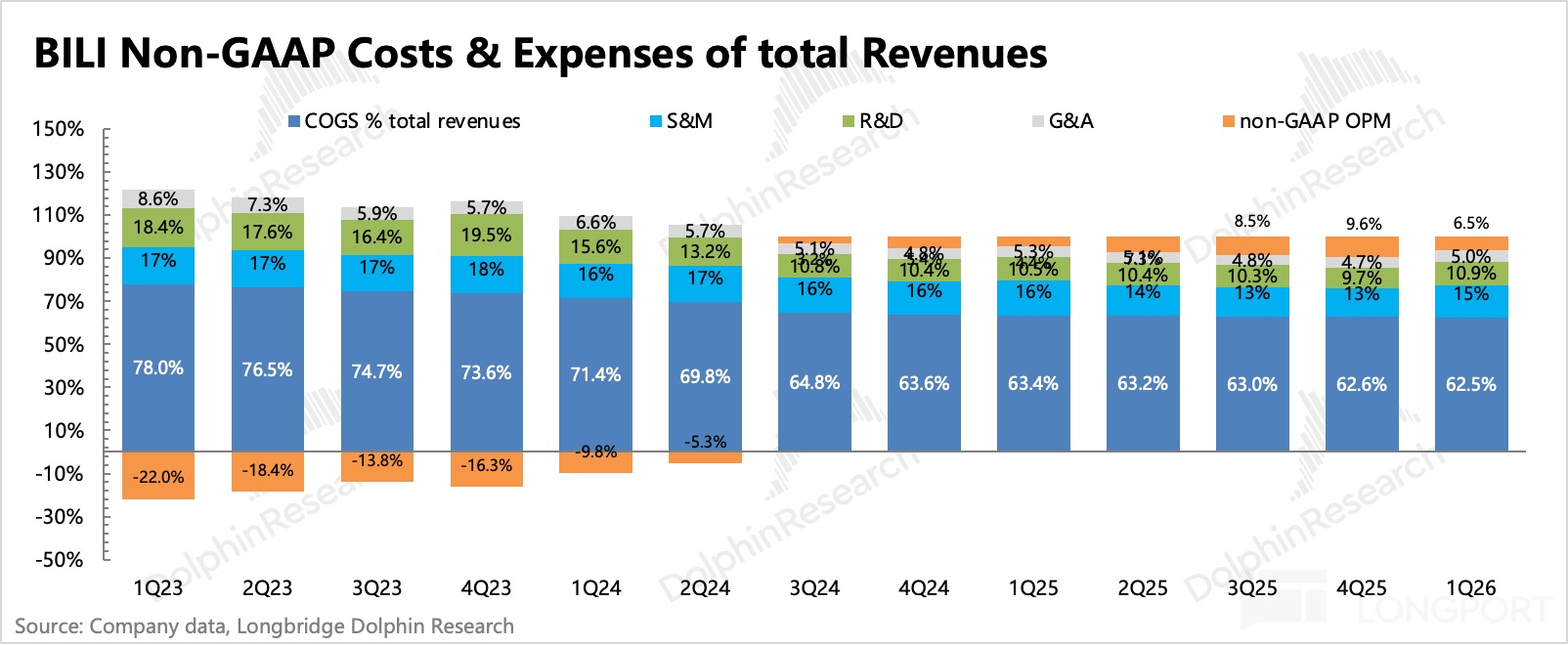
On core OP (GP minus Opex), the company delivered RMB 170mn with a 2.2% margin. Adj. net profit was RMB 590mn (adjusting back SBC at 4% of revenue), with an 8% margin.
1) GPM keeps inching up
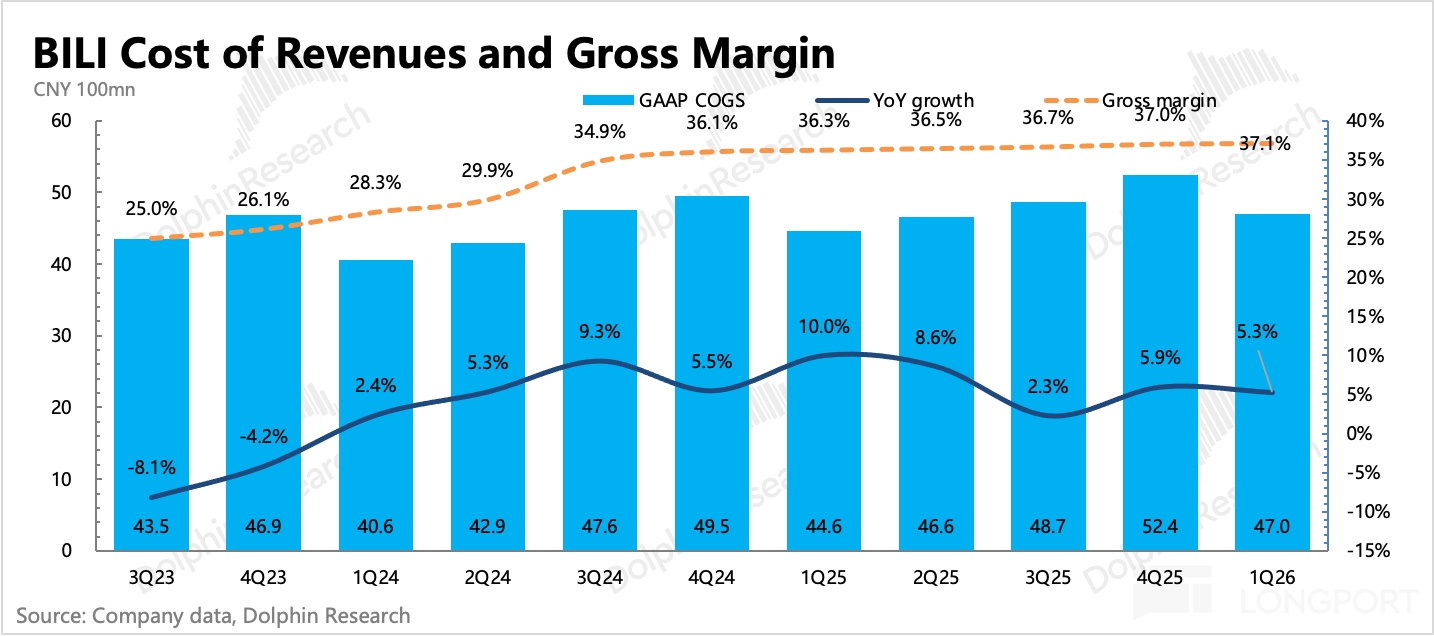
GPM gains are mainly driven by the continued high growth of higher-margin ads.
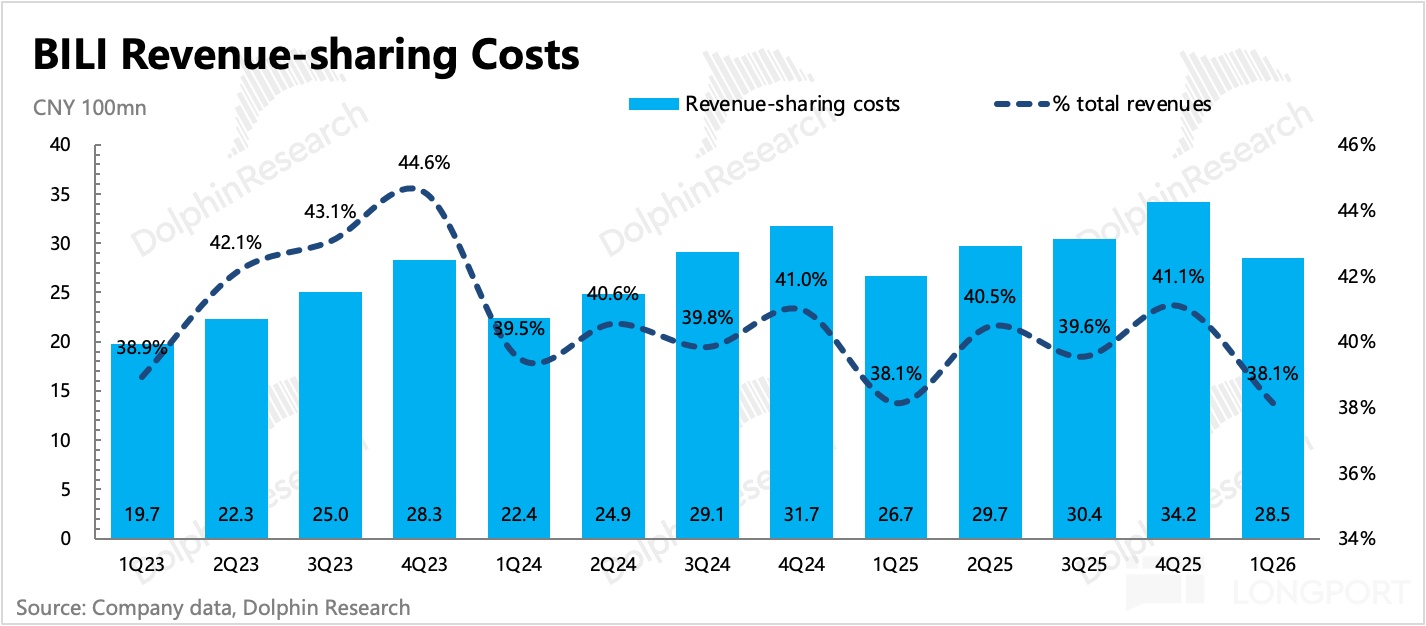
Within costs, revenue-sharing remains the largest item at 38% of revenue, tied to games, live-streaming, and Huahuo ads. Q1 revenue-sharing costs rose to RMB 2.85bn, up 7% YoY.
2) R&D up for the first time in three years
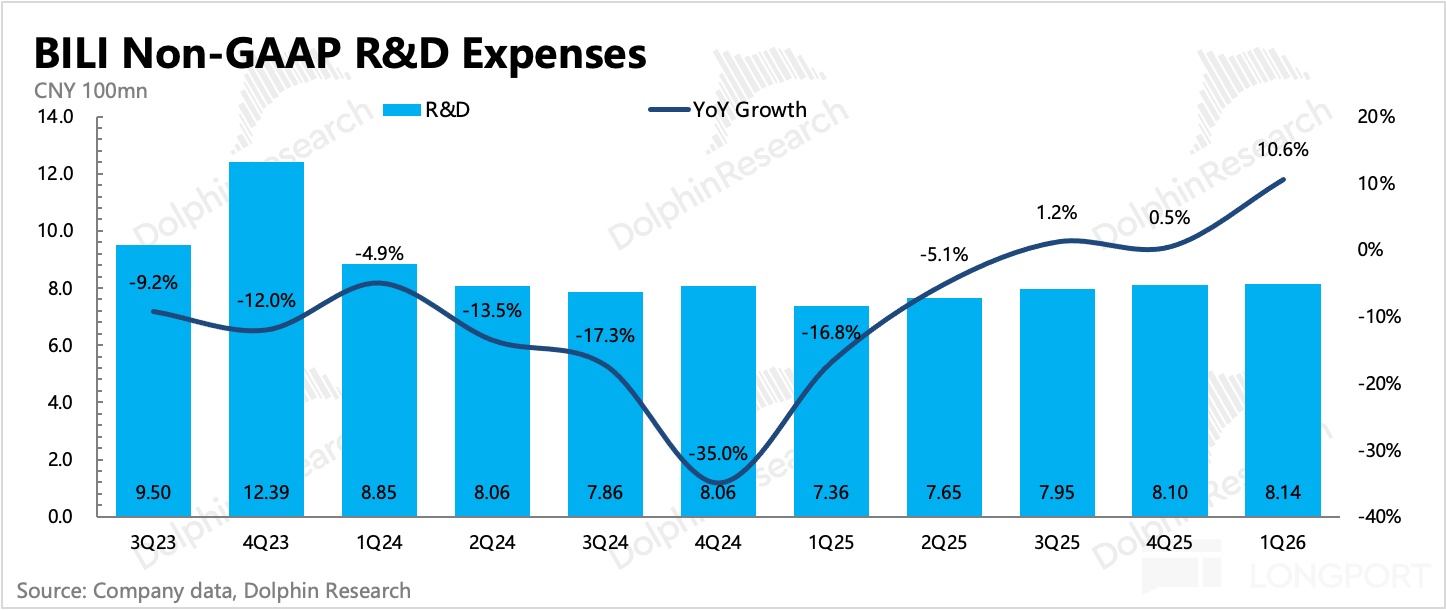
On Opex, selling was flattish and G&A edged up, so growth showed up in R&D, which rose 9% YoY for the first clear increase since 2023. The lift reflects higher AI investment.
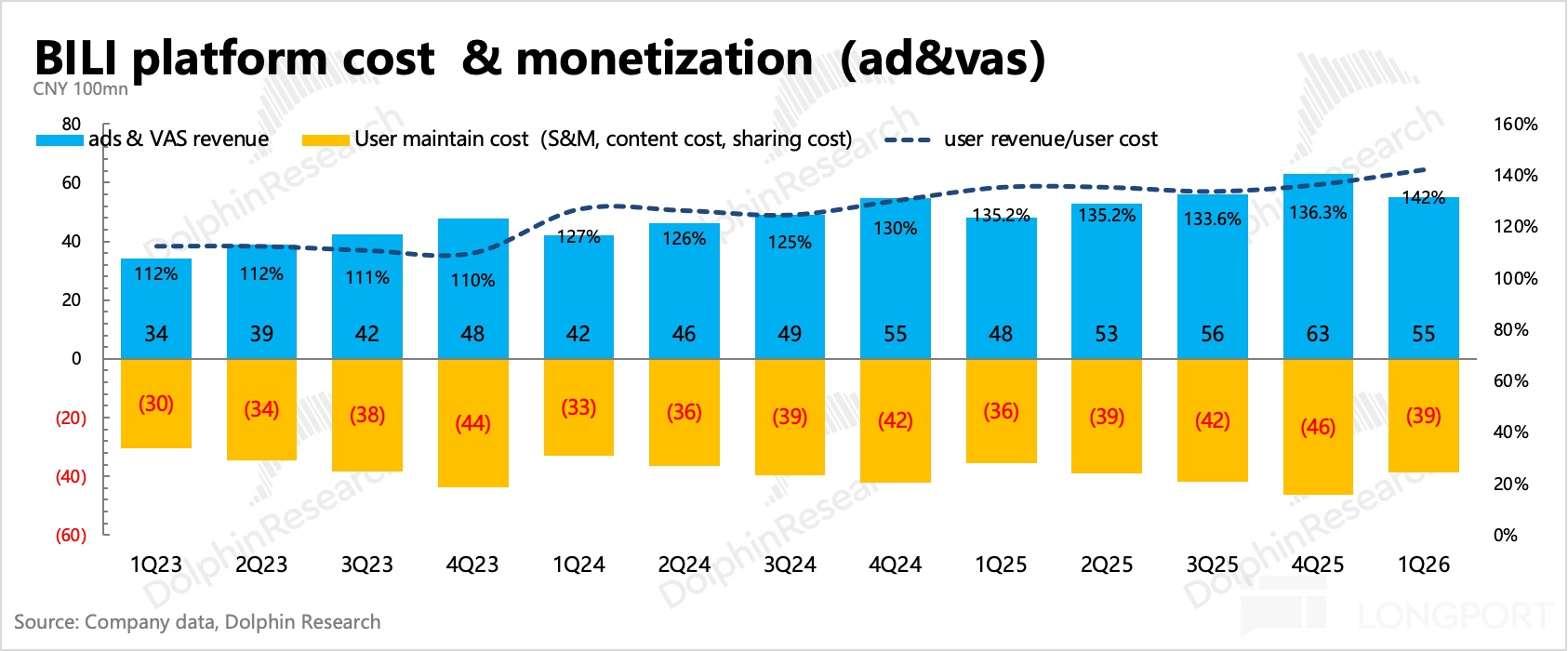
Although profits were somewhat diluted, monetization efficiency continued to improve on our 'traffic monetization vs. cost' framework. This mostly reflects a healthy ecosystem and stronger inherent monetization. Of course, management still needs to prove AI ROI with faster growth and improved monetization efficiency.
<End here>
Dolphin Research on 'Bilibili' — archive:
Earnings season (recent)
Mar 5, 2026 call notes 'Bilibili (Trans): Plan to reinvest part of incremental profit into AI this year'
Mar 5, 2026 earnings take 'Bilibili: Ads resilient; the platform’s 'one-legged' phase remains tough'
Nov 15, 2025 call notes 'Bilibili (Trans): Content pay to be an important growth engine'
Nov 15, 2025 earnings take 'Bilibili: A second growth spurt?'
Aug 21, 2025 call notes 'Bilibili (Trans): Reiterated 15–20% long-term OPM target'
Aug 21, 2025 earnings take 'Bilibili: After the 'Sanmou' thrill, where next?'
Risk disclosure and disclaimer: Dolphin Research disclaimer and general disclosure
The copyright of this article belongs to the original author/organization.
The views expressed herein are solely those of the author and do not reflect the stance of the platform. The content is intended for investment reference purposes only and shall not be considered as investment advice. Please contact us if you have any questions or suggestions regarding the content services provided by the platform.
