


HSAI (Trans): SGI biz to match LiDAR scale in 5 yrs
Below is Dolphin Research's transcript of Hesai Tech's 1Q26 earnings call. For the earnings analysis, see 'Hesai: Cutting losses to hold the line—pressure mounts on the No.1?'.
I. Key takeaways from the results
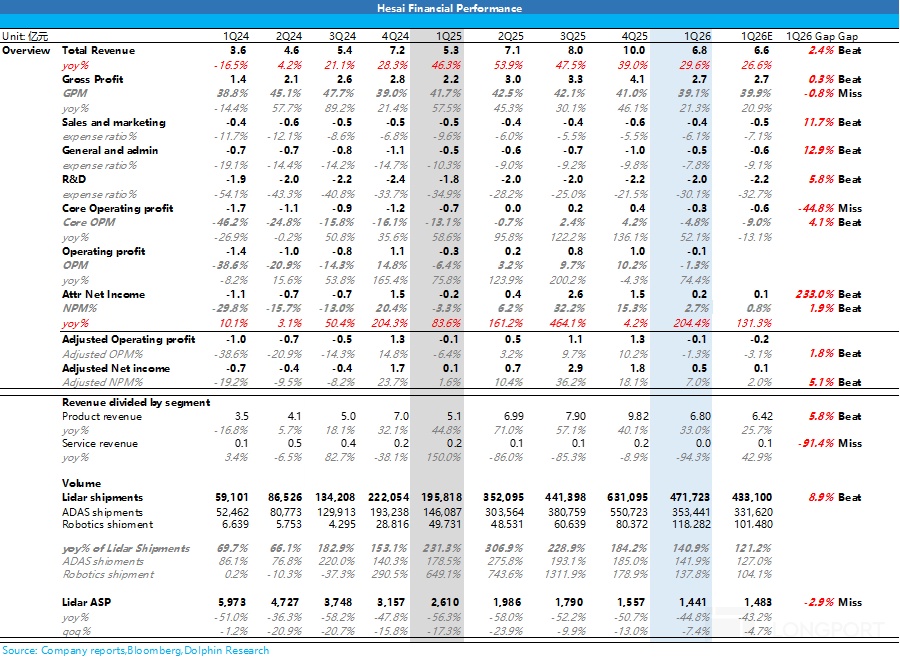
1. 2Q26 guide: Total net revenue is guided at RMB 850–900 mn (approx. $123–130 mn), up ~20%–27% YoY. Lidar shipments are guided at ~650k units. Revenue contribution from Strategic Growth Initiatives (SGI) will begin in 2Q26.
2. Full-year guide reaffirmed: FY26 lidar shipments maintained at 3.0–3.5 mn units. SGI is expected to contribute ~RMB 100 mn revenue in 2026, with a 2027 target of ~RMB 500 mn.
3. Profitability durability: 1Q26 GAAP net income was RMB 18 mn (approx. $2.7 mn). Non-GAAP net income was RMB 48 mn (approx. $6.9 mn). This marks the 4th consecutive GAAP-profitable quarter and the 6th consecutive Non-GAAP-profitable quarter.
4. Key financials: 1Q26 total net revenue was RMB 681 mn (approx. $99 mn), up 30% YoY, the 8th straight quarter of YoY growth. GPM stayed healthy at 39%+. Core lidar posted OP of RMB 42 mn, while SGI booked an OP loss of RMB 51 mn due to forward-looking strategic investment.
5. New segment reporting: From 1Q26, operations are reported under two segments—Core Lidar and Strategic Growth Initiatives (SGI, currently mainly Kosmo)—to enhance transparency and help investors track the distinct value drivers of both engines. This aims to better surface the independent growth profiles.
II. Details from the earnings call
2.1 Management highlights1. Core lidar biz.
a. Scale and share: 1Q26 lidar shipments exceeded 471k units, with both ADAS and robotics shipments more than doubling YoY. FY25 shipments reached a record 1.6 mn units, with a 2026 target to double to 3.0–3.5 mn units. As of Mar 2026, China share rose to 55% (source: Gasgoo), ~3x the No.2 and No.1 for 14 straight months. Hesai ranked No.1 globally in long-range ADAS lidar shipments with 43% 2025 share (source: Yole Group).
b. Product mix: Flagship ATX continues to scale in-vehicle installs, and the rebound edition of ATX started SOP in Apr 2026. Backlog exceeds 6 mn units. At the Beijing Auto Show, Hesai lidars appeared on 56 models from 24 mainstream brands, ranking No.1 by lidar installs, spanning Audi, Cadillac, Lotus, Li Auto, Xiaomi, BYD, Leapmotor, Geely, Great Wall, Changan, Chery, and Robotaxi players like Pony.ai and WeRide.
c. L3 trend: As the industry migrates from L2 to L3, lidar content per vehicle rises materially—L2 typically uses 1 lidar at ~$200/vehicle. Entry L3 is ~$350 (1 ATX + 2 FTX blind-spot lidars). High-end L3 can reach $500–1,000 per vehicle. Hesai has secured multi-lidar design wins at major OEMs such as Li Auto, Xiaomi, and Changan, and Li Auto’s multi-lidar models started deliveries on May 15, 2026, marking the first large-scale mass deployment of FTX blind-spot lidars.
2. Globalization
a. Mercedes-Benz: Named a strategic lidar partner and approved supplier for Mercedes-Benz’s L3 models, covering Europe and China, with production support from the Galileo Thailand manufacturing hub. This extends the existing relationship to more models and higher volumes. It broadens scope across programs and regions.
b. New markets: Won a design win for the 2026 GAC Toyota bZ3X, marking the first entry into the Japanese auto ecosystem. Also secured a new design win for Xiaomi’s overseas market, with SOP expected in 2027. Two structural growth drivers—Intl OEM partnerships and China OEMs expanding overseas—are set to power global growth.
3. Picasso platform and ETX lidar
a. Picasso is the world’s first 6D full-color ultra-sensitive SPAD-SoC that natively fuses RGB color with precise 3D geometry at the chip level to output real-time color point clouds. This is 'early fusion', distinct from peers’ 'system-level fusion' that packages a camera and lidar together and fuses later in software. Management believes Hesai is ~1 year ahead.
b. ETX, powered by Picasso, supports up to 4,320 channels and a max 600 m range, enabling ultra-high-res full-color 3D imaging and enhanced small-object detection. SOP is targeted for 2H26, with global scale-up in 2027–2028.
c. Secured an exclusive phase-2 design win for Cargo Bot transport robots. This is the industry’s first 6D full-color lidar mass-production contract for commercial vehicles.
4. Robotics
a. Hesai ranks No.1 globally by robotics lidar revenue, covering Robotaxi, Robovans, lawn-mowing robots, and humanoids (sources: GGII, Yole Group, Frost & Sullivan). The product footprint spans multiple categories. Leadership is broad-based across segments.
b. The JT128 lidar helped Honor Lighting’s humanoid robot set a new human world record at the world’s first half-marathon for humanoids. This showcased sensing performance in a demanding use case.
c. Robovans: Secured an exclusive 200k-unit lidar design win with Zelos. Deepened the strategic partnership with Neolix, becoming its largest lidar supplier. This strengthens share in logistics robotics.
d. Smart mobility: Won an FTX design-in for next-gen electric two-wheelers. Annual unit sales in China exceed 60 mn. This opens a sizeable opportunity.
5. Strategic Growth Initiatives (SGI)
a. Kosmo (AI algorithm-integrated spatial intelligence device): The world’s first spatial intelligence device with integrated AI, combining Hesai’s in-house high-precision lidar, multi-sensor suite, and proprietary 3DGS/AIGC algorithms to generate photo-real 3D environments. For a 200㎡ space, reconstruction time is ~1/5 of current 3DGS solutions and ~1/50 of traditional methods, with sharply lower labor cost. Target markets include robot simulation/training, immersive media, 4D entertainment, and industrial applications. Commercialization is progressing quickly with early orders from leading embodied-AI companies, top entertainment studios, global tech giants, industrial firms, and intl luxury brands. Revenue is expected at ~RMB 100 mn in 2026 (8-digit), targeting ~RMB 500 mn in 2027, and potentially scaling to a level comparable to core lidar within 5 years. Over time, the model aims to evolve from hardware into software + data + platform services, gradually forming an ARR model.
b. Robotic Actuation Modules: Leveraging core capabilities in materials science, simulation, precision manufacturing, and proprietary ASICs—and the engineering base of >1 mn automotive-grade motors and encoders shipped within lidar systems—Hesai is extending into robotic actuators. The effort remains early, but key performance metrics have reached industry-leading levels. Further details will be disclosed over the coming quarters.
2.2 Q&A
Q: What volume, revenue, and profit contribution could the Mercedes-Benz L3 partnership bring over the next 1–3 years and longer term?
A: Hesai has been named a strategic partner and approved supplier for Mercedes-Benz L3 models, covering Europe and China, with lidar production supported by the Galileo Thailand facility. While we cannot disclose further customer strategy details, we can confirm this new contract extends the current partnership to more models and larger volumes. Globally, our Thailand manufacturing hub, unified product architecture, and strategic collaboration with Nvidia position us uniquely to lead the ADAS market. Meanwhile, we continue to expand in the Japanese ecosystem (GAC Toyota bZ3X) and among Chinese OEMs going overseas (Xiaomi overseas, SOP 2027). Looking ahead, global growth will be underpinned by Intl OEM partnerships and China OEMs’ overseas expansion.
Q: How does Kosmo differ from and synergize with traditional lidar/scanner businesses? Are there comparable products? What is the expected financial contribution?
A: Kosmo is far more than a sensor or hardware device. It is the world’s first AI-integrated spatial intelligence device that fuses our high-precision lidar, multi-sensor inputs, and proprietary 3DGS/AIGC algorithms to seamlessly capture and reconstruct the physical world in photo-real quality. In the age of Physical AI, high-quality spatial data is a scarce strategic resource, arguably more critical than compute itself, and Kosmo is built to break that bottleneck. Traditional lidar outputs raw point clouds—the world’s 'wireframe'. Kosmo, through AI, generates complete photo-real 3D models with color, texture, and shading, closer to human perception. Our two core advantages are hardware—self-developed high-performance lidar ensures superior raw input quality—and software, where our reconstruction and AIGC algorithms have consistently outperformed other software in early customer feedback. Efficiency gains are substantial—reconstructing a 200㎡ space takes ~1/5 the time of current 3DGS and ~1/50 of traditional flows, while materially reducing labor cost.
This opportunity remains early and fast-evolving, making it hard to size TAM precisely, but it clearly spans robot simulation/training, immersive media, 4D entertainment, and industrial use cases. More importantly, Kosmo’s business model uses hardware as the 'front door' into the ecosystem, with software and platform revenues providing recurring engines via data processing, model training, and cloud-based services under licensing/subscription, which structurally supports higher software-driven margins. We have early orders from leading embodied-AI players, top entertainment studios, global tech leaders, industrial firms, and intl luxury brands.
Over the long run, Kosmo has two main paths: 4DV (3D + time) use cases, where a single lightweight Kosmo could replace today’s bulky, expensive 4D capture rigs. And a broader consumer opportunity that could mirror smartphones’ democratization of photography. Demo shipments are about to begin, and we expect 8-digit RMB revenue this year.
Q: What is the progress on humanoid robotic actuators? Where are the technical bottlenecks? Who are the potential customers? Are the actuators for the body or the hands?
A: While lidar is often seen as a sensor, it is actually a precision machine integrating optics, electronics, software, and precision mechanics to automotive-grade standards—maintaining extreme accuracy under years of vibration, heat, cold, and harsh driving, akin to asking a pro athlete to run a daily marathon without losing precision. Over the past decade, we have developed and shipped over 1 mn automotive-grade motors and encoders within lidar systems. From a physics perspective, lidar scanning modules and robotic actuation modules are highly similar, both requiring ultra-precise control of speed, position, and force. Extending from lidar to actuators is thus a natural step—capabilities in materials science, simulation, proprietary ASICs, precision manufacturing, and system engineering carry over from 'helping robots see' to 'helping robots move'.
The actuation module effort remains undisclosed in detail, but early signals are very encouraging, with key performance metrics among what we consider the industry’s best. We will share more specifics in coming quarters as the program advances.
Q: What are the ASP, revenue scale, and margin expectations for Kosmo and robotic actuation modules within SGI?
A: Both the actuation modules and Kosmo are reported under the newly established SGI segment, running in parallel with the core lidar business as early-stage innovation. As products are still in early commercialization, SGI is reported on a consolidated basis and not yet broken out. On revenue, SGI will start contributing in 2Q, and based on strong early interest and initial adoption, we expect ~RMB 100 mn for 2026 and ~RMB 500 mn in 2027. Over 5 years, SGI could scale to a level comparable to core lidar. On margins, as scale and maturity increase, SGI should be accretive to group GPM. Kosmo, integrating hardware, software, and data workflows, should structurally carry higher margins, and as deployments scale, parts of the business are expected to shift toward a software/platform ARR model, improving profitability.
On ASPs, we are still in very early deployment. Pricing is highly customized and pilot-led, and current datapoints do not reflect long-term unit economics. Once product lines enter scaled mass production, we will provide more standardized unit economics.
Q: How does the Picasso 6D lidar relate to cameras? What camera functions can 6D lidar replace? How does Hesai’s solution differ from peers’ fusion approaches, and what is customer feedback?
A: Cameras and lidars are often positioned as opposites, but it is like asking whether humans should choose color or depth—both are used together. Hesai’s 6D full-color lidar is built on that idea, enabling machines not only to detect objects but to understand the physical world more like humans. Looking ahead, in many applications the 'next-gen camera' may no longer be a camera, but a 6D full-color lidar, spanning opportunities in autonomous driving, robotics, industrial automation, infrastructure, and even consumer scenarios like Kosmo.
Technically, many current solutions package a camera and lidar in one box and fuse later in software (system-level fusion). Picasso is the world’s first 6D full-color SPAD-SoC that natively fuses RGB and precise 3D geometry at the chip level—an 'early fusion' akin to the brain combining both eyes’ real-time inputs—so the system understands depth and color in real time with perfect alignment, improving perception, reducing edge-case errors, and enhancing safety. Competitors are moving in a similar direction, which we see as validation of the trend, and we believe we are ~1 year ahead.
Customer feedback in both ADAS and robotics has been highly positive. For example, when overlapping traffic lights appear at adjacent intersections, traditional cameras struggle with depth and traditional lidar cannot see color; 6D full-color lidar solves both. Commercially, we secured an exclusive design win with Cargo Bot, the industry’s first mass-production contract for 6D full-color lidar in commercial vehicles. ETX with Picasso targets SOP in 2H26 with global scale-up in 2027–2028.
Q: Any update to the 2026 full-year revenue outlook? When does SGI start contributing in Q2? Is ~18% QoQ growth for core (ex-SGI) conservative? What is the 2Q26 shipment guide?
A: We guide 2Q revenue at RMB 850–900 mn with ~650k lidar units. Q2 will be the first quarter with SGI revenue contribution, and GPM should remain resilient even as ADAS scales rapidly. We have delivered 4 consecutive GAAP-profitable quarters and 6 consecutive Non-GAAP-profitable quarters and expect the momentum to continue. Based on normal seasonality and OEM production cadence, we expect steady QoQ improvement throughout the year. SGI is expected to contribute ~RMB 100 mn in early 2026 as it ramps. Full-year lidar shipment guidance remains 3.0–3.5 mn units, and we have high confidence in the revenue and delivery trajectory, driven by rising lidar penetration, the L3 transition boosting per-vehicle sensor content, early mass-production ramps in global ADAS programs (including China OEMs going overseas), and ongoing expansion of robotics across diversified applications. Core lidar remains the solid base, and we are highly optimistic about SGI’s potential, with more updates to come.
Q: How should we interpret falling lidar ASPs? What is the long-term pricing trend?
A: The apparent decline in ASPs reflects robust market expansion and a structural product mix shift. As the mass market scales up, ADAS lidars account for a larger share of total units, and ADAS products naturally price below robotics lidars, pulling down blended ASPs. Fundamentally, this is healthy and indicates lidar is becoming mainstream in autos and robotics.
Looking ahead, the industry’s shift to L3 is a clear structural catalyst that lifts sensor content per vehicle. In L2 last year, lidar content per vehicle was ~$200 (typically one long-range ATX); L3 starts around $350 (1 ATX + 2 FTX blind-spot lidars). With high-end ETX and more FTX units, content can reach ~$500–1,000 per vehicle. This is already reflected in early customer adoption and is scaling. In addition, with the Picasso 6D full-color SPAD-SoC, lidar is evolving from a passive safety sensor to an active intelligence layer, extending from pure safety into active functions and creating a clear upgrade cycle that should support premium pricing for advanced configurations. Over the long term, the market may resemble smartphones—once users experience better capability, they see it as an upgrade rather than a cost burden.
Q: How is lidar industry competition evolving? What differentiates Hesai’s leadership?
A: Competition discussions often jump straight to price. Unit prices have indeed declined for years, but that stems from strong in-house ASIC capability and system integration that enabled lidar to scale into mass adoption without sacrificing performance. As a result, lidar is now in not only high-end cars but even affordable home appliances, and rapidly penetrating categories once thought unlikely, such as lawn-mowing robots and electric two-wheelers. Once the cost-performance curve passes an inflection point, adoption accelerates exponentially.
Today, Hesai ranks No.1 globally in long-range ADAS lidar shipments (43% share in 2025) and lifted China share to 55% in Mar 2026—~3x the No.2. In robotics, Hesai is also the No.1 lidar revenue player across Robotaxi, Robovans, lawn-mowing robots, and humanoids. The more important question is who can lead multiple waves of tech iteration. The industry is moving to higher performance, higher resolution, new architectures, and new demand types. Hesai has launched a 4,320-channel product, is scaling blind-spot lidars (full 360° coverage) in mass production, advancing Picasso 6D full-color fusion, and building high-fidelity spatial intelligence for Physical AI via Kosmo. Our edge lies in a decade of engineering depth and talent—Hesai has built a full product family from gas-detection lidar to mechanical, semi-solid-state, and solid-state architectures, which have fundamentally different underpinnings, and we are extending the same capability to Kosmo and robotic actuation modules. This is deep tech. We welcome competition and remain highly confident in our structural advantages and our ability to deliver category-defining products. Our Physical AI roadmap is a key differentiator.
<End of text>
Risk disclosure and statements:Dolphin Research Disclaimer and General Disclosure
