


WMT: Veteran's surprise e-comm offensive — why a re-rate?
Part I broke down Walmart’s low-cost engine: differentiated small-town locations, a fully controlled end-to-end supply chain, reverse pricing with EDLP, and a broad private-label portfolio. Together, these made it the king of offline retail through extreme efficiency and cost discipline. $Walmart(WMT.US)
This piece focuses on Walmart’s e-comm biz — the key swing factor for its long-term growth and next leg in market cap — and runs a head-to-head comparison with Amazon to unpack Walmart’s differentiated path.
In FY2026, Walmart’s global e-comm exceeded $150bn, accounting for 20%+ of total revenue, becoming its second-largest segment after U.S. stores. By market position, Walmart is now the No.2 e-comm platform in the U.S., behind Amazon.
At the same time, the charts below show that although the gap is narrowing, Amazon’s U.S. e-comm share remains dominant and is still rising. In other words, Walmart captured a space Amazon has not fully monopolized and one that better fits Walmart’s asset base. How did it do that? We analyze this central question below.
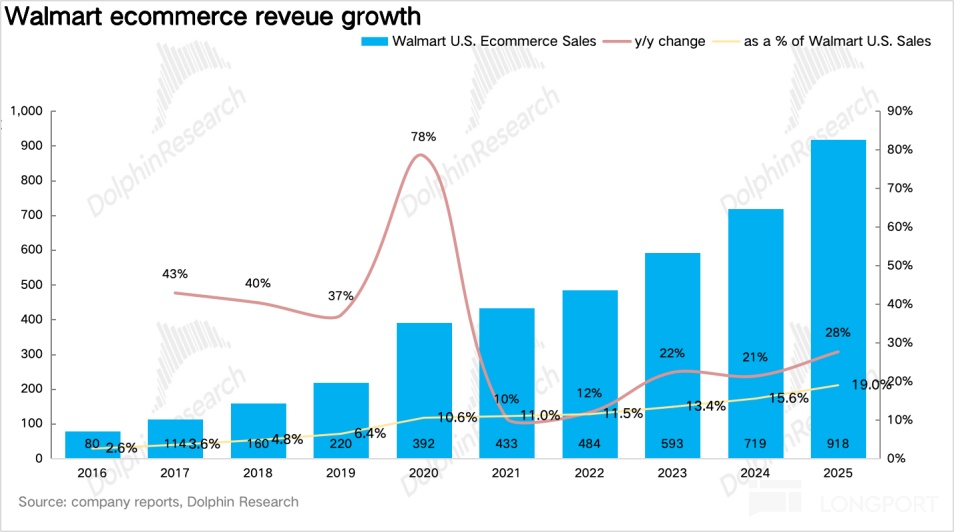
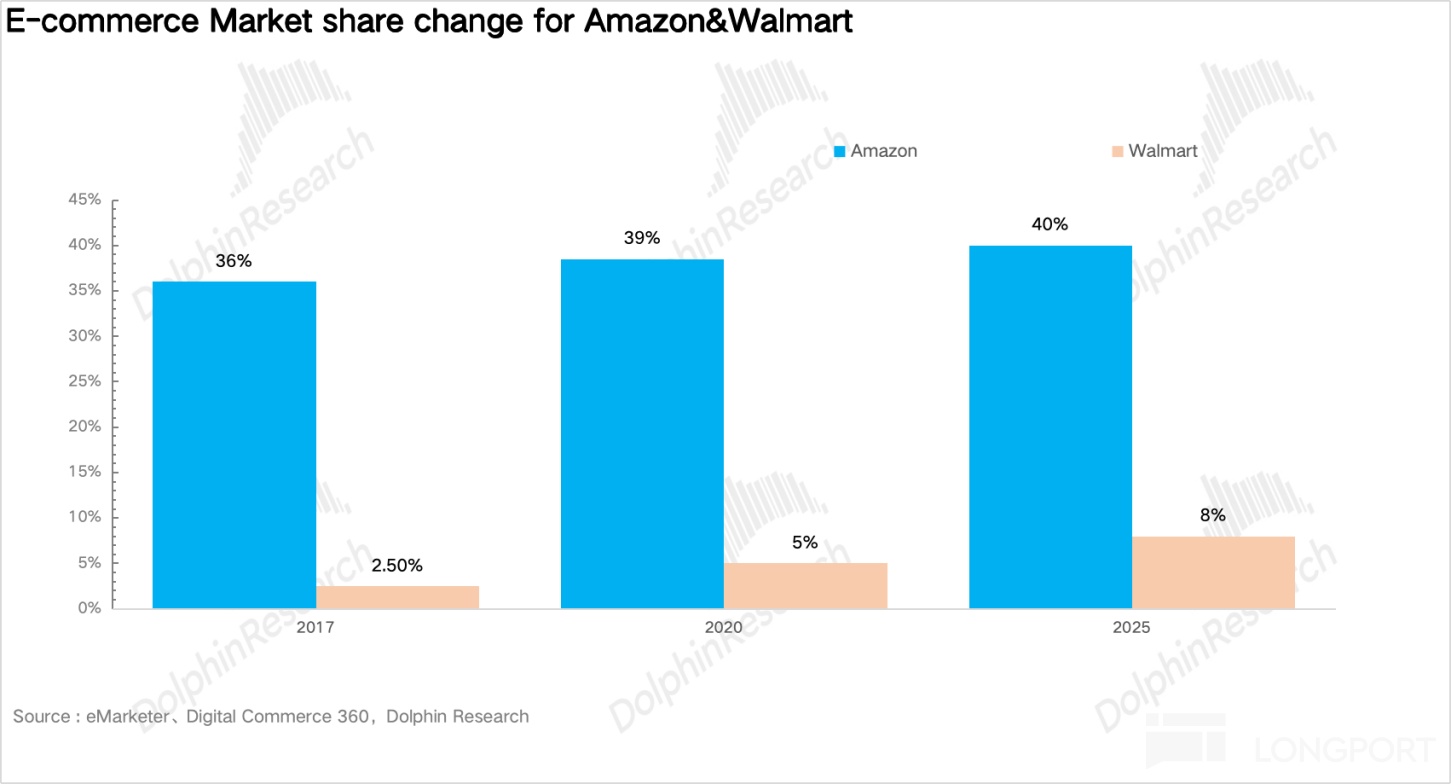
Details below:
- Amazon’s heavy-asset chokepoint vs. Walmart’s stock-asset dividend
Pre-2016, Walmart treated e-comm as an appendage to stores, lagging in strategy, org, and fulfillment. Harsh reality: from personalization algorithms to full-funnel digital ops, Amazon was born a tech-native retailer with superior data-driven decisions, online UX, and iteration speed — far ahead of Walmart’s store-first operating mindset.
If Walmart had fought Amazon head-on purely online from Day 1, it likely would have burned cash for traffic without retention, failing to clone Amazon’s tech DNA and squandering its unique asset — 4,600 stores across the U.S.
Given that, Walmart avoided a frontal traffic war, shifting focus to offline fulfillment. In our view, this was the key to its rapid e-comm scale-up.
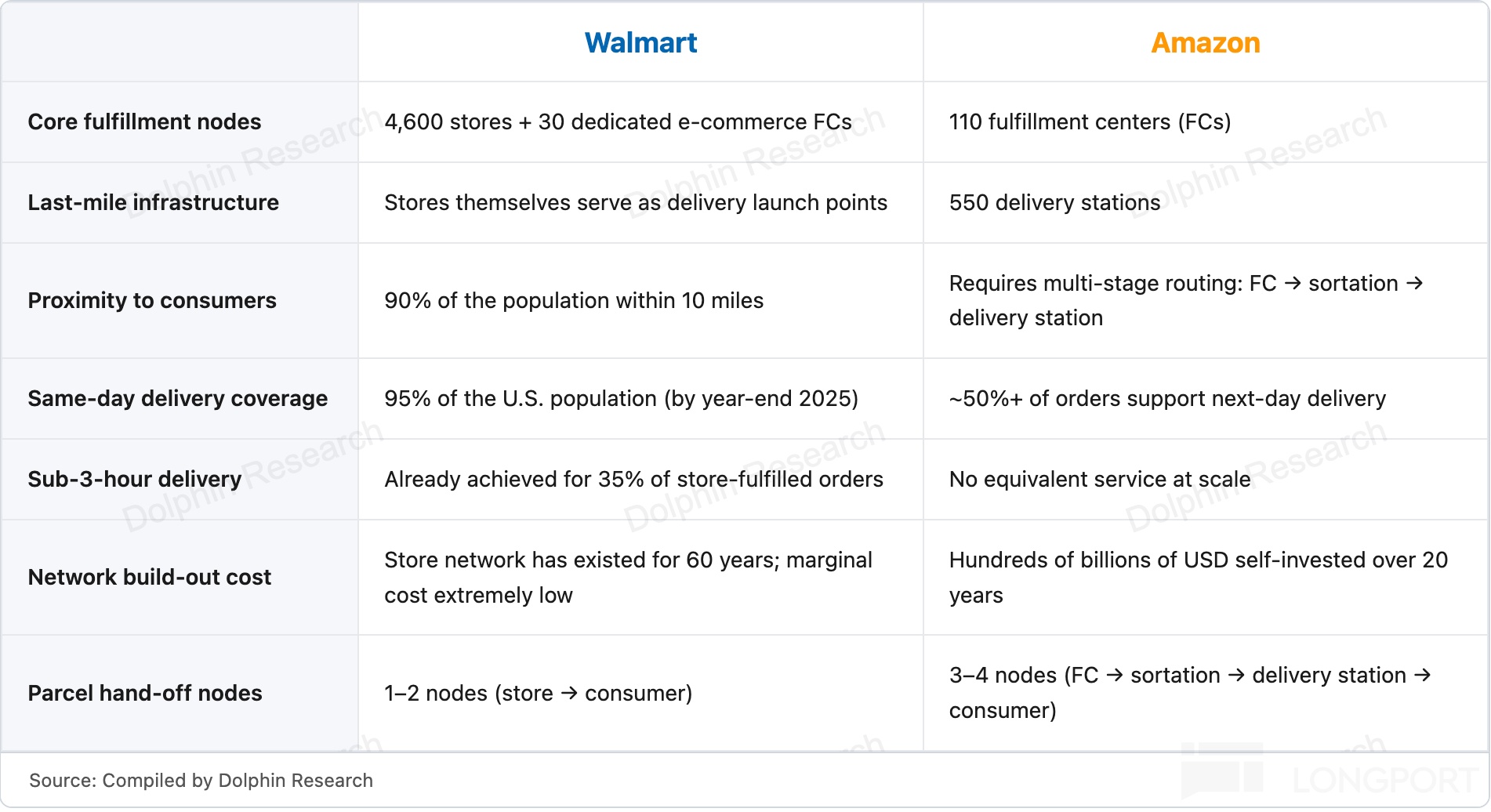
To see the core of Walmart’s playbook, start with Amazon’s model: seasoned e-comm investors know Amazon’s network is a capital-heavy logistics stack built from scratch. Parcels move through at least 3–4 nodes (supplier → FC → sort center → delivery station → last mile). Because last-mile density is low and orders are dispersed, last mile accounts for 45%–55% of total logistics cost, exceeding linehaul + sorting + warehousing combined, becoming the efficiency black hole for traditional e-comm profitability.
To stay best-in-class on speed, coverage, and CX, Amazon keeps building FCs, expanding its network, hiring drivers, and upgrading tech. That’s why its retail OPM hovered around ~3% for years even at scale.
Despite investing in delivery stations, automation, and air cargo to pull inventory closer and boost density, last mile’s outsized share keeps fulfillment expense at 14%–16% of revenue, with no clear downtrend.
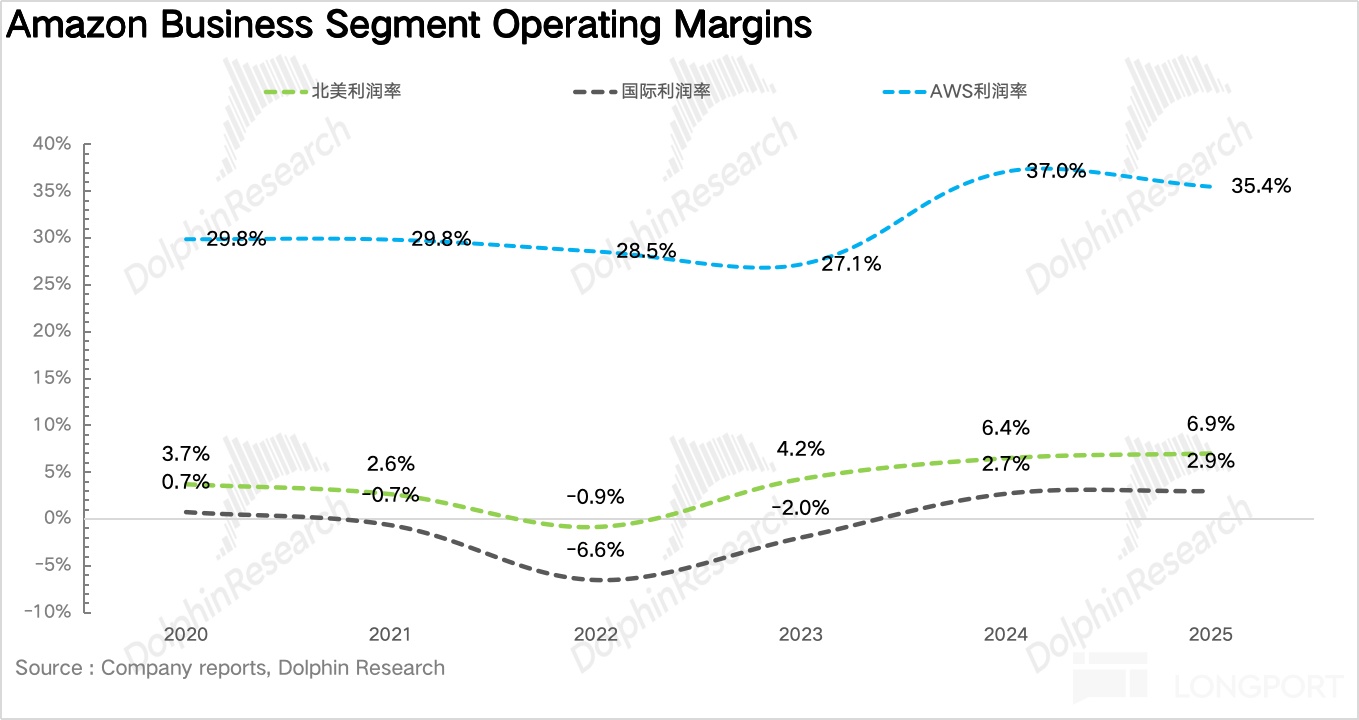
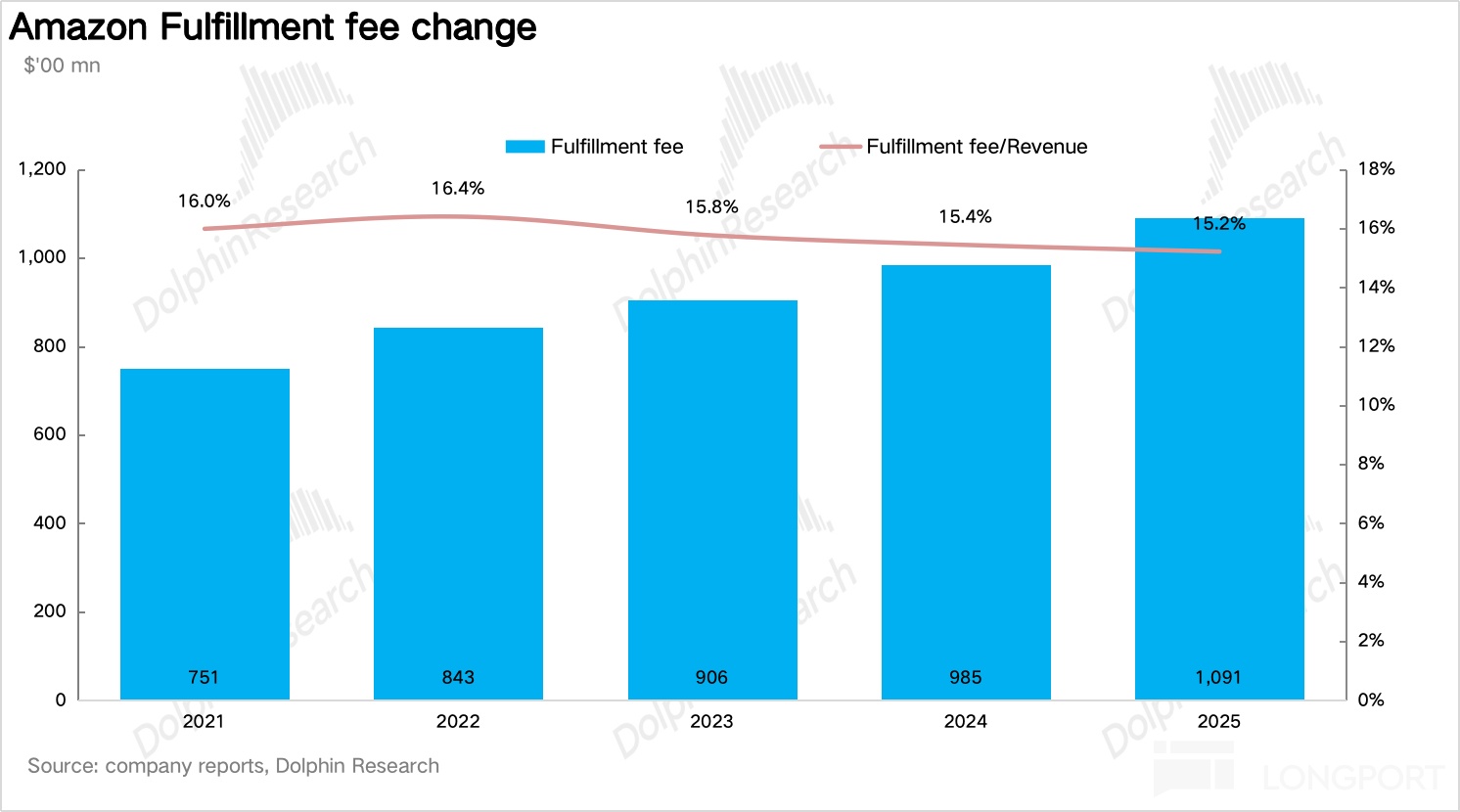
Against this backdrop, Walmart is converting its 4,600-store network into a front-end fulfillment mesh for the digital era — a store-as-warehouse model.
Here’s the simple but unmatched fact: nearly 90% of Americans live within 10 miles (16 km) of a Walmart. In effect, the ‘close-to-consumer’ network that took Amazon two decades and tens of billions to build, Walmart already has.
But having stores is not the same as fulfilling efficiently, which requires a full retrofit. Walmart sequenced three steps:
Phase 1: Put a digital brain in associates’ hands:
In 2022, Walmart rolled out Store Assist, a digital in-store picking and dispatch system. For each online order, the system prioritizes by SLA (1-hour express, same-day, next-day pickup), auto-splits into tasks, assigns to the nearest associate, and guides optimized pick paths via handhelds, directing them to backroom staging areas for fast sort and pack,
Now deployed across almost all stores.
The value: without changing store layouts, software + devices can push ‘people-to-goods’ efficiency near a dark-store benchmark at minimal marginal cost.
Phase 2: Reframe physical space:
On top of software, Walmart added pickup staging zones and delivery staging, widened aisles, and optimized shelving so online and offline flows coexist with minimal friction. This brought ‘store + warehouse’ into reality, turning stores into scalable e-comm nodes. Per management, this is ramping at scale, with ~70% of core stores slated for retrofit by end-2027.
Phase 3: Backroom automation via micro-fulfillment
Where Phases 1–2 are labor-bound, from 2023 Walmart began piloting backroom automation (APD, Accelerated Pickup and Delivery Center), a compact automated storage and picking system deployed in the backroom. For online orders, robots handle standard SKU retrieval, sort, and staging; associates focus on fresh picking, consolidation, QC, and handoff, unlocking further efficiency and cost per order gains.
APD moved to co-development with Symbotic in 2025 and remains in prototype and limited pilots. Scaled store rollouts likely land in 2027–2029, so automation dividends should phase in over the next 3–5 years, not overnight.
Put together, Walmart’s logic is clear: software first to reach ‘80% efficiency’ (Store Assist), then space/process reengineering, and finally APD automation to drive the terminal cost curve lower.
Crucially, all three layers sit on Walmart’s 4,700 existing stores — no landbanking or greenfield logistics needed. It is incremental capex on stock assets, with lower capex, cheaper trial-and-error, and greater flexibility than Amazon’s multi-hundred-million-per-FC model.
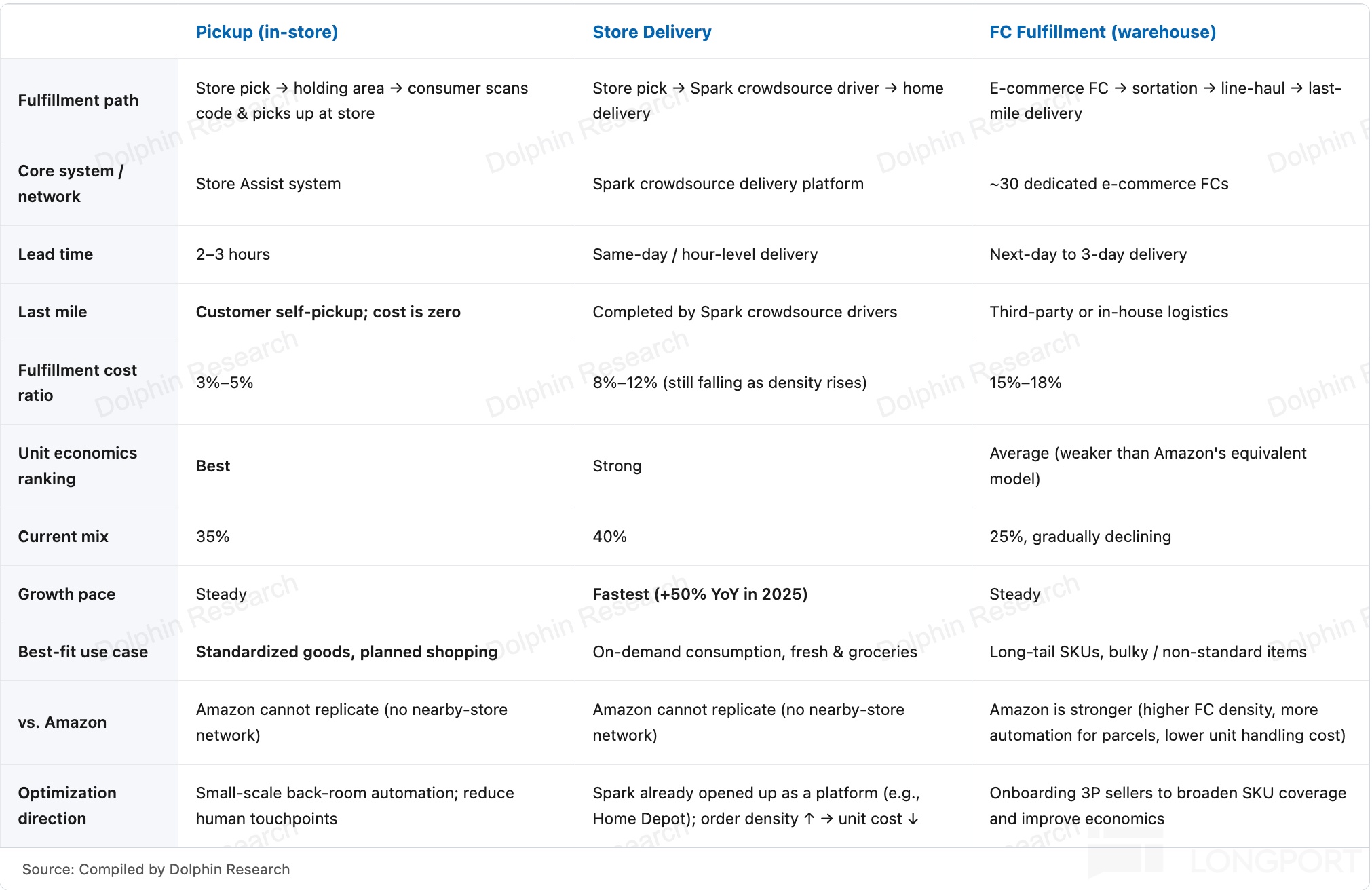
On this store retrofit base, Walmart’s 1P fulfillment now runs three modes:
1) Store pickup: Walmart’s earliest e-comm fulfillment. Orders route to the nearest store, associates pick/pack via Store Assist, stage in pickup zones, and customers scan to collect, typically within 2–3 hours.
Economically, customers bear the ‘delivery’ step, so last-mile cost is zero. Walmart only incurs in-store pick and pack, yielding a 3%–5% fulfillment expense ratio — the best unit economics and highest ops efficiency among the three paths, with ~35% mix.
2) Store ship: last mile via Spark crowd drivers. With on-demand rising in North America, store ship is Walmart’s fastest-growing mode (+50% YoY in 2025), now near 40% mix.
In 2021, Walmart opened Spark to external retailers like Home Depot, platforming the network to spread fixed costs. Higher order density lifted driver acceptance and service stability materially.
Street models suggest an 8%–12% fulfillment expense ratio for store ship, and unit cost per order is still trending down with density. Pickup and store ship both leverage near-store networks to beat Amazon’s long-haul model on cost and speed, forming Walmart’s core moat in differentiated e-comm.
3) FC ship: closest to Amazon’s model. Orders ship from ~30 dedicated e-comm FCs through sort, linehaul, and last mile, suited to long-tail SKUs and bulky/non-standard items unavailable in stores.
But Walmart’s FCs trail Amazon on piece automation, unit handling cost, and network density. Longer average distances push fulfillment expense to 15%–18%, weaker than Amazon’s economics.
Hence, Walmart has been raising its 3P mix (see below) and leaning into near-store fulfillment to lower the FC-ship share and lift e-comm profitability.
II. Start with grocery; use high-frequency to pull low-frequency
We showed how Walmart turned 4,700 stores into a prepositioned network, using stock assets to bypass Amazon’s FC efficiency trap. On the demand side, Walmart also avoided an all-category traffic fight, anchoring on grocery as its strategic beachhead.
Timeline-wise, until 2021 Walmart’s e-comm focused on fresh, food, and daily necessities, with limited 3C, apparel, and home. Fulfillment focus, resource allocation, user acquisition, and model validation all centered on grocery.
Why start with grocery — a category with ‘anti-e-comm’ traits (low margin, heavy fulfillment, time-sensitive, complex cold chain)?
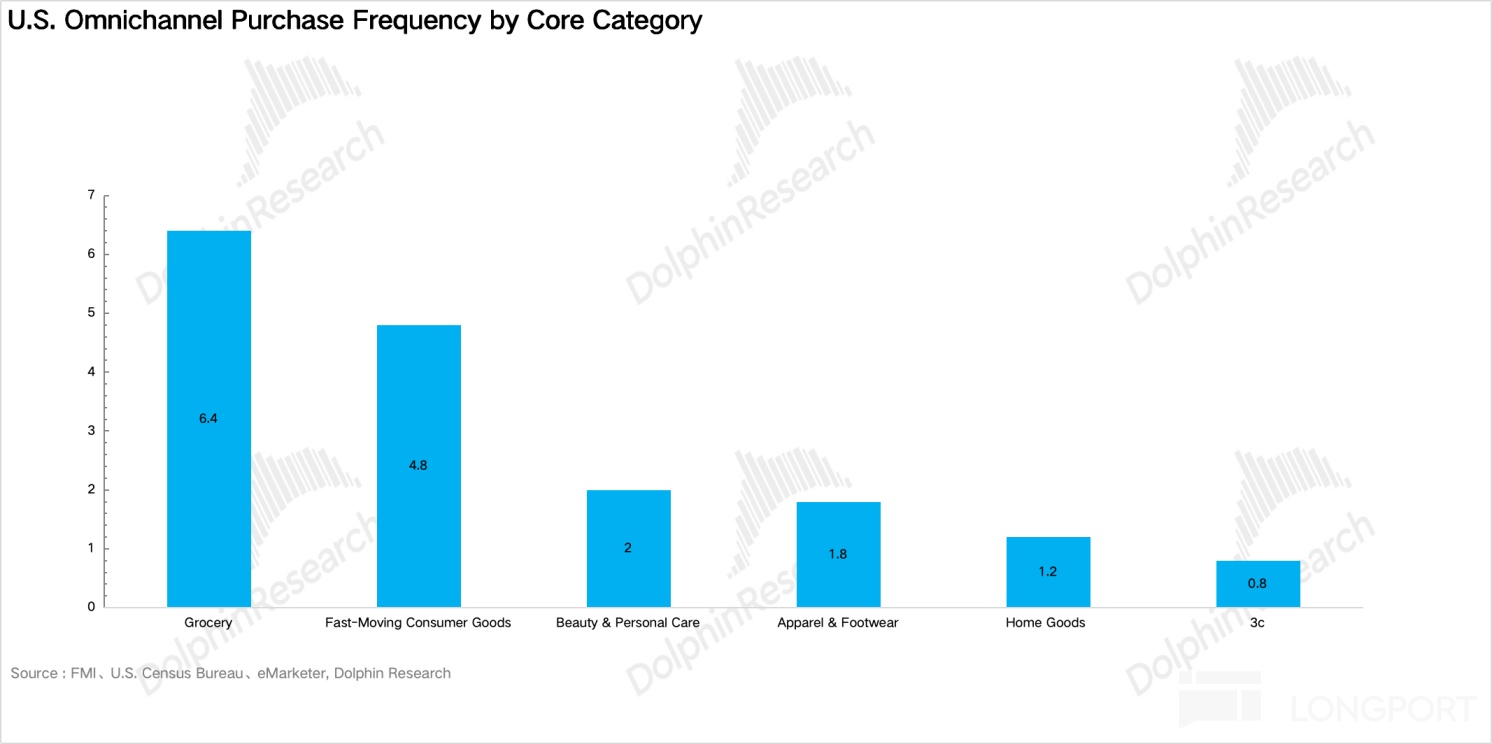
Because management saw what others could not deliver: frequency. Statista data show U.S. consumers shop for grocery 1.6x per week on Avg., while apparel, home, and electronics are typically 1–2x per month. Owning grocery means owning the most stable, repeated, non-discretionary touchpoint.
Why could Walmart succeed from grocery?
First, recognize Walmart was already the undisputed offline grocery leader before e-comm. As analyzed in ‘Walmart: How the trillion-dollar retail legend was forged?’, its nationwide dense store network, tightly controlled supply chain, and EDLP DNA inherently match grocery’s core: near-home, high-frequency, time-sensitive.
Results: grocery has long driven 60%+ of Walmart U.S. revenue, forming the largest, most recurring, and steadiest traffic base. By share, Walmart holds ~21% of U.S. grocery — more than double Kroger and Costco — while Amazon, including Whole Foods, is under 2%.
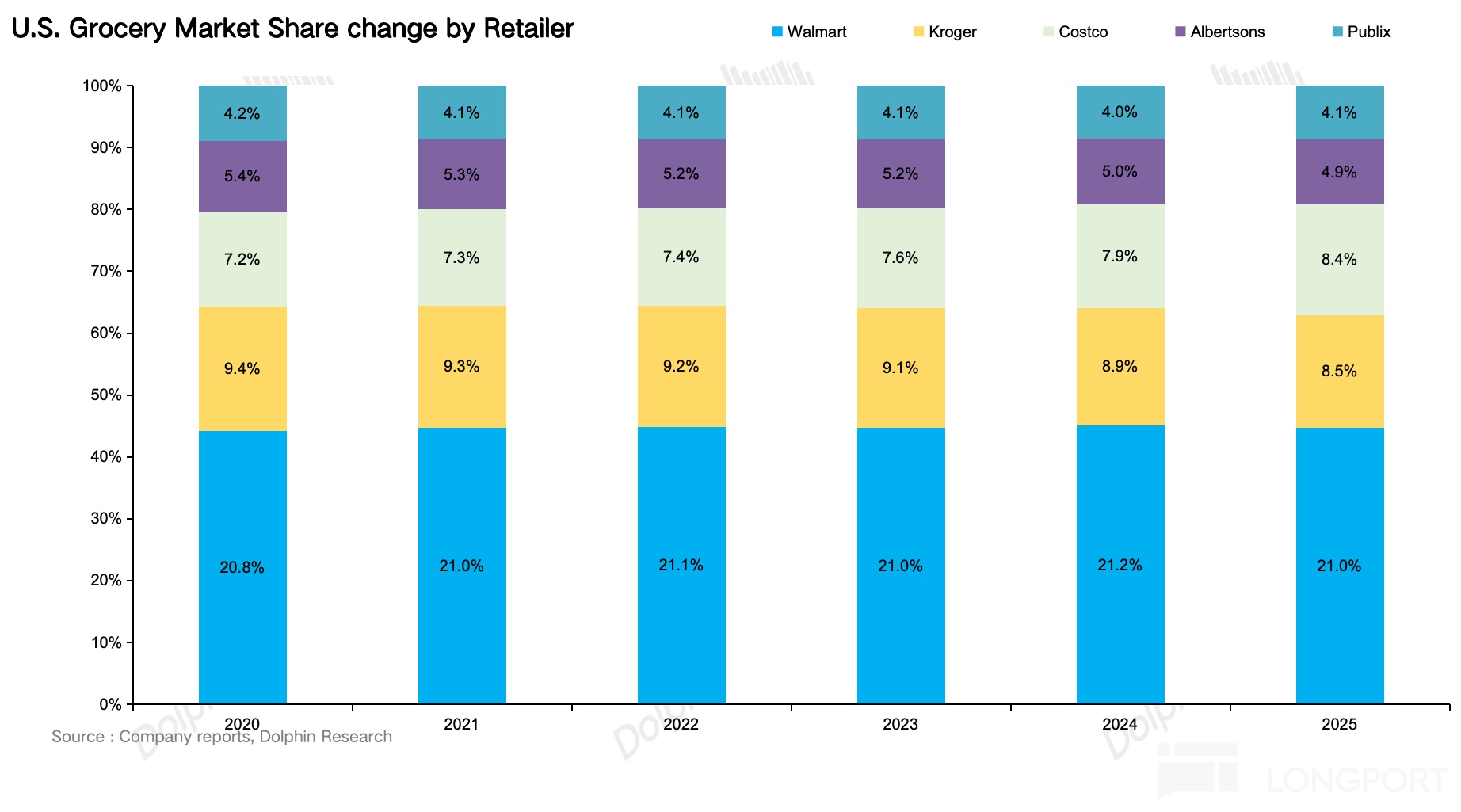
Given this, it’s clear why starting with grocery worked: it migrated high-trust offline users online with minimal new CAC, the most natural growth path.
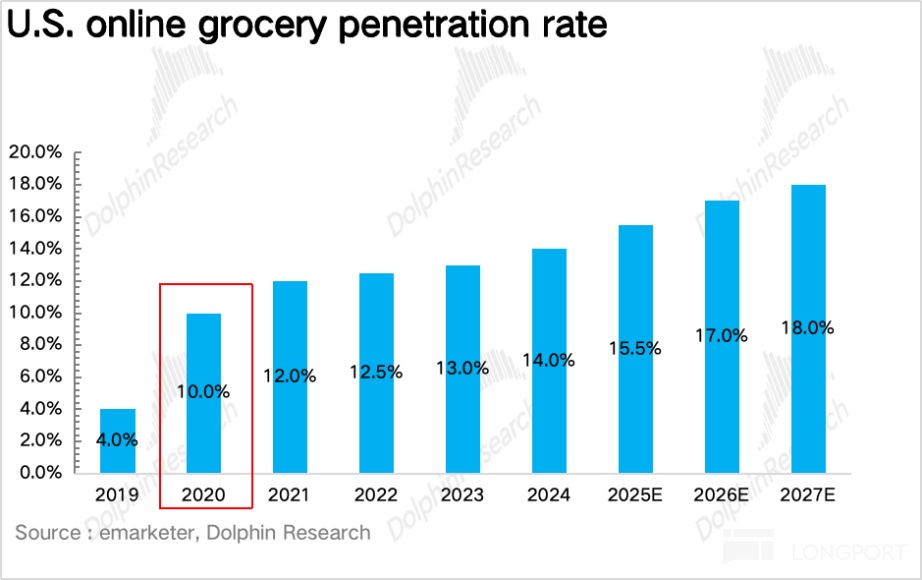
Beyond Walmart’s EDLP-grocery fit, the 2020 pandemic hit the accelerator. Pre-Covid, U.S. online grocery penetration lingered at 3%–4%, with consumer hesitancy on fresh and food.
Lockdowns forced hundreds of millions to try online grocery, pushing penetration to ~10% in 2020, and Walmart — laser-focused on grocery — caught the wave. More importantly, penetration kept rising post-Covid to ~14% in 2024, signaling a structural shift in habits, a long-term tailwind for Walmart.
With user education, trust, and fulfillment validated, from 2021 Walmart moved to ‘grocery as the base, extend to GM’.
Management recently reiterated its category strategy: use lower grocery prices to lift consumer purchasing power and redirect it to general merchandise (GM), confirming grocery as the traffic/loyalty anchor and GM as the monetization lever.
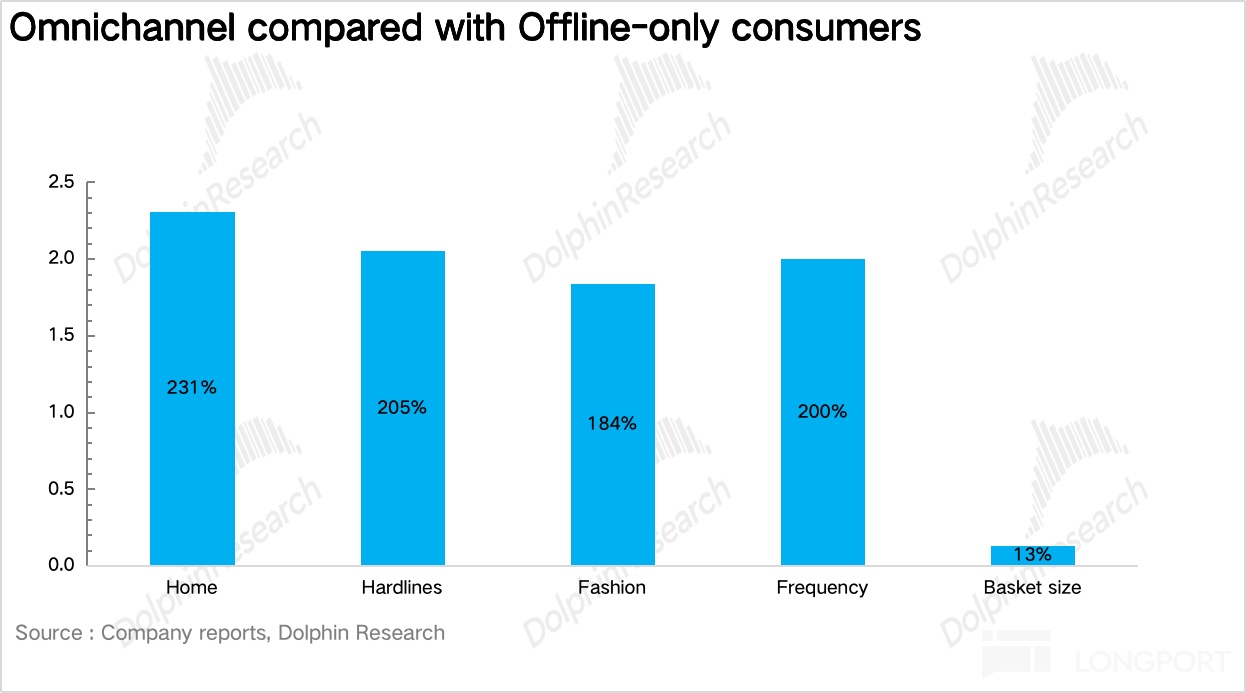
The logic is straightforward: pure online grocery users focus on replenishment, with single-use scenarios and lower AOV caps. Once users shift to omnichannel, behavior upgrades fundamentally.
Pickup and express delivery naturally drive in-store impulse. Meanwhile, rising channel trust nudges demand from fresh/grocery into daily goods, home, and small appliances, expanding both breadth and depth.
Per Walmart, omnichannel users shop 3x more frequently with 13% higher basket, and home, hardlines, and fashion sales are nearly 2x vs. store-only shoppers. This shows higher reliance and stickiness post O2O integration, boosting LTV. The flywheel becomes: grocery frequency → instant fulfillment stickiness → natural category expansion.
III. From 1P to 3P: the margin thickener
We covered how 1P cracked fulfillment and traffic. The real swing factor for turning e-comm from ‘scale for buzz’ to ‘cash machine’ is the fast-growing 3P ecosystem.
We break 3P into four interlocking modules: Marketplace (3P sellers), Walmart Connect (retail media/ads), Walmart+ (paid membership), and data. Together they form a flywheel of traffic → transactions → ads → data → better-targeted traffic, the core of e-comm re-rating.
We unpack each, versus Amazon.
3.1 Marketplace: make ‘other people’s inventory’ your own profit
Why bring in 3P when 1P runs well? Because 1P is hard to monetize, even if it stabilizes traffic. Once users arrive, they want more SKUs — 3P expands supply.
While Walmart doesn’t disclose 1P profitability, Street work suggests most 1P categories still skew grocery, so gross margin is thin. Even with lower last-mile cost under the store-warehouse model, EBIT hovers around -2%.
This is no surprise. Amazon already proved the endgame: 1P anchors price, builds fulfillment, and seeds users — low margin or breakeven but indispensable; 3P is the profit core — sellers hold inventory risk, platforms collect take-rates, fulfillment fees, and ad dollars, delivering asset-light, high-GM, high-velocity growth.
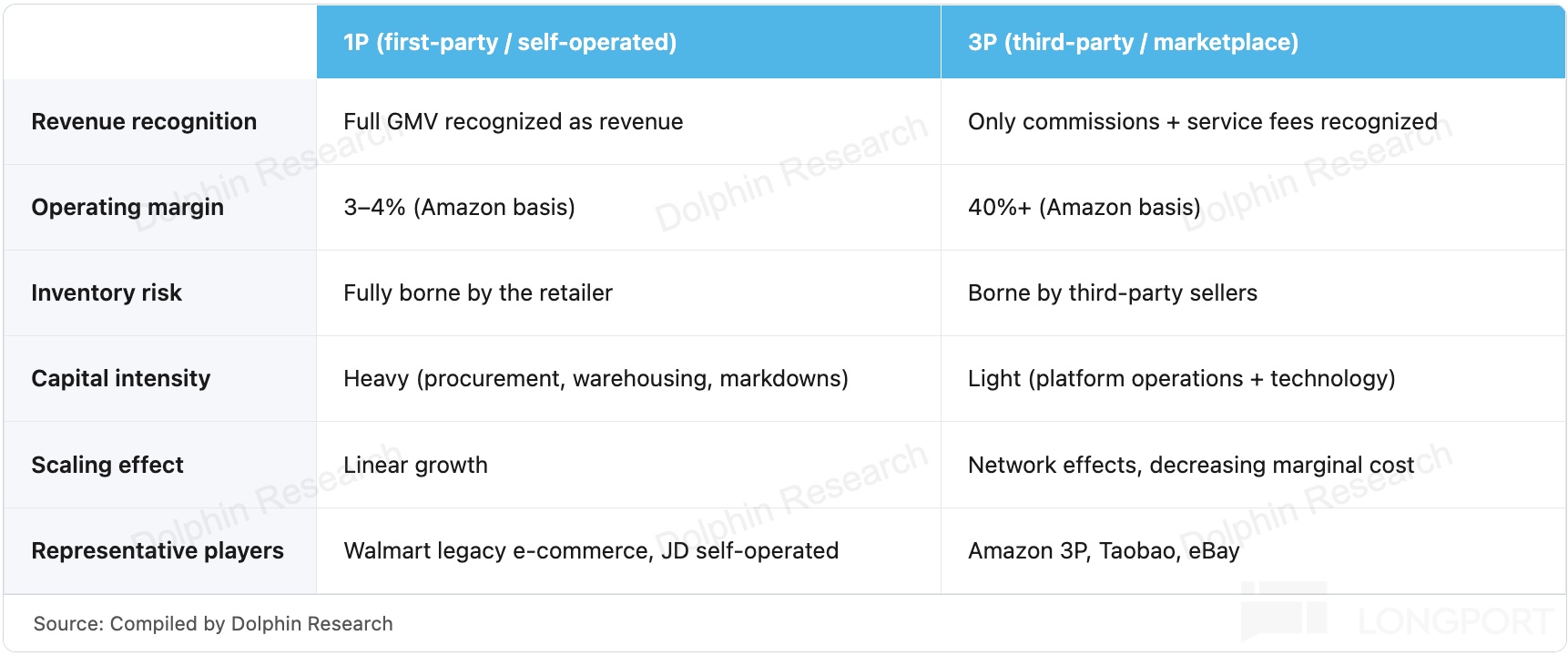
Put simply, selling your own goods is heavy lifting; helping others sell is rent-collecting. That is why shifting to 3P is the pathway to higher margins for any marketplace — Amazon did it first, and now it is Walmart’s turn.
Walmart is pushing hard from 1P toward 3P. Per Street checks, 3P GMV has grown 30%+ for multiple quarters, outpacing ~25% in 1P, with 3P now ~26% of e-comm GMV (~$45bn) and rising.
With similar take-rates for most categories (8%–15% for both Amazon and Walmart), why would sellers migrate from Amazon’s mature ecosystem? The edge lies in higher ad ROI and lower fulfillment fees.
a) Higher ad ROI
For sellers, traffic is oxygen. Amazon’s 3P is mature and crowded, with 2mn+ active sellers and 1,000+ per sub-category on Avg.
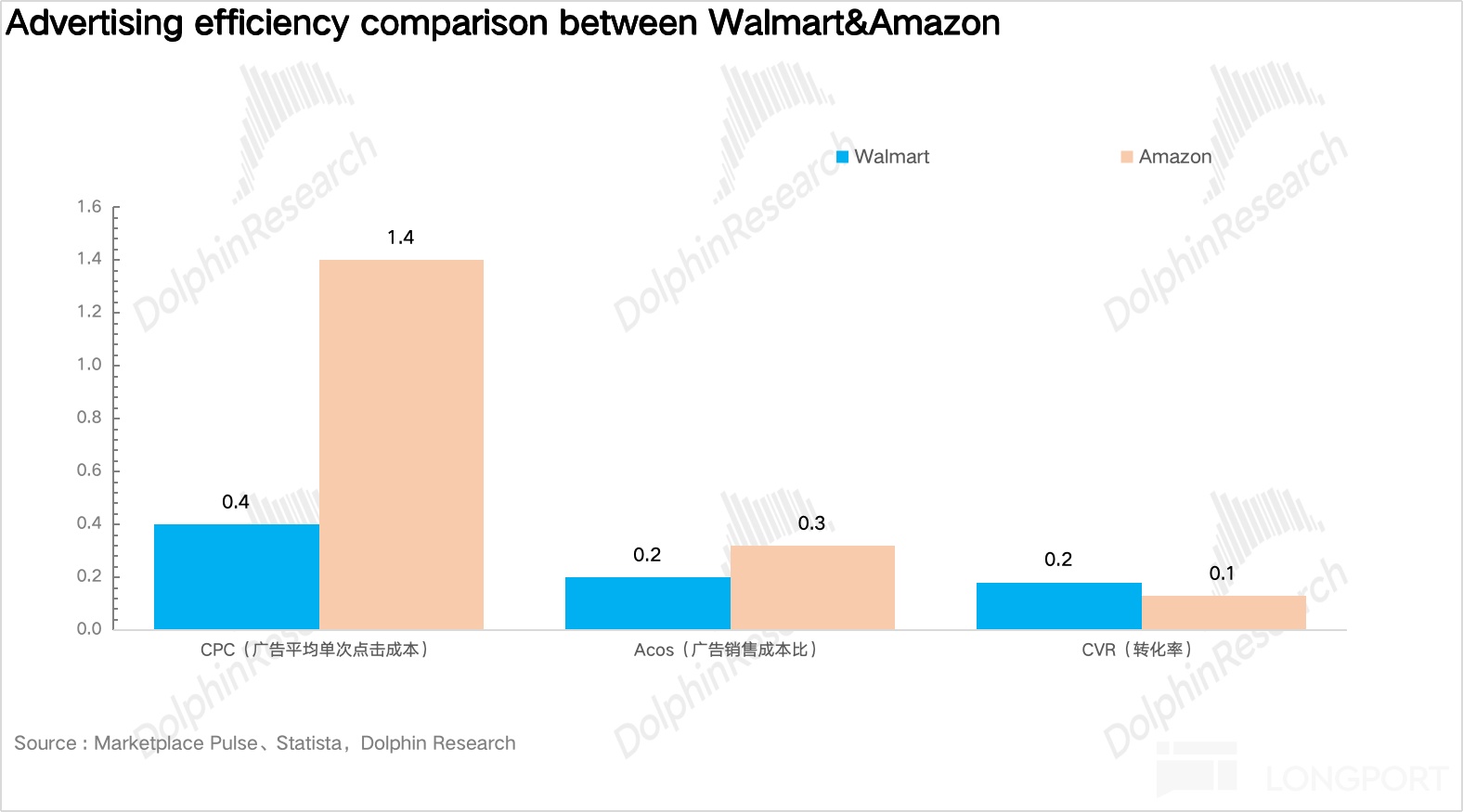
That density pushes up paid traffic costs: Marketplace Pulse shows CPC rose from ~$0.70 in 2018 to ~$1.10 in 2025, up ~60% (hot categories doubled).
For SMB sellers, ads have shifted from growth lever to survival tax — no ads, no exposure; with ads, margins get squeezed.
By contrast, Walmart Marketplace is in its early-dividend window. Active sellers are ~200k — one-tenth of Amazon — with more ad inventory and softer auction dynamics, akin to Amazon’s 2015–2018 ‘golden era’. For savvy sellers, listing on Walmart is grabbing the next traffic dividend.
Also, Walmart reaches 150mn consumers per week across channels, many converted online via stores and pickup. They are high-frequency (weekly grocery), high-trust (legacy store shoppers), and value-oriented — incremental to Amazon’s audience.
In performance terms, Walmart leads on key seller metrics shown below.
b) More attractive logistics pricing
To attract 3P, Walmart’s WFS undercuts Amazon’s FBA across all weight tiers above 1 lb. Per Morgan Stanley, the heavier the SKU, the bigger the gap; above 50 lb, WFS fees can be half of FBA.
The only exception is sub-1 lb items under $10, where Amazon’s highly automated FC network preserves a cost edge. But light/small items are a minority of GMV (<20%), with most GMV over 1 lb.
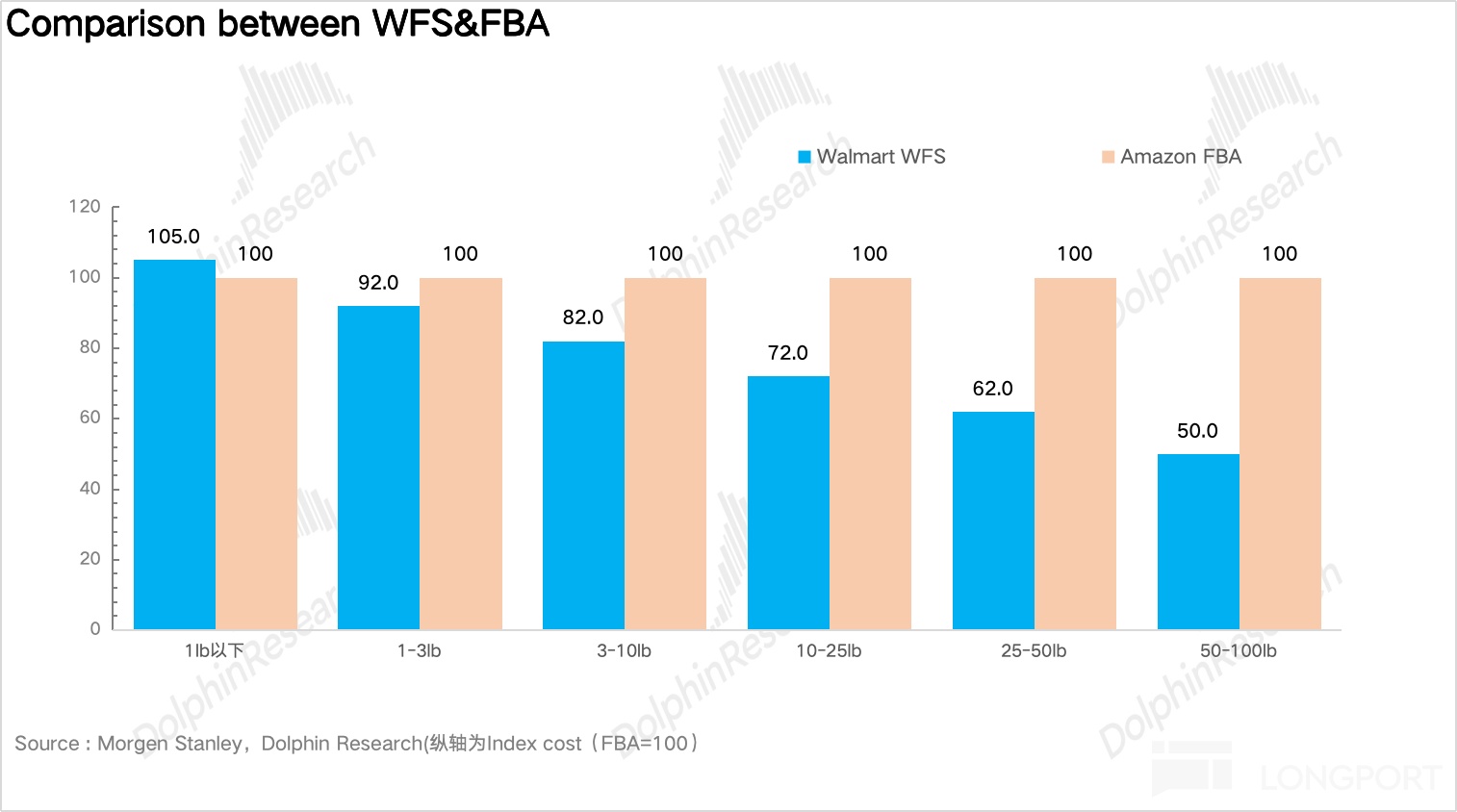
Per FY2025 disclosures, Marketplace sellers grew 50% YoY in the past 12 months, and among top decile sellers, 70% use WFS.
3.2 Walmart Connect: the retail-media cash printer
If Marketplace is the ‘transaction layer’, Walmart Connect is the ‘monetization layer’ — highest margin, fastest growth, and the largest TAM unlock in the flywheel.
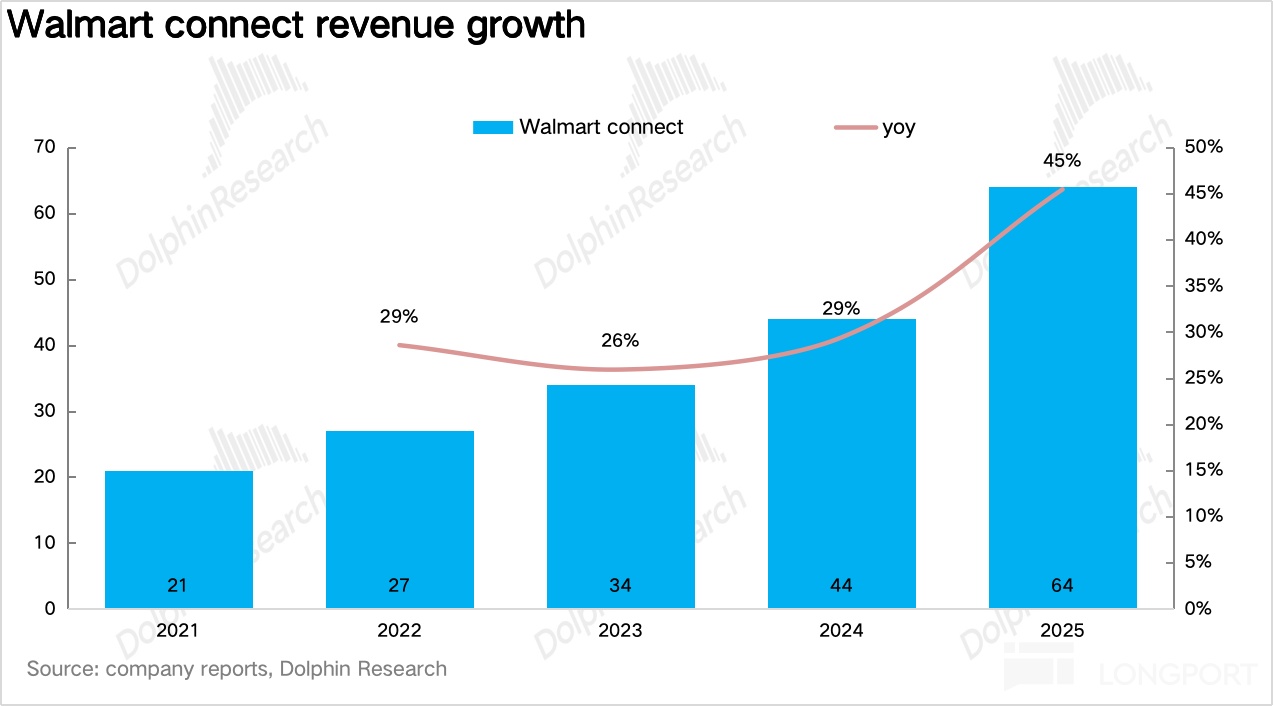
Walmart Connect inflected in 2022, with further acceleration in 2025, up 45% to $6.4bn.
On profitability, versus ~5% OPM in the core, ads monetize existing traffic and data with a software layer, producing 40%+ margins. That implies >$2.6bn profit in 2025 from ads alone, offsetting 1P losses.
We benchmarked Amazon vs. Walmart ad formats, and Walmart has largely matched Amazon via build, buy, and partner.
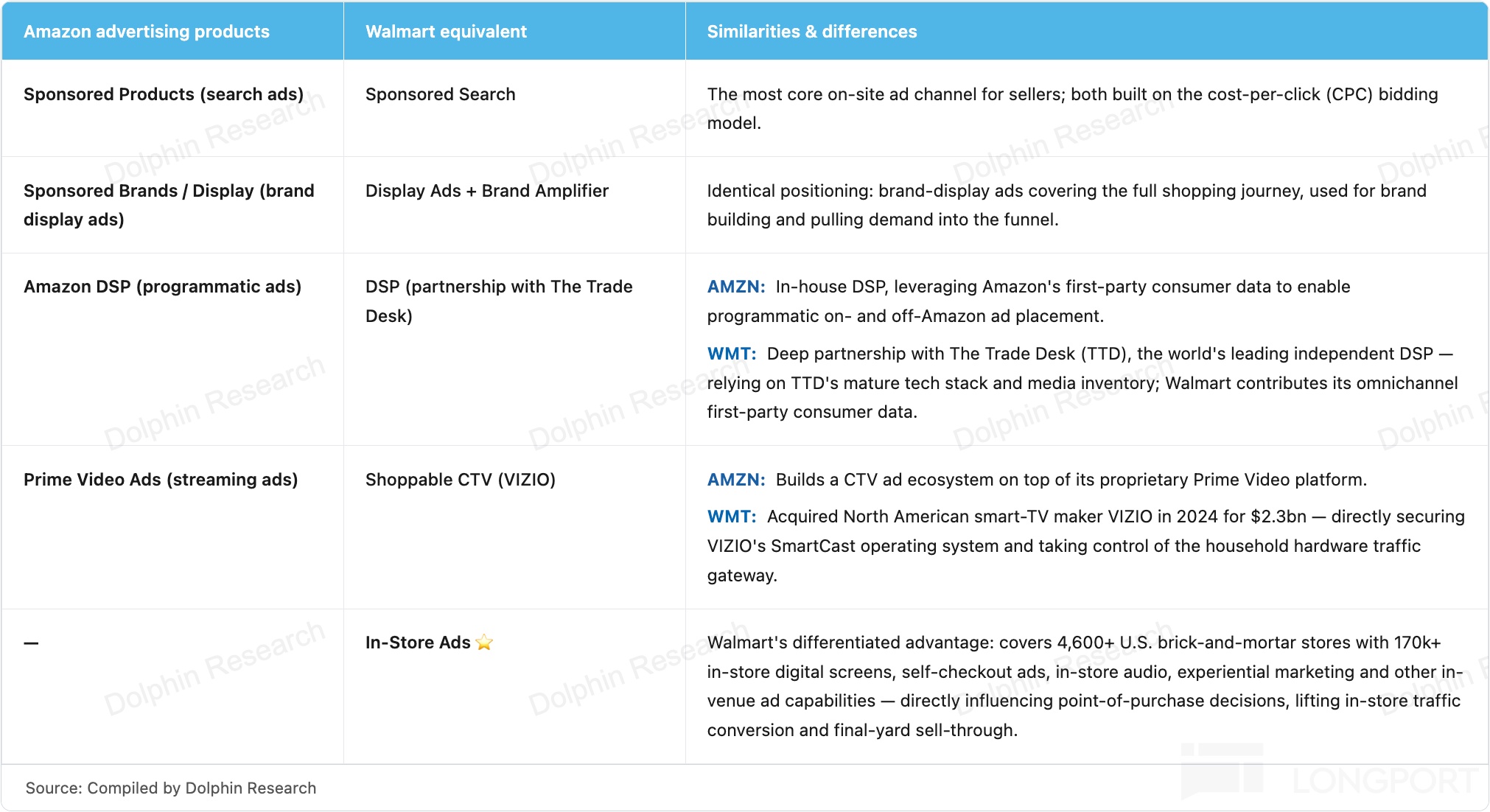
To further boost ad revenue, Walmart is tapping store traffic with in-store ads — digital screens, SCO screens, and in-store audio to influence purchase decisions. This extends monetization into physical aisles.
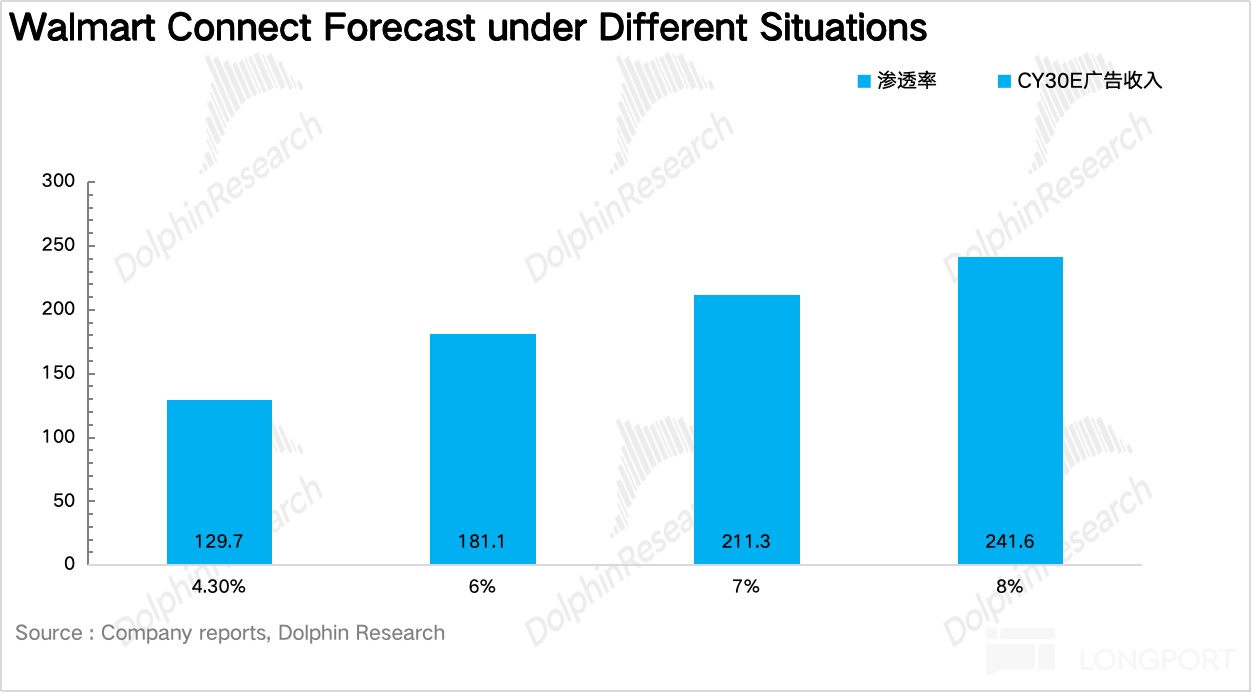
In 2025, ad penetration was ~3.9% of online GMV, under half of Amazon’s ~8.3%. Even if penetration stays flat (unlikely), with e-comm GMV growing at a 15% CAGR (company long-term ‘double-digit’ guide), GMV could rise from ~$166bn in 2025 to ~$334bn by 2030, implying ~$13bn ad revenue — more than a 2x.
But ‘flat penetration’ is a low-probability case. First, 3P mix is set to rise (from ~20% now to ~1/3 by 2030), lifting paid-promo demand.
Second, Walmart Connect is broadening products (search, category placements, brand ads), while auctions and conversion improve. We see 3x+ long-term upside, making ads a highly elastic second growth curve.
3) Luminate + Walmart+: build a high-value subscription stack, the omnichannel flywheel accelerator
Briefly on membership and data. If Marketplace and ads are the twin engines, Walmart+ and Luminate are the fuel and bearings that reduce friction and raise RPM.
Membership first: launched in 2020, Walmart+ competes with Amazon Prime. As the table shows, Walmart+ is cheaper (70% of Prime’s annual fee) and more practical for weekly savings, with free grocery delivery and fuel discounts as high-frequency benefits.
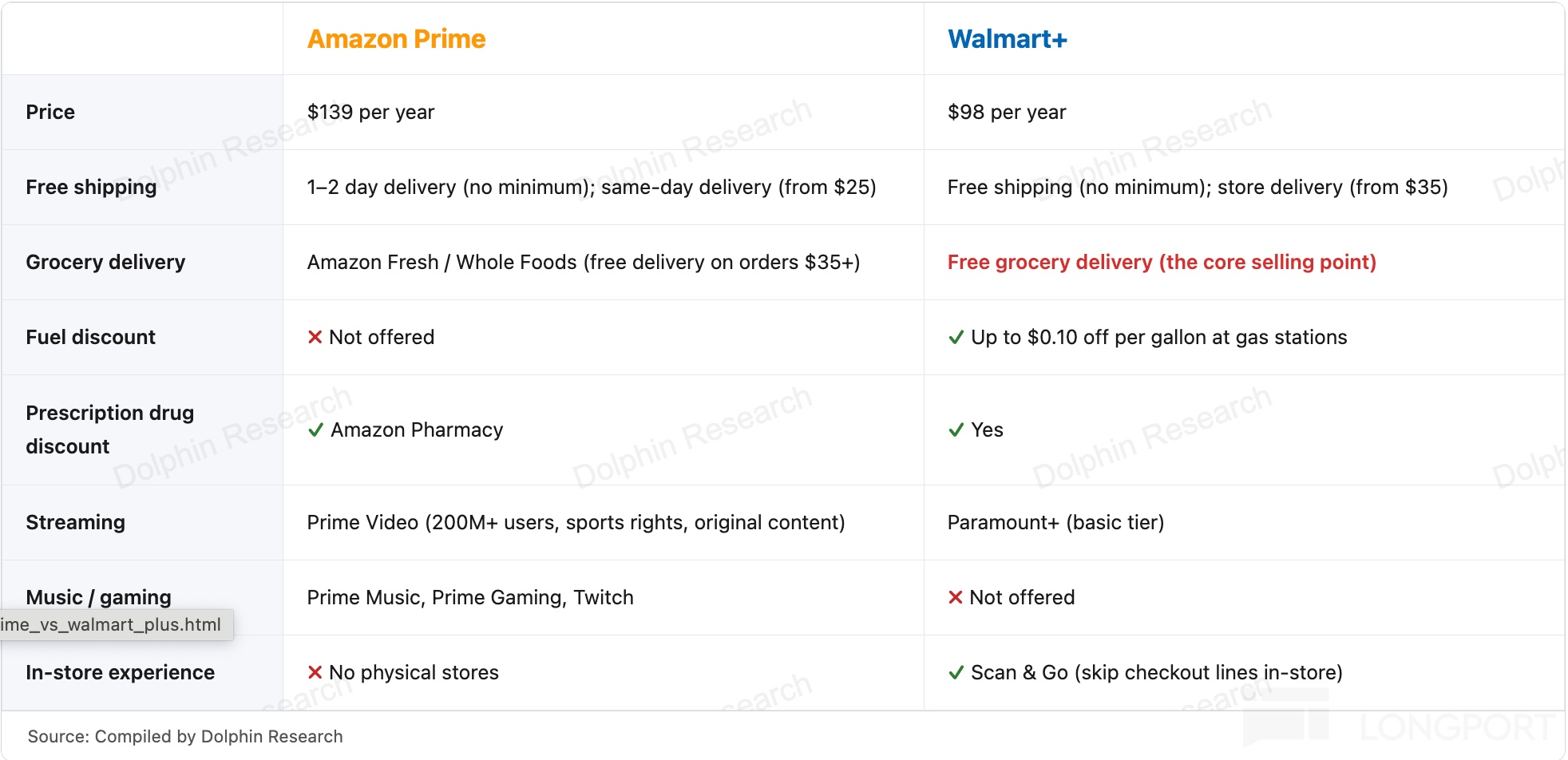
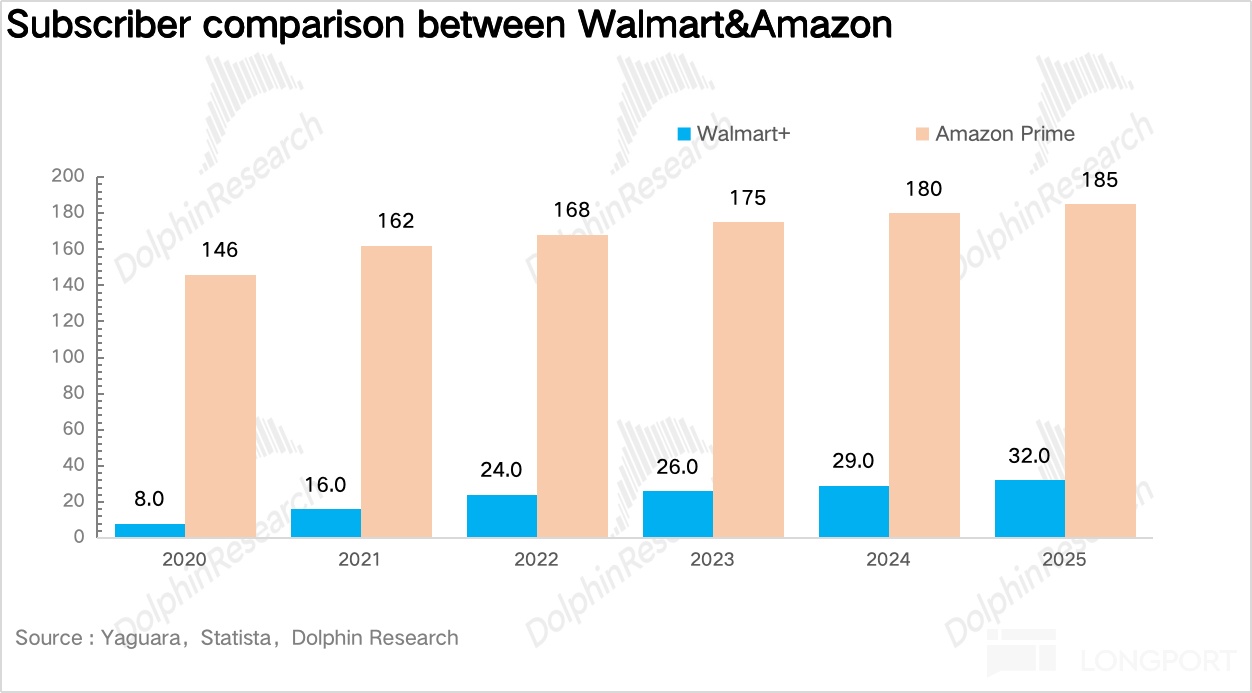
Prime, launched in 2005, now covers 65%–70% of U.S. households with richer benefits (especially content) and a more affluent skew. Given distinct target segments and positioning, Walmart+ and Prime compete in a differentiated, not zero-sum, fashion.
Looking ahead, Prime is mature and near a penetration ceiling, shifting from user growth to ARPU/engagement. Walmart+, five years in, has ~14% household penetration per Street work, focusing on value-seeking middle/low-income families and growing members at ~20%.
Luminate data: Walmart’s data monetization arm. It anonymizes and structures granular purchase data, packaged as subscription analytics for suppliers and brands.
With Luminate, suppliers see store-level real-time inventory and sales, omnichannel behavior trends, and closed-loop ad attribution. They can optimize R&D, inventory turns, marketing, and channel decisions.
For Walmart, data are stock assets; once the platform is built, each added client carries near-zero marginal cost. Subscriptions bring stable cash flow, and scale expansion drives operating leverage.
End-to-end, Walmart+ members shop more often across all categories and channels, creating the most stable, highest-frequency data. Luminate refines and monetizes that into high-margin ad revenue, while improving supply-chain efficiency for partners.
Summary: how does Walmart e-comm actually run?
We deconstructed Walmart’s rise on three layers:
Hardware: a prepositioned network centered on 4,700 stores that Amazon cannot replicate — the physical base of e-comm. User: grocery as the highest-frequency entry to lock users, then Walmart+ to convert them into loyal omnichannel GM shoppers — the traffic engine.
Monetization: a profit flywheel of ‘3P + ads + membership + data’ to turn traffic into high-GM revenue — the profit code. As a rough analogy: retail runs like Costco (low-price, high-frequency lock-in), while the platform runs like Taobao (asset-light rent collection).
At the same time, Walmart’s surge stems from grocery and omnichannel — areas where its assets shine and Amazon under-penetrated — a differentiated campaign, not a brawl on Amazon’s home turf.
This means a sizable part of recent growth was a penetration catch-up, not share stolen via trench warfare. With Amazon pushing hard into grocery, the next three years will bring a real fight.
In the final piece, we will add Sam’s Club to complete the asset puzzle and run the numbers on Walmart’s investment case. Stay tuned.
<End>
Dolphin Research on Walmart:
‘Walmart: How the Trillion-Dollar Retail Legend Was Forged?’
Risk disclosure and statements:Dolphin Research disclaimer and general disclosure
The copyright of this article belongs to the original author/organization.
The views expressed herein are solely those of the author and do not reflect the stance of the platform. The content is intended for investment reference purposes only and shall not be considered as investment advice. Please contact us if you have any questions or suggestions regarding the content services provided by the platform.
