


SOFI Has Plenty of Red Flags — Is the Premium Justified?
In Part I we deconstructed SoFi’s business stack and identified today’s growth engines as the expansion of its Loan Platform Biz. (LPB) plus the recovery in student loans. In Part II we followed Muddy Waters’ short thesis and unpacked the hidden bruises: on/off-BS charge-off shifting, FV accounting inflating profits, and equity dilution.
After two rounds of analysis, a paradox emerges. SoFi carries well-scrutinized native flaws, yet in H2 2025 the stock briefly surged to a $42bn market cap, implying a 12M fwd EV/EBITDA north of 30x, ahead of many high-growth fintech peers.
Even after two follow-on offerings and meaningful dilution that drove a sharp pullback, today’s ~$23bn market cap still trades at a premium vs. traditional financials.
So the question is whether that premium is deserved. Is SoFi a digital bank wrapped in a tech narrative, or a tech platform that happens to hold a bank charter. Different labels imply very different valuation yardsticks.
We therefore approach SoFi’s fair yardstick from two angles: market size and competition.
I. Massive TAM is not the bottleneck
SoFi spreads across lending, brokerage, payments, crypto (stablecoins), and fintech SaaS. Yet the revenue mix shows a clear strategy: monetization rests on lending, while the other verticals primarily enhance features, stickiness, and user reach.
Thus, for growth headroom, the relevant TAM is chiefly in credit. Any upside from ancillary lines should be treated, at best, as call options under optimistic scenarios.
Given industry trends and SoFi’s edge, its reachable credit markets are mainly student loans and personal loans, with personal lending offering more durable runway. This is not only because of the secular drivers in PL, but also SoFi’s positioning.
1) Student loans: policy tailwinds linger in the near to mid term
Student loans are SoFi’s home turf, especially refi after graduation. SoFi holds ~40% share in private refi (1P + 3P combined, of an estimated $37bn private refi balance in 2025).
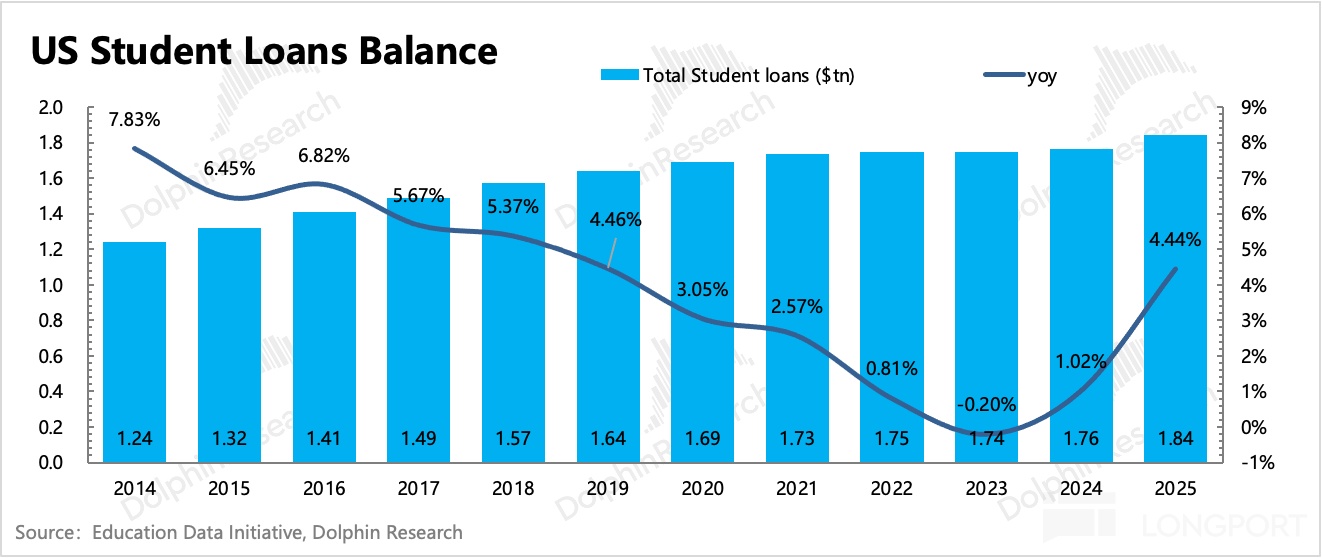
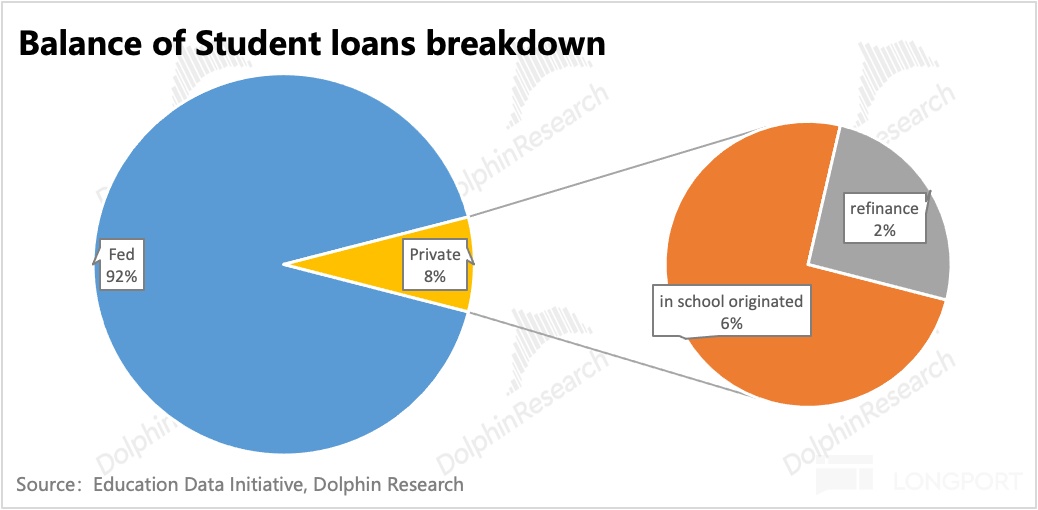
Private share should rise on three policy shifts:
a. Federal student loan repayment and interest resumed in 2023.
b. The SAVE plan (lower payment thresholds, interest relief) ends in Aug 2025.
c. From Jul 2026, the OBBBA act eliminates Grad PLUS and tightens federal graduate loan caps.
These changes raise repayment pressure on existing borrowers, boosting refi demand and shifting incremental originations to private lenders. With total SL outstandings growing slowly (tuition inflation slowing), the private SL market should expand from the ~$140-150bn range rather than stay flat.
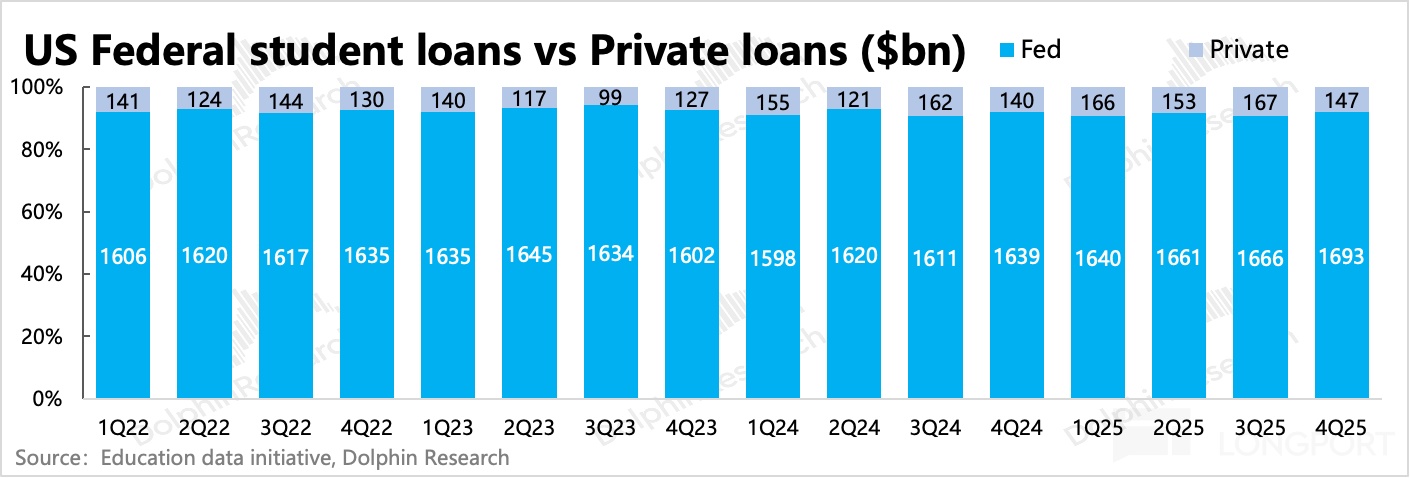
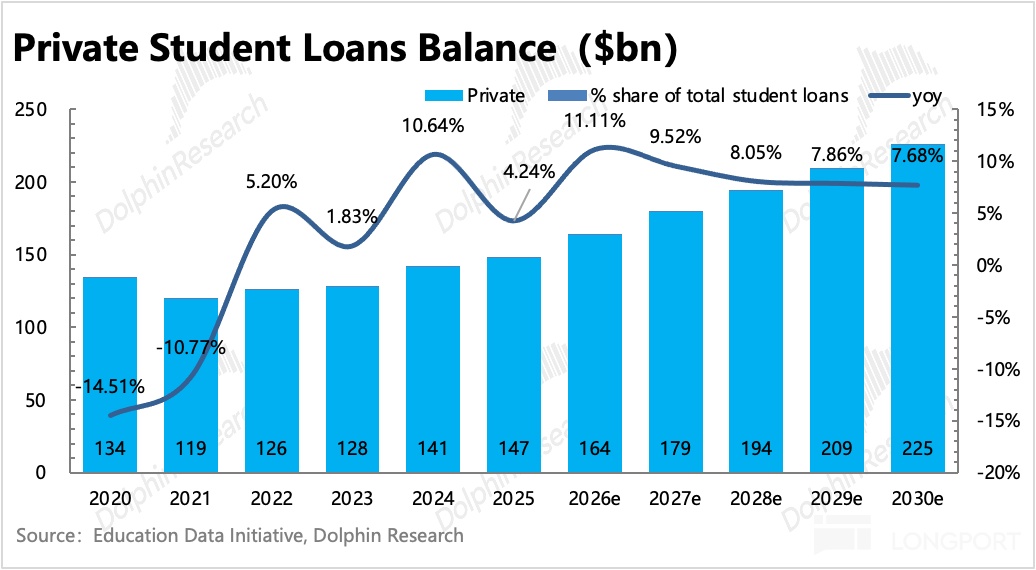
Using Motor Intelligence’s outlook, we assume:
(1) U.S. SL outstandings grow at a 3% CAGR over the next five years, slower than EM but faster than markets with mature subsidies and penetration (Japan, Korea, Australia).
(2) Private lenders’ share rises from ~8% today to 10%+ by 2030.
Combining (1)-(2), private SL outstandings reach ~$214bn by 2030, a 5Y CAGR of 7-8%.
2) Personal loans: structural growth drivers
The U.S. PL market is ~$280bn in balances, focused on unsecured terms of 3 months to <5 years, with 3-5 years most common. Use cases include home improvement and medical, but a key one is consolidating revolving debt (mostly credit cards).
Given unsecured risk, PL rates are high and skew toward sub-Prime to near-Prime borrowers, where fintechs are more active. While funding cycles can swing originations, the bigger driver is end-user demand for debt consolidation.
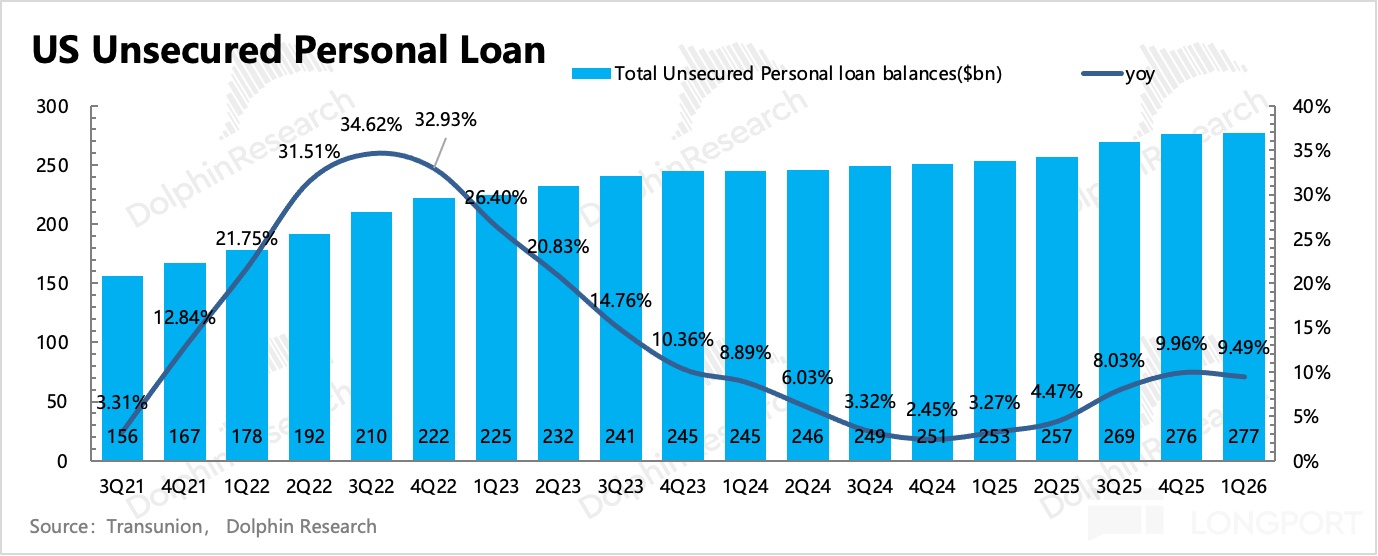
Near-term, PL volumes are rate-cycle sensitive. Early in a hiking cycle, card APRs reprice fast but PLs, often fixed-rate, lag, widening the spread and motivating refi from cards into PLs — seen in the 2022 upcycle.
Mid-cycle, PL rates catch up, narrowing the spread and dampening demand — seen in 2023-2024 as growth slowed. When cuts begin or are expected, card APRs also reset, spreads may narrow further, and credit risk rises into downturns, keeping lenders cautious on PL supply despite looser liquidity — hence a slower rebound from 2025 cut expectations.
But the long-term driver is clear. Card balances have surged and carry higher APRs, expanding demand to refi into lower-rate PLs (~10-15% vs. ~20% on cards). This is strongest among Prime+ borrowers.
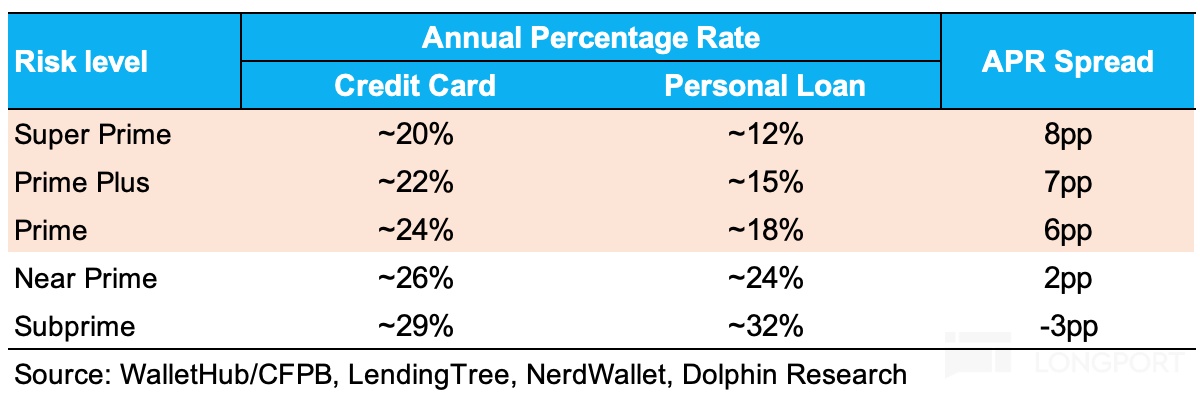
PL models offer lower rates only to higher-credit borrowers, enabling the arbitrage. Prime+ also holds larger card lines, so their refi balances are higher in absolute terms.
This overlaps with SoFi’s core audience of higher-credit users. Versus peers, SoFi should benefit more as card-refi use cases expand.
Today 20-40% of PL demand is for card consolidation, based on borrower surveys and platform disclosures. LendingTree indicates over half of users borrow to pay down debt, primarily cards.
SoFi’s borrower survey shows ~1/4 cite consolidation as the top reason, and ~70% of them aim at card payoff, implying ~18% card-refi within SoFi’s PL mix.
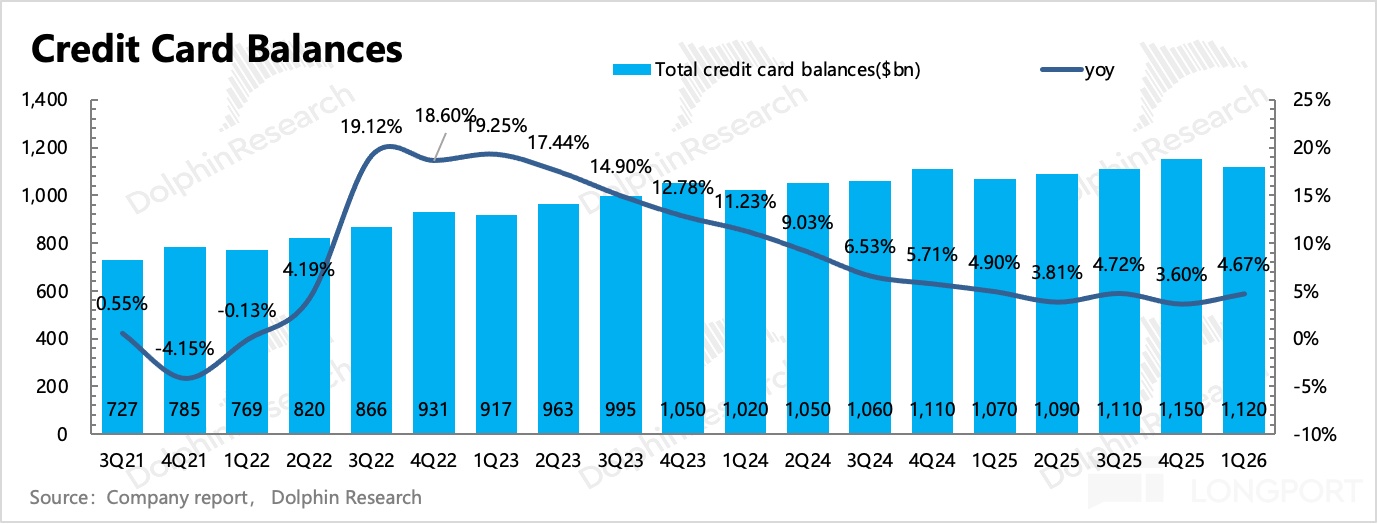
Even so, that captures under 8% of total card balances given the trillion-dollar card market. To gauge headroom, we narrow the denominator to segments with higher conversion propensity.
a) Focus on Prime+ (~80% of card borrowers, per TransUnion) where rate spread drives refi intent. b) Within Prime+, 50-60% of card balances revolve and accrue interest (vs. 75%+ market-wide, per CFPB).
Thus, the targetable card pool is ~$1.15tn*80%*55% ≈ $506bn. The numerator is PL used for card payoff at $277bn*(20-40%) ≈ $82.8bn, implying a ~16% penetration.
With the focus on convertibles, raising penetration should face few structural hurdles. Early in a new hiking cycle, card APRs reset fast while PL rates lag, supporting demand expansion.
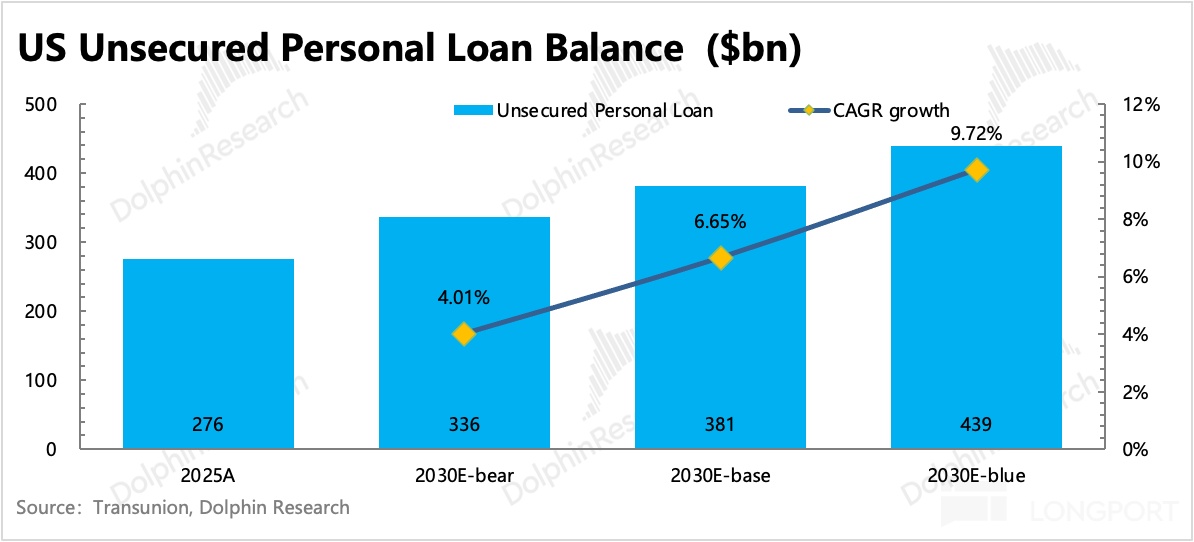
We then sensitize the core ratio — PL for card payoff divided by Prime+ card balances — to estimate incremental PL growth under different scenarios.
3) Mortgages: no edge for SoFi, not modeled in detail
The U.S. mortgage market is vastly larger, with ~$2tn in 2025 originations alone. But SoFi lacks product breadth and risk-model depth vs. incumbent banks, and current penetration is low.
Despite recent momentum, we defer to third-party forecasts and assume total mortgage outstandings exceed $16tn by 2030 (3-4% CAGR). We do not build a detailed TAM for SoFi here.
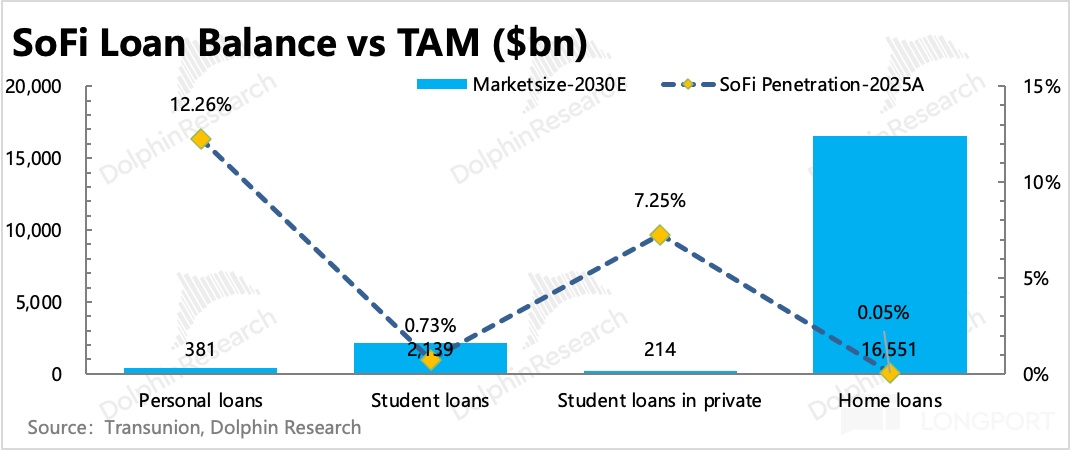
Aggregating (1)-(3), the broad credit TAM is ~$17tn. Excluding mortgages, core PL + SL TAM is near $600bn. SoFi’s 1P loan balance (UPB) was $34.2bn in Q4 2025, or ~6% penetration of the target TAM.
Unlike traditional lenders, SoFi also built a 3P platform in 2024, originating and servicing on behalf of capital partners. These do not sit on SoFi’s BS, but count toward brand market share from an ecosystem view.
Adding $13.2bn of 3P serviced loans (reported as 'Transferred loans serviced') to the $34.2bn 1P book, total loans reach ~$47.4bn. On the 2030 TAM, penetration rises from ~6% to ~8%, with the split by sub-market as below:
II. Balanced competitiveness: room to advance, room to defend
Having framed the space, what share can SoFi ultimately reach from ~8% today. A key constraint is SoFi’s focus on higher-credit borrowers, with average FICO ~755 across the three lending lines.
The stated floor is ~680, mapping to Prime/Good and above — roughly 70% of U.S. borrowers, or ~147mn out of ~210mn with a FICO. With ~14mn members, the surface suggests ample runway.
But the true potential is narrower, shaped by strategy and competition. We focus on SL and PL.
1) Student loans: hold the line
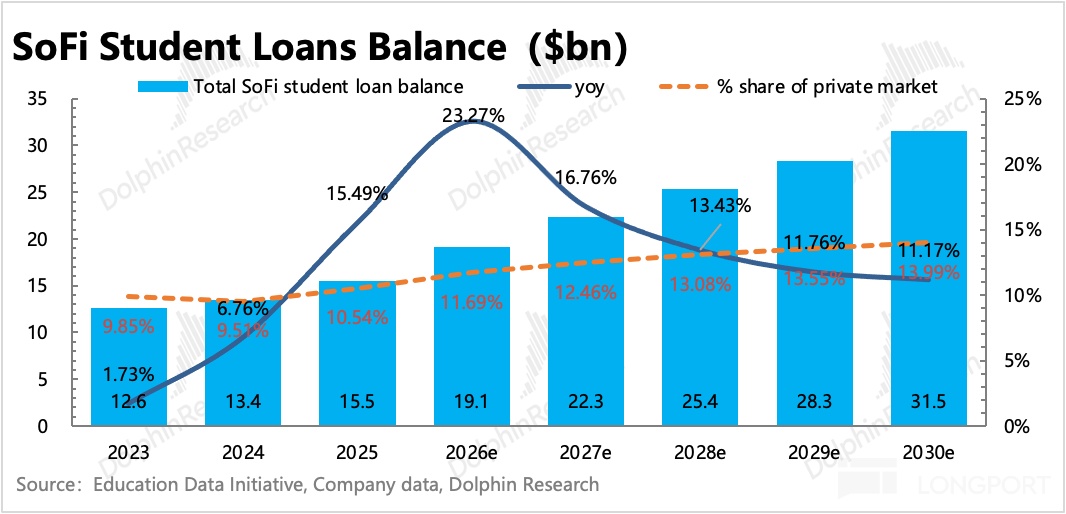
SL is the foundation even if not the top revenue source. SoFi is the 40%+ leader in private refi (incl. serviced transfers), but only ~11% of the broader private SL market.
Moving upstream into in-school lending is hard. Underwriting is different, school certifications and preferred lists are required, co-signer workflows must be built, and disbursements cluster by semester, raising funding management demands.
The in-school market is stable and entrenched with the Dept. of Education and private incumbents like Sallie Mae and College Ave. For SoFi, defending the refi lead should suffice to ride policy-driven refi demand post-OBBBA.
We project SoFi’s 1P+3P SL balances to grow at a 15% CAGR over five years, lifting private-market share from ~10.5% to ~14%.
2) Personal loans: where the knife fight is
PL is the cash cow. 1P alone contributes nearly half of Lending segment revenue, and most 3P today is also PL. Management highlights PL as a core growth pillar.
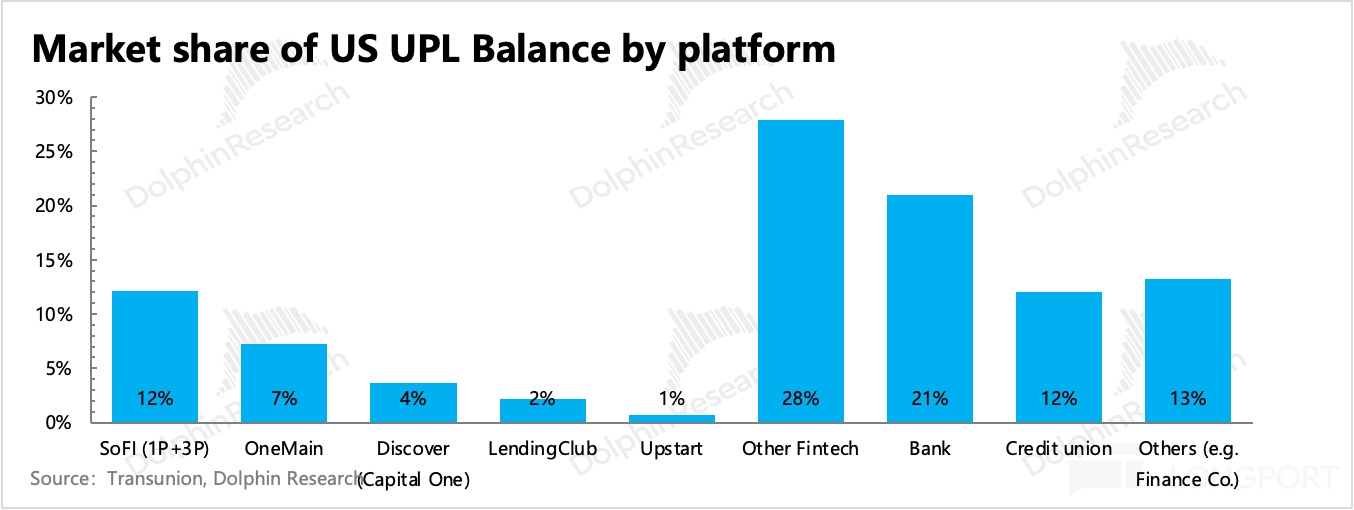
Competitors span OneMain (OMF) in subprime/branch networks, online fintech originators like LendingClub and Upstart, and bank players like Discover and Citi.
As of 3Q25, fintechs account for 53% of unsecured PL balances originated and serviced (ex fully sold). Traditional lenders are smaller not only due to UX and digital reach, but also conservative risk appetite limiting loan sizes — fintech avg. origination around $10k vs. ~$5k at many credit unions.
Intensity is evident in direct-mail volume, the key PL acquisition channel. Per Mintel, industry PL mailers rose 28% YoY in Apr, led by OneMain, SoFi, and Upstart. SoFi’s share was the largest at ~11%.
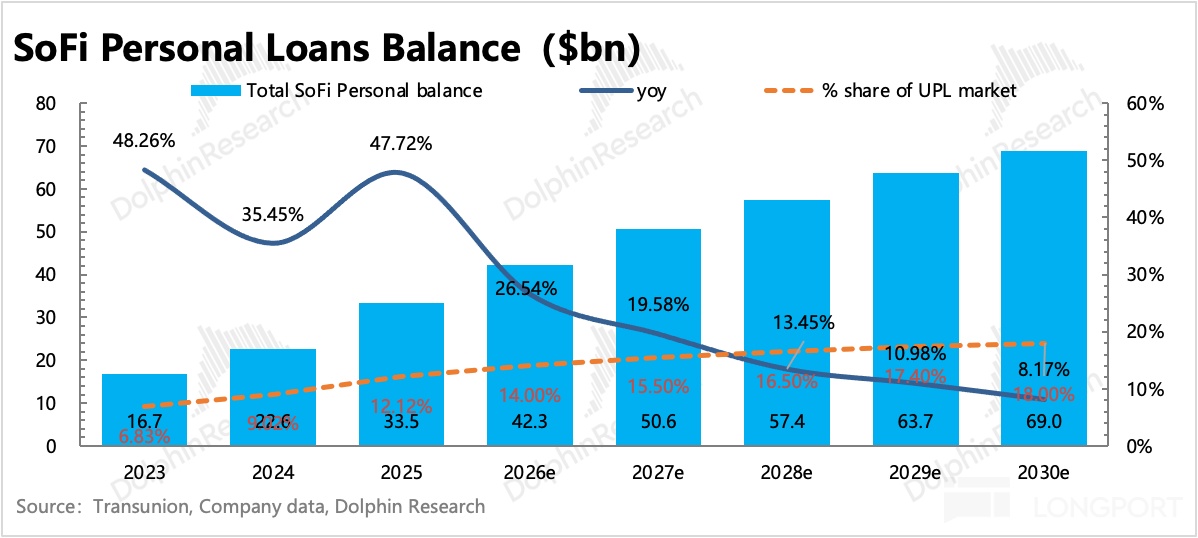
SoFi’s push has been aggressive, with market share climbing from ~6.8% in 2023 to ~12% by end-2025, driven by LPB. The catch: PL demand skews below Prime, which diverges from SoFi’s higher-credit focus.
Only ~35% of PL borrowers are Prime+ vs. ~70% for the overall market. In balances, Prime+ rises to ~50-60% given higher lines. In the Prime+ PL niche where SoFi competes most directly, its share is already ~22%, the clear leader.
Unless SoFi deliberately lowers its credit bar, share gains will slow from here. The brand still markets to 'high-credit' users, so a loosening seems unlikely near term.
Equally, downside risk to share looks limited. Versus incumbents, SoFi offers a more flexible origination workflow and a scalable 3P platform, while vs. pure-play fintechs dependent on warehouse lines, SoFi enjoys a charter-driven funding-cost edge with a fuller user ecosystem and a high mix of direct deposits.
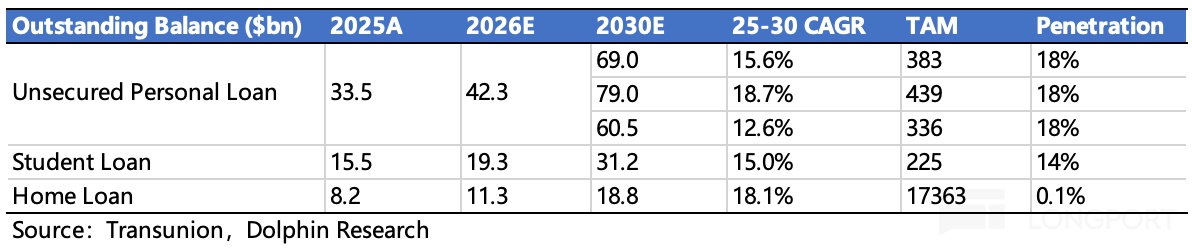
One more latent flywheel: SL users stick to the platform and, as they enter the workforce, convert into PL and eventually mortgage users. We model SoFi’s combined 1P+3P loan balances rising from ~$33.5bn in 2025 to ~$67bn in 2030.
That implies unsecured PL share rising from ~12% to ~18%, a 5Y CAGR of ~16%.
III. Does SoFi still carry pure tech value
Beyond data-driven underwriting, SoFi’s 'hard tech' sits in its tech platform, Galileo, a fintech SaaS provider for core infra such as card issuance workflows, payments, and account management. Peers span Affirm and Block on the digital bank side and middleware players like Marqeta and Jack Henry.
The fintech SaaS story has matured, and Galileo, while capable, remains a small contributor. Competition is intense, clients are mid-sized fintechs with rate-sensitive budgets, and with cut hopes fading and hike expectations rising, wins in larger enterprises have yet to become a core growth driver.
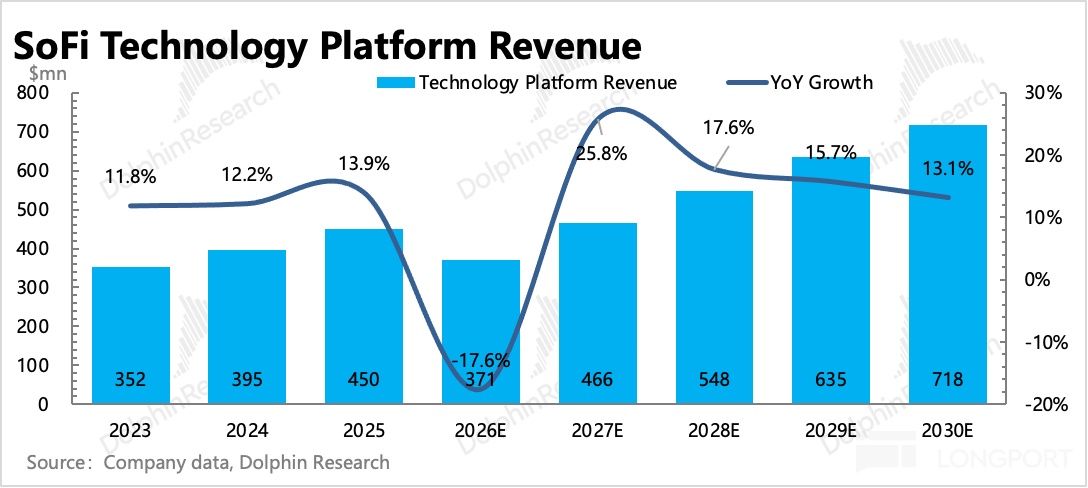
In Q1 2026, revenue fell 27% YoY due to the loss of Chime (insourcing). Ex-Chime, growth was ~12%, still slower than 19% in Q4 last year.
Management cited 13 new go-lives and a deal with a top-3 U.S. telecom, which may offset churn at the high end. For now, we model a 15% CAGR through 2027+, below some Street forecasts at ~20%.
IV. With lending as the floor, is SoFi’s 'fin+SaaS' story expensive
The real growth engine is simple: PL industry beta plus market-share alpha. Broader fin services help acquisition and retention, while SaaS, despite higher tech content, is more of a multiple lever in liquid markets than a fundamental driver today.
1) Near to mid-term valuation under guidance
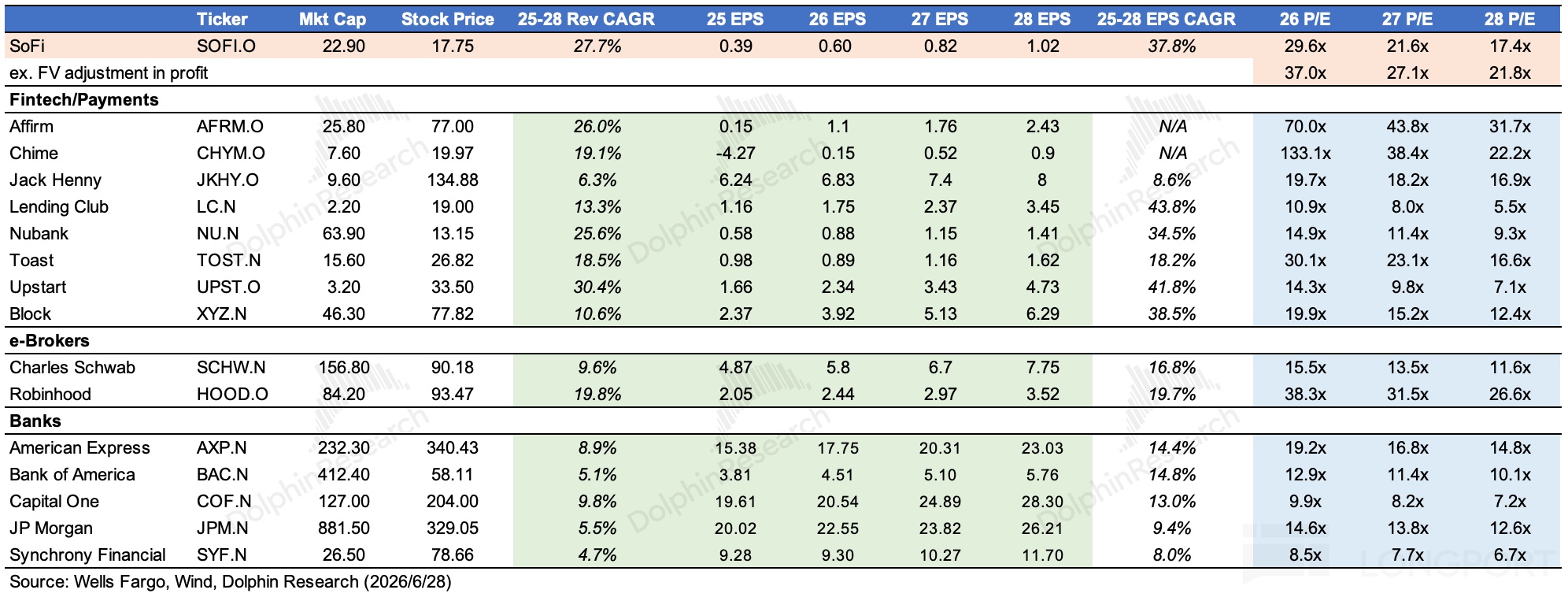
For 2026, management guides to: 1) members +30%+, 2) Adj. revenue ~$4.65bn (+30% YoY), 3) Adj. EBITDA ~$1.6bn (34% margin, +52% YoY), 4) Adj. net income ~$825mn (18% margin), implying Adj. diluted EPS ~$0.60 (+54% YoY).
On that, the ~$23bn market cap implies ~14x Adj. EV/EBITDA 2026E or ~29x GAAP P/E, richer than lenders but in line with higher-growth fintech platforms like Robinhood.
Versus them, SoFi’s operating leverage and platform depth are somewhat weaker, so 29x P/E does not screen obviously stretched on near-term growth alone. However, adjusting for FV accounting uplift per Part II, we haircut profits by 20% based on 1Q26, lifting 2026 P/E to ~37x and Adj. EV/EBITDA to ~18x — squarely in 'fintech star' territory.
2) Long-term value under our base case
On our market and share framework (summary below), by 2030 SoFi could exceed $10bn in total revenue, a 20-25% CAGR. Note: we simplify the core.
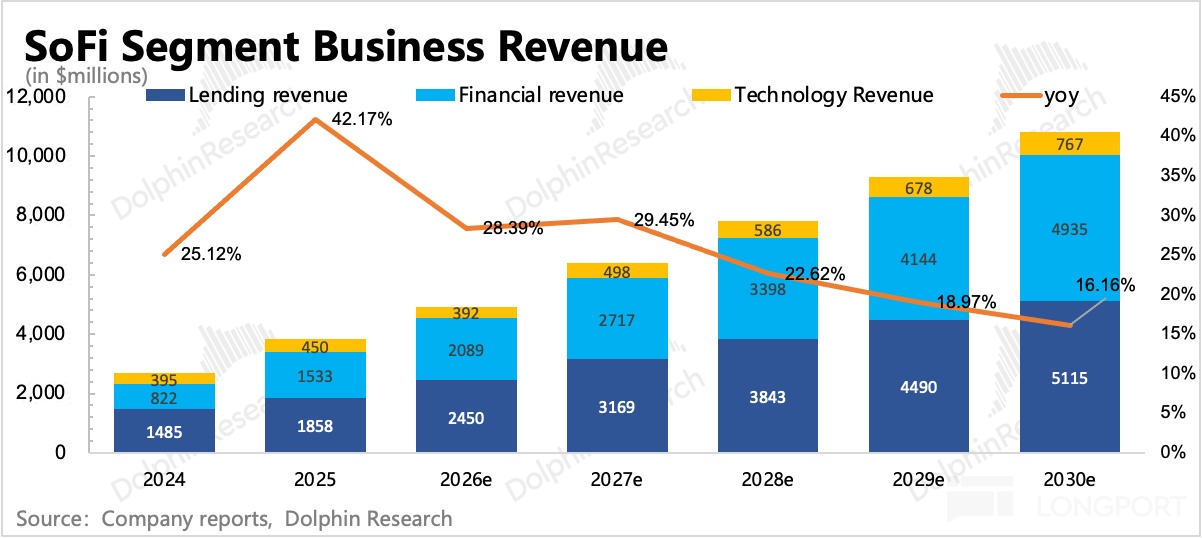
Assuming Adj. EBITDA margins converge toward peer levels at 35-40% (vs. ~31% today), EBITDA could top $3.8bn by 2030. Applying the same 20% FV haircut yields ~$3.0bn Adj. EBITDA.
Using a 12-15x EV/EBITDA multiple on 2030E and discounting at 15% (required return) gives an equity value of ~$22.6-28.2bn in PV terms. The lower bound is around today, and the upper bound implies ~20% upside.
Putting (1)-(2) together, SoFi screens 'rich near term, potential over time'. The market is paying for post-transition growth rather than today’s blemishes. Our long-term stance is neutral to slightly positive, leaving room for upside.
That said, a premium brings volatility risk. Near-term catalysts exist (SL policy tailwinds, early-hike card consolidation), and SoFi bolstered cash with two raises in a liquid market. Still, position with a margin of safety per your risk tolerance.
<End>
Dolphin Research on 'SoFi':
Jun 17, 2026, Part II coverage: A new 'Enron'? Muddy Waters clickbait or is SoFi truly broken
Jun 16, 2026, Part I coverage: Targeted by Muddy Waters: SoFi, genuine fintech upstart or 'high-tech gimmick'
Risk disclosure and statement:Dolphin Research disclaimer and general disclosure
The copyright of this article belongs to the original author/organization.
The views expressed herein are solely those of the author and do not reflect the stance of the platform. The content is intended for investment reference purposes only and shall not be considered as investment advice. Please contact us if you have any questions or suggestions regarding the content services provided by the platform.
