


Agent revenue doubled, Token surged 5x quarter-on-quarter: What does Yunzhi Sheng's preview actually indicate?
$UNISOUND(09678.HK) On July 22, Unisound released its performance forecast for the first half of 2026: Revenue is expected to reach 530 million to 580 million RMB, representing a year-on-year growth of 31% to 43%, with the growth rate nearly doubling compared to the same period in 2025. Among this, revenue from intelligent agent business reached 515 million to 550 million RMB, surging by 200% to 220% year-on-year; direct token call revenue from large models was approximately 30 million RMB, with a gross margin no lower than 60%, and a 500% quarter-on-quarter increase in Q2. More critically, over 60% of total revenue comes from repeat purchases, with the scale of repeat purchases growing by 40% year-on-year.
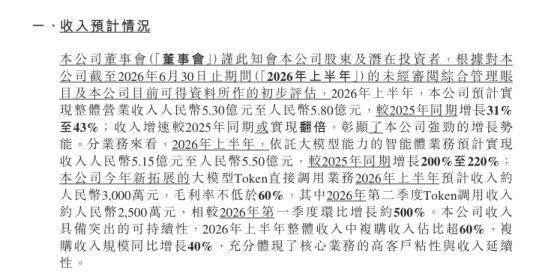
The value of this data lies in the fact that it is built upon a high base where large model revenue had already increased tenfold in 2025. Achieving growth rates on a small base is not difficult; accelerating growth on a high base reveals true strength—the market sees here the closed loop of "concept-revenue-repeat purchase" for large models, which is accelerating realization at this company.
I. Positioning in High-Value Segments: Transitioning from Project-Based to MaaS
Pure model manufacturers often fall into the trap of being questioned for "burning money to tell stories," while traditional project-based models struggle to escape the pitfall of "increasing revenue without increasing profit." The structural changes at Unisound precisely hit the intersection of "vertical scenarios + intelligent agents + token calls," turning model capabilities into billable standard products rather than simply piling up heavy assets for computing power.
The over 200% growth rate in intelligent agent business reflects how long-cycle industry clients in healthcare, home furnishing, transportation, and government affairs are moving "model-based automated workflows" from pilot stages to normalization. Leveraging the Shanhai Large Model and U2 native Agent foundation, Unisound encapsulates industry-specific agents through its "Beast Tooth" platform, creating reusable outputs in scenarios such as medical record quality control, medical insurance risk control, and subway voice interaction. These businesses have long client certification cycles, heavy reliance on scenario know-how, and high switching costs; once they enter core processes, moats naturally form.
More significant is the direct token call business: 30 million RMB in revenue, gross margin ≥60%, and a 500% quarter-on-quarter growth in Q2. This marks the beginning of the company's transition from "project-based delivery" to a MaaS (Model-as-a-Service) / API pay-per-use business model—revenue is no longer entirely dependent on single contracts but linked to customer call intensity. In the current capital market preference for "standardized, predictable, high-margin recurring income," this segment represents the position with the greatest valuation elasticity.
II. Commercialization Advancement: From "Whether It Exists" to "How Good It Is"
In the past year, market judgment on AI has swung repeatedly between "betting on parameters" and "doubting monetization." Unisound's preview acts more like a mirror: what is closer to industrial truth today than "how big the parameters are or how high the rankings" is "whether it can be embedded in workflows and whether it can generate repeat purchases."
The over 2x growth in intelligent agent revenue, 5x quarter-on-quarter growth in token calls, and repeat purchase ratio exceeding 60% with a 40% year-on-year increase all point to one conclusion: the penetration of models in top vertical scenarios is not a one-off project, but an intensifying call frequency year by year. Long-cycle industries such as healthcare, home furnishing, transportation, and government affairs, once they move "billable model workflows" from pilots to normalization, will reverse-forced iteration among foundational capabilities, domain adaptation, and execution reliability. This is the true background color of model commercialization. This also means the AI industry narrative is shifting from "foundational breakthroughs" to "model realization." When a company uses repeat purchases as its foundation, MaaS as its new engine, and intelligent agents as its main revenue source, it validates not just a ranking score, but whether the "foundation-Agent-call" chain can self-sustain. For the model layer, this is a harder wind vane than any macro slogan: commercialization quality is judged by repeat purchases, not press conferences; space size is judged by tokens, not parameters. III. Growth Resilience: Repeat Purchases Building the Bottom and Structural Optimization Among these previews, the most easily overlooked yet most valuable for the long term is "repeat purchase ratio exceeds 60%, repeat purchase scale grows 40% year-on-year." In the AI sector, one-time project-based revenue and renewable subscription/call revenue correspond to two completely different valuation systems—the former is close to system integration, while the latter benchmarks against SaaS/MaaS. A repeat purchase ratio of over half, still accelerating, first indicates that customers have moved model capabilities from "pilot funds" into "annual budgets," implying rigid demand; secondly, it also verifies that the company is switching from sales-driven to product-driven. Coupled with the 60% gross margin of the token business and its steep quarter-on-quarter growth curve, Unisound is expected to form a dual-wheel drive pattern in the second half of the year: "steady intelligent agent main business and high-growth token business." Overall, Unisound proves with this preview that the dividends of the large model industry chain are spreading from "single technological breakthroughs" to a full-chain closed loop of "technology-product-commercialization." As for how the market prices it, it depends on whether the quarter-on-quarter slope of the token business can be maintained, whether the repeat purchase ratio can continue to rise, and whether the path to narrowing losses is realized synchronously. Unisound may not be the ultimate winner, but it has taken a solid step forward in pushing the question mark hanging for over a year—"can model manufacturers run out sustainable revenue."The copyright of this article belongs to the original author/organization.
The views expressed herein are solely those of the author and do not reflect the stance of the platform. The content is intended for investment reference purposes only and shall not be considered as investment advice. Please contact us if you have any questions or suggestions regarding the content services provided by the platform.
