



The Giant Ship Amidst Soaring Oil Prices: Examining the Offensive and Defensive Strategies of the "Three Barrels of Oil"
This summer of 2026, the international crude oil market once again staged a "rollercoaster" ride. After a brief resumption of navigation, the Strait of Hormuz was blockaded again, and it seems that the "switch" of geopolitical conflict can tug at the nerves of oil prices more than supply and demand fundamentals.
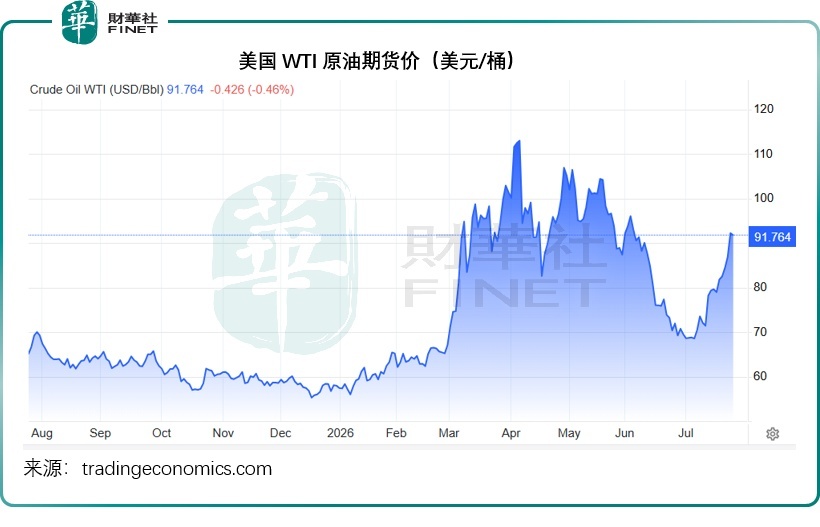
As shown in the chart below, the US WTI crude oil futures price surged from $68 at the beginning of the month to $91.76.
Brent crude oil futures prices broke through $100, as shown in the chart below.
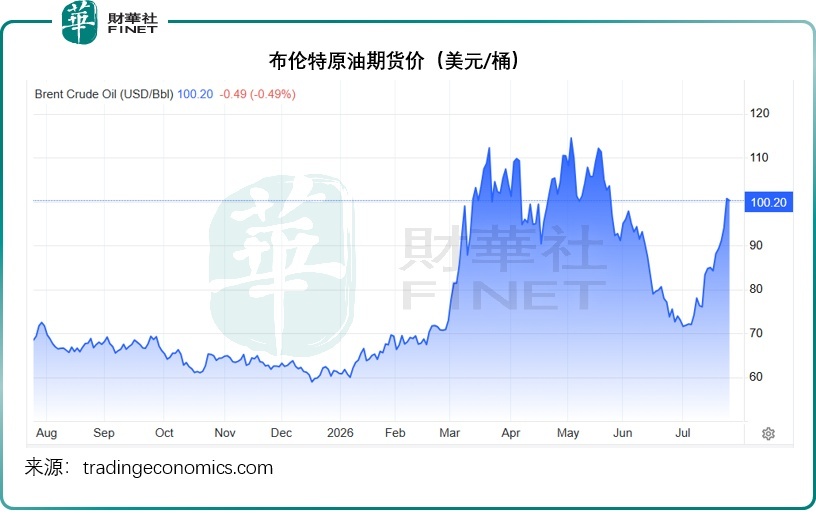
It is worth noting that refined oil prices also experienced more significant volatility. We observed that the year-on-year increases for WTI crude oil futures and Brent crude oil futures were 40.79% and 46.45%, respectively, while the cumulative increase in gasoline prices during the same period reached 66.14%, and the increase in heating oil reached 80.38%. The sharp rise in refined oil prices is not only due to the increase in crude oil prices but also due to the widening supply gap.
Previously, 24 out of Russia's 34 largest refineries were attacked, and with US refineries operating at over 96% capacity, this further intensified pressure on the refined oil supply outlook. However, after Ukraine shifted its attack focus from large refineries to maritime targets, Russia's fuel supply may show signs of improvement.
However, amidst unstable geopolitical situations, oil prices are highly likely to continue fluctuating significantly.
While global markets hold their breath watching oil price developments, domestic refined oil price adjustments continue as usual. In this oil price storm dominated by geopolitical risks, what impact will the "Three Barrels of Oil"—$PETROCHINA(00857.HK), $SINOPEC CORP(00386.HK), and $CNOOC(00883.HK)—face?
Deconstructing the Business Architecture of the Three Barrels of Oil
In 1998, a major restructuring of China's domestic oil industry defined the inherent industrial boundaries of PetroChina, Sinopec, and CNOOC, laying the foundation for the differentiated resource endowments and business bases of the three companies.
For over two decades, these three group enterprises have continued to iterate based on the initial division of labor, addressing their own shortcomings and optimizing business structures through specialized restructuring, asset divestiture, and industry chain mergers and acquisitions, gradually solidifying distinct business models and competitive barriers.
Among them, Sinopec's trillion-level vertical integration of AVIC Aviation Fuel (at the group level) in 2026 is the most 标志性 restructuring reform among central state-owned energy enterprises in recent years.
1) PetroChina: Balanced Layout across the Onshore Full Chain, an All-Round Comprehensive Energy Giant
PetroChina is positioned as a comprehensive giant in the onshore oil and gas full industry chain, forming a balanced upstream and downstream business structure. As a listed company, it is the largest oil and gas producer and seller dominating the Chinese oil and gas industry. Its main businesses include the exploration, development, production, transportation, and sales of crude oil and natural gas, as well as new energy businesses; it also engages in the refining of crude oil and petroleum products, the production and sales of basic and derivative chemical products, other chemical products, and new materials; and retail and trading businesses.
In 2025, $PETROCHINA(601857.SH)'s crude oil production was 948 million barrels, and its sellable natural gas production was 53,632 billion cubic feet; it processed 1.376 billion barrels of crude oil, of which 699.8 million barrels were crude oil produced by its own oil and gas business, accounting for 50.9%, meaning self-produced crude oil could cover half of the refining raw material demand; it produced 117 million tons of refined oil throughout the year.
Compared to peers, PetroChina's refining sector does not need to completely passively purchase imported crude oil, so the pressure from rising raw material costs during high oil price periods is relatively less; and during oil price downturn cycles, downstream refined oil and natural gas retail businesses can hedge against the contraction of upstream extraction profits, making performance fluctuations potentially smoother than peers.
From a financial perspective, the 2025 financial report prepared according to Chinese Accounting Standards shows that PetroChina achieved total revenue of 2.86 trillion yuan (unit: RMB, hereinafter the same) (ranking first among the Three Barrels of Oil), with non-GAAP net profit attributable to shareholders of 161.671 billion yuan, and a weighted average return on net assets of 10.1%. Its natural gas sector has arguably become a second stable profit curve. In 2025, its external sales revenue from natural gas was 578.857 billion yuan, accounting for 20.21% of its total revenue, and the operating profit margin of its natural gas sales business may have reached 10.50%, contributing 60.802 billion yuan in operating profit, which accounted for 27.73% of PetroChina's operating profit for the period.
PetroChina possesses the country's largest natural gas production, supply, storage, and sales network, with abundant reserves of coalbed methane and shale gas domestically. The rigid demand attribute of this sector may become a key factor in hedging against crude oil cycle fluctuations.
2) Sinopec: Downstream Refining and Terminal King, Possibly Reshaping Growth Curves via Group Restructuring
Sinopec (600028.SH) is the enterprise among the "Three Barrels of Oil" listed companies with the highest proportion of downstream refining, refined oil retail, and chemical businesses. Although its parent company, Sinopec Group, retains some upstream exploration and development assets, the listed entity traditionally centers on refining bases along the coasts of East and South China, with relatively limited self-produced upstream oil and gas resources, relying long-term on imported crude oil for refining and processing; the terminal gas station network, chemical industry, and aviation fuel support form its basic foundation.
Upstream exploration and mining serve only as supporting supplements. In 2025, the total annual oil and gas equivalent production was approximately 525 million barrels, less than 29% of PetroChina's 1.842 billion barrels, of which crude oil production was 282 million barrels, less than 30% of PetroChina's. However, it processed 250 million tons of crude oil during the period, produced 44.22 million tons of light chemical oil, and produced 149 million tons of refined oil, higher than PetroChina's 117 million tons. Due to its relatively small crude oil business scale, its refining business mainly relies on externally purchased crude oil. When oil prices rise sharply, raw material procurement costs directly squeeze refining gross margins, which is also the core reason for Sinopec's weak profit elasticity in past oil price surge cycles.
In terms of business structure, Sinopec's refining and refined oil sales sectors combined contributed nearly 60% of revenue, with basic chemical product production ranking second. In 2025, the company's total revenue was 2.78 trillion yuan, and non-GAAP net profit attributable to shareholders was 29.529 billion yuan, with a non-GAAP net profit margin of only 1.06%. The significant pressure on profitability lies in the fact that the profitability of refining enterprises depends not only on raw material costs but is also constrained by product prices and market demand. In 2025, the volume and price of refined oil and chemical products fell simultaneously, compounded by continuous declines in crude oil prices leading to inventory-related profit reductions, resulting in a substantial shrinkage in profits under multiple squeezes.
3) CNOOC: Pure Upstream Elasticity King, Deepest Cost Moat
CNOOC (600938.SH) is the purest enterprise among the Three Barrels of Oil. The 2025 annual report shows that oil and gas sales revenue was 335.652 billion yuan, accounting for 84.29% of operating revenue; trade income was 53.684 billion yuan, accounting for 13.48%. The company focuses corely on offshore oil and gas exploration, extraction, and production, without the drag of refining businesses, and has no need for purchased crude oil processing, exhibiting extreme purity in its upstream attributes.
The cost moat is its most core competitive advantage. In 2025, the company's official primary cost per barrel of oil was $27.9/barrel, firmly ranking in the lowest interval of the domestic oil and gas industry. While the average international Brent oil price fell by 14.6% for the year, the company's non-GAAP net profit attributable to shareholders was 120.379 billion yuan, with a year-on-year decline of only 9.76%; the net profit decline was significantly lower than the oil price drop. Relying on extreme cost control—a 2.2% decrease in the primary cost per barrel of oil, combined with a steady 7% growth in annual net production—it effectively hedged against downward oil price pressures, highlighting profit resilience.
Minimalist business brings polarized characteristics: in high oil price environments, crude oil sales profits are fully realized, and net profit margins lead peers by a wide margin; when oil prices fall, without large-scale downstream business buffers, the magnitude of performance decline may also be more severe.
Differentiated New Energy Transformation of the Three Barrels of Oil: Endowments Determine Paths to Reduce Dependence
The global carbon neutrality wave, superimposed on China's "15th Five-Year Plan" energy structure adjustment plan, continues to narrow the growth space for traditional models relying solely on oil and gas extraction and refining. Reducing dependence on petrochemical cyclical industries and creating a second growth curve has become a consensus among the three giants.
Based on their respective resource, scenario, and technological advantages, the three transformation tracks are clearly distinct, yet they all unanimously tend towards the idea of empowering new energy with traditional businesses, and then feeding back into the main business to reduce carbon emissions with new energy.
PetroChina: Oil & Gas Bases + Wind/Solar/Geothermal/Storage, Prioritizing Internal Clean Substitution
Relying on vast northwest onshore oil fields and Gobi desert land resources, PetroChina takes electrification substitution in oil fields as the core of its transformation, focusing on four major sectors: large-scale wind and solar bases, geothermal heating, salt cavern energy storage, and CCUS, following the route of "stabilizing oil and increasing gas + parallel development of green energy".
It builds tens of millions of kilowatts of wind and solar power stations in desert areas such as the Tarim, Junggar, and Ordos basins, gradually replacing the electricity needed for oil and gas extraction with self-produced green power. In 2025, the annual wind and solar power generation was 7.93 billion kWh, a year-on-year surge of 68%. Relying on underground geothermal reserves in the Huabei and Northeast oil fields, it expanded urban centralized heating businesses, signing new geothermal heating areas exceeding 100 million square meters in 2025. It transforms depleted oil wells and underground salt caverns into compressed air energy storage sites; simultaneously 布局 ing carbon sequestration, injecting carbon dioxide generated from refining and natural gas extraction into underground oil layers for enhanced oil recovery, achieving dual benefits of carbon capture and increased oil and gas production.
The overall strategy prioritizes internal substitution, first using new energy to compress traditional business costs, and then gradually expanding outward to external power supply and comprehensive energy services. The transformation rhythm is steady, significantly weakening the impact of oil price cycles on overall operations.
Sinopec: Terminal Networks + Hydrogen + Charging/Swapping, Building a Comprehensive Energy Ecosystem Relying on Offline Scenarios
The company has explicitly announced the commencement of a new journey of secondary entrepreneurship, accelerating the construction of an industrial pattern of "One Base, Two Wings, Three Chains, Four New", with energy resources as the base, refining and chemicals as the two wings, three sales chains of refined oil, natural gas, and chemical products as the traction, and new energy, new materials, new businesses, and new tracks as the strategic emerging growth poles. In the future, it will strengthen strategic emerging industries, layout and develop future industries, actively develop wind power, photovoltaics, hydrogen, and biomass energy, deepen the construction of the green power "source-grid-load-storage" system, promote the industrialization of CCUS technology, accelerate the construction progress of key projects such as high-performance carbon fibers, and closely monitor low-carbon circulation, biological manufacturing, AI, and other fields to explore industrial entry points.
CNOOC: Offshore Engineering Empowers Offshore New Energy, Deeply Cultivating the Blue Ocean Track of Far-Deep Sea
CNOOC lacks large-scale onshore terminal scenarios. It comprehensively migrates decades of offshore engineering and deep-sea operation technologies to the field of offshore clean energy, focusing on far-deep sea wind power, offshore wind power hydrogen production, and marine CCUS, making it the main force in domestic far-deep sea wind power development.
The company has a clear plan to transform from a purely offshore oil and gas extractor to an offshore comprehensive energy service provider, completely extending its marine resource advantages into the low-carbon era.
Future Development Prospects: From "Selling Oil" to "Comprehensive Energy Services"
Looking ahead, the development prospects of the "Three Barrels of Oil" are no longer solely anchored to the rise and fall of international oil prices, but depend on who can 率先 achieve scaled profitability on the new energy track, completing the metamorphosis from "traditional oil product supplier" to "comprehensive energy service provider".
In the short term, against the backdrop of frequent geopolitical conflicts and tight balance in the global crude oil supply chain, the traditional oil and gas main business remains the profit ballast for the "Three Barrels of Oil". The high oil price dividends from upstream and the stable cash flow from downstream form a hedge, smoothing out cyclical fluctuations. But in the long run, as the penetration rate of new energy vehicles breaks through 50%, the peak and continuous decline in refined oil demand is an irreversible trend.
The future of the "Three Barrels of Oil" lies in transforming existing massive assets into competitive barriers in the new energy era. PetroChina's comprehensive energy ports, Sinopec's hydrogen networks, and CNOOC's offshore wind farms are all concrete manifestations of this transformation. Whoever can convert the capital expenditure of new energy businesses into tangible profit contributions during the "15th Five-Year Plan" period will occupy a dominant position in the energy landscape of the next decade.
Conclusion
Amidst the huge waves of the energy cycle, only by seeing the structure clearly can one grasp value. The offensive and defensive ways of the "Three Barrels of Oil" are not only the survival rules of the enterprises themselves but also a microcosm of the national energy security strategy. The 13th Hong Kong Stock Exchange Top 100 Selection is about to begin. Let us jointly witness those outstanding enterprises that traverse cycles and reshape patterns amid changes in the times, exploring true long-termism amidst changing winds and clouds.
Author: Wu Yan
The copyright of this article belongs to the original author/organization.
The views expressed herein are solely those of the author and do not reflect the stance of the platform. The content is intended for investment reference purposes only and shall not be considered as investment advice. Please contact us if you have any questions or suggestions regarding the content services provided by the platform.
