



Deconstructing CATL's (03750.HK) Semi-Annual Report: Growth Logic and Concerns
In the first half of 2026, the global lithium-ion battery industry is in a cycle of structural differentiation: growth in end-user demand for electric vehicles has slowed, while AI computing infrastructure is driving an explosion in energy storage demand, and fluctuations in raw material prices continue to squeeze the profit margins of battery manufacturers.
As the global leader in power batteries, $CATL(03750.HK) reported a half-year performance characterized by a significant surge in revenue, slowing profit growth, and declining gross margins. On one hand, it relies on its energy storage business to hedge against pressure on EV demand; on the other, it is laying out sodium-ion batteries and AIDC energy solutions to open up a second growth curve. Meanwhile, it is rewarding shareholders with substantial dividends and share buybacks. However, issues such as weakening marginal profits in the off-season may trigger divergence in the capital market.
Revenue rises across the board, quarterly profit margins continue to contract
From the perspective of core financial data, $CATL(300750.SZ) showed strong momentum in overall scale growth in the first half of the year, but the growth rate at the profit end has slowed, with the decline in gross margin likely being the most intuitive drag factor.
Financial statements prepared in accordance with Chinese Accounting Standards (hereinafter the same) show that in the first half of 2026, CATL achieved operating revenue of 276.917 billion yuan (unit: RMB, hereinafter the same), a year-on-year increase of 54.80%; non-GAAP net profit attributable to shareholders was 39.013 billion yuan, a year-on-year increase of 43.44%, with revenue growth significantly outpacing profit growth.
The contradictory characteristics become clearer when splitting the quarterly data: its Q2 single-quarter revenue was 147.786 billion yuan, with a year-on-year expansion to 56.92% and accelerated quarter-on-quarter growth; however, Q2 non-GAAP net profit attributable to shareholders was 20.921 billion yuan, with a year-on-year growth rate falling back to 36.13%. This is not only far below the overall profit growth rate for the first half of the year but also shows a clear marginal weakening compared to the profit growth in Q1.
The core issue behind profit growth lagging behind revenue may lie in the gross margin indicator: the company's overall gross margin for the first half of the year declined by 1.09 percentage points year-on-year to 23.93%, while the Q2 gross margin decreased by 2.42 percentage points year-on-year to 23.15%. Judging from the industry cycle, the primary driver is likely the fluctuating upward trend in prices of upstream lithium-ion raw materials such as lithium and cobalt, which increased production costs; coupled with increased depreciation and amortization due to continuous capacity expansion, increased investment in new technology R&D, and a rising proportion of low-priced energy storage cell shipments, these factors may have collectively compressed product profit margins.
Management also admitted that short-term profitability is subject to 阶段性 (phased) disturbances from raw material fluctuations, new business investments, and product structure adjustments, but the foundation for medium-to-long-term profitability remains solid.
Energy storage business takes the lead in growth, but gross margins for both lines decline synchronously
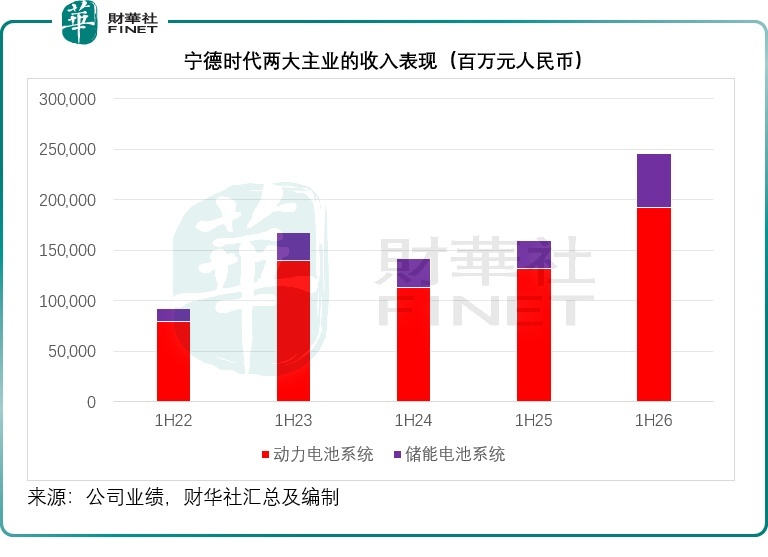
CATL's two core businesses, power batteries and energy storage batteries, present a "one stable, one explosive" pattern. The energy storage sector has already become the ballast stone hedging against weak EV demand, but gross margins for both businesses have declined.
Management revealed that the combined sales volume of power and energy storage batteries grew by approximately 60% year-on-year in the first half of the year, with the proportion of energy storage battery sales in total sales rising to one-quarter, a growth magnitude far exceeding that of power batteries. Notably, the overall gross margin of the energy storage battery system has always been higher than that of the power battery business. As the proportion of energy storage shipments continues to rise, it theoretically could hedge against downward pressure on profitability in the EV track, but at this stage, affected by rising raw material prices, the gross margins of both sectors have declined synchronously, and the hedging effect has not yet been fully released.
In the first half of 2026, the revenues of its power battery systems and energy storage battery systems increased by 46.02% and 87.54% year-on-year, respectively, reaching 192.125 billion yuan and 53.261 billion yuan; segment gross margins decreased by 1.78 and 1.56 percentage points year-on-year, respectively, to 20.63% and 23.96%.
The fundamental differentiation in demand is clear: domestic terminal sales of new energy passenger vehicles are under pressure, but the battery installation per vehicle is steadily increasing, driving positive growth in the domestic power battery market; the year-on-year growth rate of new energy vehicle sales in Europe remained above 30% in the first half of the year, and the demand for new energy commercial vehicles in China remains highly prosperous, dispersing the risk of fluctuations in a single market. The underlying trend of global electrification has not reversed. The energy storage track is comprehensively driven by AI computing infrastructure. The construction of AIDC data centers has spawned massive demand for energy storage backup power, becoming the industry's strongest growth engine.
Data from SNE Research shows that the global lithium-ion battery market size will break through 2,018 GWh in 2026, a year-on-year increase of 40.1%. Energy storage is the core source of incremental growth, with CATL's energy storage shipments contributing nearly one-third of the global energy storage market's increment.
On the capacity side, CATL management revealed that the overall capacity utilization rate in the first half of the year was as high as 94.9%, basically operating at full capacity; current effective capacity is 525 GWh, and under-construction capacity is 764 GWh. Most of the capacity will be put into production in the next two years, sufficient to undertake long-term orders for global energy storage and electric vehicles.
At the 细分 (segmented) product level, domestic energy storage sales were slightly higher than overseas, with complete energy storage system products accounting for nearly 70% of total energy storage shipments. The 587Ah large-capacity energy storage cells have achieved scaled delivery, further reducing the cost per kilowatt-hour of energy storage systems with large cell solutions, consolidating industry competitiveness. Management predicts that the global energy storage market will maintain high-speed expansion in 2026 and 2027. Relying on its zero-carbon energy layout, the company can output complete energy solutions for AIDC scenarios, making AI computing infrastructure the second growth curve for its energy storage business.
Sodium-ion batteries landing step by step: Cost advantage 凸显 (stands out), flexible production lines adapt to market rhythm
Management revealed that from a cost dimension comparison, after scaled mass production, the material cost of sodium-ion batteries has a clear advantage over lithium iron phosphate batteries under the current lithium carbonate price system; apart from the cost dividend, the characteristics of sodium-ion batteries, such as wide temperature range operation, excellent low-temperature discharge performance, and longer cycle life, perfectly adapt to diverse scenarios such as northern low-temperature energy storage, low-speed vehicles, and base station backup power. Customers are very interested in sodium battery products, and contracts have been successively signed with some customers. Management also stated that the current production line can flexibly switch between lithium-ion and sodium-ion batteries, and specific shipment volumes will depend on market demand and the maturity progress of the industrial chain.
Dividends + Multi-billion Buyback Implemented, Substantial Rewards Solidify Market Confidence
Along with the release of results, CATL launched a heavyweight shareholder return plan, balancing interim cash dividends and share repurchase cancellation, possibly aiming to stabilize expectations in the secondary market.
Regarding dividends, the company plans to pay an interim dividend of 1.411 yuan per share, with a total dividend amount of 6.493 billion yuan; the buyback plan is even more impressive: the company launched a new A-share share repurchase plan, planning to use funds ranging from 20 billion yuan to 40 billion yuan, with all repurchased shares used for cancellation to reduce total share capital, thereby increasing earnings per share and optimizing the share capital structure.
AH Shares Discount Exceeds 25%, Stock Price Trends Diverge Completely After Earnings Disclosure
As a dual-listed enterprise in A+H shares, CATL's A-share stock price has been discounted by more than 30% compared to H-shares for most of this year, which is very rare among AH shares listed simultaneously, ranking first in discount magnitude. After the disclosure of half-year results, the performance in the two secondary markets took opposite directions: A-shares surged in response, while H-shares fell against the trend, narrowing the price gap.
There are two core roots causing extreme discounts: First, the pricing systems and investor structures of the two markets are completely different. A-shares are dominated by individual retail investors with stronger trading sentiment, recently favoring narratives in the AI upstream, diverting funds to chase semiconductors and optical concepts; Hong Kong stocks focus on cash flow and certain returns, preferring industry leaders, so it is no surprise that they continue to maintain enthusiasm for CATL. Second, the circulating share volume of H-shares is extremely small, with Hong Kong stock circulating shares less than 5% of A-share circulating volume. Scarcity pushes up the unilateral volatility elasticity of Hong Kong stocks.
CATL's latest half-year report pushing a multi-billion A-share buyback plan may provide some support for A-share stock price performance.
Conclusion
Reviewing CATL's H1 2026 performance as a whole, the company is walking on the path of an industry cycle intertwined with scale expansion and profit contraction. Relying on its position as the global leader in power batteries, coupled with the blue ocean dividend of energy storage spurred by the AI computing wave, the company's revenue maintains high-speed growth of over 50%, and the energy storage business has already become the core pillar hedging against fluctuations in new energy vehicle demand; sodium-ion battery technology is steadily advancing, lithium-sodium flexible production lines are landing, and massive under-construction capacity reserves continuously build mid-to-long-term industry barriers. But the unavoidable reality is that upstream raw material price hikes, continuous R&D investment, or product structure adjustments may jointly suppress profitability levels.
Facing divergence in the capital market, the company has introduced a heavyweight measure combining interim dividends with up to 40 billion yuan in A-share buyback cancellations. On one hand, it fulfills shareholder return commitments and boosts confidence among on-floor investors; on the other hand, it also uses the price difference between the A+H markets to keep promises to shareholders.
Looking to the future, the rise in global electrification penetration rate, the explosion of AIDC energy storage demand, and the commercialization of sodium-ion batteries are expected to drive its growth prospects. Short-term gross margin repair still needs to wait for the raw material cycle to fall back, but the core competitiveness of the leading company traversing industry fluctuations remains solid.
Amid the washing away of sand to reveal gold, the long-term investment value of high-quality hardcore technology enterprises is worth continuous scrutiny and excavation. The 13th Hong Kong Stock Exchange 100 Strong Selection is about to grandly commence, selecting mid-tier enterprises in Hong Kong stocks using multi-dimensional quantitative standards, discovering leading value benchmarks in the new quality productivity track for 广大 (vast) investors. Whether CATL can once again join the new list of Hong Kong Stock Exchange 100 Strong is worth looking forward to by the market.
Author: Wu Yan
The copyright of this article belongs to the original author/organization.
The views expressed herein are solely those of the author and do not reflect the stance of the platform. The content is intended for investment reference purposes only and shall not be considered as investment advice. Please contact us if you have any questions or suggestions regarding the content services provided by the platform.
