


Annual revenue of $41.8 billion, SHEIN public prospectus, global fast fashion giant rushes to Hong Kong IPO
According to disclosures by the Hong Kong Stock Exchange, on July 26, 2026, Shein International Holdings Limited (hereinafter referred to as "SHEIN" or "the Company") passed the hearing, with Goldman Sachs, Morgan Stanley, and JPMorgan Chase serving as joint sponsors.
SHEIN was founded in 2012 by Xu Yangtian (Chris Xu). Initially rooted in China, the company entered the overseas apparel market through a cross-border e-commerce model and grew rapidly via a data-driven "small batch, quick response" supply chain system. After more than ten years of development, SHEIN has grown from a cross-border clothing seller into a consumer internet platform covering global markets.
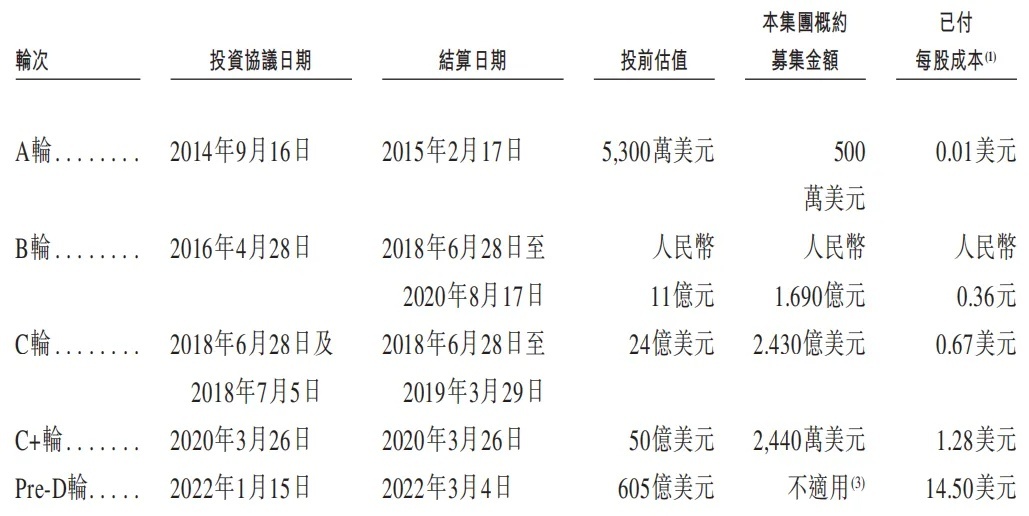
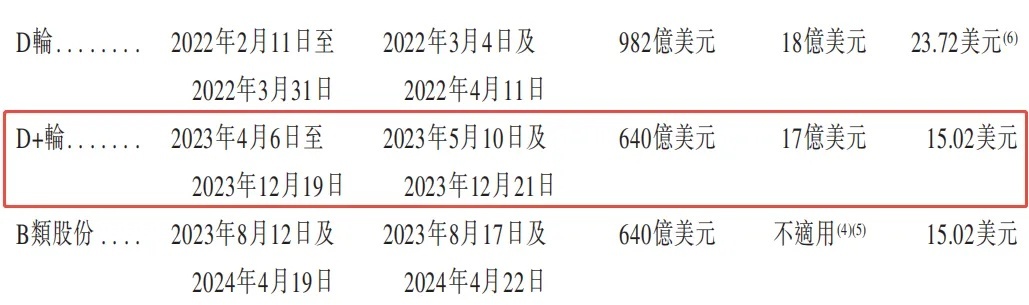
From 2014 to 2023, the company completed six rounds of financing, raising a cumulative total of approximately $3.8 billion. Investors included Tiger Global Fund, General Atlantic, Coatue Management, DST Global, Mubadala, Sequoia China, IDG Capital, Boyu Capital, GIC, and Shunwei Capital. Following the D+ round financing completed in December 2023, the company's post-money valuation reached $64 billion (approximately HK$500 billion).
Source: Prospectus ▲
Main Business
IPO FOCUS
SHEIN is a global online fashion and lifestyle company that meets consumers' diverse fashion needs by offering a rich variety, highly inclusive, frequently updated, and cost-effective product range.
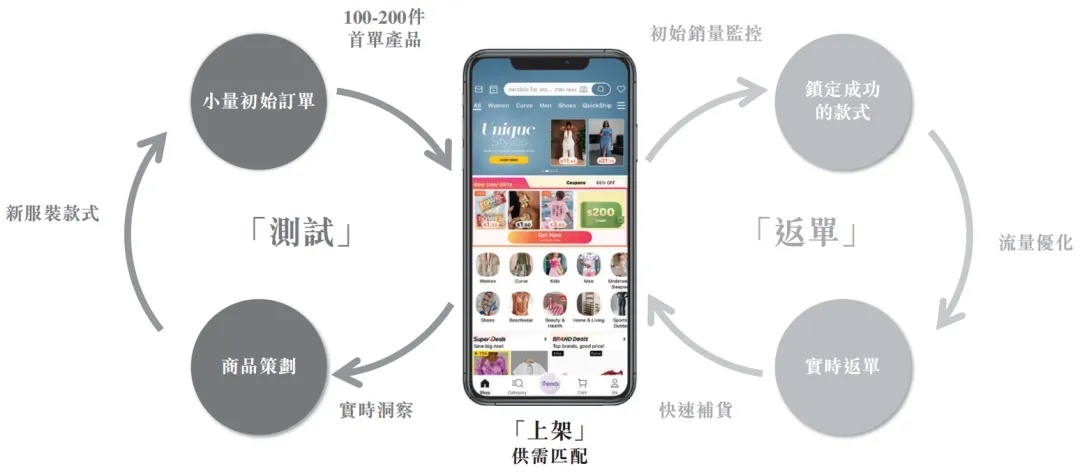
The company's core operating model is its self-developed "Large-Scale Automated Small Batch Quick Response" (LATR). By leveraging two infrastructure pillars—an end-to-end intelligent supply chain and an agile global fulfillment network—it balances product selection diversity, design update speed, and inventory management efficiency. New product testing typically starts with small batches of 100 to 200 pieces. After real-time evaluation of customer feedback, best-selling products can be restocked in as little as five days.
Source: Prospectus ▲
Based on retail sales in 2025, SHEIN is the world's largest online fashion destination and one of the top five global apparel and footwear companies. According to iResearch, the combined market share of the top 20 enterprises in the global fashion industry in 2025 was only about 20.5%. With a 1.9% market share, SHEIN ranks in the top four of the industry.
The company's active customer base grew from 186 million in 2023 to 273 million in 2025, a compound annual growth rate (CAGR) of 21.2%; it further increased to approximately 281 million for the twelve months ended March 31, 2026.
Total Order Volume increased from 715 million orders to 1.078 billion orders during the same period, with an average annual order frequency per customer remaining stable at around 4 times. As of March 31, 2026, the company offered over 2 million clothing styles. Under the first-party model, customers could discover approximately 4,700 new clothing styles on average each day.
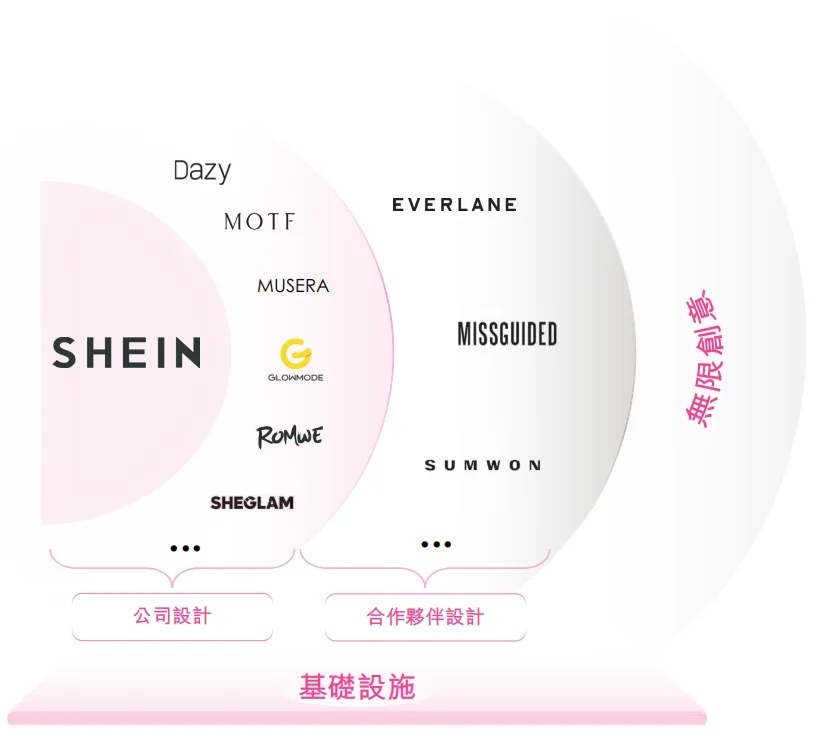
Starting with its flagship brand SHEIN, the company gradually expanded into other proprietary brands such as MOTF (mid-to-high end), Glowmode (sportswear), and SHEGLAM (beauty). It also introduced third-party merchants and partner brands through its marketplace model, covering categories including apparel, footwear, accessories, beauty, and home living. In October 2025, the company upgraded its original SHEIN X program to the SHEIN Xcelerator brand empowerment initiative, providing integrated support in supply chain, fulfillment, and marketing. This initiative currently contributes less than 1% to the group's net revenue and remains in the incubation stage. As of June 30, 2026, the company employed over 370 in-house designers.
Source: Prospectus ▲
As of June 30, 2026, the company operated approximately 6 million square meters of warehouse space across Asia, North America, Europe, the Middle East, and South America, and maintained 25 customer service centers globally. In 2025 and for the three months ended March 31, 2026, over 90% of orders were delivered within 10 working days after shipment. Currently, most products produced by supply chain partners are stored in central warehouses in mainland China before shipment; in 2025, net revenue corresponding to products stored in these warehouses accounted for over 90%.
Regarding the supply chain, the number of contracted manufacturers increased from approximately 5,800 in 2023 to approximately 7,500 in 2025, with no minimum purchase requirements. Cooperation agreements with individual contracted manufacturers typically renew automatically on an annual basis. The company does not rely on any single supply chain partner; throughout the track record period, no single supplier accounted for more than 10% of the group's total procurement volume.
The company's inventory turnover days remained in a low range of 35 to 38 days, at 36 days in 2025. The proportion of unsold inventory stayed in the low single digits. Fulfillment costs per order decreased from $18.9 in 2023 to $17.7 in 2025, rising slightly to $17.9 in Q1 2026 due to changes in tariff and customs tax policies.
Additionally, the company independently developed and operates over 1,700 internal software systems, forming a proprietary technology platform supporting supply chain management, smart manufacturing, and data analysis. The Shein Apparel Manufacturing Innovation Center (CIGM), established in 2022, focuses on innovation in apparel manufacturing processes. In 2025, it obtained 12 new patents, with another 34 pending, and developed over 70 types of new sewing and garment-making tools.
Notably, since May 2025, the company has passed on some of the additional costs resulting from the cancellation of the U.S. de minimis tariff exemption policy by raising prices in the U.S. market. It is also preparing corresponding measures in response to Europe's move to cancel tariff exemptions for low-value goods. The company is addressing tariff environment changes through dynamic pricing, increasing local inventory, and establishing a dedicated trade compliance team. These related cost changes have been partially reflected in the increase in fulfillment cost ratios.
Industry Outlook
IPO FOCUS
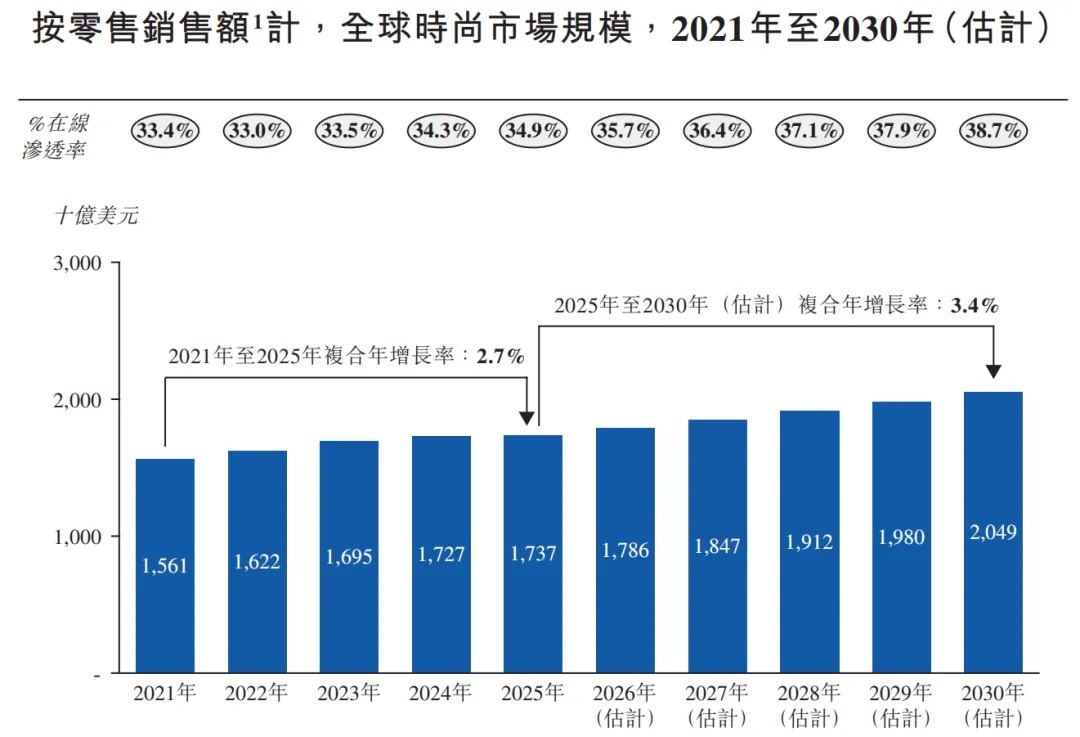
According to iResearch data, the global fashion industry (covering apparel, footwear, and accessories) had a market size of $1.7 trillion in 2025, expected to grow to $2.0 trillion by 2030, representing a CAGR of approximately 3.4% from 2025 to 2030.
Online penetration is the core driver of industry growth. The global online fashion retail market size grew from $522 billion in 2021 to $606 billion in 2025, and is projected to reach $792 billion by 2030. Online penetration rates increased from 33.4% to 34.9% during the same period and are expected to reach 38.7% by 2030.
Source: Prospectus ▲
The fashion industry has long faced a "trilemma," making it difficult to simultaneously balance product selection richness, design update speed, and inventory management efficiency. The industry's average inventory waste rate is as high as 30%, reflecting that most enterprises tend to maintain higher inventory levels, thereby pressuring profitability.
Equity Structure
IPO FOCUS
The company employs a dual-class share structure. Class A shares carry ten votes per share, while Class B shares carry one vote per share. However, resolutions regarding reserved matters such as amendments to the articles of association, appointment or removal of independent non-executive directors, appointment or removal of auditors, and voluntary liquidation of the company are voted on a one-share-one-vote basis.
Immediately prior to this offering, all issued Class A shares were held by the founding group. Institutional investors held preferred shares acquired through previous financing rounds, which will convert into Class B shares upon completion of the listing according to applicable conversion ratios.
The beneficiaries of different voting rights are Mr. Xu Yangtian (company founder), Ms. Miao Miao, Ms. Gu Xiaoqing, and Mr. Ren Xiaoqing. Each holds Class A shares through British Virgin Islands (BVI) companies controlled individually. Their equity interests also concentrate some shares through a concerted action holding platform, Trendy Group Holdings Limited, with Ms. Miao Miao controlling the relevant voting rights. Based on equity proportions, the founding group holds approximately 64.9% of shares. On a fully converted basis (assuming all preferred shares have been converted into Class B shares according to conversion ratios), benefiting from the ten-votes-per-share arrangement for Class A shares, the founding group's combined voting power increases further to approximately 94.9%, making them the controlling shareholders. Other shareholders are primarily institutional investors from multiple financing rounds, such as IDG Capital and Sequoia China.
The equity structure immediately prior to this offering is as follows:
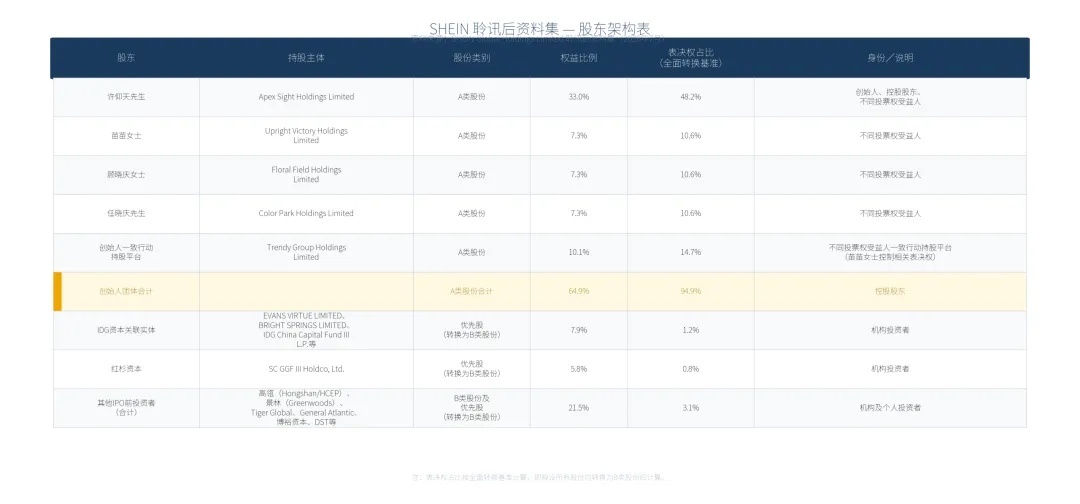
Chart: IPO Focus ▲
Financial Data
IPO FOCUS
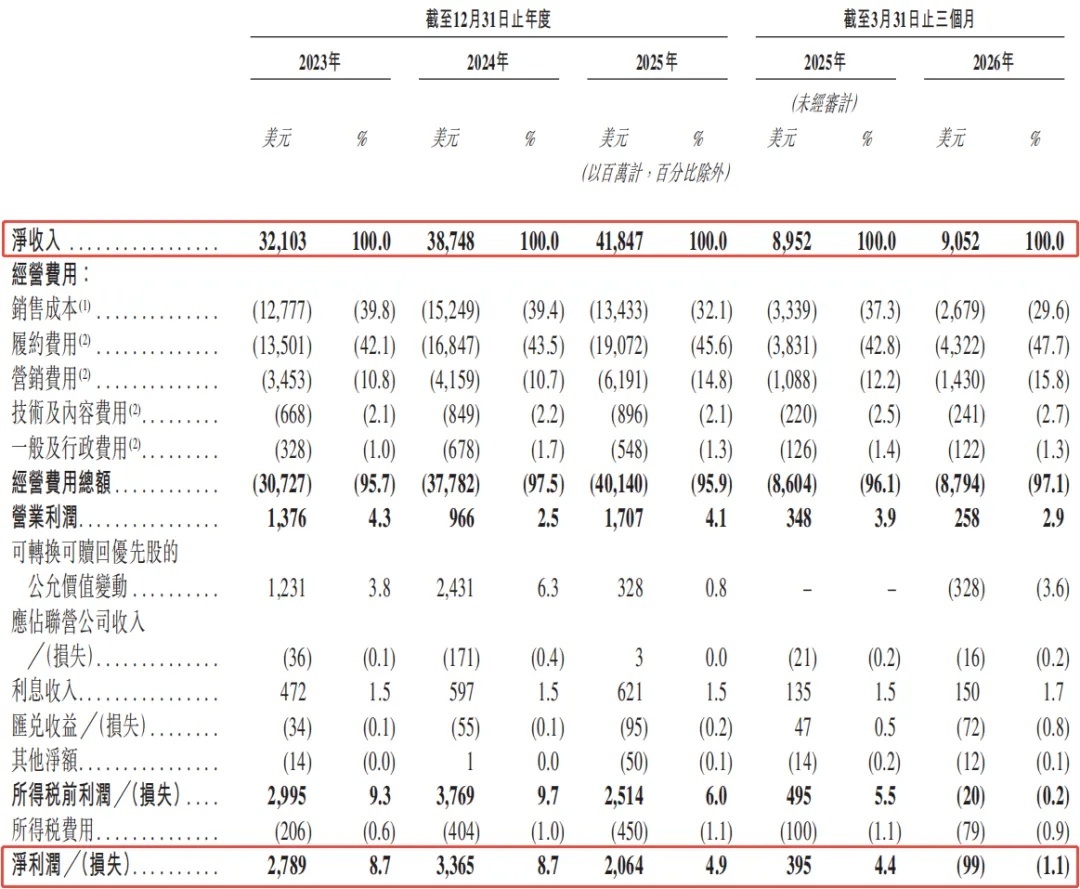
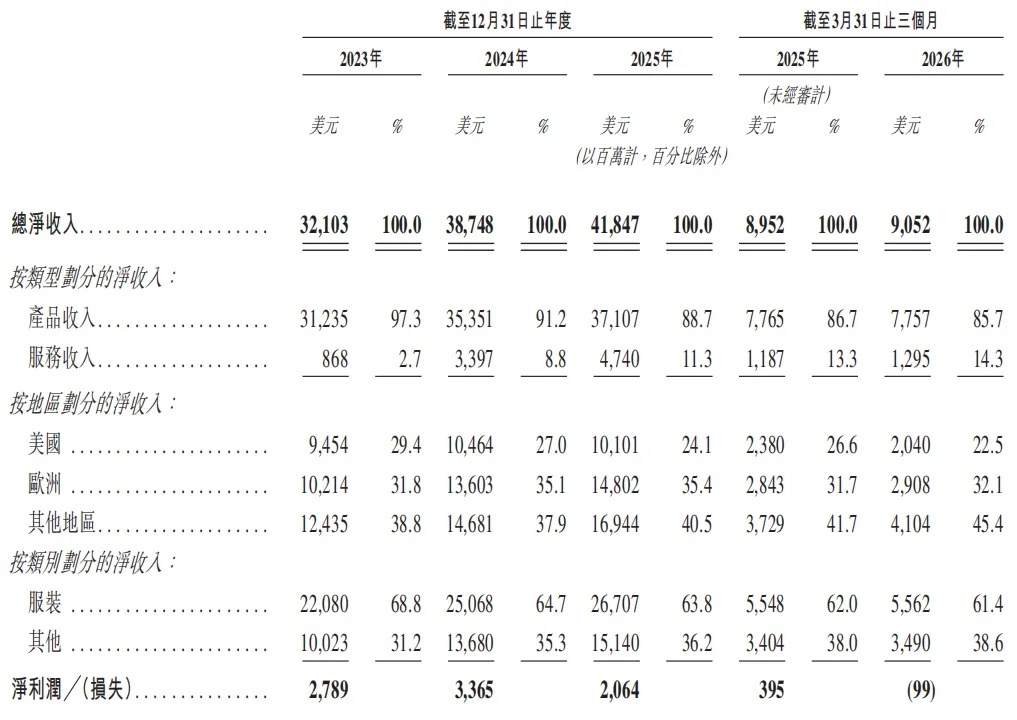
From 2023 to 2025, SHEIN's net revenue increased steadily, reaching $32.1 billion, $38.75 billion, and $41.85 billion respectively, with a CAGR of 14.2%. Net revenue in Q1 2026 was $9.05 billion, a year-over-year increase of 1.1%.
Net Profit stood at $2.79 billion and $3.37 billion in 2023 and 2024 respectively, but declined to $2.06 billion in 2025, a year-over-year drop of 38.7%. Corresponding net profit margins were 8.7%, 8.7%, and 4.9%. In Q1 2026, the company recorded a net loss of $99 million, compared to a net profit of $395 million in the same period last year.
The fluctuation in net profit was mainly influenced by changes in the fair value of convertible redeemable preferred shares—a non-operating income item that narrowed significantly from $2.43 billion in 2024 to $330 million in 2025, and turned into a $330 million fair value loss in Q1 2026.
Source: Prospectus ▲
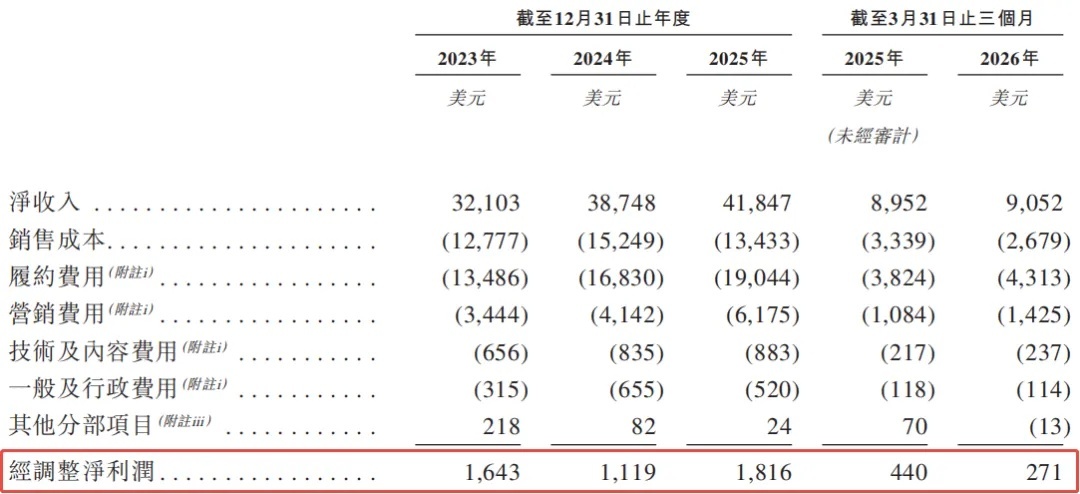
After excluding items that do not involve cash flow changes, the company's adjusted net profit for the past three years was $1.64 billion, $1.12 billion, and $1.82 billion respectively. The adjusted net profit for Q1 2026 was $270 million.
Source: Prospectus ▲
In terms of revenue structure, service revenue (mainly from marketplace commissions and fulfillment service fees) increased from 2.7% in 2023 to 11.3% in 2025, reflecting the continuous expansion of the third-party marketplace business; product revenue share correspondingly decreased from 97.3% to 88.7%.
By region, revenue from Europe increased from 31.8% to 35.4%, while the U.S. share decreased from 29.4% to 24.1%. By category, revenue from non-apparel categories (home, beauty, appliances, etc.) increased from 31.2% to 36.2%, while apparel share decreased from 68.8% to 63.8%.
Source: Prospectus ▲
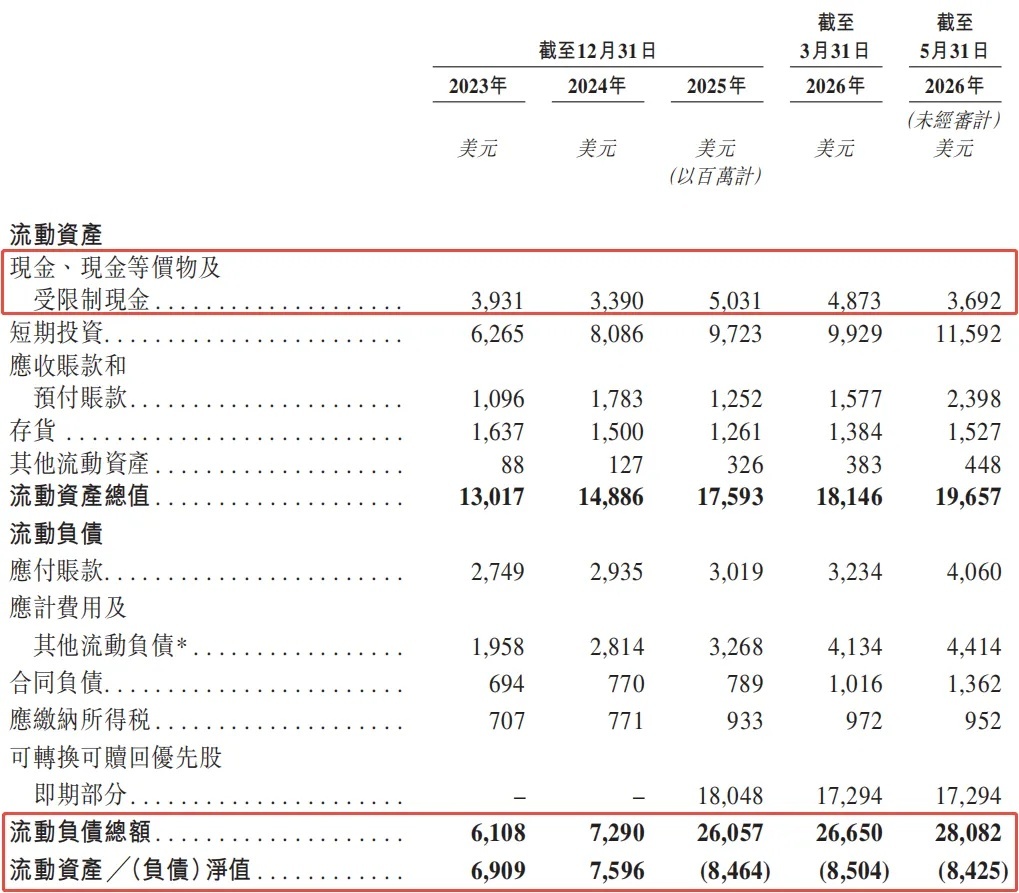
Regarding working capital, the company's cash reserves are adequate. As of May 31, 2026, cash, cash equivalents, and restricted cash amounted to $3.69 billion. However, the company's current liabilities level is relatively high; as of the same date, net current liabilities were $28.08 billion, and net current assets were $8.42 billion.
Source: Prospectus ▲
The copyright of this article belongs to the original author/organization.
The views expressed herein are solely those of the author and do not reflect the stance of the platform. The content is intended for investment reference purposes only and shall not be considered as investment advice. Please contact us if you have any questions or suggestions regarding the content services provided by the platform.
