


$VG Total Stock(VTI.US) Save this, learn from it

To be honest, most people really don't need to research thousands of US stocks.
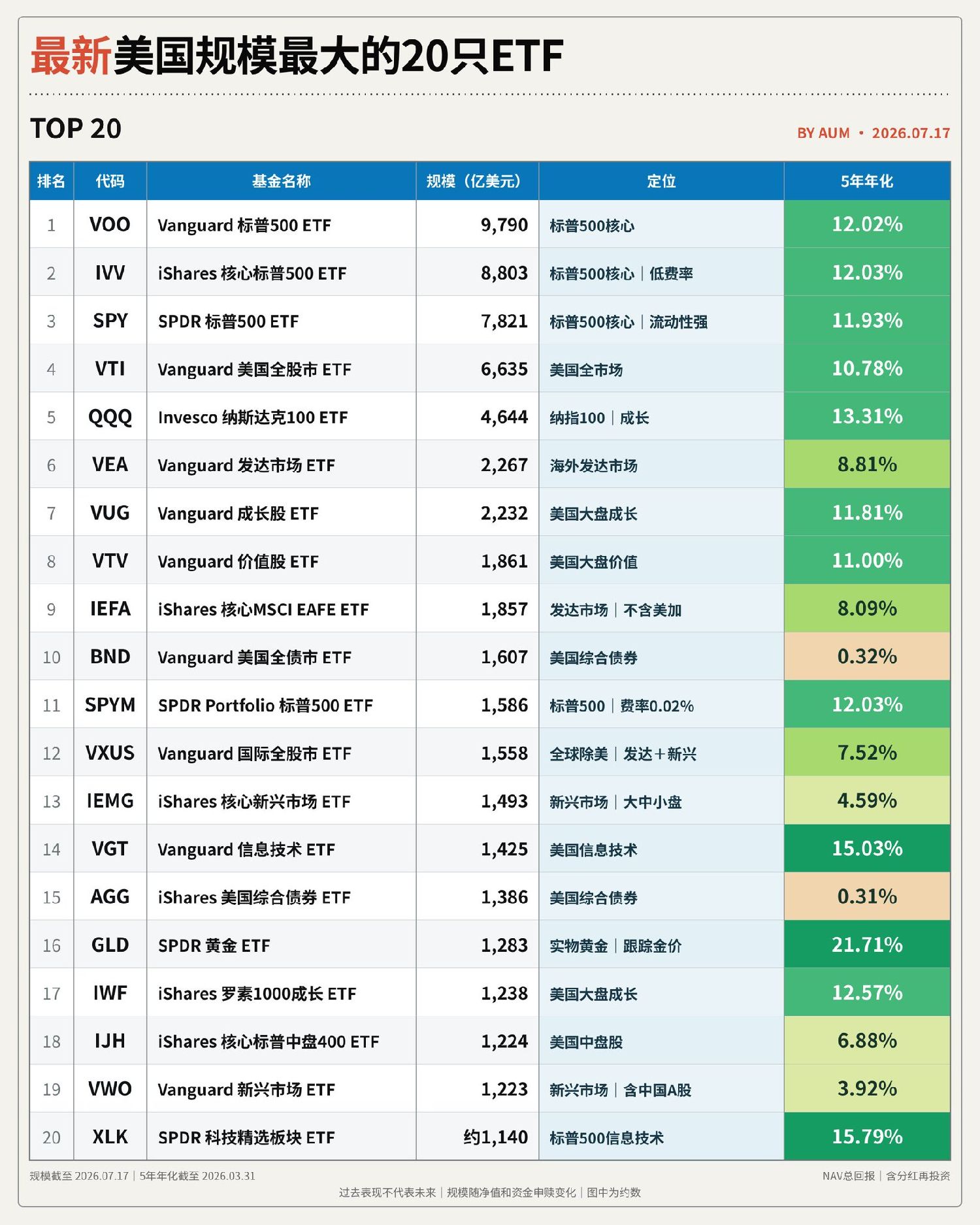
Understanding these 20 mainstream ETFs
is enough to build a portfolio covering US stocks, overseas markets, bonds, and gold.
However, I'll warn you first: you don't need to buy a little bit of all 20.
For example, ETFs like $VOO, $SPY, $QQQ, and $VUG
have significant overlap in their holdings.
So, more ETFs aren't necessarily better.
You need to determine what you want to allocate first,
and then pick just one from the same category, which is usually sufficient.
I. How to choose core US stocks?
If you want long-term exposure to the US large-cap market, picking just one from VOO, IVV, SPY, or SPYM is enough.
They all track the S&P 500, with very similar holdings and trends, so there's no need to buy all four.
In simple terms:
VOO: Large scale, widely used by long-term investors.
IVV: Low fees, suitable for long-term holding.
SPYM: Even lower fees, with clear cost advantages.
SPY: Stronger trading and options liquidity.
I personally dollar-cost average into SPY, mainly because I opened my account quite early.
It might not be the only correct choice.
For long-term investing, choosing the right product is just the first step.
The rest is about sticking to regular investments, letting time and compound interest work their magic.
If you want to cover US small and mid-cap companies,
you can look at VTI.
It covers most listed companies in the US.
You can simply understand it as "buying the entire US stock market with one fund."
II. Want to add growth and tech?
If you can accept higher volatility,
you can add a growth or tech ETF outside your core position.
QQQ: Nasdaq 100, obvious growth attributes, but not a pure tech ETF.
VUG: US large-cap growth stocks.
VGT: Information Technology sector.
XLK: Information technology companies within the S&P 500.
You don't need to buy all of these either. Their holdings have considerable overlap; picking one to supplement your growth position is enough. They may rise more sharply during uptrends, but drawdowns are also typically more pronounced.
III. How to allocate overseas markets?
If you don't want to split by country and region,
VXUS is a hassle-free choice. It covers developed and emerging markets outside the US, allowing you to complete basic overseas allocation with just one ETF.
If you want to adjust proportions yourself, you can also choose separately:
VEA and IEFA are for developed markets, while VWO and IEMG are for emerging markets.
If you don't have specific regional allocation ideas, directly choosing VXUS is the simplest option.
IV. How to choose bonds and gold?
Bonds are usually used to reduce the overall volatility of the portfolio.
BND and AGG are both common US aggregate bond ETFs.
Their positioning is quite similar, so picking one is enough.
However, bonds don't never fall.
They just typically have smaller fluctuations than stocks.
For gold, you can look at GLD.
It has a large scale and active trading, primarily used to track gold prices.
If you care more about long-term holding costs, you can also look into IAU or GLDM.
Gold isn't a mandatory option. If you want an asset in your portfolio that behaves differently from stocks, consider allocating a small portion.
V. The portfolio can actually be very simple.
If you just want to build a portfolio for long-term execution,
you can refer to these three approaches:
Hassle-free version: VTI + VXUS + BND covers US, overseas markets, and bonds, with a simple and direct structure.
Growth version: VOO + QQQ or VUG + VXUS uses US large-caps as the core, adding a growth style, which will also result in higher volatility.
The copyright of this article belongs to the original author/organization.
The views expressed herein are solely those of the author and do not reflect the stance of the platform. The content is intended for investment reference purposes only and shall not be considered as investment advice. Please contact us if you have any questions or suggestions regarding the content services provided by the platform.
