



UAI Intelligent Rushes for Hong Kong Stock Listing: Industrial Embodied Intelligence Begins to Deliver a Harder Answer Sheet
At the World Artificial Intelligence Conference on July 17, five "Gap Edge" humanoid robots and one mobile handling robot jointly demonstrated completing line-side warehouse picking and delivery actions, with zero human intervention throughout the process. Previously, UAI (YouAiZhiHe) had just released its industrial embodied intelligence large model "Zhihe" FabriX and its industrial native humanoid robot "Gap Edge," while also announcing the signing of an initial order for 4,000 units.
UAI's market positioning is now clearer: as a robotics company sprinting towards a Hong Kong IPO, its industrial embodied intelligence is moving beyond single-machine displays on stages into the testing phase of multi-machine collaboration, continuous operation, and batch delivery. However, there are still production, deployment, acceptance, and payment collection steps between intent orders and recognized revenue; subsequent execution will determine how much financial value this round of product upgrades can solidify.
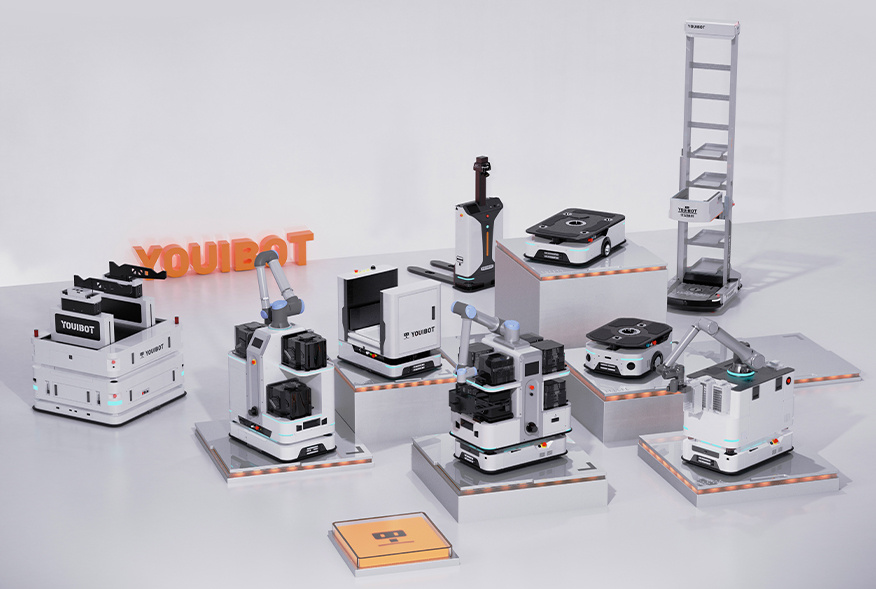
Filings with the Hong Kong Stock Exchange show that in 2025, UAI achieved revenue of 340 million yuan, with an overall gross margin of 36.5% and an adjusted net loss of 106 million yuan. Its business mainly involves industrial logistics and inspection/operation & maintenance, with revenue primarily coming from semiconductors, energy & chemicals, and lithium batteries.
Product launches serve to expand capability boundaries, while financial statements need to answer more specific questions: whether existing scenarios can sustain repeat purchases, whether the same model can be reused across products, and whether revenue expansion can gradually reduce reliance on custom deliveries and external financing.
The industrialization route of embodied intelligence is shifting from single-machine performance to multi-machine collaboration and task closed-loop systems.
The prospectus cites Frost & Sullivan's forecast that the global industrial mobile manipulation robot solution market will grow from 4.2 billion yuan in 2024 to 32.9 billion yuan in 2030, with a CAGR of 45.8% from 2025 to 2030. The Chinese market is expected to grow from 2 billion yuan to 17.6 billion yuan during the same period, with a CAGR of 47.8%.
The industrial direction behind the forecast data is already quite clear: AGVs excel at fixed-route transportation, robotic arms excel at fixed-station operations, humanoid robots pursue broader environmental adaptability, and mobile manipulation robots attempt to integrate mobility, perception, grasping, and scheduling into a single production system.
Management expert Peter Drucker once said, "Nothing is more useless than efficiently doing something that shouldn't be done in the first place." The implication for the robotics industry is this: factories purchase task completion quality; the robot form factor is merely the path to achieve it. UAI proposes "one brain, multiple forms," introducing industrial knowledge, deterministic constraints, and cluster scheduling into FabriX, attempting to allow different forms of robots to share decision-making capabilities, thereby reducing the cost of having to develop a new system every time entering a new scenario.
Data shows that based on 2024 revenue, UAI ranks first among global industrial mobile manipulation robot companies, with a market share of 6.1%, and holds a 12.0% share in the Chinese market. If the scope is expanded to overall embodied intelligent robot solutions, the company's global share is only 0.3%, and its Chinese share is 0.9%. Niche leading advantages have formed, but the industry scale remains in its early expansion stage.
What current ranking achievements bring are customer cases, industrial data, and supply chain bargaining power, but they cannot be directly exchanged for stable profits. UAI's future industry position needs to be further consolidated by replication efficiency across factories and industries.
There is an essential difference between industrial embodied intelligence and consumer-grade AI. Language models might occasionally give a wrong answer, but users can ask again; if a robot makes even one movement deviation in a wafer fab, substation, or chemical plant site, it could lead to production line stoppages, equipment damage, or even safety accidents.
The upper limit of the model determines how many tasks can be completed, but the lower limit of the engineering system determines whether customers dare to use it long-term. UAI placing the model, motion control, task scheduling, and fault recovery within the same architecture reflects that competition in industrial robots is shifting from single parameters to system reliability.
Semiconductors build barriers, lithium batteries provide incremental growth, and repeat purchases determine expansion quality.
According to financial reports: UAI's revenues from 2023 to 2025 were 108 million yuan, 255 million yuan, and 340 million yuan respectively, representing a year-on-year growth of 33.3% in 2025. While revenue growth slowed compared to 2024, the business structure added new support: semiconductor revenue in 2025 was 92.22 million yuan, accounting for 27.1% of total revenue; energy & chemical revenue was 113 million yuan, accounting for 33.3%; and lithium battery revenue was 88.72 million yuan, accounting for 26.1%.
Among these, lithium battery revenue increased significantly from 15.87 million yuan in 2024, becoming one of the most obvious increments in the company's revenue expansion. During the same period, the number of orders increased from 233 in 2023 to 402 in 2025.
Data shows that UAI's semiconductor customer repeat purchase rate reached 75% in 2025, the lithium battery customer repeat purchase rate reached 100%, and the 3C and other manufacturing customer repeat purchase rate reached 78%. By the end of 2025, the company served over 400 clients, cumulatively landing over 800 industrial embodied intelligence scenarios, with an overall customer repeat purchase rate exceeding 70%.
The understanding of "intelligence" at industrial sites carries strong engineering attributes. Navigation errors, production beats, fault recovery, cleanliness, safety redundancy, and system interfaces all enter the client's acceptance checklist.
Semiconductors are the high-barrier testing ground for industrial robots. Wafer manufacturing and packaging processes have strict requirements for cleanliness, vibration control, positioning accuracy, and continuous operation. Robots must also connect to manufacturing execution systems, warehouse systems, and production equipment.
This means not only is the initial certification cycle longer, but the migration cost after successful integration is also relatively high,
The importance of repeat purchases exceeds simply increasing orders. For the first project, on-site surveys, software integration, equipment debugging, and safety certifications are usually required. Project replication can amortize upfront R&D and deployment costs.
Financial report data shows that UAI's overall gross margin increased from 26.1% in 2023 to 36.5% in 2025. Semiconductor business gross margin increased from 13.3% to 42.3%, and energy & chemical business gross margin increased from 35.6% to 49.8%. This indicates that the company has already obtained better pricing and delivery efficiency in some mature industries.
Its lithium battery business is still in another stage. In 2025, lithium battery revenue scaled up rapidly, but the gross margin was only 13.3%, lower than semiconductors and energy & chemicals. New industries can increase revenue growth rates but may drag down profit margins in the early stages. Reasons typically include heavy customization, low benchmark project quoting, and supply chains not yet forming economies of scale. UAI needs to precipitate lithium battery projects into standard modules to reduce engineering investment in subsequent orders, so that revenue growth will generate more obvious profit elasticity.
Order visibility provides UAI with a certain buffer. By the end of 2025, the company's unfulfilled contract value was 354 million yuan, subsequently increasing to 407 million yuan on the final practical feasible date, which already exceeds the full-year 2025 revenue scale. Related contracts still need to be recognized according to delivery and acceptance progress and cannot be simply equated with next year's revenue, but it shows the company has accumulated a considerable amount of in-hand projects.
As for globalization, we need to return to examine the revenue structure. Data shows that in 2025, 93.7% of the company's revenue came from mainland China, Japan accounted for 1.0%, and China's bonded zones accounted for 3.4%. Overseas markets are currently closer to capability reserves and have not yet constituted a major source of growth.
In the application documents, UAI proposed building regional spare parts warehouses in Japan and planned to increase sales and technical support in markets such as Japan, Singapore, Malaysia, and Taiwan, China. Industrial robot overseas expansion relies on local deployment, spare parts response, and after-sales engineers. The importance of covering how many countries is lower than the ability to form a stable local service radius.
Revenue scale has passed the verification line, but cash flow still needs to pass through the deep waters of engineering.
UAI's net loss in 2025 was 384 million yuan, of which 249 million yuan came from changes in the book value of redemption liabilities, belonging to non-cash items related to pre-IPO financing arrangements. After excluding share-based payments, changes in redemption liabilities, etc., the company's adjusted net loss was 106 million yuan, with an adjusted net loss margin of 31.2%, significantly narrowing from 122.0% in 2023.
Currently, UAI's revenue scale and gross margin have improved, but the profitability path still requires expense efficiency to keep up.
Embodied intelligence models, humanoid robots, and overseas teams all require continuous investment. Data shows that in 2025, the company's R&D expenditure was 83.02 million yuan, accounting for 24.4% of revenue; R&D, sales, and administrative expenses totaled 248 million yuan, approximately twice the gross profit of 124 million yuan for the same period.
To this end, UAI needs to let modular R&D produce higher reuse rates and precipitate project experience into standard products, software systems, and service revenue. Because if it relies long-term on custom solutions, revenue increases are often accompanied by simultaneous expansion of R&D, deployment, and after-sales personnel, making it difficult to fully realize economies of scale.
Cash flow composition presents a stricter test for UAI.
In 2025, the company's net cash outflow from operating activities was 185 million yuan, and trade receivables and notes receivable increased to 247 million yuan; cash and cash equivalents at year-end were 243 million yuan, while net cash inflow from financing activities in the same year was 301 million yuan.
Industrial projects typically feature long delivery cycles, complex acceptance nodes, and slow payment collection. The company needs to shorten project cycles, increase advance payment ratios, and improve accounts receivable turnover. The financial content of the 4,000 intent orders will gradually emerge in subsequent batch deliveries and cash collections.
A Hong Kong IPO can supplement funds for model R&D, capacity construction, and internationalization. The use of funds itself points to the company's capability gaps in the next stage.
Filings show that UAI plans to build new production lines, with a first-phase designed annual capacity of 2,000 units, expected to go into production by the end of 2028, while strengthening overseas sales, technical support, and certification systems. Capacity expansion echoes the 4,000 intent orders, but it requires meeting certain prerequisites: orders must convert into binding procurement contracts, and stable outsourced production and supply chain management capabilities must be established before the new production lines go online.
Next, the industrial embodied intelligence industry will see clearer stratification. If model capabilities can reduce deployment costs, increase repeat purchases, and improve cash flow, robotics companies will very likely gradually form platform-type revenues. But if business remains long-term stuck in custom projects and intent orders, scale expansion will still be constrained by profit and capital pressures.
UAI has entered the scale verification stage. The next answer sheet won't be written on the exhibition stand, but will fall on delivery cycles, accounts receivable, unit project profits, and exactly how many robots a single "brain" can manage and how many factories it can enter.
The copyright of this article belongs to the original author/organization.
The views expressed herein are solely those of the author and do not reflect the stance of the platform. The content is intended for investment reference purposes only and shall not be considered as investment advice. Please contact us if you have any questions or suggestions regarding the content services provided by the platform.
