


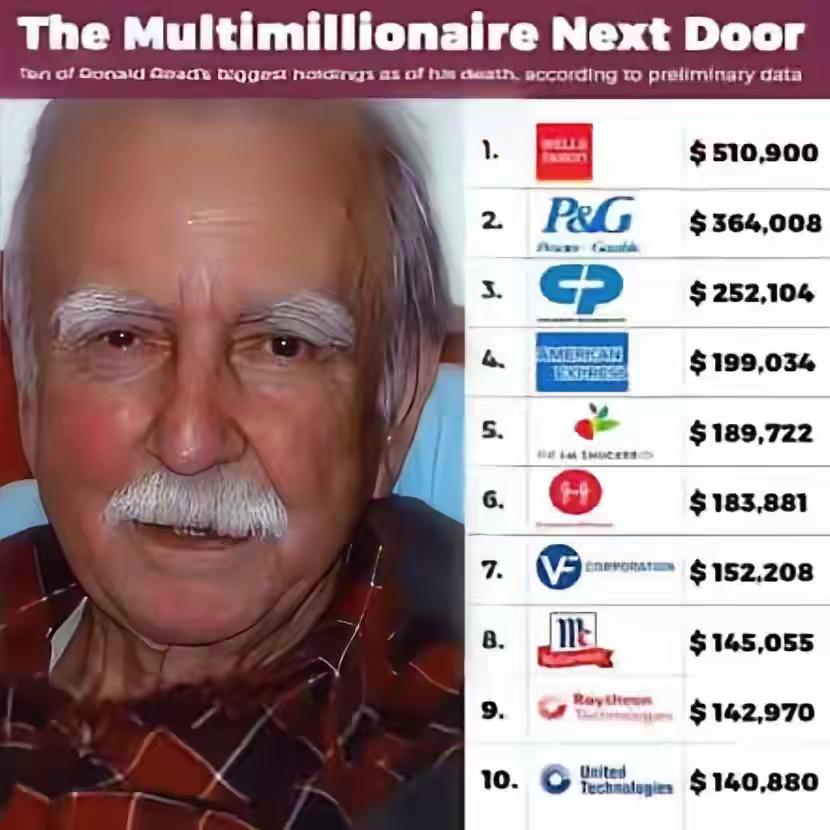
American janitor Ronald Read passed away at the age of 92, and only then did his family discover he had nearly $8 million. When investigators went through his dusty stock list, everyone fell silent: in his entire life, he had bought only 92 stocks and never sold a single share. Prominently listed were Procter & Gamble, JP Morgan, Johnson & Johnson, Wells Fargo, Colgate-Palmolive, CVS, GE...
This story first exploded in the US investment circle and among ordinary people after being deeply reported by The Wall Street Journal. No one expected that the old man in the small town of Brattleboro, Vermont, who wore tattered coats and pinned up his clothes with safety pins, doing manual labor as a gas station mechanic and department store janitor for his whole life, had quietly accumulated a huge fortune. Not to mention neighbors and friends, even his stepchildren were completely unaware; they were all stunned when sorting out his estate.
Ronald Read came from an extremely ordinary background. Born in 1921 into a rural family, he was the first in his family to successfully graduate from high school. Coming of age during World War II, he joined the army and fought in North Africa, Italy, and the Pacific theater. He returned home with an honorable discharge in 1945 and worked as a service attendant and mechanic at his brother's gas station for 25 years. Although he should have retired to enjoy his golden years, he couldn't stay idle and went on to work as a janitor at the local JCPenney department store for another 17 years, finally stopping work completely at the age of 76.
His lifelong frugality was obvious to everyone in town. At the age of 38, he spent $12,000 to buy a two-bedroom apartment, and never moved again since. For daily transportation, he drove a used Toyota Yaris. To save a few cents on parking fees, he was willing to walk several hundred meters further to park in free zones.
Even in his 90s, he still chopped wood and built fires himself for heating, refusing to spend money on help. His only "luxury consumption" each day was buying an English muffin with peanut butter and a cup of coffee at the hospital cafeteria, always sitting on the same fixed stool.
Everyone around him knew he saved money, but no one imagined that he invested almost every penny he saved into the stock market.
According to The Wall Street Journal's analysis of his holdings, he bought his first stock in 1959, spending $2,380 to purchase 39 shares of Pacific Gas and Electric Company. By the time he died in 2014, this initial holding had appreciated to $10,735.
The copyright of this article belongs to the original author/organization.
The views expressed herein are solely those of the author and do not reflect the stance of the platform. The content is intended for investment reference purposes only and shall not be considered as investment advice. Please contact us if you have any questions or suggestions regarding the content services provided by the platform.
