


The global air bearing spindle market continues to develop towards high precision and high speed, with semiconductors and advanced manufacturing becoming the core growth engines.
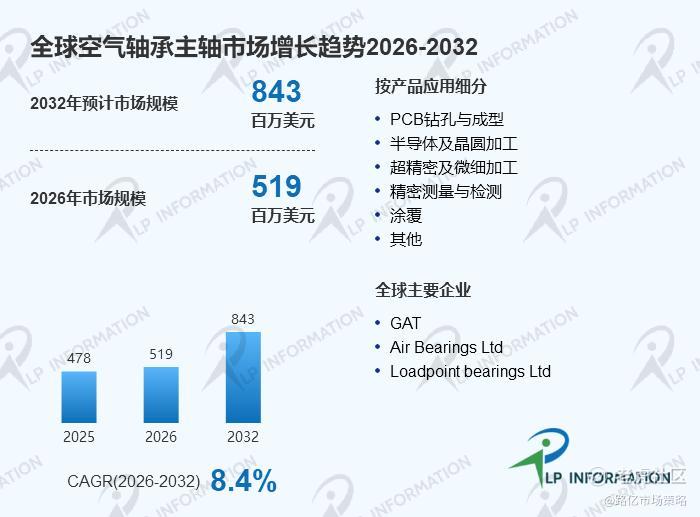
According to research data from LP Information, the global air bearing spindle market size was approximately $478 million in 2025 and is projected to reach $843 million by 2032, with a Compound Annual Growth Rate (CAGR) of 8.4% during the period from 2026 to 2032.
An air bearing spindle is a high-precision spindle equipment that achieves non-contact rotational motion using an air film support. By forming a stable air film between the bearing and the rotor through compressed air or other gases, it reduces friction, wear, vibration, and thermal deformation caused by mechanical contact. Compared to traditional rolling bearing spindles, air bearing spindles offer higher rotational accuracy, lower motion error, higher speed capabilities, and longer service life, making them widely used in fields requiring extremely high processing precision and stability.
In 2025, the global production volume of air bearing spindles was approximately 50,500 units. With the rapid development of semiconductor manufacturing, advanced packaging, high-end PCBs, precision optics, aerospace components, and micro-nano processing industries, the demand from manufacturing enterprises for high-speed, high-precision, and low-vibration processing equipment continues to rise, driving the penetration of air bearing spindles from traditional precision machining fields into the core links of advanced manufacturing.
I. Industry Chain Analysis: Upstream Precision Materials and Core Components Determine Product Performance, Midstream Manufacturing Emphasizes Technical Accumulation
The air bearing spindle industry chain has obvious technology-intensive characteristics. The upstream mainly includes high-precision metal materials, special alloys, precision ceramics, air bearing materials, high-speed motors, encoders, sensors, drive control systems, spindle shaft bodies, throttling elements, sealing components, and air source processing equipment. Among these, the processing accuracy of the spindle shaft core, air bearing gap control, high-speed motor stability, and air film uniformity directly affect the final performance of the product. Therefore, suppliers need to possess ultra-precision machining, material processing, and micron-level assembly capabilities.
The midstream manufacturing link mainly includes air bearing design, spindle structure development, precision machining, dynamic balance testing, high-speed operation testing, and system integration. Since air bearing spindles involve the integration of multi-disciplinary technologies such as fluid mechanics, mechanical design, motor control, and materials engineering, their R&D cycle is relatively long, and the industry entry barrier is high. Leading enterprises usually have complete R&D systems and long-term customer verification experience, and can provide customized solutions according to different application scenarios such as PCB drilling, wafer processing, and optical inspection.
Downstream applications cover semiconductor equipment manufacturers, PCB processing enterprises, precision machine tool manufacturers, optical manufacturing enterprises, scientific research institutions, and aerospace component suppliers. As terminal manufacturing develops towards high precision, miniaturization, and complex structures, the importance of air bearing spindles in high-value manufacturing links continues to increase.
II. Consumer Level Analysis: High-End Manufacturing Demand Drives Market Upgrade, Customers Focus More on Comprehensive Performance
From the consumer side, air bearing spindles are not traditional consumer products but key industrial components serving advanced manufacturing enterprises. Their demand mainly comes from equipment upgrades, production line expansion, and the iteration of high-end manufacturing technologies. In recent years, the development of AI servers, high-performance computing equipment, and new energy vehicle electronics has driven the growth in demand for high-layer PCBs, HDI circuit boards, and IC substrates, putting forward higher requirements for PCB micro-hole processing precision, thereby promoting the expanded application of high-speed air bearing spindles.
The semiconductor industry is also an important growth area for air bearing spindles. In processes such as wafer processing, advanced packaging, precision inspection, and micro-machining, processing equipment needs to maintain extremely low vibration and high stable operating states. Traditional mechanical bearing spindles find it difficult to fully meet the needs of some high-end applications, so the advantages of air bearing technology are gradually becoming apparent.
In addition, the increasing demand for micron even nanometer-level processing precision in industries such as precision optics, medical devices, and aerospace manufacturing has also led customers to pay more attention to spindle operational stability, maintenance costs, service life, and system compatibility when purchasing, rather than just the purchase price.
III. Production Side Analysis: High Technical Barriers, Global Supply System Shows Specialized Competitive Landscape
The production process of air bearing spindles involves ultra-precision manufacturing and strict quality control, posing high requirements for enterprise production capabilities. Core manufacturing links include high-precision shaft body processing, air bearing structure design, micro-hole throttling processing, high-speed motor integration, dynamic balance calibration, and long-term reliability testing. Among them, air film thickness control usually reaches the micron level, and any processing error may affect the rotational accuracy and operational stability of the spindle.
Currently, the global air bearing spindle market presents a competitive landscape where "international leading enterprises master high-end technologies, while local enterprises accelerate breakthroughs." European, American, and Japanese enterprises have strong advantages in ultra-high speed, high precision, and semiconductor-related application areas due to long-term technical accumulation. At the same time, Chinese enterprises have continued to invest in precision manufacturing, intelligent equipment, and semiconductor industry chain construction in recent years, gradually increasing their market share in PCB processing, high-end equipment supporting, and domestic substitution fields.
With the development of manufacturing towards intelligence and automation, production enterprises are strengthening digital testing capabilities, improving spindle operational reliability through online monitoring, intelligent control, and data feedback, and promoting the development of products from single components to intelligent motion control modules.
IV. Regional Market Analysis: Rapid Growth in Asian Manufacturing Demand, China Becomes an Important Growth Market
From a regional market perspective, North America, Europe, and the Asia-Pacific region are the main demand areas for global air bearing spindles.
The North American market relies on its advantages in the semiconductor, aerospace, precision instruments, and high-end equipment manufacturing industries to maintain stable demand for air bearing spindles. The US possesses a relatively mature semiconductor equipment ecosystem and scientific research system, with continuous demand from high-end processing equipment manufacturers for high-precision spindle components.
The European market has a strong foundation in precision machinery, industrial automation, optical manufacturing, and aerospace. Countries such as Germany and Switzerland have a relatively complete high-end manufacturing industry chain and have high demand for highly reliable air bearing spindle products. Meanwhile, the European manufacturing sector puts forward higher requirements for energy saving, high efficiency, and long-term stable operation, which is conducive to the promotion of high-performance products.
The Asia-Pacific region is an important area for future market growth. China, Japan, and South Korea have huge industrial scales in semiconductors, electronic manufacturing, PCBs, new energy vehicles, and precision processing. Among them, China's manufacturing upgrade and the trend of semiconductor localization are driving the growth of domestic substitution demand for air bearing spindles; Japanese enterprises maintain technological advantages in the field of ultra-precision processing; South Korea benefits from the expansion of investment in the semiconductor industry, leading to increasing demand for high-speed precision processing equipment.
V. Market Development Prospects: Semiconductors, AI Industry, and Advanced Manufacturing Open Long-Term Growth Space
In the next few years, the air bearing spindle market will still maintain good growth potential, mainly benefiting from the upgrading of advanced manufacturing industries. With the continuous advancement of artificial intelligence servers, high-performance computing equipment, and data center construction, PCB and semiconductor packaging technologies are constantly developing towards high density and high precision, putting forward higher requirements for high-speed drilling and micro-processing equipment.
At the same time, the rapid development of new energy vehicles, power semiconductors, and third-generation semiconductor materials (SiC, GaN) will also promote the upgrading of wafer processing and precision inspection equipment, providing new application space for air bearing spindles.
In addition, the trend of smart manufacturing is changing the structure of industrial equipment demand. In the future, customers will not only focus on spindle speed and precision but also place greater emphasis on equipment intelligent monitoring, predictive maintenance, energy consumption control, and integration capabilities with automated production lines. Suppliers with digital functions, high reliability, and customized service capabilities are expected to gain higher market competitive advantages.
VI. Industry Development Opportunities Analysis: Domestic Substitution, Technology Upgrades, and Emerging Industries Bring New Demand
There are three main development opportunities in the air bearing spindle industry in the future. First, the trend of high-end equipment localization provides market space for local enterprises. With the increasing demand for the localization of semiconductor equipment, high-end CNC machine tools, and precision processing equipment, domestic enterprises are accelerating breakthroughs in core component technologies.
Second, the expansion of the new energy and electronics industries creates new application scenarios. The development of new energy vehicle electronics, energy storage equipment, smart terminals, and AI hardware will continue to increase the demand for precision processing equipment.
Third, product technology upgrades bring value enhancement opportunities. In the future, air bearing spindles will develop towards higher speeds, higher stiffness, lower vibration, and smarter control. Enterprises with capabilities in material innovation, structural optimization, and system integration will occupy an advantageous position in market competition.
VII. Industry Challenges Analysis: Manufacturing Difficulty, Cost Pressure, and Customer Verification Cycle Remain Main Restricting Factors
Although the market prospect is good, the air bearing spindle industry still faces certain challenges. First, the technical threshold of this product is high, requiring long-term R&D investment and extensive application verification. New entrants find it difficult to quickly establish competitive advantages.
Second, manufacturing costs are high. High-precision processing equipment, advanced testing instruments, and strict quality control systems all increase production costs, making the price of air bearing spindles significantly higher than that of ordinary mechanical bearing spindles.
In addition, downstream customers usually have high certification requirements, especially in the field of semiconductor equipment. New suppliers need to undergo a relatively long time for testing and verification, resulting in a long market introduction cycle. Therefore, enterprises need to continuously improve product reliability, service capabilities, and the depth of customer cooperation.
VIII. Competitive Landscape Analysis: International Enterprises Occupy the High-End Market, Chinese Enterprises Accelerate Technological Breakthroughs
Main participants in the global air bearing spindle market include GAT, Air Bearings Ltd, Loadpoint Bearings, Novanta (Westwind), Professional Instruments, AMETEK Precitech, NTN, Cranfield Precision, PI Nelson Air Corp, as well as Chinese enterprises Guangzhou Huozhi Electromechanical, Jingxiao Suspension, Hualing Precision Machinery, etc.
International enterprises have long served the semiconductor, precision measurement, and aerospace fields, having obvious advantages in high-speed and high-precision products. In recent years, Chinese enterprises have gradually achieved breakthroughs in PCB processing, domestic equipment supporting, and some precision manufacturing fields through independent R&D, improvement of the industry chain, and accumulation of customer applications.
In the future, market competition will shift from pure product competition to competition in technology, service, and ecology. Enterprises that can provide complete solutions, including spindle design, application support, maintenance services, and intelligent management capabilities, will be easier to obtain long-term market share.
Report Scope
By Product Type:
Static Pressure Air Bearing Spindle
Dynamic Pressure Air Bearing Spindle
By Spindle Function:
Tool-Type Air Floating Spindle
Workpiece-Type Air Floating Spindle
By Drive Structure:
Integrated Air Floating Spindle
Externally Driven Air Floating Spindle
By Speed:
Low-Speed Air Bearing Spindle (<30,000 rpm)
Medium/High-Speed Air Bearing Spindle (30,000–100,000 rpm)
Ultra-High-Speed Air Bearing Spindle (100,000–200,000 rpm)
Extreme High-Speed Air Bearing Spindle (>200,000 rpm)
By Application:
PCB Drilling and Forming
Semiconductor and Wafer Processing
Ultra-Precision and Micro-Machining
Precision Measurement and Inspection
Coating
Other Applications
Main Enterprises Include: GAT, Air Bearings Ltd, Loadpoint Bearings Ltd, Novanta (Westwind), Professional Instruments Company, AMETEK Precitech, ABTech Manufacturing, NTN, Seagull Solutions, Cranfield Precision, PI Nelson Air Corp, Guangzhou Huozhi Electromechanical Co., Ltd., Eitzenberger GmbH, Jingxiao Suspension, Hualing Precision Machinery, etc.
The copyright of this article belongs to the original author/organization.
The views expressed herein are solely those of the author and do not reflect the stance of the platform. The content is intended for investment reference purposes only and shall not be considered as investment advice. Please contact us if you have any questions or suggestions regarding the content services provided by the platform.
