



All three strike prices are fully occupied. Should I still follow this trade?
After yesterday's close, two small-cap stocks each jumped up a notch: AXT moved from 46.94 to 58.64, and Applied Optoelectronics (AAOI) moved from 90.11 to 95.24. During the daytime session, someone had already laid out the structure for both of these tickets—one filled all three strike prices of 35, 40, and 50 in three separate trades, while the other sold Puts and bought Calls to execute a calendar risk reversal.
The volume wasn't significant: AXT's three trades totaled $1.87 million, which is 0.062% of its $3.011 billion market cap; AAOI's two legs totaled $2.39 million, a ratio of 0.033%. Both are far from 0.1%. On the contrary, the trade with the highest ratio yesterday hit 0.33%, ranking first overall, occurring on KSTR—I didn't touch that one at all, reasons will be explained at the end.
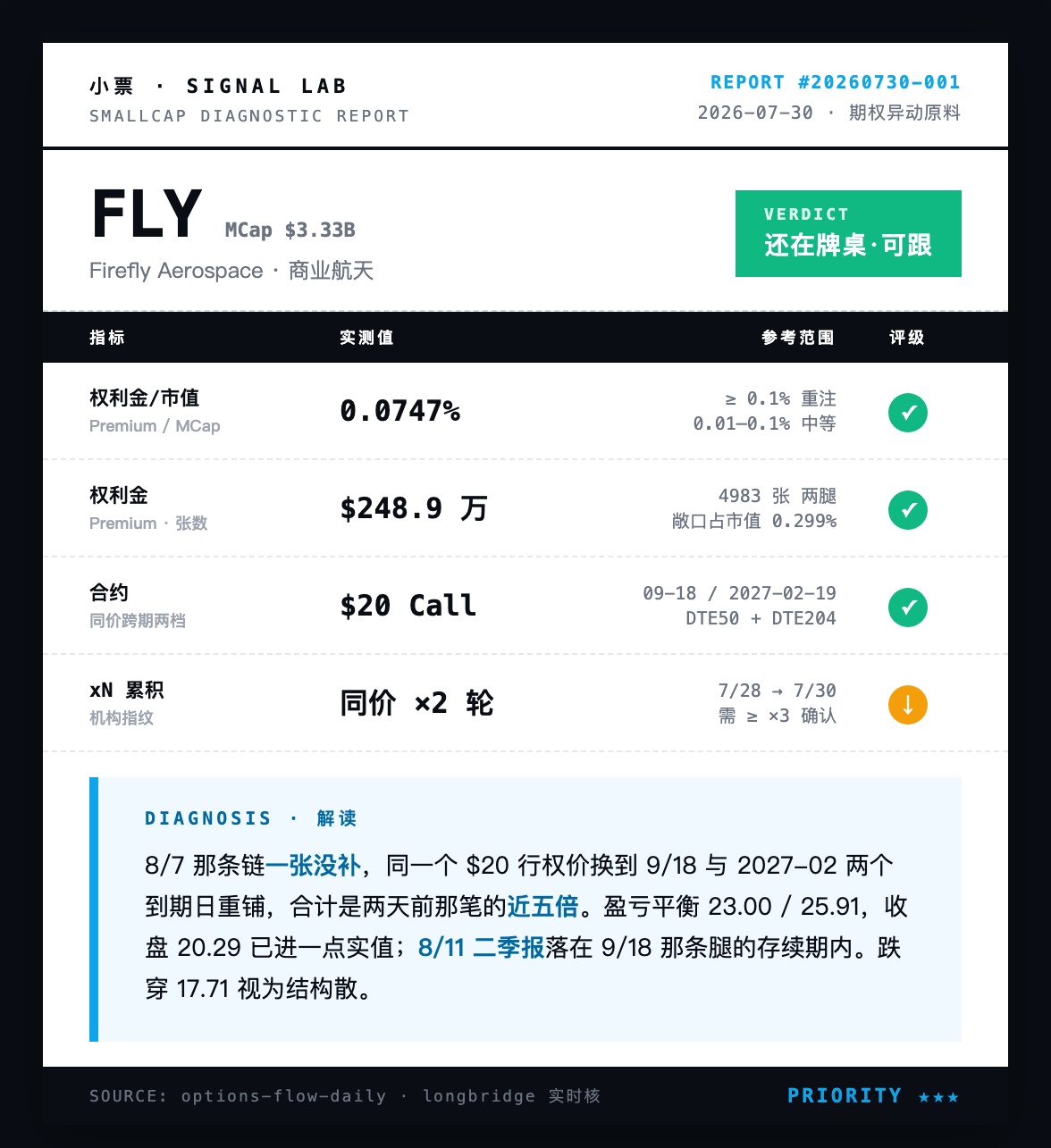
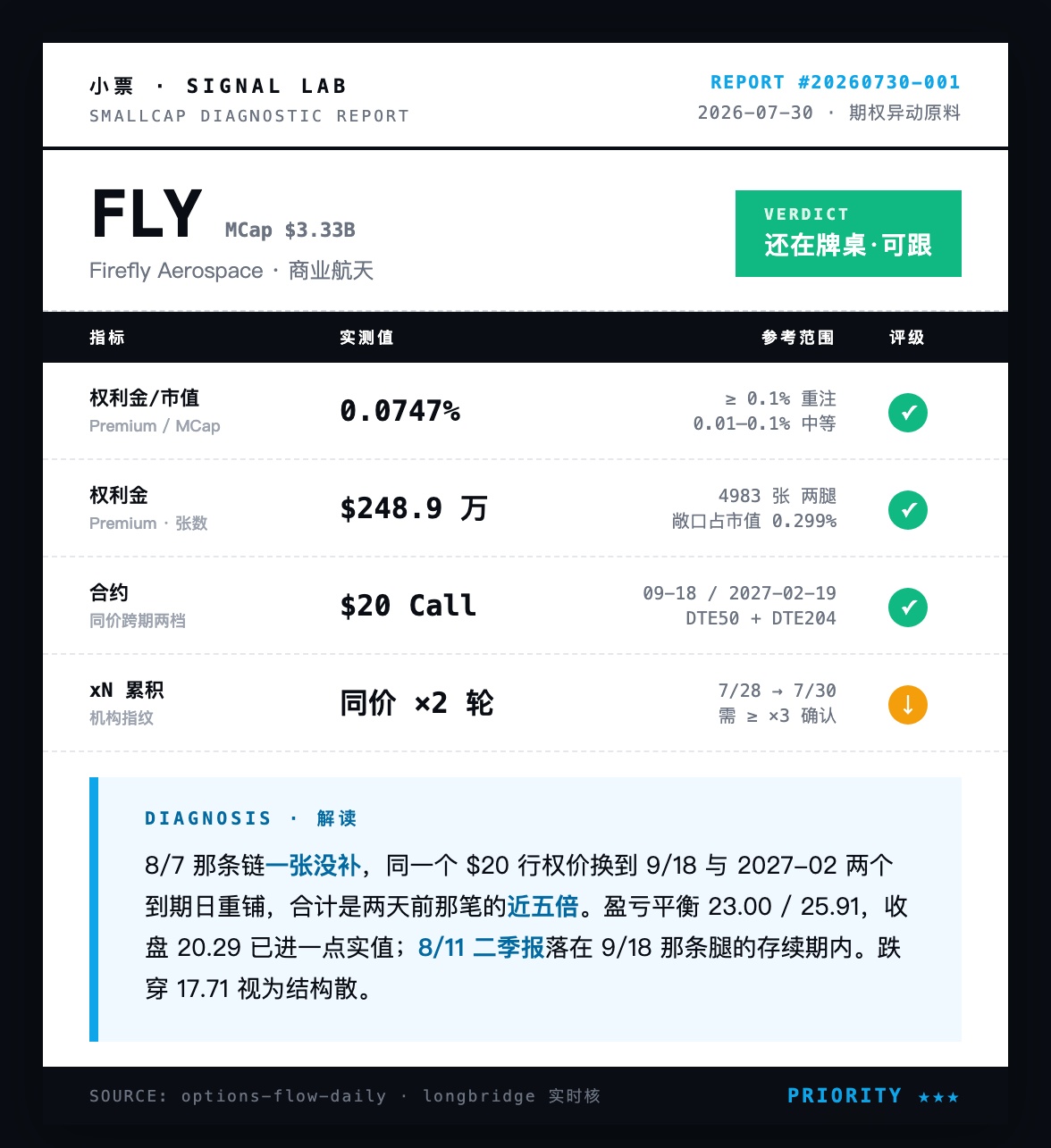
The real player still at the table is Firefly Aerospace.
Two days ago, my observation point for it was: would there be a second same-price add-on on the 8/7 chain before adding no new positions ahead of the 8/11 earnings report, treating it as a one-time bet? The answer was the opposite—no additions were made on 8/7. Instead, the same $20 strike price was re-laid with two further expiration dates: the 9/18 batch was $469,000 for 1,563 contracts, and the February 2027 batch was $2.02 million for 3,420 contracts, totaling $2.489 million, nearly five times the amount from two days ago. The far-end unit price was $5.91 per share with a breakeven of $25.91, and the near-end was $3.00 with a breakeven of $23.00. Yesterday's closing price just reached $20.29, putting both batches slightly in-the-money. The premium amortized against the $3.332 billion market cap is 0.0747%, still under 0.1%, but the notional exposure of 4,983 contracts ($9.966 million) accounts for 0.299% of the market cap, touching the edge on this board.
To clarify: FLY itself had no news yesterday; the 13.73% gain followed the broader market and sector. The real key date is the Q2 report on 8/11, and the 9/18 leg happens to cross it. I will follow this one—the $20 price level has been repeatedly selected in two rounds, and the main position has been pushed back half a year, not betting on a single near-term option. If it breaks below $17.71, consider the structure broken.
The most accurate signal yesterday was AXT, but it is also the one I am least able to follow today.
The timing is key: At 10:50, in the same minute, 9/18 $40 Puts and 11/20 $35 Puts were sold, collecting $1.36 million; at 13:31, another fund bought 9/18 $50 Calls, paying $513,000. All three trades fell within the daytime session, while the Q2 report was released after the close—revenue of $47.59 million beat expectations, net income turned positive to $11.1 million, revenue more than doubled year-over-year, and the company credited data center demand, with the CEO stating a turning point has arrived. That $50 Call has a breakeven of $59.19; in the night session at $58.64, it has closed in, going from 6.9% out-of-the-money to basically breaking even within a few hours; the assignment costs for the two Sold Puts are $32.79 and $26.59, which are now completely safe.
I wrote about this line once on 7/14, concluding to follow. This time the structure is more complete than last time, and 0.062% is higher than last time's 0.04%. There is only one problem: entering now means taking over a 25% gain that has already occurred after the close. I acknowledge the signal, but I won't chase the position. I'd rather wait for it to re-establish $48.67 as support before saying anything.
━━━━━━
For the Applied Optoelectronics trade, I need to take back half of what I said before.
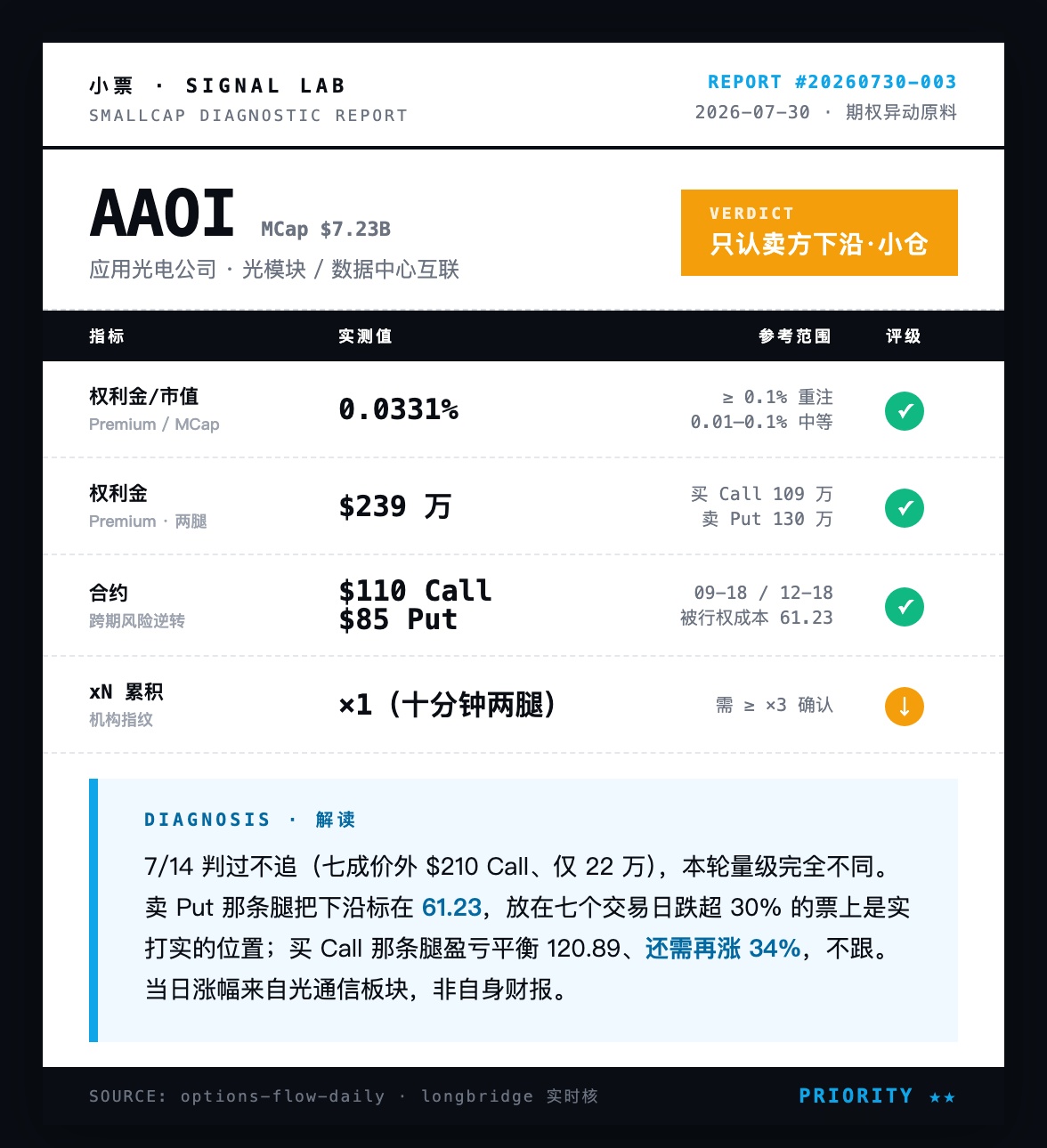
On 7/14, I used AAOI as an example of not chasing, because the options that day were 70% out-of-the-money $210 Calls, worth only $220,000. This trade yesterday is not on the same scale: at 10:24, $1.09 million was used to buy 9/18 $110 Calls, and at 10:34, $1.3 million was received from selling 12/18 $85 Puts, completing a calendar risk reversal within ten minutes. The positions of the two legs are very far apart—the $85 Put has a unit price of $23.77 per share and an assignment cost of $61.23; the seller's stance is to accept delivery even if it drops another 30%, which is a solid floor for a stock that has dropped over 30% in seven trading days; the $110 Call has a breakeven of $120.89, requiring another 34% rise from yesterday's close.
The reason AAOI rose yesterday lies in the sector, not itself: optical communications were generally down in the pre-market, with LITE down 8% and COHR down 9%; during the session, the entire chain counter-attacked, with LITE rising over 15% and COHR rising nearly 13%, while AAOI itself did not release earnings. Therefore, I only recognize the position marked by the Sell Put leg, setting $61.23 as the lower bound; I do not follow the Buy Call leg, as a 34% gap cannot be sustained by sector sentiment alone. You can watch with a small position, but don't treat it as exclusive.
Finally, that 0.33% trade. According to the raw data, KSTR's two batches of September Calls totaled $338,000 yesterday, with a ratio ranking first overall against its $101 million market cap, five times higher than AXT. But the denominator is fake: looking at the true identity, KSTR's full name is the SSE STAR 50 Index ETF, listed on AMEX, with EPS and BPS both at 0, and total shares of 4.25 million—4.25 million multiplied by 23.85 equals exactly 101 million. The 'market cap' field in the raw data contains the fund size, not any company's market cap.
An ETF tracking the SSE STAR Market has nothing to do with informed capital in US small caps. The most direct evidence is the price: while the Nasdaq Composite rose 8.81% and optical communications fully counter-attacked yesterday, it closed down 0.29%, completely outside this market. Discard this trade. DRAM in the same batch of raw data has the same issue (Roundhill Storage ETF, EPS and BPS both 0); I discarded it once on 7/22 and once on 7/24, and it appeared for the third time yesterday—skip these two tickers directly in the future.
Only two remain on the watchlist. For Firefly, watch the Q2 report on 8/11; before then, see if there is a third same-price add-on on the 9/18 chain. Invalid if it breaks below $17.71. For Applied Optoelectronics, only watch $61.23; if it retraces without breaking and the seller hasn't closed the position, then consider that leg.
AXT does not enter the list—the signal is correct, but at $58.64, this position is no longer left for followers.
The copyright of this article belongs to the original author/organization.
The views expressed herein are solely those of the author and do not reflect the stance of the platform. The content is intended for investment reference purposes only and shall not be considered as investment advice. Please contact us if you have any questions or suggestions regarding the content services provided by the platform.
