


Nan Er Hynix 7709, no need to clock in today.
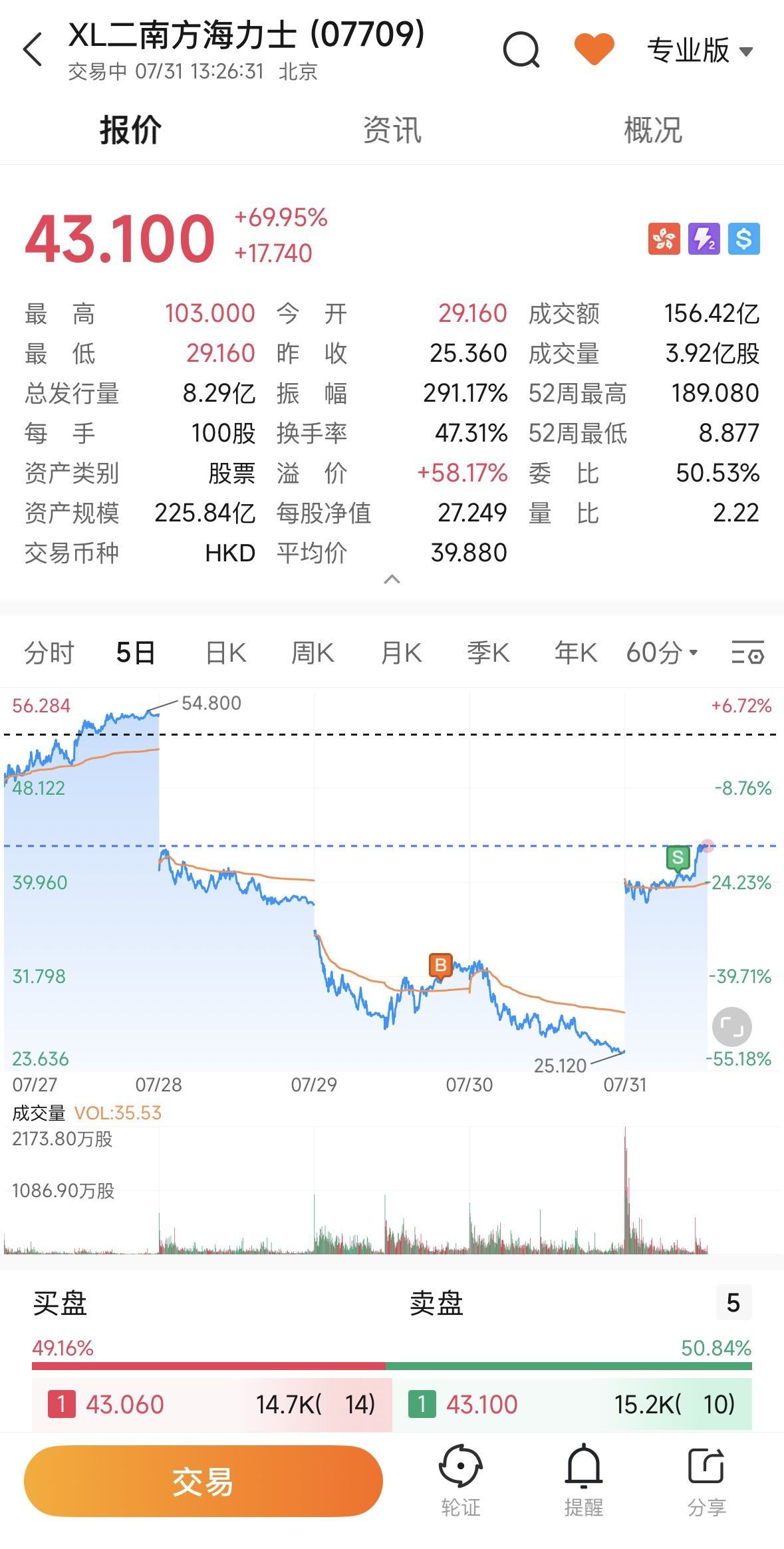
On July 29, I mentioned in my post that I went all-in (though Longbridge missed posting it because the web version has been inaccessible lately, so I took a lazy shortcut hehe). My entry point was around 30. At the time, I judged that for 7709, 30 was already a relatively bottom-level position, so I chose to go all-in. What I didn't expect was that the next day, the underlying stock continued to plummet along with the sector, with 7709 dropping to around 25. However, I held my ground: first, it hadn't hit my stop-loss level yet; second, I believed my judgment was correct.
This morning, I sold half of my position at over 40 to secure profits. On one hand, I wanted to realize some of the floating gains. On the other hand, starting next Monday, the rules for 7709 are changing: leverage will no longer be fixed at 2x. Instead, the specific multiplier will be determined daily by the issuer and announced only after market close. This introduces significantly more uncertainty, so I chose to take some profits off the table and reduce my risk exposure.
Why I believe 30 is a bottom
First, the core contradiction driving this sell-off is panic and an "expectation gap," not a fundamental disproof—SK Hynix's revenue and profits are both at historical highs. The drop reflects sentiment and overly high expectations, which typically recover more easily than scenarios where fundamentals genuinely deteriorate. Second, by July 29, the selling pressure from passive stop-losses and forced liquidations had already been largely digested. According to Citigroup's estimates, Korean retail investors had incurred total losses of approximately $38.7 billion through leveraged ETFs at that time. In just the first half of July, over 1.2 million leveraged retail accounts hit margin call lines, with more than 300,000 accounts already forcibly liquidated. Such massive liquidation data often signals that the "unbearable selling pressure" has been largely cleared out, leaving diminishing marginal selling pressure. Third, an 86% drop over 34 trading days represents an extreme slope of decline, itself a product of extreme emotion. Coupled with the historic signal of South Korea's stock market experiencing its first-ever two consecutive circuit breakers, technical analysis usually suggests this accompanies a 阶段性 (phased) emotional bottoming out. Fourth, Choi Tae-won publicly called for support at this level and spent money to buy the underlying stock directly for the first time, which serves as a signal of someone willing to bear the cost of their own judgment. Fifth, even the issuer couldn't hold on and was about to revert to pre-launch levels before the rally. They were so afraid of losses that they hurriedly changed the rules, implying the current price level is roughly accurate.
Reflections after securing profits
The outcome this time was good, but I don't want to package it as a story of "successful bottom-fishing." Going all-in on a leveraged financial derivative—a product that can halve in value twice within 34 days—is essentially closer to a high-odds gamble than a replicable investment decision. Choosing to take some profits at over 40 this time, besides locking in gains, is more importantly an admission: since leverage rules are changing and market uncertainty is rising, there is no need to bet the entire portfolio on an uncertain rule and market condition. Keeping some of the realized floating profits rather than continuing to gamble is more important.
Sharing personal trading experience, based on public information verification. This does not constitute investment advice. 7709 is a daily-reset high-leverage derivative with extreme volatility. The product prospectus explicitly warns that it may result in the loss of most or all of your investment in a single day. It is only suitable for short-term trading or hedging, and for investors who can withstand significant or total loss of principal. Markets carry risks; decisions require independent judgment.
The copyright of this article belongs to the original author/organization.
The views expressed herein are solely those of the author and do not reflect the stance of the platform. The content is intended for investment reference purposes only and shall not be considered as investment advice. Please contact us if you have any questions or suggestions regarding the content services provided by the platform.
