


 SpaceX Option
💢💢💢
💰 Amazon clears the "three-year payback" ledger: After a deep correction in AI infrastructure, these five main themes remain worth watching
$Amazon(AMZN.US)
$Meta Platforms(META.US)
$Microsoft(MSFT.US)
$Alphabet - C(GOOG.US)
$NVIDIA(NVDA.US)
$Broadcom(AVGO.US)
$Micron Tech(MU.US)
$Taiwan Semiconductor(TSM.US)
In recent weeks, the AI infrastructure sector has experienced significant volatility. Chips, memory, optical communications, Neocloud, data centers, and power stocks have all faced valuation compression across almost every high-elasticity direction. The market is concerned that tech giants are investing hundreds of billions in computing power, but AI revenue and free cash flow may not materialize simultaneously.
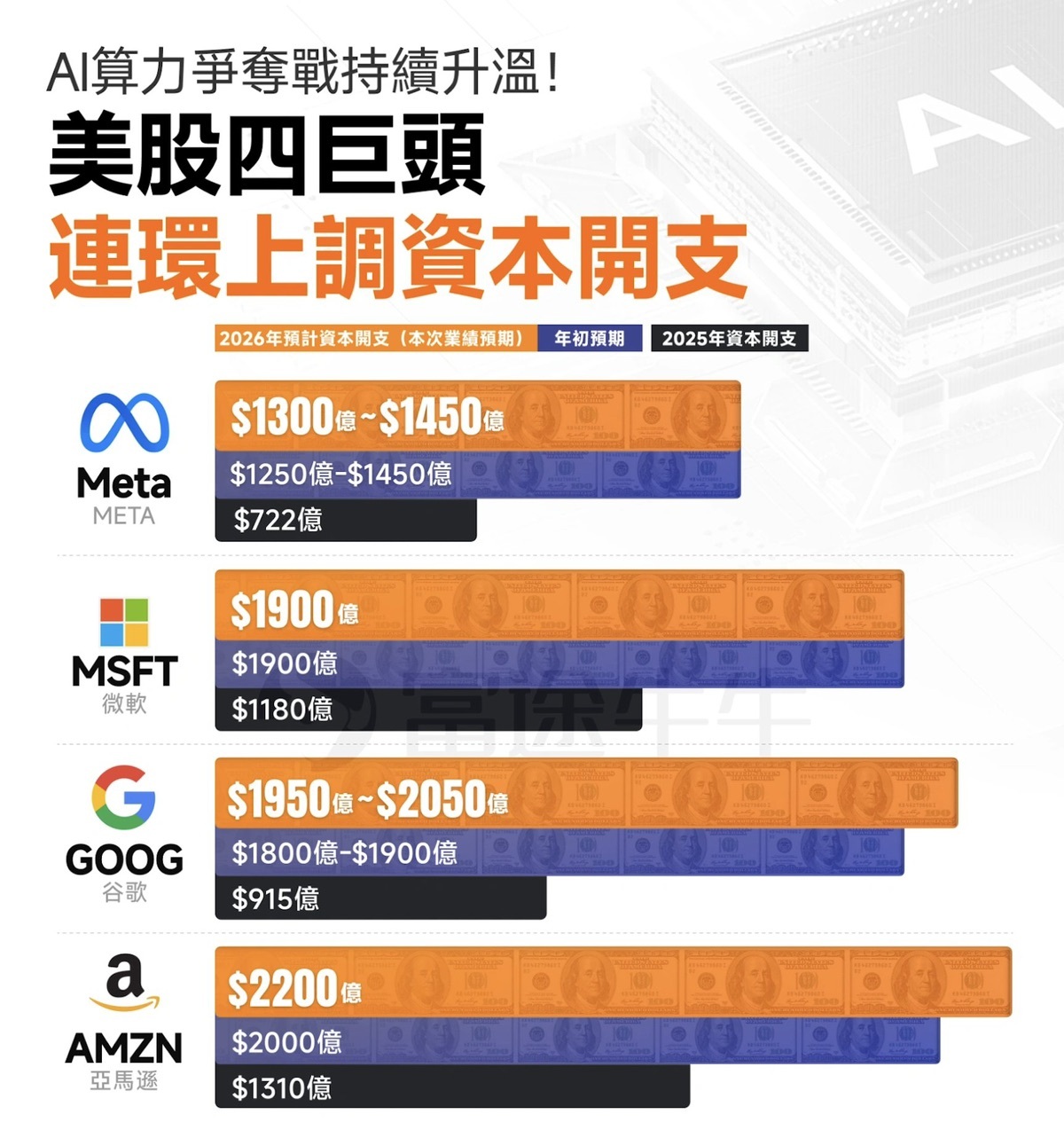
However, in sharp contrast to the stock price pullback, major players' capital expenditures (CapEx) have not slowed down; instead, they are accelerating. According to the latest earnings guidance, Meta, Microsoft, Google, and Amazon have all further raised or maintained their high CapEx expectations. Calculated at the upper end of the range, the combined CapEx of these four companies for 2026 will approach $750 billion, far exceeding the actual investment of approximately $455.8 billion in 2025.
Amazon has systematically broken down the ROIC framework for AI CapEx for the first time, presenting a clear ledger—payback in less than three years.
Management divides AI infrastructure investments into two types of assets: servers and networking equipment have a useful life of about 5 to 6 years, while data centers, land, buildings, and power infrastructure can last over 30 years. Amazon stated that servers and networking equipment break even on average in less than three years, with an additional two to three cycles of generating free cash flow after payback.
Data centers with a lifespan exceeding 30 years can accommodate at least five to six generations of servers, meaning this is not a one-time investment but a long-term asset reusable across multiple chip generations. Amazon also noted that profit margins and returns in the AI sector are actually slightly ahead compared to its core business at the same stage of development.
Morgan Stanley calculated from a business model perspective: cumulative CapEx by major cloud providers could exceed $1.4 trillion, with available computing power increasing from approximately 30GW in 2025 to about 120GW in 2028. Their calculation of three business models shows that potential incremental ROIC for AI infrastructure could reach 25% to 50%—leasing GPUs at about 31%, building own computing power and selling model APIs at about 46%, and leasing third-party computing power at about 25%.
After the deep correction, Morgan Stanley remains bullish on five main themes:
First, cloud giants with scale and monetization capabilities—Meta, Google, Microsoft, and Amazon—are more likely to recover CapEx thanks to user entry points, enterprise customers, and in-house chip capabilities.
Second, companies controlling bottleneck assets related to "power-on time," including fuel cells, gas turbines, energy storage, and operators converting Bitcoin mining farms into AI data centers.
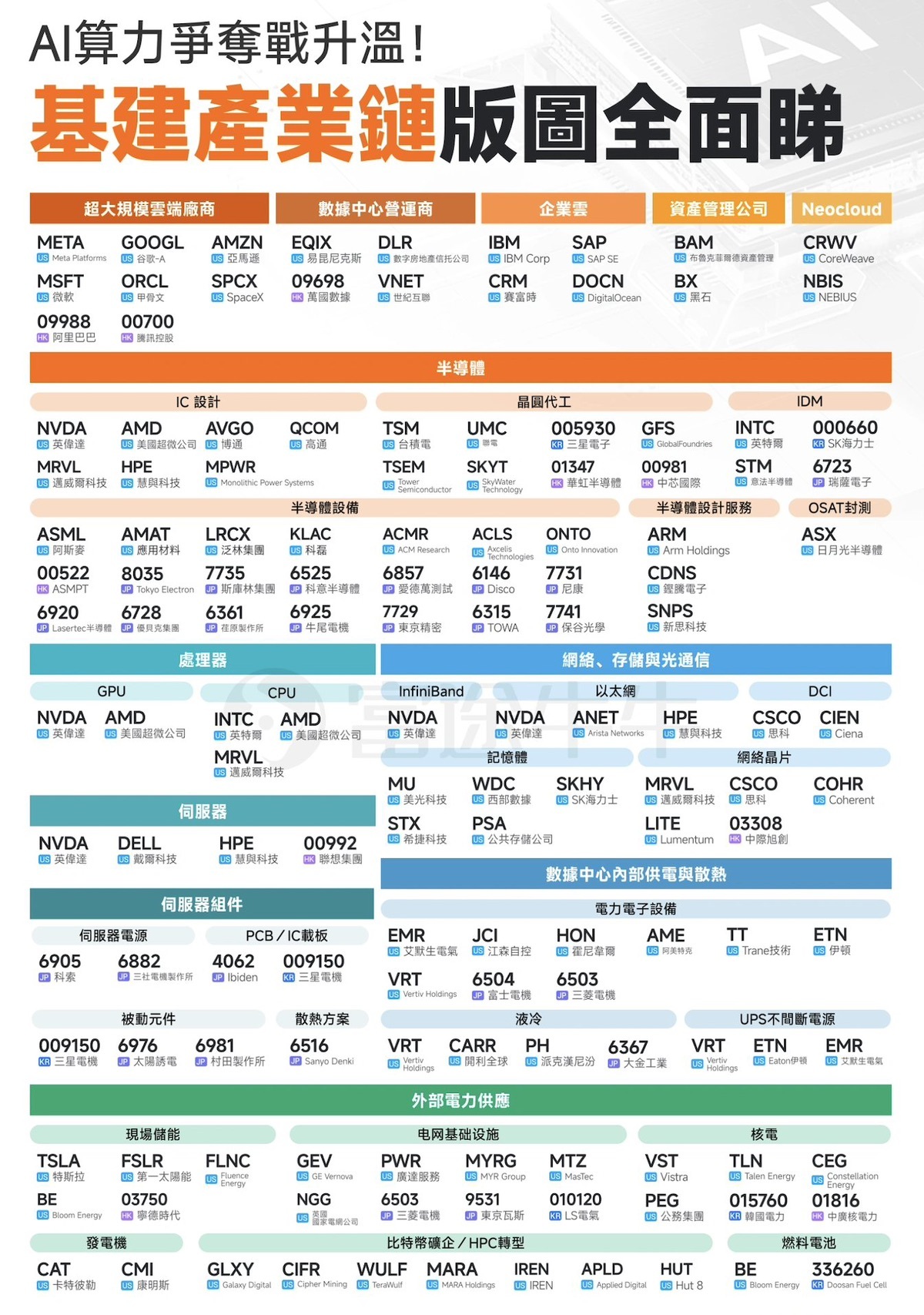
Third, the core theme of the computing power manufacturing ecosystem, focusing on industry chain companies such as NVIDIA, Broadcom, Micron, TSMC, Samsung, and SK Hynix. Memory remains relatively favored, with demand for HBM, DRAM, and enterprise SSDs potentially keeping supply tight through 2027 and 2028.
Fourth, Chinese AI solution providers, represented by companies like Alibaba, Tencent, and SMIC, which have relatively low valuations and room for upward revision in AI commercialization.
Fifth, energy security and grid equipment, including Bloom Energy and GE Vernova, with more diversified sources of demand.
High investment and slow returns triggered this round of deep correction, but the upward revision in CapEx guidance by giants proves that the industry fundamentals have not changed. Looking ahead to the next phase, the market will shift from broad-based gains to structural differentiation, with funds paying closer attention to return on investment and cash flow realization capabilities.
The copyright of this article belongs to the original author/organization.
The views expressed herein are solely those of the author and do not reflect the stance of the platform. The content is intended for investment reference purposes only and shall not be considered as investment advice. Please contact us if you have any questions or suggestions regarding the content services provided by the platform.
