


Approved 19 in one year! Two classic famous prescriptions approved on the same day, Ruiyang and Healthy Yuan enter the 400 billion yuan new TCM battlefield
Recently, a public notice from the National Medical Products Administration (NMPA) has stirred waves in the traditional Chinese medicine (TCM) industry — "Wuwei Xiaodu Yin Granules" by Ruiyang Pharmaceutical and "Banxia Baizhu Tianma Tang Granules" by Sichuan Guangda Pharmaceutical, under Health Yuan, were approved for market on the same day. This brings the total number of ancient classic formula TCM compound preparations approved in 2026 to 19.
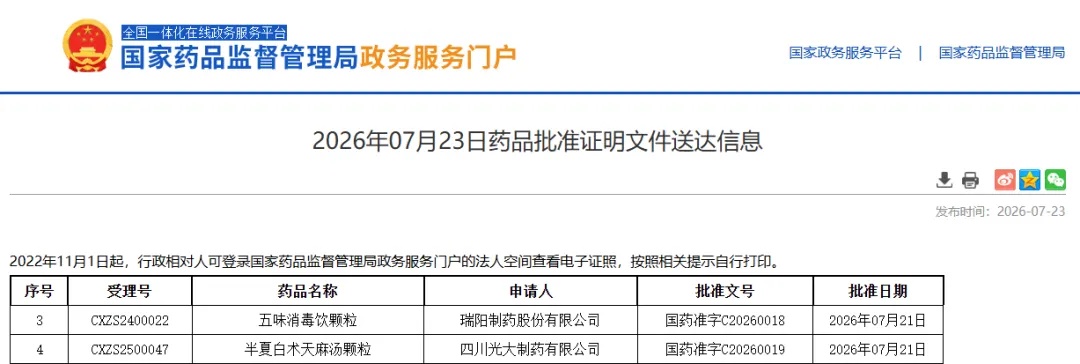
The approval of two classic formulas from Qing Dynasty medical texts on the same day appears, on the surface, as merely the approval of products from two companies. However, behind this lies the accelerated formation of a brand-new track in the TCM industry.
With "Clinical Trial Exemption" Opened, Pharma Companies Rush into the 400 Billion New Track
The heat surrounding TCM innovation first stems from continuous policy easing.
The implementation of the "Traditional Chinese Medicine Law" in 2017 first clarified the legal status of ancient classic formulas at the national legislative level. What truly excited the industry was the release of the "Classification and Submission Requirements for TCM Registration" by the NMPA in 2020, which listed ancient classic formula TCM compound preparations separately as Category 3.1. It explicitly stated that if the prescription originates from the "Catalog of Ancient Classic Formulas," is prepared throughout using traditional processes, and strictly follows the ancient methods of usage, dosage, and indications, clinical trials can be exempted, allowing direct application for production. Drug approval numbers specifically adopt the format "Guoyao Zhunzi C" — this "C" prefix signifies that classic formula preparations have gained an independent identity within the drug family for the first time.
If the reform of registration categories opened a door, then the policy boost in 2026 laid the cornerstone for the path ahead. In February, eight departments including the Ministry of Industry and Information Technology jointly issued the "Implementation Plan for High-Quality Development of the TCM Industry (2026–2030)," explicitly proposing the construction of five TCM industry integrity and innovation centers, promoting the approval and launch of a batch of innovative TCM drugs, and cultivating 10 major Chinese patent medicine varieties. Later that month, the State Council approved the "15th Five-Year Plan for the Revitalization and Development of Traditional Chinese Medicine," listing the promotion of TCM inheritance and innovation as a key task. The Center for Drug Evaluation of the NMPA also released the "Technical Guiding Principles for Clinical R&D of Innovative TCM Drugs Patient-Centered" in April, initiating the establishment of an efficacy evaluation system more suited to the characteristics of TCM.
Once the policy gate opens, corporate actions move faster than expected. To date, the state has published a total of 324 prescriptions in the "Catalog of Ancient Classic Formulas," providing enterprises with a clear "topic scope." From 2021 to 2025, 70 innovative TCM drugs were approved for market, half of which were classic formula preparations.
Entering 2026, the pace of approvals has further accelerated. In the first half alone, varieties such as Yiguanjian Granules by Kangyuan Pharmaceutical, Shaoyao Gancao Tang Granules by Hebei Wanbang Fulin, Qingfei Tang Granules by Jiangxi Yaodu Zhangshu, and Taohe Chengqi Tang Granules by Sinopharm were densely launched. Adding the two newly approved in July, the annual cumulative total has reached 19.
Market size has risen accordingly. According to industry research institutions, the market size of TCM classic formulas was approximately 100 billion yuan in 2019, and is expected to exceed 200 billion yuan by 2026. The total scale of the entire TCM industry was about 1 trillion yuan in 2025, while the TCM industrial market scale had already exceeded 400 billion yuan in 2025.
An undeniable reality is: although this cake is large, not everyone gets an equal share. Among the 68 A-share listed TCM companies in 2025, only 8 achieved positive revenue growth. The combined revenue of Baiyunshan, Yunnan Baiyao, and China Resources Sanjiu accounted for more than 63% of the total revenue of these 68 companies. For cross-border players like Ruiyang Pharmaceutical and Health Yuan, originally focused on chemical drugs, cutting into the TCM track through classic formulas is a strategic choice to avoid head-on competition and quickly establish a position.
From "Recreating a Bowl of Soup" to AI Prescription: Three Paths, Each with Its Own Approach
Starting from ancient formulas, different companies have their own focuses. The main lines of current TCM innovation roughly fall into three categories.
The first line is the most bustling: standardization and formulation conversion of classic formulas. Sinopharm has a vivid term called "recreating a bowl of soup" — turning the decoctions recorded in ancient texts into modern formulations with controllable quality, measurable components, and precise dosages. It sounds simple, but it is not easy to execute. From confirming the origin of medicinal materials and restoring processing techniques to stabilizing the quality of intermediates, every step requires extensive process research. Wuwei Xiaodu Yin comes from the Qing Dynasty's "Yi Zong Jin Jian," and Banxia Baizhu Tianma Tang comes from "Yi Xue Xin Wu." These formulas have been used clinically for two or three hundred years, and their safety and efficacy have been verified over a long period. However, transforming them into mass-produced drugs is another matter entirely.
It is worth noting that homogenized competition among classic formulas is beginning to emerge. There are currently multiple applications for Banxia Baizhu Tianma Tang Granules, forming a situation where many companies compete for the same variety. An industry insider admitted that without differentiated indications or dosage form innovations, future market space will inevitably be diluted.
The second line has a higher threshold: original breakthroughs in Category 1.1 innovative TCM drugs. Unlike the "clinical trial exemption" path for classic formulas, Category 1.1 innovative drugs must undergo randomized controlled clinical trials, typically taking 8 to 10 years from R&D to market launch. In June 2026, Tasly's Zaoren Ningxin Dripping Pills were approved, becoming the first domestic Category 1.1 innovative TCM drug of the year. In July, Tianjing Zelan Granules, developed by the team led by Duan Jin'ao from Nanjing University of Chinese Medicine in collaboration with Lei Yunshang Pharmaceutical, also received clinical trial approval. These varieties are not reproducing ancient formulas but conducting true source innovation under the guidance of TCM theory, representing a higher-order form of TCM R&D.
The third line is the revolution of underlying tools: digitalization and intelligence are rewriting R&D logic. The plan by eight departments including the MIIT explicitly requires "using new-generation information technologies such as artificial intelligence and big data to construct knowledge graphs for characteristic prescriptions such as classic formulas and experienced prescriptions of famous old TCM doctors." In May 2026, the "Huayao Xinglin Zhiyan" intelligent agent landed in Jiangxi, aiming to leverage AI to improve the R&D efficiency of innovative TCM compound drugs and classic formulas. Yiling Pharmaceutical's "Luoshu Large Model" has been selected as a national intelligent agent benchmark case. On the manufacturing side, the National Modern TCM Innovation Center is pushing to move away from traditional clay pot decoction, reshaping the TCM production process with modern extraction, separation, and purification technologies.
These three lines are not distinct. Conversion data from classic formulas provides training material for AI models; R&D of Category 1.1 innovative drugs provides application scenarios for new technologies; and digital tools accelerate the progress of the first two lines. This is an interlocking chain of evolution that empowers each other.
Behind the Bustle: Three Things Cause Concern
A hot track does not mean there are no worries.
The most direct challenge is homogenization. Although the catalog of 324 classic formulas seems to offer many choices, the varieties genuinely favored by concentrated enterprise attention amount to only twenty or thirty. With numerous companies clustering around limited popular varieties, the dilution of subsequent commercial space is almost inevitable. The industry is shifting from the rough stage of "applying for any available formula" to an elimination round stage competing on R&D depth and refined market operations.
Deeper constraints come from the resource end. Supply bottlenecks for rare medicinal materials such as natural bezoar and musk have become systemic vulnerabilities for high-end TCM products. Even if a variety is approved for market, if key raw material supplies cannot meet demand, large-scale production remains an empty talk. How to break through the hard constraints of medicinal material resources is a long-term proposition the industry must face.
Another easily overlooked shortcoming is weak basic research. The correlation mechanisms between "formula-syndrome-efficacy" in TCM compound prescriptions are far from clearly explained by modern science. Why do these specific herbs work together? What is the exact material basis? The answers to these fundamental questions determine how far TCM innovation can go.
Internationalization is equally concerning. In the first half of 2025, TCM export value decreased by 5.6% year-on-year. While the surface reason is fluctuations in international market demand, the root cause lies in insufficient standardization and branding capabilities. The channel for Chinese patent medicines to enter mainstream markets in Europe and America as drugs remains narrow, with them often appearing instead as dietary supplements.
Looking to the future, the direction of policy efforts is clear. The "integrity and innovation" proposed in the "Implementation Plan for High-Quality Development of the TCM Industry" — standing firm on TCM theory and clinical experience while actively introducing modern technology — is evolving from a slogan into a concrete action framework. The "15th Five-Year Plan" explicitly states that by 2030, "the innovation and creativity of the TCM industry will significantly enhance." This is both a goal and a forcing mechanism.
From Wuwei Xiaodu Yin in the Qing Dynasty's "Yi Zong Jin Jian" to Category 1.1 innovative drugs assisted by AI R&D, the TCM industry is undergoing not just product-level renewal, but a systematic reconstruction from R&D paradigms to industrial logic. As the 400 billion market welcomes the dual drive of institutional dividends and technological change, what truly tests enterprises is not who runs faster, but who can find the perfect balance point between "integrity" and "innovation." After the noise subsides, those who can clearly articulate the clinical value of ancient formulas using modern scientific language will be the ones left standing.
Source: Medical Research Society
The copyright of this article belongs to the original author/organization.
The views expressed herein are solely those of the author and do not reflect the stance of the platform. The content is intended for investment reference purposes only and shall not be considered as investment advice. Please contact us if you have any questions or suggestions regarding the content services provided by the platform.
