


艰难重回发行价后,卡罗特再迎基石解禁新挑战

CAROTE experienced significant stock price fluctuations after its listing, with the stock price rising 58.3% on the first day of trading, but then falling to HKD 4.22, a decline of nearly 27% from the issue price. Recently, the stock price rebounded to HKD 6.4, but then adjusted back to HKD 6. The upcoming release of restricted shares will be a key factor affecting the subsequent stock price trend, especially since the shares of two cornerstone investors will be released on April 3, which may put pressure on the stock price
The four words "high open and low close" best describe the stock price performance of CAROTE (02549) since its listing.
On October 2, 2024, CAROTE successfully listed on the main board of the Hong Kong Stock Exchange, with its stock price rising 58.3% on the first day of trading, providing substantial gains for investors. However, its stock price subsequently fell sharply, dropping to a low of HKD 4.22 within nearly a month, a decline of nearly 27% from the issue price of HKD 5.78, and over 61% from the highest price of HKD 10.88 on the first day of listing, showcasing a dramatic plunge from the clouds to the ground.
After the sharp drop to HKD 4.22, CAROTE's stock price rebounded over 50% to HKD 6.4 within four trading days, recovering to the issue price. However, it then began a new round of decline, and after nearly a month of sideways consolidation, it regained upward momentum, breaking through the previous high resistance level of HKD 6.4, but then retraced below that level. As of the close on February 21, the stock price was HKD 6 per share, only slightly above the issue price by less than 5%.
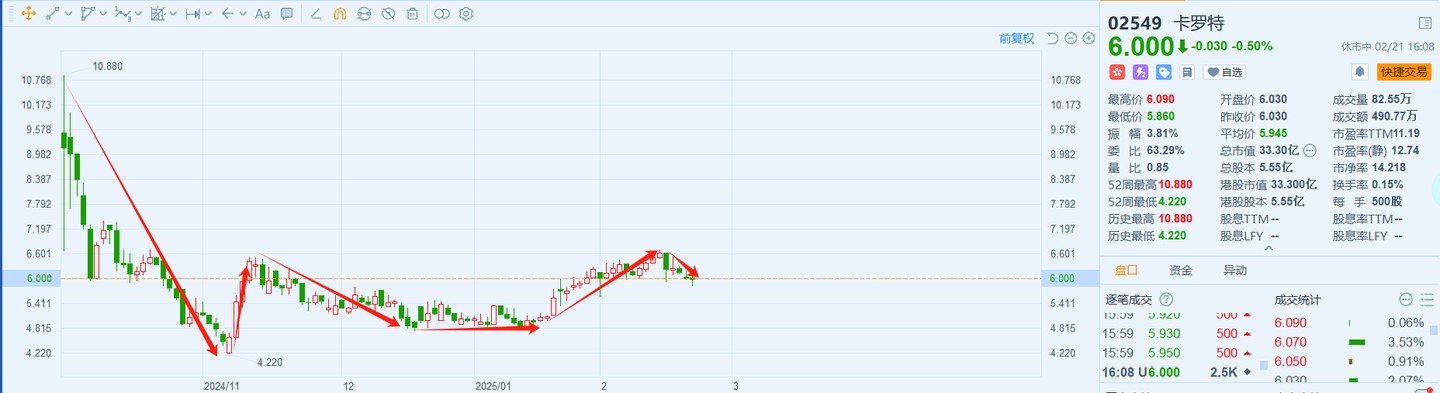
After the stock price reached this level, questions arose regarding whether the subsequent trend would be upward or downward. The upcoming lock-up expiration will also be a key factor influencing the future stock price movement.
According to observations from Zhitong Finance APP, the two cornerstone investors introduced during CAROTE's IPO will have their lock-up restrictions lifted on April 3. Both hold 4.88% of CAROTE's shares (after the exercise of the over-allotment option), totaling 9.76%. If the cornerstone investors sell their shares after the lock-up expiration, it may put significant pressure on CAROTE's stock price.
After the Excitement, "A Mess"
Looking back at CAROTE's performance during its listing, it exhibited extremely high market enthusiasm during the offering phase. Before the offering, CAROTE attracted two cornerstone investors, Jingwei Venture Capital and Yuan Sheng Capital, both of which primarily focus on the primary market, subscribing to approximately 27.0915 million shares of CAROTE, totaling 54.183 million shares, accounting for about 41.72% of the global offering shares, with a staggering 83.45% of the international placement.
As the offering phase progressed, CAROTE's popularity surged further, achieving an oversubscription of 1,347.27 times in the Hong Kong public offering, making it the most subscribed company on the Hong Kong main board this year, triggering a 50% clawback. Therefore, a total of 64.9325 million shares were issued in both the public offering and international placement, totaling approximately 130 million shares, which accounted for 24.25% of the total share capital (before the exercise of the over-allotment option).
In the international placement, after the two cornerstone investors subscribed for over 80% of the shares, an oversubscription of 7.91 times was recorded, which, although not as explosive as the public offering, still indicated strong institutional demand for CAROTE.
Amid such intense enthusiasm, CAROTE's stock price surged over 100% in the dark market on September 30, with the final dark market quote showing HKD 10.26, an increase of 77.51% from the offering price. Excluding fees, investors could earn HKD 2,240 per lot The impressive performance during the dark market phase can be attributed to two main factors. Firstly, CAROTE has achieved continuous growth in its performance over the past years. Secondly, Chinese assets began to rise significantly in late September 2024, which greatly boosted market sentiment. This was also a key reason for CAROTE's stock price doubling in the dark market.
However, the drawbacks are also evident. After a significant short-term profit, investors expressed their emotions by cashing out, leading many to secure their profits. As a result, CAROTE faced immense selling pressure on its first day of trading, with the increase temporarily falling to 16%. However, driven by strong market sentiment, it ultimately recorded a 58.3% increase on its first trading day.
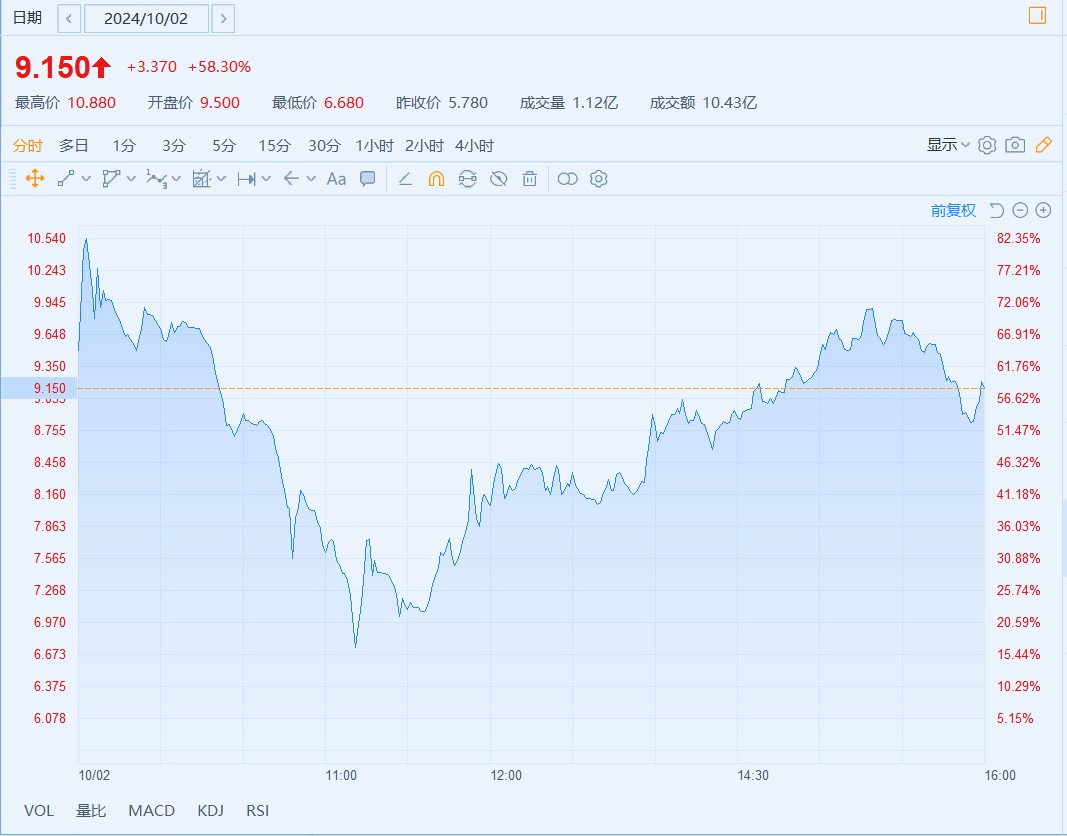
A few days after CAROTE's listing, the Hang Seng Index peaked and corrected, causing market sentiment to cool rapidly. This led to a continuous and significant decline in CAROTE's stock price, which fell to HKD 4.22 after breaking the issue price. During this process, CAROTE had 19.4795 million shares of over-allotment, equivalent to about 15% of the global offering shares, which were fully exercised before October 28, yet this could not stop the downward trend of CAROTE.
As of now, the Hang Seng Index has broken through previous highs, showing signs of a bull market, which has led to a recovery in CAROTE's stock price from its lows. However, as of the close on February 21, CAROTE's stock price was HKD 6, only up 3.8% from the issue price and still far from its peak.
The 54.183 million shares held by cornerstone investors Jingwei Venture Capital and Yuan Sheng Capital, accounting for about 10% of CAROTE's total share capital, will be released from the lock-up on April 3. At the same time, the 74.99% shares held by the controlling shareholder will also have restrictions lifted on the same day (subject to maintaining the controlling shareholder status). If the cornerstone and controlling shareholders reduce their holdings subsequently, it will put pressure on CAROTE's stock price, making its fundamentals particularly important at this time.
Multiple Potential Operational Risks May Suppress Company Valuation
Since 2013, CAROTE has transitioned from OEM to ODM business, designing, developing, and supplying customized cookware and other kitchenware products for international brand owners and retailers. Leveraging the expertise gained from its ODM business and experience with customer preferences, CAROTE entered the online retail space in 2016, launching its own cookware brand, CAROTE.
As of September 14, 2024, CAROTE offers a diverse product portfolio of over 2,500 SKUs to retail consumers worldwide and has established 48 self-operated online stores across 19 online markets in 19 regions globally, creating its own global channels.
According to a report by ZhiShi Consulting, based on retail sales in 2023, CAROTE ranks among the top five in the online cookware industry in major markets, ranking fourth in China, second in the United States, third in Western Europe, second in Southeast Asia, and third in Japan, with market shares of 1.2%, 13.1%, 1.3%, 8.6%, and 8.1%, respectively From the performance perspective, CAROTE has achieved rapid growth, with revenues of 675 million, 769 million, and 1.583 billion yuan from 2021 to 2023, and adjusted net profits of 31.7 million, 109 million, and 243 million yuan during the same period. In the first three months of 2024, CAROTE's revenue grew by 72.34% year-on-year to 503 million yuan, and adjusted net profit increased by 73.21% to 97 million yuan.
The continuous rapid growth of CAROTE can be attributed to several factors. Firstly, the strong rise of its own brand kitchenware. From 2021 to 2023, the revenue share of CAROTE's brand business was 41.9%, 69.1%, and 87.2%, respectively, with significant increases in revenue from its own brand products. By 2023, the share of ODM business had decreased to 12.8%.
Secondly, the overseas market has become the main driver of performance growth. In 2023, the revenue from markets outside of China accounted for as much as 79.3% of CAROTE's total revenue, with rapid growth in overseas market revenue, particularly notable in the United States and Western Europe, where growth was exponential.
However, in CAROTE's voluntary announcement on October 28, 2024, it stated that its unaudited revenue for the first three quarters of 2024 is expected to grow by approximately 40%-50% year-on-year, while the revenue growth rate for the first quarter of 2024 was as high as 72.34%. This indicates that CAROTE's growth rate may have declined in the second and third quarters of 2024, which could be a major reason for the current sluggish stock price.
In addition, CAROTE faces numerous operational challenges. Firstly, market competition may continue to intensify. Whether domestically or internationally, the kitchenware market is a highly competitive industry. To attract customers and expand market share, CAROTE adjusted its pricing strategy in 2023, further highlighting the high cost-performance ratio of its products, which caused the gross margin of its brand business to drop to 39.2% in 2023, compared to 45.9% in the same period of 2022. If market competition continues to intensify in the future, it may affect CAROTE's profitability.
Secondly, there is an excessive reliance on certain e-commerce platforms. According to the prospectus, in the first three months of 2024, revenue from Amazon and Walmart accounted for 52.2% and 17.2%, respectively, totaling about 70%. Over-reliance on certain e-commerce platforms may increase potential operational risks; if these platforms raise service fees or other costs in the future, it could impact CAROTE.
Thirdly, there is too much dependence on a single market. According to the prospectus, as of the first quarter of 2024, revenue from the U.S. market accounted for as much as 60% of CAROTE's total revenue, a significant increase from 16.5% in 2021. If market demand in the U.S. declines in the future or if tariff issues arise, CAROTE's excessive reliance on the U.S. market may be affected. Moreover, CAROTE, which primarily generates revenue from the U.S. market, may find it difficult to increase its company valuation, as potential tariff risks are one of the factors suppressing valuation increases.
In summary, while the impressive past performance and high market sentiment led to a surge in CAROTE's stock price on its first day of listing, the decline in sentiment and the disruption of shares have caused CAROTE's stock price to continue to fall. Although it has now rebounded above the issue price, the unlocking of restricted shares may put pressure on the stock price. Investors should remain vigilant about the possibility of slowing revenue growth for CAROTE, while the fierce market competition, excessive reliance on certain e-commerce platforms, and dependence on a single market also increase CAROTE's potential operational risks Uncertainty may continue to suppress CAROTE's valuation level
