哈尼斯品牌服装(NYSE:HBI)是否属于高风险投资?

Simplywall
2025.08.03 12:35
portai
我是 PortAI,我可以总结文章信息。

Hanesbrands (NYSE:HBI) faces risks due to its significant debt, totaling $2.35 billion, with net debt at $2.17 billion after accounting for cash. The company's liabilities exceed its cash and receivables by $3.26 billion, indicating potential financial strain. Despite a low interest cover ratio of 2.3, Hanesbrands has shown a 58% increase in EBIT, suggesting resilience. However, only 26% of EBIT has converted to free cash flow, complicating debt management. Overall, while the debt situation is concerning, the growth in EBIT offers some optimism for shareholders.

Howard Marks put it nicely when he said that, rather than worrying about share price volatility, 'The possibility of permanent loss is the risk I worry about... and every practical investor I know worries about.' So it seems the smart money knows that debt - which is usually involved in bankruptcies - is a very important factor, when you assess how risky a company is. We note that Hanesbrands Inc. (NYSE:HBI) does have debt on its balance sheet. But should shareholders be worried about its use of debt?

AI is about to change healthcare. These 20 stocks are working on everything from early diagnostics to drug discovery. The best part - they are all under $10bn in marketcap - there is still time to get in early.

When Is Debt A Problem?

Debt and other liabilities become risky for a business when it cannot easily fulfill those obligations, either with free cash flow or by raising capital at an attractive price. Part and parcel of capitalism is the process of 'creative destruction' where failed businesses are mercilessly liquidated by their bankers. However, a more usual (but still expensive) situation is where a company must dilute shareholders at a cheap share price simply to get debt under control. Of course, the upside of debt is that it often represents cheap capital, especially when it replaces dilution in a company with the ability to reinvest at high rates of return. When we examine debt levels, we first consider both cash and debt levels, together.

What Is Hanesbrands's Net Debt?

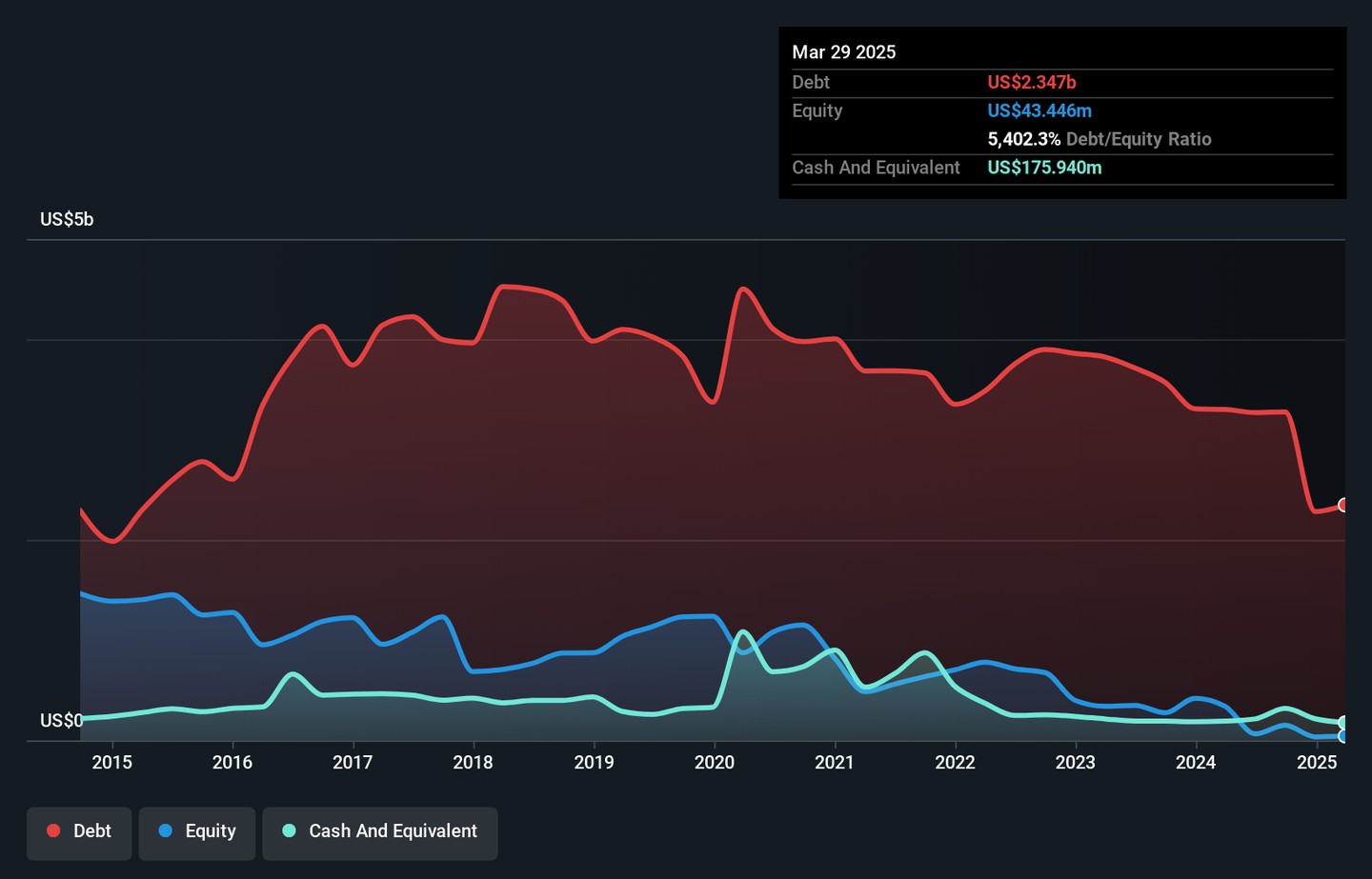
You can click the graphic below for the historical numbers, but it shows that Hanesbrands had US$2.35b of debt in March 2025, down from US$3.30b, one year before. However, it does have US$175.9m in cash offsetting this, leading to net debt of about US$2.17b.

NYSE:HBI Debt to Equity History August 3rd 2025

A Look At Hanesbrands' Liabilities

We can see from the most recent balance sheet that Hanesbrands had liabilities of US$1.11b falling due within a year, and liabilities of US$2.67b due beyond that. Offsetting this, it had US$175.9m in cash and US$342.1m in receivables that were due within 12 months. So its liabilities outweigh the sum of its cash and (near-term) receivables by US$3.26b.

The deficiency here weighs heavily on the US$1.44b company itself, as if a child were struggling under the weight of an enormous back-pack full of books, his sports gear, and a trumpet. So we'd watch its balance sheet closely, without a doubt. At the end of the day, Hanesbrands would probably need a major re-capitalization if its creditors were to demand repayment.

Check out our latest analysis for Hanesbrands

We measure a company's debt load relative to its earnings power by looking at its net debt divided by its earnings before interest, tax, depreciation, and amortization (EBITDA) and by calculating how easily its earnings before interest and tax (EBIT) cover its interest expense (interest cover). The advantage of this approach is that we take into account both the absolute quantum of debt (with net debt to EBITDA) and the actual interest expenses associated with that debt (with its interest cover ratio).

While we wouldn't worry about Hanesbrands's net debt to EBITDA ratio of 4.4, we think its super-low interest cover of 2.3 times is a sign of high leverage. So shareholders should probably be aware that interest expenses appear to have really impacted the business lately. Looking on the bright side, Hanesbrands boosted its EBIT by a silky 58% in the last year. Like a mother's loving embrace of a newborn that sort of growth builds resilience, putting the company in a stronger position to manage its debt. When analysing debt levels, the balance sheet is the obvious place to start. But ultimately the future profitability of the business will decide if Hanesbrands can strengthen its balance sheet over time. So if you want to see what the professionals think, you might find this free report on analyst profit forecasts to be interesting.

Finally, a business needs free cash flow to pay off debt; accounting profits just don't cut it. So we always check how much of that EBIT is translated into free cash flow. In the last three years, Hanesbrands's free cash flow amounted to 26% of its EBIT, less than we'd expect. That weak cash conversion makes it more difficult to handle indebtedness.

Our View

We'd go so far as to say Hanesbrands's level of total liabilities was disappointing. But on the bright side, its EBIT growth rate is a good sign, and makes us more optimistic. Looking at the bigger picture, it seems clear to us that Hanesbrands's use of debt is creating risks for the company. If all goes well, that should boost returns, but on the flip side, the risk of permanent capital loss is elevated by the debt. The balance sheet is clearly the area to focus on when you are analysing debt. However, not all investment risk resides within the balance sheet - far from it. For example - Hanesbrands has 1 warning sign we think you should be aware of.

Of course, if you're the type of investor who prefers buying stocks without the burden of debt, then don't hesitate to discover our exclusive list of net cash growth stocks, today.