Canalys:第二季度中国大陆 PC 市场同比增长 12% 出货量达 1020 万台

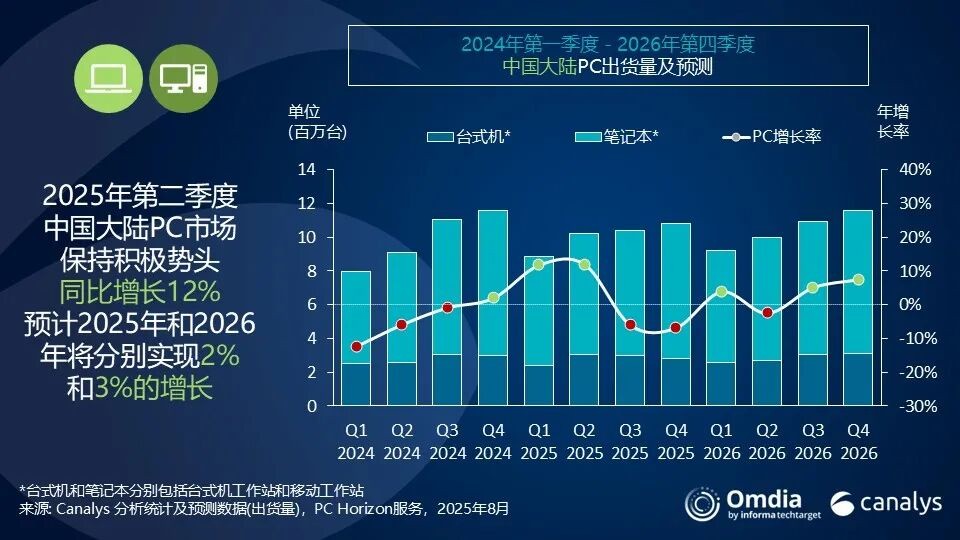
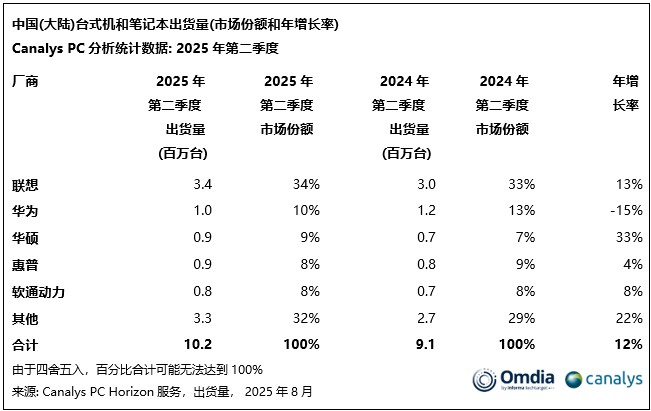
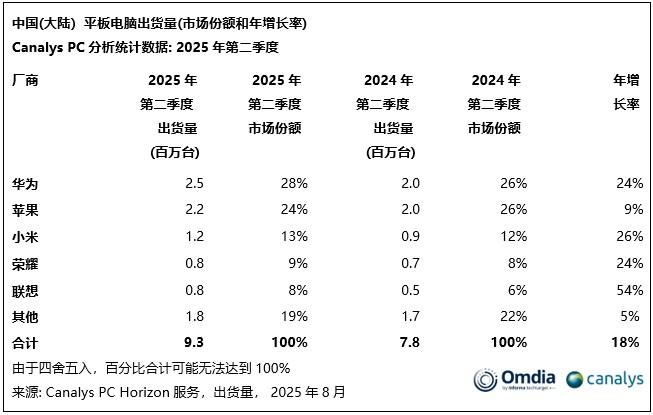
According to the latest data from Canalys, the PC market in mainland China (excluding tablets) is expected to grow by 12% year-on-year in the second quarter of 2025, with shipments reaching 10.2 million units. Both consumer and commercial demand performed well, growing by 13% and 12% respectively. The growth is mainly driven by consumer subsidies and government procurement. Tablet shipments increased by 18% year-on-year, totaling 9.1 million units. Future forecasts indicate that PC shipments will grow by 2% in 2025 and by 3% in 2026. AI PC shipments account for 28% of the overall market
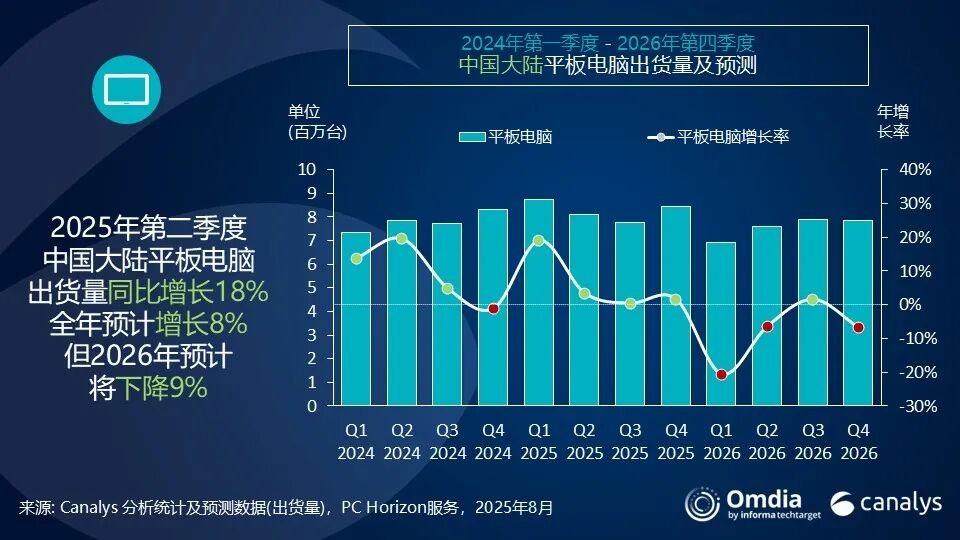
According to the latest data from Canalys (now merged into Omdia), the PC market in mainland China (excluding tablets) is expected to grow by 12% year-on-year in the second quarter of 2025, with shipments reaching 10.2 million units. Both consumer and commercial demand have performed well, with shipments increasing by 13% and 12% year-on-year, respectively. This growth is primarily driven by ongoing consumer subsidies and strong procurement activities from state-owned enterprises and the government. Meanwhile, tablet shipments increased by 18% year-on-year, totaling 9.1 million units this quarter. Future forecasts indicate that PC shipments in mainland China will grow by 2% in 2025 and 3% in 2026, while tablet shipments are expected to grow by 8% in 2025 but decline by 9% in 2026.

Emma Xu, a senior analyst at Canalys (now merged into Omdia), stated, "National subsidies remain a crucial factor for manufacturers' success. In the second quarter of 2025, Apple performed particularly well. The competitively priced new MacBook Air, supported by policies, contributed to strong growth for Apple in the mainland China market. In addition, competition among upstream CPU manufacturers has also driven device upgrades, with a large number of cost-effective PC products entering the market. AMD launched the new Ryzen AI series AI PC chips, along with the latest Radeon RX 9060 GPU and Ryzen 9000 series processors, all of which are competitively priced. At the same time, Intel and AMD also offered significant discounts on previous-generation products in the second quarter of 2025. Despite manufacturers releasing a wave of new products this quarter, the average selling price of PCs still declined month-on-month.

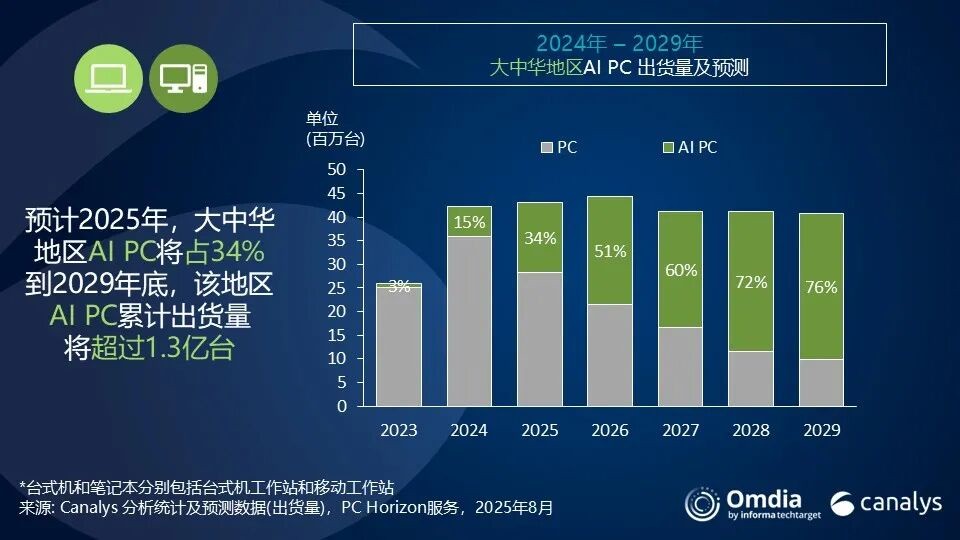
Xu stated, "In the second quarter of 2025, AI PC shipments accounted for 28% of the overall PC market in mainland China, indicating an increasing demand from consumers and enterprises for higher hardware performance. The domestic AI ecosystem in China is rapidly developing—from upstream AI chips (such as Cambricon and Ascend, primarily deployed in enterprises and cloud vendors) to edge software and hardware platforms (such as Tongxin UOS and HarmonyOS), all of which are continuously improving. The Chinese government officially released the 'Artificial Intelligence + Action' policy in August 2025, proposing that by 2027, the penetration rate of AI devices and intelligent agents will reach 70%, and by 2030, the penetration rate of AI software and applications will reach 90%, aiming to fully transition Chinese society into the AI era by 2035. This policy will accelerate the construction of local AI infrastructure and the popularization of edge devices (including AI PCs), and will also promote the commercialization of AI agents and assistants on these devices in the coming years It is expected that the PC market in mainland China will grow by 2% year-on-year in 2025 and by 3% in 2026, mainly driven by replacement demand from consumer subsidies and procurement by state-owned enterprises and the government. According to Canalys (now merged into Omdia), the penetration rate of AI PCs will increase rapidly, reaching 34% in 2025 and further rising to 52% in 2026. By the end of 2029, it is expected that approximately 107 million AI PCs will be shipped in the Greater China region, laying a solid foundation for the widespread use of AI applications.

Xu Ying stated: "In contrast to the PC market, the tablet market in mainland China is relatively stable. As competition among manufacturers intensifies, specification upgrades, product diversification, and AI features are gradually becoming the new norm. To maintain market share, manufacturers are targeting a broader user base, such as gamers, creators, and casual entertainment users, and are launching more targeted products, including small-sized gaming tablets and high-performance models equipped with AI features. Xiaomi has launched its first gaming tablet, and more manufacturers are expected to follow suit. However, in the high-end market, Apple and Huawei still maintain a strong leadership position. As the overall tablet penetration rate has reached a high level, manufacturers will face greater challenges in expanding market share or improving profitability. Value-added innovative technologies such as AI integration and a thriving content ecosystem will increasingly become key differentiating factors."
Canalys (now merged into Omdia) predicts that the tablet market in mainland China will reach a new high in the first half of 2025, driven by subsidies, with total shipments expected to reach 34 million units for the year, an 8% year-on-year increase. However, as consumer demand cools, the market is expected to shrink by 9% in 2026, with shipments falling to 31 million units.