


TrendForce 集邦咨询:4Q25 DRAM 价格延续涨势 服务器需求提前发酵、旧制程产品涨幅仍较大

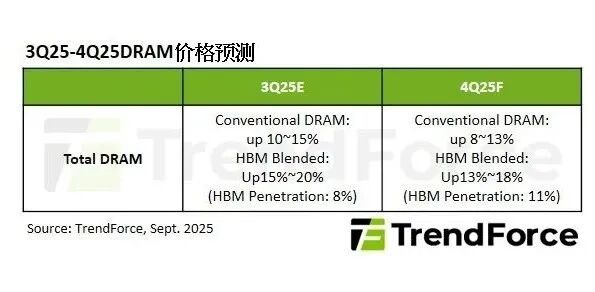
According to the latest survey by TrendForce, DRAM prices are expected to continue rising in the fourth quarter, with significant increases in older process products. Overall, general DRAM prices are expected to increase by 8-13% quarter-on-quarter. Due to the three major DRAM manufacturers prioritizing capacity allocation for high-end Server DRAM and HBM, PC DRAM prices have slightly risen, while the procurement volume of DRAM by major OEMs is expected to decrease quarter-on-quarter. The demand from cloud service providers is recovering, and it is anticipated that DRAM procurement demand will grow significantly by 2026
According to the latest survey by TrendForce, due to the three major DRAM manufacturers continuing to prioritize the allocation of advanced process capacity to high-end Server DRAM and HBM, the capacity for PC, Mobile, and Consumer applications is being squeezed. At the same time, affected by the differentiated demand for various end products, the price increase of old process DRAM in the fourth quarter remains considerable, while the price increase of new generation products is relatively moderate. It is estimated that the overall price of conventional DRAM will increase by 8-13% quarter-on-quarter, and if HBM is included, the increase will expand to 13-18%.
PC DRAM Prices Slightly Rise, US CSPs Intend to Purchase Server DRAM in Advance
In the fourth quarter, as PC promotions and distribution momentum are expected to slow down, the overall shipment volume of PC OEMs will decrease accordingly, and the DRAM bit procurement volume of major OEMs is expected to show a quarterly decline. Additionally, due to the three major manufacturers actively shifting capacity to Server DDR5, the supply scale of PC DDR5 and PC DDR4 is limited, thus the overall PC DRAM prices will continue to rise slightly in the fourth quarter.
Server DRAM, on the other hand, is experiencing a recovery in demand from CSPs (Cloud Service Providers) as the momentum for building infrastructure warms up, and the demand for DDR5 products continues to strengthen. Currently, both US and Chinese CSPs expect significant growth in DRAM procurement demand by 2026. US companies plan to start purchasing in advance as early as the fourth quarter of 2025 to ensure sufficient supply, thus they have a more open attitude towards prices. Although manufacturers are actively reallocating capacity, some suppliers face technical issues with their products, and all manufacturers plan to prioritize capacity for HBM4 in the first half of 2026, which introduces variables to the supply situation of DDR5. It is expected that prices will continue to rise in the fourth quarter. Furthermore, although some manufacturers have delayed the discontinuation schedule for Server DDR4 for specific customers, due to the ongoing purchasing enthusiasm, DDR4 prices are still expected to see considerable increases in the fourth quarter.
Mobile DRAM Prices Rise, Graphics DRAM Demand Remains Strong, Consumer DRAM Price Increase Slows Compared to Last Quarter
Mobile DRAM-LPDDR4X, used in mid-to-low-end smartphones, has seen a continuous reduction in global total supply bits, leading brand manufacturers to strengthen inventory to prevent supply chain disruptions, exacerbating the supply-demand imbalance and driving LPDDR4X prices up by more than 10% quarter-on-quarter in the fourth quarter. As for LPDDR5X, in addition to being used in high-end smartphones, it is also expanding its use in other end applications; although there is no obvious shortage in the short term, considering future supply capacity and product pricing strategies, TrendForce estimates that LPDDR5X prices will continue to rise in the fourth quarter The stocking wave of PC applications in the fourth quarter, along with the increased market expectations for NVIDIA's RTX 6000 series, will continue to drive the demand for Graphics GDDR7. Additionally, manufacturers expect a supply-demand imbalance, which will support price increases, with GDDR7 prices rising more significantly than in the previous quarter. In contrast, the older GDDR6 process, which maintains a certain adoption rate in the previous generation of graphics cards, will see stable procurement levels. However, due to significant supply constraints, the price increase for GDDR6 is expected to remain higher than that of GDDR7 in the fourth quarter.
The supply of Consumer DDR4 from manufacturers is also very limited, and their stance on price increases is firm. Furthermore, as terminal product sales have not strengthened and after DDR4 prices nearly doubled in the third quarter, the buying momentum has slowed down, leading to expectations that the price increase in the fourth quarter will moderate. DDR3 continues to see pre-stocking demand, and factors such as capacity being squeezed and manufacturers rapidly reducing inventory are expected to lead to continued price increases in the fourth quarter
