


AI 带来史无前例 “电力牛市”! 高盛 “6P 法则” 揭示 AI 时代的电力财富密码

Goldman Sachs' latest research report points out that global data center electricity demand will grow by 175% by 2030, primarily driven by AI. AI is seen as a "power consumer," which will trigger a "super bull market" for power stocks. Goldman Sachs recommends investing around three main lines: "reliability - availability - efficiency." As AI applications become more widespread, electricity demand will continue to surge, making electricity supply a core infrastructure for AI data centers
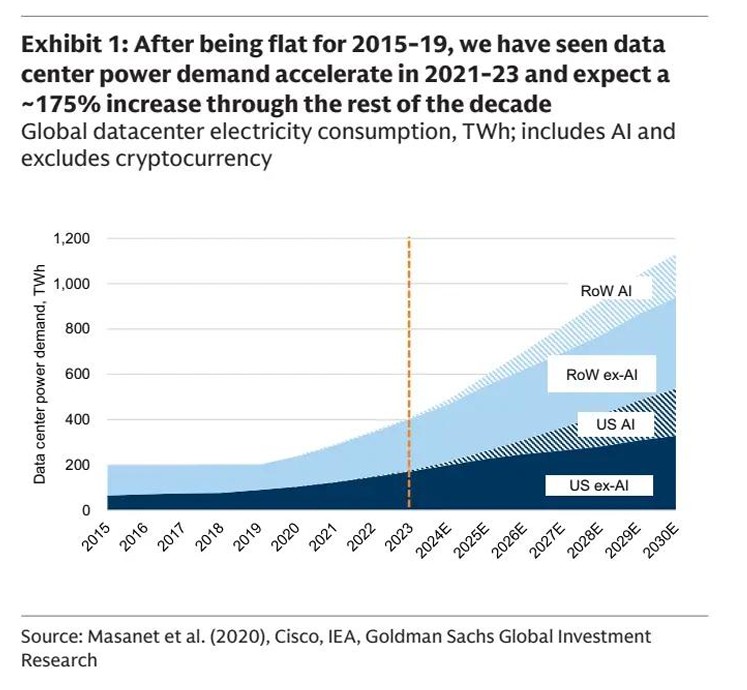
According to the Zhitong Finance APP, Wall Street financial giant Goldman Sachs has revised its forecast in the latest research report regarding the massive electricity demand driven by global data centers (including AI and non-AI, with AI-led growth dominating) by 175% compared to 2023 (previously +165%), equivalent to adding the electricity resource load of another "top ten electricity-consuming country in the world" by 2030. In the view of Goldman Sachs' analyst team, the end of AI large models is electricity—this institution emphasizes that AI, which can be described as an "electricity-consuming behemoth," will bring about an unprecedented "super bull market" for electric stocks. In terms of specific investment strategies, Goldman Sachs recommends focusing on "6P" around three investment themes: "reliability—availability—efficiency."
The essence of the global AI competition is a competition for computing power infrastructure, and the core foundation of computing power is a stable and large electricity supply system. For this reason, the demand for electricity to power AI data centers is skyrocketing at an unprecedented rate, and AI has seemingly transformed into an "electricity glutton." The high-energy-consuming AI data centers, which are expanding exponentially due to the fierce demand for computing power infrastructure such as AI chips, are fundamentally reliant on this core electricity supply, which is also the origin of the market view that "the end of AI is electricity."
With AI applications like ChatGPT, Claude, and DeepSeek sweeping the globe, the energy demand of large-scale AI data centers worldwide is so immense that this year, some long-neglected electric utility stocks have entered the sights of top investment institutions on Wall Street. The accelerating demand for AI computing power closely related to artificial intelligence training/inference is expected to continue to surge in the coming years, as the already "electricity-consuming behemoth" high-performance data centers will have an increasing demand for electricity resources. AI data centers are undoubtedly the most critical large infrastructure construction projects of the AI era, essential for the efficient operation of generative AI applications like ChatGPT and the iterative updates of AI large models such as the GPT series.
A forecast report from the International Energy Agency (IEA) indicates that by 2030, the electricity demand of global data centers will more than double, reaching approximately 945 terawatt-hours (TWh), slightly higher than Japan's current total electricity consumption, with artificial intelligence applications being the most important driving force behind this growth; it is expected that by 2030, the overall electricity demand of data centers focused on artificial intelligence will increase by more than four times.
Regarding the extensive list of electric stocks in the stock market, Goldman Sachs advises investors to allocate "shovels and buckets" in the electricity supply chain based on the three main axes of "reliability—availability—efficiency," layering allocations across four core tracks: power generation and fuel side, electrical equipment and system integration, engineering EPC/transmission and distribution construction, cooling and efficiency/demand-side management. For example, electric equipment and system integration stocks benefiting from high elasticity in electricity expenditure Capex include Schneider Electric, Siemens, Eaton, Prysmian, Nexans, and NKT.
AI/Data Center Electricity Market: 6 Driving Factors and Constraints Goldman Sachs stated in its latest research report that the drivers and constraints of the global power market come from "6 Ps": Pervasiveness (AI pervasiveness and penetration), Productivity (computing power/server efficiency), Prices (power generation/electricity prices/electricity costs), Policy (policy incentives and approvals), Parts (equipment supply), and People (construction and operation & maintenance workforce). Specifically, Goldman Sachs prioritizes segments and companies in the entire electricity supply chain that can improve reliability, meet incremental demand, and enhance energy efficiency.
Regarding Pervasiveness (AI pervasiveness and penetration) and Productivity (computing power/server efficiency), Goldman Sachs pointed out that the "Jevons Paradox" reveals that the total demand for electricity continues to rise due to AI penetration, with energy efficiency improving during the large-scale AI inference phase but total demand being highly elastic. It is expected that by 2030, the total electricity consumption of global data centers will increase by 175% compared to 2023 (including AI & non-AI).
In terms of Prices (power generation/electricity prices/electricity costs) and Policy (policy incentives and approvals), Goldman Sachs stated that the average low-carbon cost in the U.S. based on the Green Reliability Premium is about $40/MWh. In the short term, it relies on renewable energy and natural gas, while in the long term, it will rely on an increased share of nuclear power (large nuclear power plants + SMR) to offset the expansion of carbon emissions from data centers. Goldman Sachs indicated that after the IRA policy incentives fade, it may rise to $48/MWh—this is absorbable against the backdrop of strong free cash flow and return rates of hyperscalers, with an impact on EBITDA/ROIC of less than 1 percentage point.
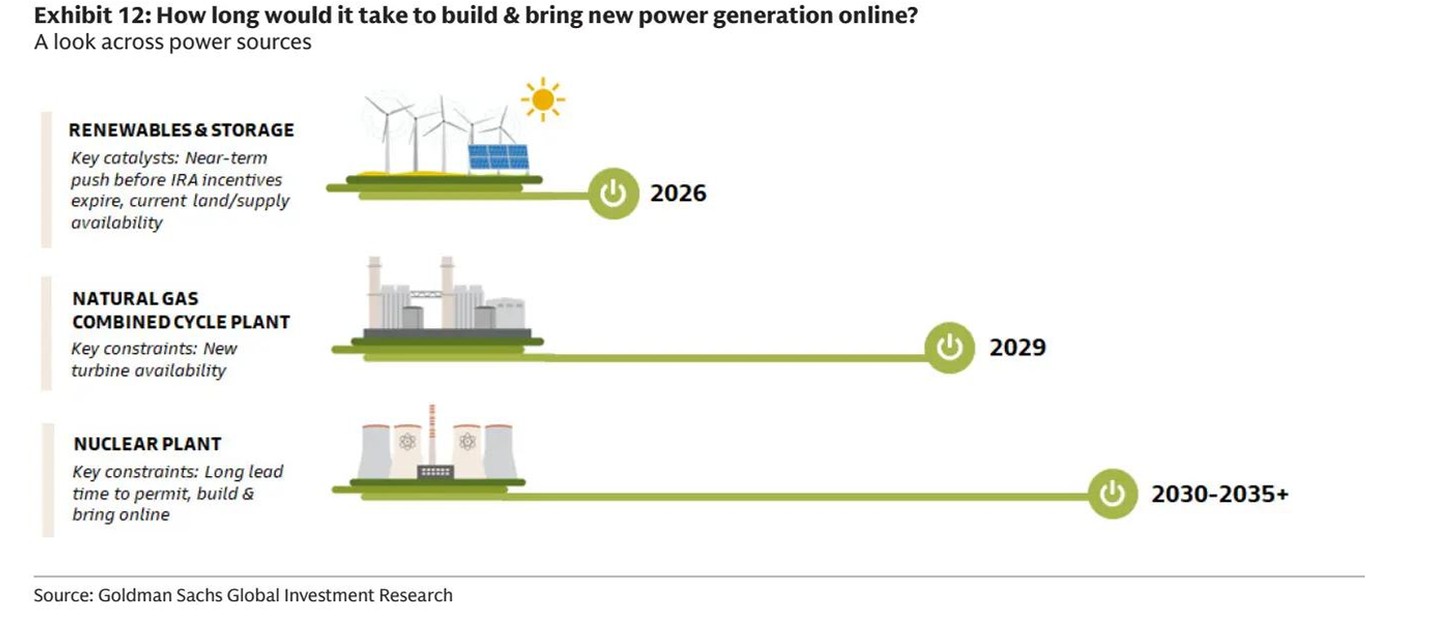
Additionally, Goldman Sachs stated that as the IRA (Inflation Reduction Act) expires, the pace of grid capacity construction will not change in the short term. The U.S. power industry still has a trend of rush installations/rush grid connections to lock in incentives, with permitting/siting being the key non-price constraints.
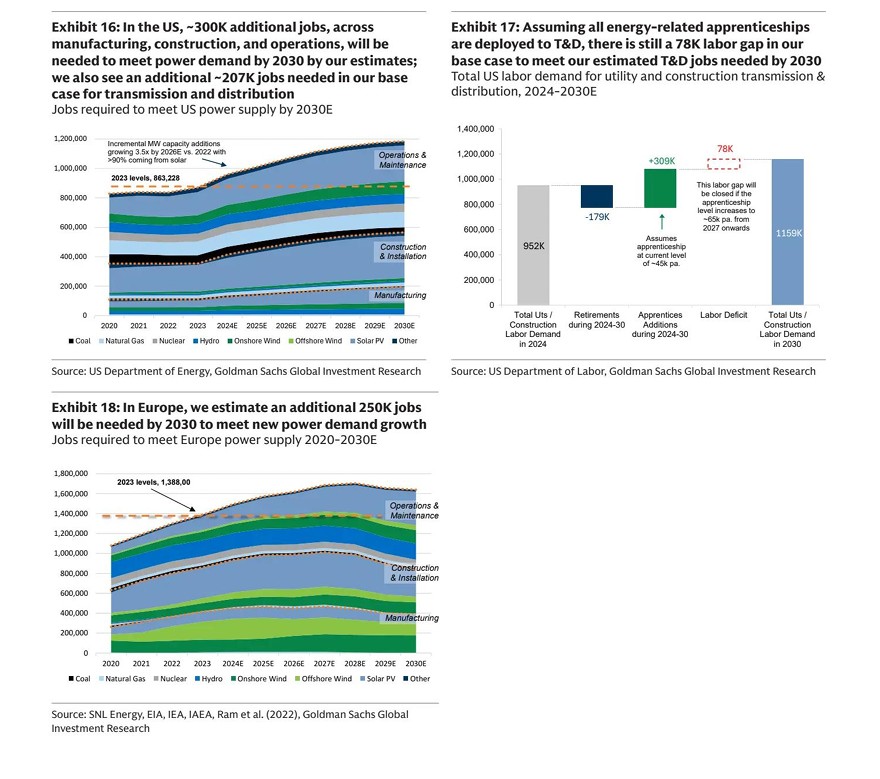
Regarding Parts (equipment supply) and People (construction and operation & maintenance workforce), Goldman Sachs' analyst team indicated that the labor gap remains a significant risk in the global power market: it is estimated that by 2030, there will be about 300,000 new electricity-related jobs in the U.S., with an additional 210,000 needed for T&D (transmission and distribution); Europe will need about 250,000 electricity jobs. Goldman Sachs expects that by 2030, the cumulative capital expenditure for the U.S. grid will be about $790 billion (higher than Goldman Sachs' previous estimate of about $780 billion), with about 67% directed towards strengthening measures in transmission, distribution, and grid levels
In terms of new capacity on the power generation side, Goldman Sachs estimates that approximately 82 GW of new installed capacity will be needed globally to meet data center loads by 2030 (previously estimated at about 72 GW); it is expected that the incremental power generation composition serving data center loads in the U.S. by 2030 will be approximately: natural gas peaking about 51%, solar power systems about 27%, CCGT (combined cycle gas turbine) about 12%, and wind power systems about 9%.
Goldman Sachs' "AI Power Version" Long Bull Market Map of the Industry Chain
Therefore, based on Goldman Sachs' 6P rule, the analyst team of the institution recommends that investors layer their allocations across four core tracks: power generation and fuel side, power equipment and system integration, engineering EPC/transmission and distribution construction, and cooling and efficiency/demand-side management.
In terms of upstream fuel/power supply and utilities, Goldman Sachs recommends positioning in companies such as NextEra Energy, Kinder Morgan, EQT, Cameco, Antero Resources, Energy Transfer, Public Service Enterprise Group, and Vistra, among others. These stocks primarily benefit from rapid grid connection, strong load tracking capabilities, and assets/developers that can quickly sign long-term PPAs with technology companies.
In the area of power equipment and system integration, mainly benefiting from the high elasticity of capital expenditures from tech giants, Goldman Sachs recommends positioning in areas such as substation equipment, switchgear, transformers, DC equipment, UPS, distribution, and cables, including Schneider, Siemens, Eaton, Prysmian, Nexans, and NKT.
In terms of engineering EPC/transmission and distribution construction, Goldman Sachs recommends positioning in transmission engineering contractors, distribution network upgrade companies, and data center EPC (such as Quanta, MYR, Primoris, etc.); for cooling and efficiency/demand-side management, Goldman Sachs suggests focusing on power infrastructure companies related to next-generation liquid cooling/immersion cooling, waste heat recovery, distribution optimization, and AI server energy efficiency improvement solutions, such as Vertiv, Carrier, Trane Technologies, Alfa Laval, Caterpillar, Carel, and ABB, among others
