


解碼平安一季度業績隱情:新戰略的斷舍離與穩節奏

Direction is more important than volatility
After experiencing a collective surge under the "dual bull market" of stocks and bonds in 2024, A-share listed insurance companies showed significant performance differentiation in the first quarter.
Overall, Ping An, China Pacific Insurance, China Life Insurance, China Reinsurance, and New China Life Insurance recorded a net profit attributable to shareholders of 84.176 billion yuan, a slight increase of 1.4% year-on-year;
Among them, China Re and China Life both saw profit growth of around 40%;
However, Ping An, the largest and most complex in terms of business, underperformed, with revenue and net profit declining by 5.2% and 26.4%, respectively, marking the largest drop among listed insurance companies during the same period.
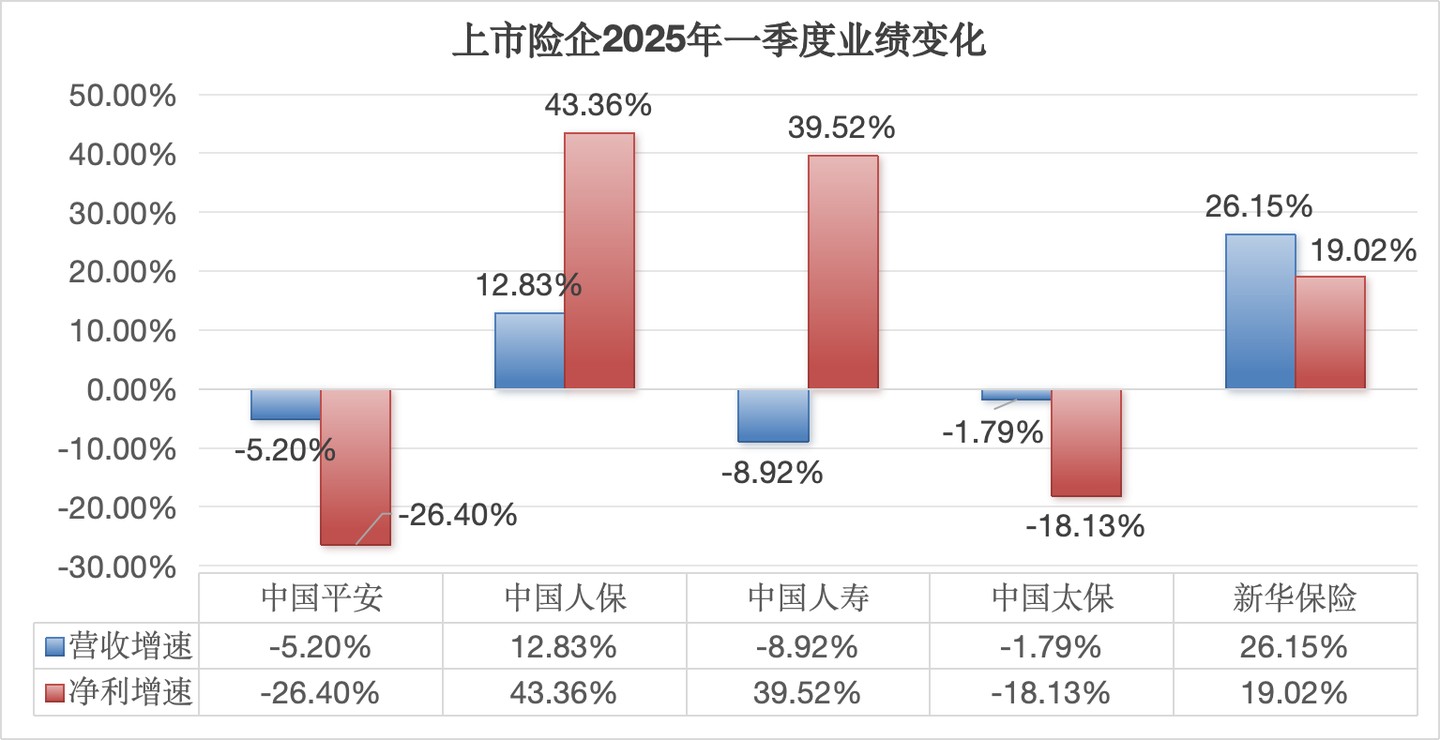
The profit fluctuations far exceeding those of peers seem somewhat unexpected, as Ping An remains a top performer in 2024:
On the liability side, it leads A-share insurance companies with a premium growth rate of 7.17%, exceeding the second-place China Re by 4.47 percentage points;
On the investment side, its comprehensive investment return rate is also the highest among peers, with a net investment return rate only 0.1 percentage points lower than that of China Re.
However, in the first quarter of 2025, a significant profit gap has emerged between Ping An and China Re, which had been closely matched the previous year.
Xinfeng's analysis reveals that the reasons for the performance differentiation between Ping An and its peers are quite complex:
On one hand, it stems from the fluctuations in its investment portfolio amid bond and stock market conditions, as well as differences in accounting treatment under the new accounting standards;
On the other hand, it is due to the more complex business structure of Ping An as a comprehensive financial group.
Excluding short-term investment fluctuations and focusing solely on the core insurance business, Ping An's insurance business attributable operating profit grew by 2.2% year-on-year, with life and health insurance business growth reaching 4.99%.
Shifting the focus from short-term fluctuations to the long term, even though Ping An's core business remains robust, it needs to find new support under the shadow of declining interest rates and an intensifying "asset shortage."
Xinfeng has noted that Ping An has recently updated its development plan for 2025-2027, stating that in the context of financial stockpiling and homogeneous competition, it will deepen its "comprehensive finance + medical care and elderly care" strategy to build core competitiveness through differentiation.
The Mystery of Deceleration
From historical performance, Ping An's profit of 27 billion yuan in the first quarter after adopting the new accounting standards is not low, but it represents a significant decline from the peaks of 2023-2024.
However, compared to peers that often see profit growth of 30% or 40%, the nearly 30% decline seems quite striking.
After dissection, the primary reason for Ping An's profit fluctuations remains the changes in investment returns.
In fixed-income assets, the first quarter of 2024 was a typical "bull market";
The yields on 10-year and 30-year government bonds fell by 27 and 38 basis points, respectively, with bond market trading volume sharply increasing, and total trading volume growing by 42.9% year-on-year.
In contrast, the bond market in the first quarter of 2025 saw a noticeable correction.
The yield on 10-year government bonds rose from 1.6% to 1.90%, with the yields on 1-year government bonds, 10-year government bonds, and 10-year policy bank bonds rising by 45, 14, and 11 basis points, respectively In contrast to the direction of the bond market, the stock market in the first quarter of 2025 showed a recovery compared to the same period last year, with smaller fluctuations.
Compared to the 2.2% increase in the Shanghai Composite Index in 2024, the 0.5% decline in 2025 reflects slight volatility;
In terms of Hong Kong stocks favored by insurance funds, the Hang Seng Index and the Hang Seng Tech Index surged by 15.3% and 20.7% respectively in the first quarter of 2025, a significant increase compared to the declines of 3% and 7.6% in the same period last year.
The divergence of the stock-bond seesaw may become a watershed for performance;
Although insurance companies exhibit a "dumbbell-type" layout on the asset side, the specific proportions, targets, and timing choices may still lead to differences in investment returns.
Xinfeng discovered that Ping An and Taikang, which experienced profit declines in the first quarter, indeed showed a higher inclination towards bond allocation by the end of 2024, being the only two A-share insurance companies with bond holdings accounting for over 60% of their investment assets;
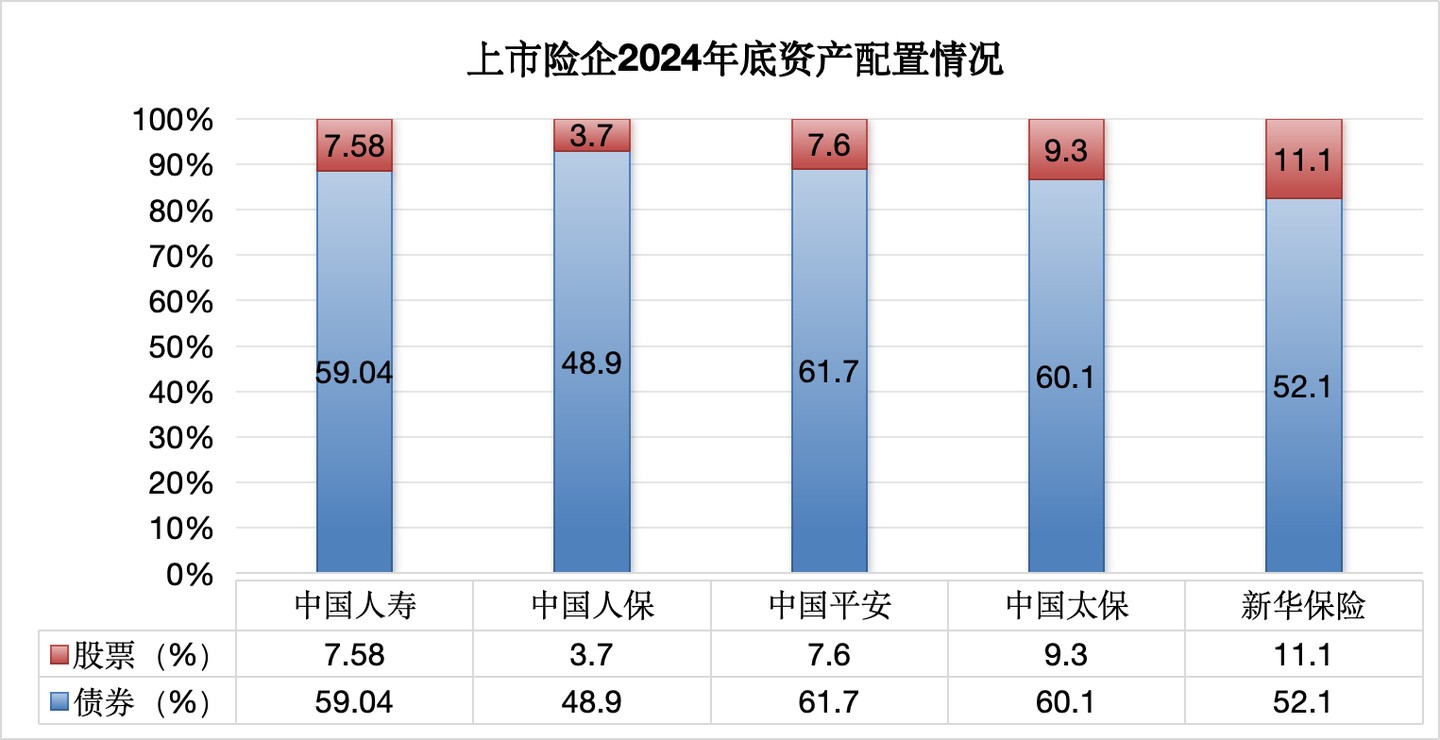
However, considering the subsequent performance of the bond market and the downward trend in interest rates, the fluctuations in the first quarter may soon be smoothed out.
Under the new accounting standards, the distinction in the statistical scope for stocks may further widen the investment returns among various insurance companies.
Xinfeng noted that Xinhua, China Life, and PICC, which saw significant profit increases in the first quarter, all experienced substantial growth in investment returns, with PICC even stating in its earnings forecast that "the implementation of medium- and long-term capital market entry requirements significantly enhanced investment performance."
From the asset allocation situation at the end of 2024, Ping An's stock position was not significantly lower than that of the aforementioned companies.
The differences in performance may be related to the classification of assets.
Under the new standards, financial assets are classified into three categories based on measurement methods: AC (financial assets measured at amortized cost), FVTPL (financial assets measured at fair value with changes recognized in profit or loss), and FVOCI (financial assets measured at fair value with changes recognized in other comprehensive income).
Changes in the market value of OCI may not be included in the current profit or loss, allowing insurance companies to account for long-term held, allocation-type stock assets.
When stock market values decline, losses do not appear in the current profit and loss statement, and the same applies when values rise.
Xinfeng's statistics show that as one of the earliest listed insurance companies to adopt the new standards, Ping An's proportion of stocks in the OCI account is significantly higher than that of its peers;
This may lead to the fact that the value of some stock assets that increased in the first quarter was not realized in the financial report.
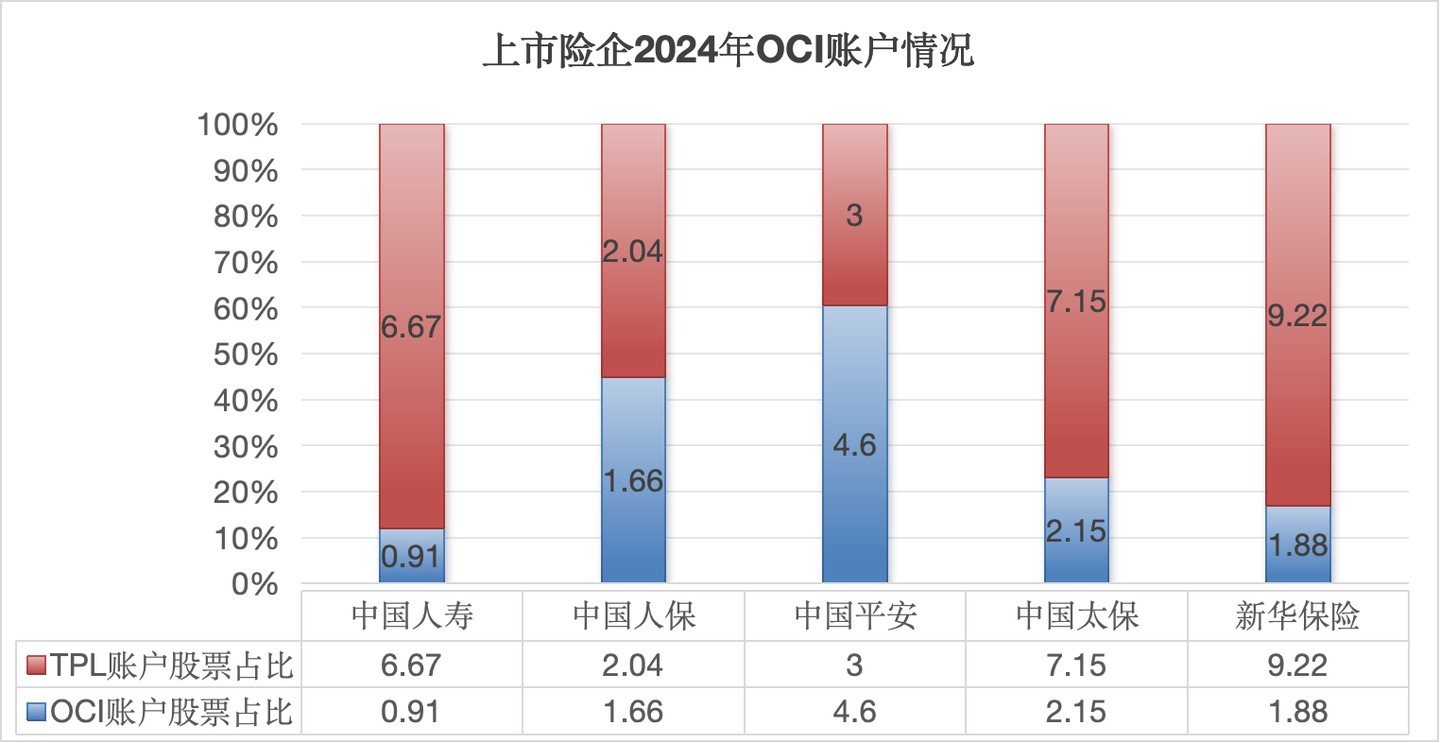
On the other hand, as a comprehensive financial group, Ping An also has a more complex business structure than its peers.
Currently, it has six segments: life and health insurance, property insurance, banking, asset management, financial empowerment, and other businesses;
Among them, financial empowerment includes several member companies such as Lufax, OneConnect, Ping An Health, and Autohome.
The diverse business structure supports Ping An's main business and strategy, also causing its performance fluctuations not to be entirely synchronized with its peers After excluding short-term fluctuations, both Ping An Insurance and asset management business showed growth;
However, the banking sector's performance plummeted by 5.59%, and the group's overall operating profit ultimately rose slightly by 2.43%.
What’s Next
For the insurance industry, which has liabilities lasting for decades, short-term profit changes are not suitable as effective references;
Moreover, for a "financial giant" like Ping An, direction is far more important than fluctuations.
Based on past strategies, Ping An has had various explorations and struggles in incremental excavation:
On one hand, the technological context is gradually becoming clearer.
Since 2012, technology has frequently appeared as a keyword in Ping An's annual reports;
In 2017, Ping An clearly stated that in the next ten years, it would deepen "finance + technology," applying innovative technology deeply in traditional finance and five areas: finance, healthcare, automotive, and real estate, viewing it as a "new engine" for development.
Since that year, Ping An has classified its subsidiaries, such as Lufax, Ping An Good Doctor, OneConnect Financial Technology, and Autohome, under the "technology business" segment, listed separately in the annual report.
Three years later, the technology business reached a profit peak, contributing nearly 8 billion yuan in profit to the group;
However, the performance of such businesses has fluctuated dramatically and declined year by year.
In 2024, the technology business turned from profit to a loss of 29 million yuan, and that year Ping An redefined its positioning from "technology business" to the auxiliary nature of "financial empowerment";
It stated that the group "continues to build leading technological capabilities, widely applied in the main financial business, and accelerates the promotion of ecosystem construction."
On the other hand, the importance of healthcare and wellness is continuously increasing.
When the direction was initially set in 2017, Ping An's overall strategy still leaned towards divergent exploration, with the listed five major ecosystems of finance, healthcare, automotive, and real estate having a strong offensive implication;
After 2022, the focus shifted to healthcare, emphasizing the development of a "comprehensive finance + healthcare" service system, providing professional "financial advisors, family doctors, and elderly care managers" services.
The personal insurance industry today is facing challenges far more difficult than before.
Although profits of listed insurance companies showed differentiation in the first quarter, after excluding short-term investment fluctuations, the clouds hovering over various institutions remain similar:
First, under the backdrop of declining interest rates and an unchanging "asset shortage," how to promote the matching of company assets and liabilities;
Second, after abandoning the advantages in interest rates, how to ensure the competitiveness of products in a homogenized market.
In this predicament, the choice of the "second growth curve" is crucial.
Ping An's answer is to continue down the path of "comprehensive finance + healthcare and elderly care."
In the planning for the next three years, Ping An clearly stated that "the rapid growth of healthcare demand and uneven resource allocation, coupled with the aging population and changes in the elderly care landscape, have led to a rapid increase in customer demand for commercial healthcare and elderly care."
It stated: "The group will seamlessly integrate differentiated healthcare and elderly care services with financial business, empowering the main financial business."
From this perspective, Ping An has several indicators that continue to improve.
For example, the integrated healthcare and wellness resources as a payer have already been put into the market;
By the end of the first quarter, home elderly care services had covered 75 cities nationwide, and wellness community projects had been laid out in five cities In the self-operated medical ecosystem, the revenue of Peking University Health Group, which was taken over in 2021, remains stable, while Ping An Health's online diagnosis and treatment platform has nine specialties and can provide 24/7 consultations.
Ping An stated that "the medical and elderly care ecosystem creates independent direct value and also creates indirect value, empowering the financial main business."
This advantage is also reflected in the indicators.
By the end of the first quarter, nearly 63% of Ping An's customers had enjoyed medical and elderly care service rights, with the average number of contracts per customer and average AUM being 1.6 times and 4.0 times that of ordinary individual customers, respectively.
At the same time, it has driven growth in customer numbers, retention rates, and insurance product penetration rates.
In the first quarter, the penetration rate of Ping An's personal protection products reached 45.8%, an increase of 0.9 percentage points from the beginning of the year;
The new business value of life insurance and health insurance reached 12.891 billion yuan, with a year-on-year growth rate of over 30%.
However, in the current aging process, leading insurance companies focusing on health and elderly care are not limited to Ping An alone.
For example, China Life ranks first in the industry for personal pension business in 2024, while cumulatively laying out 17 institutional elderly care projects in 14 cities;
China Pacific Insurance is deeply involved in pilot projects for exclusive commercial pension insurance and personal pension, with its Taibao Home established in 13 cities and 15 parks, and offline experience centers for home elderly care established in 127 cities.
With years of accumulation and a large amount of resources at hand, Ping An certainly has its advantages, but how to establish an effective moat in this newly emerging "blue ocean" of health and elderly care remains to be seen over time
