美元下跌,但影響尚在

The US dollar is under pressure from trade policies, budget deficits, and interest rate uncertainties, leading to a decline in the first six months of this year, followed by a period of stability. Analysts point out that the uncertainty in policies and market volatility have prompted traders to turn to the euro, pound, and Swiss franc. The trend of de-dollarization is expected to continue over the next 12 months, potentially driving up the exchange rates of major G10 currencies against the dollar. Although trade agreements reached with the EU and Japan have alleviated some tariff uncertainties, budget deficits and the debt crisis remain significant challenges for the dollar
Overview
-
The dollar is facing resistance from trade policy decisions, budget deficits, and interest rate uncertainties.
-
The decline of the dollar mainly occurred in the first six months of this year, and has remained relatively flat since July.
Policy uncertainty. Soaring deficits. Weak economic growth. These are some key factors that may exert pressure on the dollar over the next 12 months, continuing the downward trend of the dollar that has been evident for most of 2025.
“Today we impose tariffs, and tomorrow we don’t,” said Zain Vawda, an analyst at the foreign exchange consulting firm Oanda. “This erratic policy change is damaging the dollar.”
He noted that unprecedented market volatility has prompted traders to avoid the dollar in favor of buying euros, pounds, and Swiss francs.
Vawda stated that given Washington may implement two to three rate cuts this year, the trend of de-dollarization is expected to continue for some time, which could drive up the exchange rates of mainstream G10 currencies such as the euro against the dollar, the Swiss franc against the dollar, and the Canadian dollar against the dollar.
As the currency with the highest trading volume against the dollar, the euro may rise in the context of a strengthening European economy, large-scale economic stimulus plans, and market expectations of lower rate cuts compared to the U.S.
On July 27, the U.S. and the EU signed a long-awaited trade agreement, under which the EU will pay a 15% tariff on goods sold to the U.S., significantly lower than the initially proposed 30% rate. This news caused the dollar to rise about 1.2% on that day, although the dollar has overall declined about 13% this year.
Mark Connors of financial consulting firm Riskdynamics believes that unless more pressing risks are addressed, this agreement and the trade agreement reached with Japan on July 23 will not significantly boost the dollar.
“These agreements eliminate the uncertainty of tariffs,” Connors said, “but we still face enormous budget deficits and a debt crisis.”
In the face of ongoing uncertainty, the dollar's performance may become a disadvantage or advantage for other mainstream currencies:
-
Pound: Analysts say that although the pound to dollar exchange rate nearly reached 1.4 at the end of June, the increase was mainly due to the weakening dollar rather than investor confidence in the UK economy. Vawda believes the pound will remain relatively flat over the next year.
-
Canadian Dollar: As of mid-September, the Canadian dollar to dollar exchange rate has been hovering around 1.38. Vawda stated that if Ottawa can reach a favorable tariff agreement with Washington and comprehensively revise the USMCA next summer, the Canadian dollar is expected to appreciate. This is because oil prices are likely to rise, boosting Canada’s main exports, which in turn is expected to enhance the Canadian dollar's performance.
-
Swiss Franc: Although the Swiss franc may continue to benefit from its safe-haven status, significant appreciation means that the country's central bank may boost exports by selling.
-
Yen: The trade agreement reached by Japan includes a 15% tariff on exports to the U.S. and a commitment to invest $550 billion within the U.S. While this eliminates tariff uncertainty, Connors expects that the yen's downturn will not improve until the country addresses a series of macroeconomic challenges "Japan still faces fiscal challenges, high inflation, and low growth, along with a huge trade deficit with the United States," Connors said. The country's overnight lending rate is 50 basis points, while the U.S. exceeds 400 basis points. "Unless the Bank of Japan raises interest rates in the near future, and at least by 25 basis points, I do not believe the yen will appreciate significantly."
As the dollar fluctuates and global foreign exchange markets become more volatile, investors are increasingly choosing to use futures and options as hedging tools for their portfolios. The number of independent users of foreign exchange futures and options at the CME Group increased by 19% year-on-year, with contract open interest reaching a record high of 3.78 million in March this year, with a nominal total value of approximately $358 billion.
Despite the continuous growth in participation, the overall market still faces challenges. The market is highly fragmented, with an increasing number of platforms offering foreign exchange trading, making it difficult for investors to obtain reliable pricing and liquidity. Additionally, many institutions and small-scale investors in the futures market may have limited connections or clearing permissions. This has created a "secondary" market between participants who can access relevant liquidity and those who cannot.
The renminbi is also attracting investor attention, partly due to the current tense trade situation between China and the U.S., and partly because the renminbi's status as a global reserve currency is continuously rising.
According to Deutsche Bank, as the world's second-largest economy, China has gradually opened up its financial markets, increasing the acceptance of the renminbi in the Asia-Pacific region, Europe, and emerging markets. More and more institutions are using the renminbi for cross-border trade and investment financing.
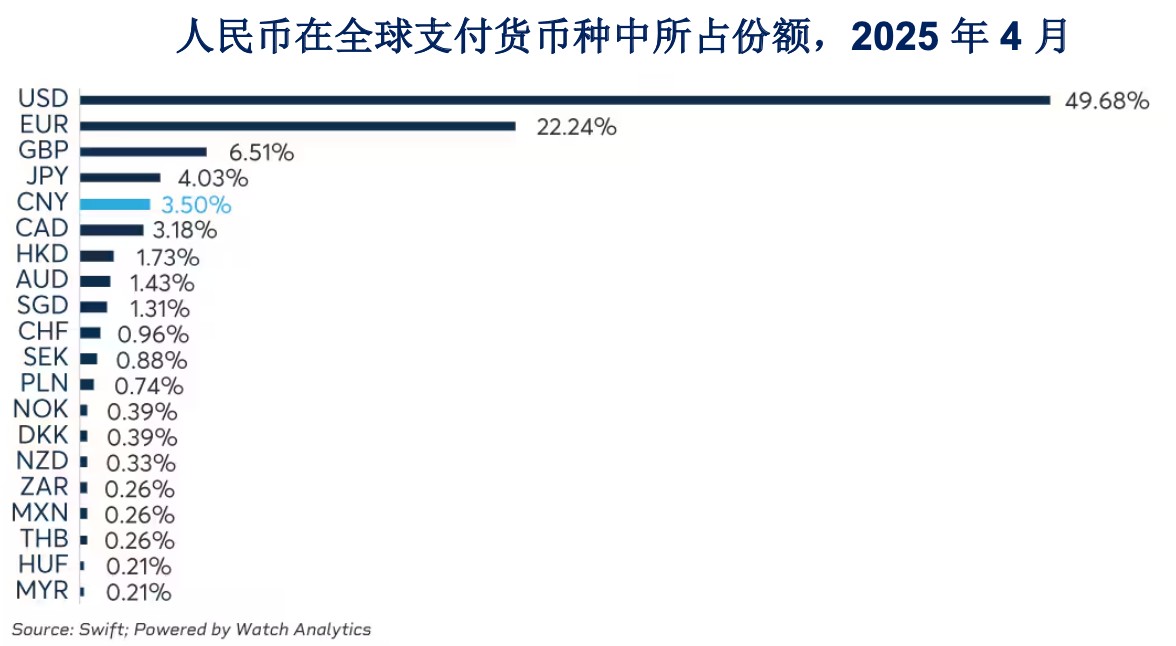
The bank stated that by April 2025, China's share of the global SWIFT payment market will reach 3.5%, up from 2% in 2023. In terms of trade, 6% of global commercial activities will be settled in renminbi in 2024, also an increase from less than 2% in 2023.

Deutsche Bank also noted that this marks a significant change in "currency preference, especially in emerging markets and major global trade corridors."
Katy Kaminski, Chief Research Strategist at AlphaSimplex, also believes that if the current anti-dollar narrative continues, the renminbi may strengthen further.
She pointed out, "Despite recent short positions on the renminbi, the Chinese government may introduce new stimulus policies that could boost its economy and currency."
However, she also stated that even so, the renminbi would need at least 10 years to have any impact on the dollar's reserve status.
On the other side of the world, the Mexican peso is facing challenges that could stall its significant rise this year. Due to Trump's announcement on July 31 to extend the tariff exemption deadline for Mexico by 90 days, uncertainty remains. Officials from Trump's team have also indicated that they hope to renegotiate the terms of the agreement when the United States-Mexico-Canada Agreement (USMCA) is reviewed next July Jeff Young, head of investment strategy for quantitative solutions at PGIM, is relatively bullish on the dollar.
"Despite facing risks such as tariffs, unprecedented political events last year, and significant interest rate cuts by the Federal Reserve, the U.S. economy continues to grow robustly," he said. "This indicates that the U.S. has some very deep sources of resilience, even enough to offset the impact of factors like tariffs."
He went on to say, "The fundamental growth trends in relevant sectors in the U.S. remain slightly stronger than in the Eurozone. For example, the development of artificial intelligence in the U.S. far outpaces that in Europe. Everyone wants to get a piece of the action in artificial intelligence, and that is the current situation here in the U.S. So the U.S. still has tremendous vitality, firmly attracting investments from all sides."
Kim Forrest of Bokeh Capital is less concerned that American exceptionalism is waning.
"Our economic structure remains outstanding," she said, adding that the U.S. benchmark interest rates are still higher than in many countries. "We are still the easiest country in the world to start a business, and we have well-defined case law, allowing everyone to have clear expectations of the outcomes in U.S. courts."
According to Forrest, the liquidity of the U.S. futures and options markets is the highest in the world, enabling investors to quickly and efficiently offset losses from dollar depreciation.
"If you make a five-year investment in Europe, you can completely control any type of cross-currency risk by buying futures and options," Forrest said. "This brings a significant convenience advantage to dollarization."