


中美重大表態!美財長:若中國推遲稀土出口管制 美國或延長關税休戰期

U.S. Treasury Secretary Janet Yellen stated that if China delays its export controls on rare earths, the U.S. may extend the tariff truce on Chinese goods. Since the beginning of this year, the U.S. and China have reached a 90-day ceasefire agreement in the trade war, with the next deadline approaching in November. Yellen mentioned at a press conference in Washington that both sides will negotiate in the coming weeks. Recently, tensions in U.S.-China relations have escalated, with both sides accumulating negotiating leverage for the upcoming Asia-Pacific Economic Cooperation summit
FX168 Financial News Agency (Asia-Pacific) reported on Thursday (October 16) that U.S. Treasury Secretary Scott Bessent hinted that if China stops implementing strict new rare earth export control plans, the U.S. may extend the deadline for imposing import tariffs on Chinese goods for more than three months.
(Source: Bloomberg)
Since the beginning of this year, the U.S. and China have agreed to a series of 90-day ceasefire agreements in the trade war, with the next deadline approaching in November.
Bessent told reporters at a press conference in Washington on Wednesday: "Is it possible that we could extend the (tariff truce) deadline in exchange? It's possible. But all of this will be negotiated in the coming weeks."
Bloomberg pointed out that the current focus of the Trump administration is to prevent China from implementing stricter rare earth control measures. To this end, the U.S. is offering incentives to persuade Beijing to abandon the plan while threatening severe penalties if it does not.
After several months of temporary stability in U.S.-China relations, Washington has recently expanded some technology restrictions and proposed tariffs on Chinese ships entering U.S. ports, leading to heightened tensions. China has also taken similar measures and plans to implement stricter export controls on rare earths and other critical materials.
Economists believe that the latest moves by both sides are aimed at accumulating negotiating chips ahead of a possible leaders' meeting during the APEC summit in South Korea later this month. Meanwhile, unless an extension is granted, the tariff war ceasefire agreement will expire on November 10. Previously, U.S. tariffs on China had soared to 145%.
When asked by reporters whether the two largest economies in the world would fall into a prolonged trade war if they could not reach a trade agreement, U.S. President Donald Trump replied, "Well, we are already in a trade war."
Trump stated on Wednesday: "Our tariffs are 100%. Without tariffs, we would look like nothing."
After Bessent's remarks, U.S. stock markets continued to rise, while Trump's comments were made after the close of the New York stock market on Wednesday.
U.S. Trade Representative Jamieson Greer expressed skepticism about whether Beijing would continue to implement its rare earth export control plan, stating that the plan would hinder trade in consumer goods containing even trace amounts of rare earth elements.
Greer said, "The scope and scale are simply unimaginable and unmanageable."
Meanwhile, Bessent predicted that the U.S. and several of its allies would respond in a coordinated manner to China's actions.
Earlier on Wednesday, at a forum hosted by CNBC in Washington, Bessent stated: "We will take a strong collective response to this because China's bureaucracy is incapable of managing supply chains or manufacturing processes in the rest of the world."Coordinated Response
Bessent pointed out that "all of my peers" are attending the annual meetings of the International Monetary Fund and the World Bank in Washington this week, and stated, "We will engage in dialogue with our European allies, Australia, Canada, India, and Asian democracies."
China announced new regulations last week requiring overseas companies to obtain approval from the Chinese government before exporting products containing trace amounts of certain rare earth elements originating from China.
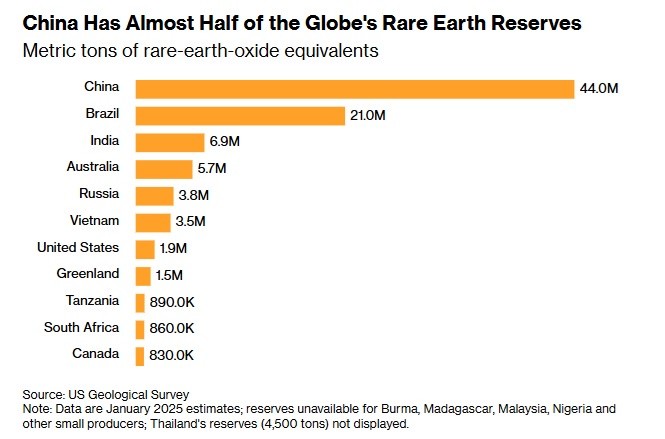
(Source: Bloomberg)
Trump's response was to threaten a 100% tariff on Chinese goods before November 1. He suggested canceling the meeting with Chinese President Xi Jinping and warned that the U.S. might cut off edible oil trade. Edible oil is a key raw material for biofuels.
However, Bessent said at a press conference that, to his knowledge, Trump is "willing" to meet with Xi later this month in South Korea.
Bessent also indicated that he is "very likely" to go to Asia ahead of Trump and meet with Chinese Vice Premier He Lifeng
