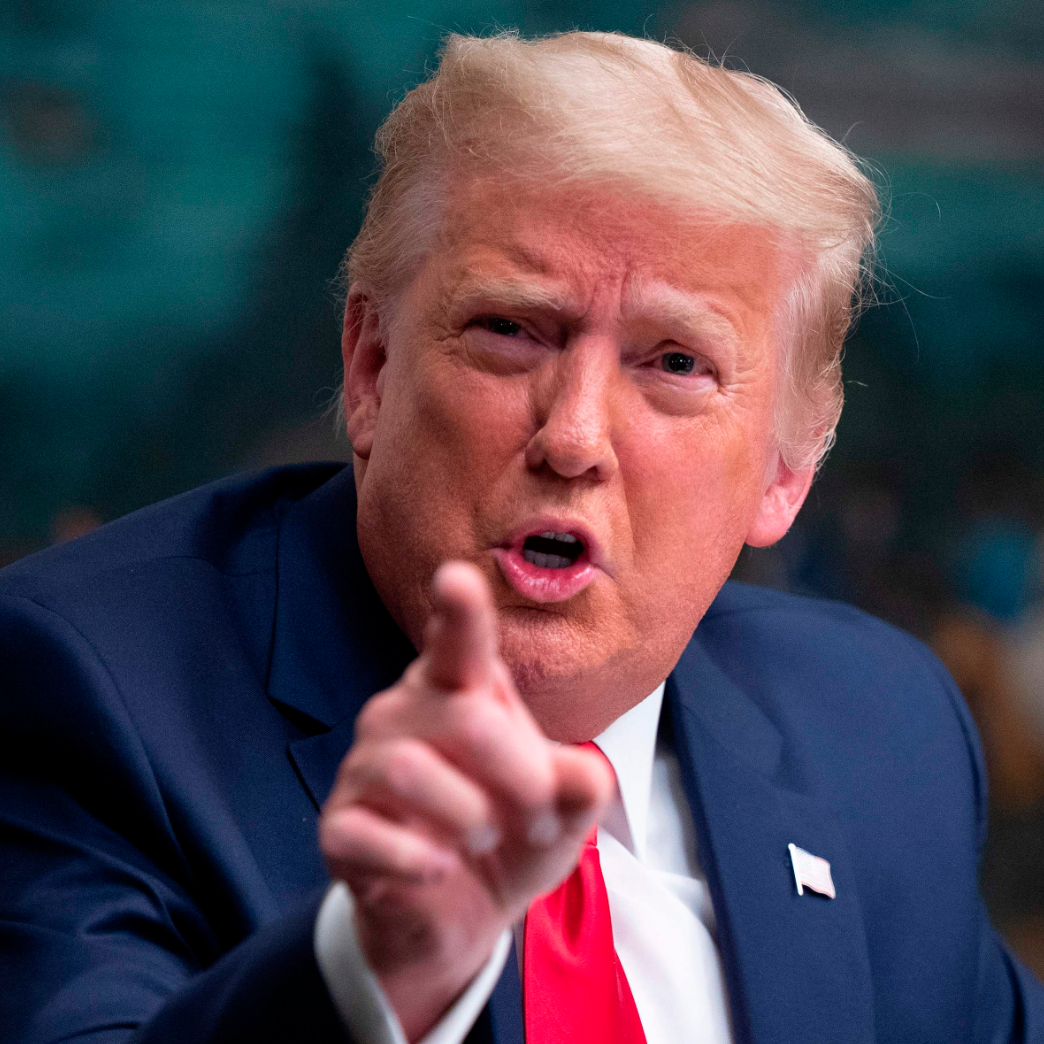
Donald Trump-related activity tracking.
2026
Jul29
The Trump administration is pushing the FAA to exempt commercial space launches from 13 environmental laws, including the National Environmental Policy Act (NEPA), to accelerate approvals for companies like SpaceX and Blue Origin . This deregulatory move aims to reduce compliance costs and maintain U.S. leadership in the global space race .
Jul28
President Trump visited GM's Milford Proving Ground in Michigan on July 27, 2026, promoting tariffs as a tool for economic growth and highlighting $20 billion in manufacturing investments . This visit coincided with GM reporting a significant Q2 earnings beat (EPS $3.57) and raising its FY26 profit guidance to the $14B-$16B range, driven by strong demand for high-margin trucks and SUVs . Consequently, GM's stock surged 9.46% over the past week, reaching a high of $87.08 .
US President Trump announced a phased tariff plan on imported generic drugs, offering a two-year zero-tariff grace period followed by a 100% tariff in August 2028 and 200% in 2029 for manufacturers that fail to relocate production to the U.S. . Indian pharmaceutical stocks, including Aurobindo and Lupin, fell sharply as the industry, which operates on thin 4-6% margins, faces potential exclusion from its largest market . The policy also aims to reduce reliance on Chinese APIs, which currently supply 70% of India's needs .
Jul27
The Trump administration is finalizing a voluntary AI regulatory framework requiring companies like OpenAI, Anthropic, and Google to submit advanced models for government review—potentially lasting 30 days—before public release . The focus is on high-compute models capable of cyber-exploitation, with a deadline of August 1st for the framework's completion .
President Trump announced that Transportation Secretary Sean Duffy has requested the production of small and micro cars within the United States . This move aligns with broader administration efforts to tighten local content rules under USMCA renegotiations and implement new tariffs to protect domestic industry .
President Trump has publicly pressured the Federal Reserve to lower interest rates to the 'lowest in the world' ahead of the July 29 FOMC meeting [citation:1, 3]. While praising Chair Kevin Warsh as 'outstanding,' Trump criticized other board members for being 'politically motivated' in their resistance to cuts [citation:2, 13, 16].
President Trump and VP Vance claim the U.S. holds significant leverage over Iran, citing a degraded Iranian military and ongoing 'good talks' . Despite threats of 'major military punishment' following Houthi attacks , the administration suggests the U.S. is in a 'stronger strategic position' regardless of whether negotiations succeed or fail . Meanwhile, Brent crude has surged past $100/barrel amid Hormuz Strait tensions .
President Trump is visiting GM's Milford Proving Ground in Michigan to highlight $20 billion in manufacturing investments and job creation ahead of the August 4 primary . This visit coincides with GM's strategic shift to slow its EV transition, focusing instead on expanding internal combustion engine (ICE) capacity and onshoring production to mitigate tariff risks .
Trump’s second term is facing significant economic headwinds as key metrics like employment, manufacturing jobs, and disposable income stall [citation:1, 12]. Inflation remains above the Fed's target due to new tariffs on 60 countries and volatile oil prices [citation:8, 11, 22]. Financial conditions are tightening, with 10-year Treasury yields hitting a term-high of 4.7% and mortgage rates reaching 6.58% [citation:3, 13]. Meanwhile, the BofA Bull & Bear indicator has surged to 9.6, a level historically associated with market corrections [citation:9, 19].
Jul24
President Trump is meeting with nuclear energy CEOs on Friday to celebrate milestones in advanced reactor development . This follows several micro-reactors achieving 'criticality'—a key technical stage—by a July 4th deadline set by the administration . Companies like Oklo and X-Energy are increasingly integrated into federal programs alongside Nvidia and Microsoft to power AI data centers .
Wheat prices have surged approximately 19% this month, nearing a three-year high due to a 'perfect storm' of geopolitical escalation in the Black Sea and extreme weather across major producers like the EU and US . Attacks on key ports and severe heatwaves in France and Germany have significantly tightened global supply expectations .
Jul23
President Trump has implemented new tariffs of 10% to 12.5% on approximately 99% of U.S. imports, covering 60 to 80 trading partners . These measures, based on Section 301 of the Trade Act of 1974, replace expiring temporary levies and specifically target nations with perceived weak anti-forced-labor protections . While oil, gas, and certain USMCA-compliant goods receive exemptions, major economies like the EU, Japan, and South Korea face significant new duties .
Jul22
President Trump announced a phased tariff plan for imported generic drugs: a two-year 0% tariff grace period starting August 2026, followed by a 100% levy in 2028 and 200% in 2029 . The policy aims to force production reshoring to the U.S., exempting only those who build domestic factories or agree to 'most favored nation' pricing .
Jul21
President Trump has proposed a tiered tariff structure for imported generic drugs: a two-year 0% grace period followed by a 100% tariff in August 2028 and a 200% tariff in August 2029 . The policy aims to force pharmaceutical production back to the U.S. by penalizing companies that fail to establish domestic manufacturing facilities . While patented drugs remain unaffected, major exporters like India, which provides nearly half of U.S. generics, face significant disruption .
President Trump has agreed to ethics provisions within the CLARITY Act, which restrict federal officials from profiting from digital assets during their tenure . This move addresses long-standing conflicts of interest regarding Trump’s family crypto projects and clears a critical hurdle for a Senate vote targeted before the August recess . The bill seeks to establish a comprehensive regulatory framework, specifically clarifying the jurisdictions of the SEC and CFTC .
Jul20
President Trump signed proclamations under Section 338 of the 1930 Tariff Act to impose 50% tariffs on a wide range of Canadian imports, including wine, cement, and dairy, effective August 19, 2026 . While energy, potash, and critical minerals are currently exempt, the measures pointedly remove USMCA exemptions for the affected goods, signaling a sharp escalation in bilateral trade friction .
Jul14
Recent reports from the BlueGreen Alliance and E2 indicate that President Trump’s rollback of clean energy policies has led to the cancellation or delay of 216 to 223 manufacturing and industrial projects, totaling nearly $83 billion in lost or stalled investment . This shift has reportedly resulted in the loss of 470,000 jobs and significant hits to projected GDP growth .
New York Governor Kathy Hochul signed a first-in-the-nation executive order pausing permits for new hyperscale data centers (50MW+) for up to one year [citation:1, 5]. The moratorium aims to establish a regulatory framework to address surging utility costs, water usage, and grid strain caused by AI expansion [citation:7, 10].
Jul13
President Trump signed a proclamation granting a two-year EPA emissions exemption to chemical manufacturers critical to semiconductors, medical devices, and national defense, citing national security and the lack of viable compliance technology .