


Major breaking news on Trump! Trump threatens to impose new tariffs on Japan, to announce trade agreements with multiple countries after July 4th

U.S. President Trump threatened to impose new tariffs on Japan due to Japan's refusal to accept U.S. rice. Trump's chief economic advisor stated that the White House plans to announce trade agreements with multiple countries after July 4th. Trump expressed on social media his desire to maintain trade relations with Japan, but at the same time expressed dissatisfaction with Japan's rice shortage. Despite Trump's threats, negotiations between the U.S. and Japan are expected to continue
FX168 Financial News (Asia-Pacific) reported that U.S. President Donald Trump threatened to impose a new round of tariffs on Japan, citing Japan's refusal to accept U.S. rice exports. Trump's chief economic advisor stated that the White House plans to announce trade agreements with multiple countries after July 4.
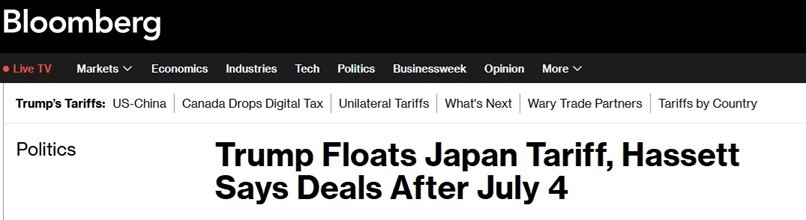
(Source: Bloomberg)
On Monday (June 30), Trump took the latest round of marginal policies against Japan, with just over a week remaining before the July 9 deadline to impose tariffs on dozens of trading partners, including Japan.
Trump stated on social media on Monday, "They do not accept our rice, and they are facing a severe rice shortage themselves. In other words, we will just send them a letter. We hope to continue our trade partnership with them for many years to come."
For weeks, Trump has been trying to exert influence on negotiating partners before the deadline, vowing to terminate brief negotiations with partners he finds difficult to deal with and instead send them letters setting tariff rates.
In April, Trump suspended tariffs on various countries to allow time for negotiations. Since then, Trump and his team have repeatedly promised that a series of agreements could be reached in a few weeks. However, so far, the only two agreements announced are broad framework agreements reached with China and the United Kingdom.
Meanwhile, Kevin Hassett, director of the White House Council of Economic Advisers, hinted on Monday that the government would announce trade agreements with multiple countries after Independence Day.
Hassett pointed out that the government's current focus is to push for the passage of a large tax and spending bill in Congress before the holiday.
Hassett said, "Everyone might take a moment to watch some fireworks on the Fourth of July, and then we will come back to deal with these matters. We are ready to report to the president on the frameworks we have currently negotiated to see if he agrees."
Hassett revealed that despite Trump's latest threats, negotiations between the U.S. and Japan are expected to continue.
He told reporters, "Things are not over yet. I know he just posted, but negotiations will continue until the end."
Trump's threats to interrupt negotiations with other countries sometimes lead trading partners to make concessions on policies that anger him, thereby restarting negotiationsLast Friday, Trump stated that he would terminate all trade negotiations with Canada in retaliation for its imposition of a digital services tax. However, after Ottawa revoked the tax, Hassett told reporters on Monday, "We have made significant progress in our negotiations with Canada."
Japan is one of the most important trading partners of the United States and was originally one of the targets for agreements planned by the Trump administration.
U.S. Secretary of Commerce Howard Lutnick stated last week that the White House is preparing to finalize agreements with about 10 major trading partners, while other countries will receive formal notifications of the set tariff rates.
U.S. and Japanese officials have engaged in trade negotiations for several months, but have yet to resolve the thorny issues surrounding tariff levels and trade barriers.
Japan has been urging Trump to eliminate the 25% tariff on automobiles, claiming that these tariffs are severely impacting a key industry. However, Trump has rejected this request, stating that the number of American cars imported from Japan is not significant. All products exported from Japan to the U.S. face a separate tariff of 24%, which has been reduced to 10% during the negotiations
