


Japan and South Korea face the brunt of tariffs, will the wave of currency depreciation in Asia rise again? Trump's strategy may change the outlook

U.S. President Trump announced a new 25% tariff on Japan and South Korea starting August 1, which is expected to put depreciation pressure on Asian currencies. Forex strategists pointed out that currencies such as the yen and won may face depreciation in the short term, despite recent appreciation of Asian currencies. Trump's tariff policy has raised market concerns about Asian stocks and currencies, with analysts predicting that the Japanese currency will be particularly affected
TradingKey - Before the end of the equal tariff suspension period on July 9, U.S. President Trump announced new tariffs of 25% on Japan and South Korea, and foreign exchange strategists expect that Asian currencies such as the yen, won, and baht will face depreciation pressure in the short term. However, Trump's extension of the negotiation deadline again demonstrates his strategy of leaving room for negotiation, making the medium-term outlook for Asian currency exchange rates uncertain.
On Monday, July 7, Trump announced on the social platform Truth Social his tariff letter to the leaders of 14 countries, stating that starting from August 1, Japan and South Korea will face a tariff rate of 25%, while the other 12 countries will face tariffs ranging from 25% to 40%.
Trump warned that if these trading partner countries seek retaliation by raising tariffs, the U.S. government will respond with equivalent rates.
Wells Fargo strategists stated that the foreign exchange market may be more sensitive to this, and Asian exporters are particularly vulnerable. Among the G10 currencies, the long positions in the yen are the most tense, and the shift in long positions for the won is also quite significant.
As a result of the new tariff policy, the yen weakened, with the USD/JPY rising nearly 0.30%, but the increase later narrowed to 0.10%, reporting at 146.19. At the same time, Asian currencies such as the renminbi and won did not show the expected depreciation, with USD/KRW currently down 0.48% and USD/CNH down 0.09%.
Since April this year, especially after early May, Asian currencies have experienced strong appreciation, which analysts attribute to the end of the U.S. exceptionalism narrative and the so-called Mar-a-Lago agreement. Since 2025, the exchange rate of the dollar against major Asian currencies has fallen, with the yen experiencing the largest depreciation, reaching 7.16%.
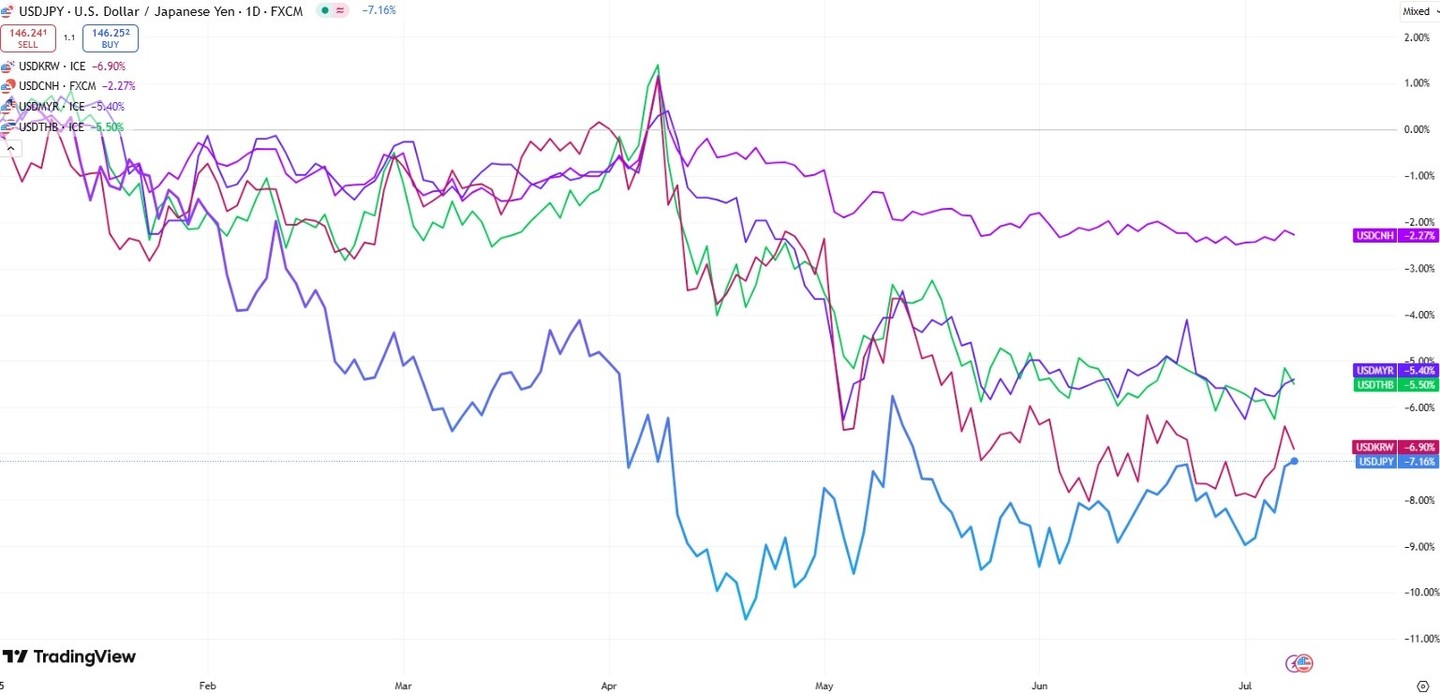
【Exchange rates of the dollar against major Asian currencies since 2025, source: TradingView】
Before the deadline of the equal tariff suspension period on July 9, Trump's new tariff policy targeting several Asian countries has to some extent triggered expectations of a depreciation wave for Asian currencies.
Rayliant Global Advisors analysts predict that the Asian stock markets affected by the latest round of trade threats may decline, and their currencies will weaken, especially the yen.
Australia and New Zealand Banking Group believes that imposing a 25% tariff on Japan may pose challenges for the yen. At the same time, due to global policy uncertainty, the Bank of Japan may take a more cautious approach to further interest rate hikes The latest CFTC data shows that short positions in USD/JPY remain high, and if more negative tariff news targeting Japan emerges, this currency pair may experience a short squeeze.
However, a trader from Sumitomo Mitsui Trust Bank stated that it was originally expected that if Japan were to be subjected to tariffs, people would buy yen to hedge against risk, so the decline in the yen was unexpected. With Trump hinting at room for negotiation, it is anticipated that the yen will not continue to weaken indefinitely, but there is indeed a risk of accelerated yen buying to cover short positions.
It is worth noting that the new 25% tariff imposed on Japan is not significantly different from the 24% tariff announced in early April, while the rate for South Korea remains unchanged. Analysts point out that the tariff levels that have not significantly worsened may help stabilize Asian currencies.
Additionally, the deadline of August 1 has effectively extended the original deadline of July 9. Morgan Stanley analysts stated that the tariff agreement is now back on the negotiation table
