How many dissenting votes will there be at the July FOMC meeting?

The question of whether to cut interest rates at the July FOMC meeting is no longer the only focus of the market; instead, "who supports and who opposes" has become the biggest highlight. Standard Chartered believes that Federal Reserve Governors Bowman and Waller are expected to oppose keeping interest rates unchanged and instead support a 25 basis point cut, which would mark the first time since 1993 that two governors cast dissenting votes at the same meeting. The market may view this as a prelude to a policy shift: even if there is no rate cut in July, actions in September or December are more likely. The market reacted positively: U.S. stocks rose, and the front end of the U.S. Treasury yield curve steepened
This month's Federal Reserve meeting is no longer solely focused on whether to cut interest rates; instead, "who supports and who opposes" has become the main highlight.
According to the Chase Trading Desk, a recent report from Standard Chartered indicates that the Federal Reserve's meeting on July 30 may see a rare occurrence of two governors voting against, suggesting that the rate-cutting process is about to begin: Federal Reserve governors Bowman and Waller are expected to oppose maintaining the current interest rate and instead support a 25 basis point cut, marking the first time since 1993 that two governors have voted against in the same meeting.
This unusual divergence may signal a significant shift in the Federal Reserve's policy stance, and the market may interpret these two opposing votes as a precursor to a more dovish position from the FOMC, leading to a more positive reaction.
Two Governors Clearly Express Support for Rate Cuts
Both governors have expressed their inclination to support a rate cut in July.
According to a previous article from Wall Street Insight, Waller has clearly stated that a rate cut could happen as early as July, believing that the FOMC should view tariff-driven price increases as a one-time factor. Waller does not believe that the labor market is strong enough to sustain second-round wage and price increases.
Similarly, Bowman stated, "If inflationary pressures remain controlled, I would support lowering the policy rate as early as the next meeting." Both governors see risks of a weakening labor market.
This means that the likelihood of two opposing votes at the July FOMC meeting is very high, opposing the decision to remain on hold. This would also be the first time since 1993 that two governors have voted against in the same meeting. In a Federal Reserve system that emphasizes consensus, such divergence itself is an important signal.
Rare Split in FOMC Voting
Internally, this may be interpreted as a sign of Powell's "ability to build consensus" weakening.
In recent decades, the consistency of FOMC voting has been the norm rather than the exception. Powell seems more inclined to delay policy actions, allowing the data to speak more clearly if that is what is needed to achieve consensus. Standard Chartered believes this may slow the Federal Reserve's response to changing conditions, even if it means reducing regrets over premature actions.
Consistency helps the FOMC project a unified voice, but it may also mean that policy ambiguity and divergences have not been adequately discussed. Forward guidance may still be part of the Federal Reserve's toolbox under any framework, but if not all FOMC members support this guidance, its effectiveness may diminish.
The report also notes that the two opposing votes may not only be interpreted as implicit criticism of Powell and the Federal Reserve but also as a response to political pressure from the Trump administration. Since the 50 basis point cut last September, the Federal Reserve has struggled to dispel concerns that political considerations may influence monetary policy. If it becomes increasingly perceived that Republican or Democratic FOMC members are voting collectively, such concerns may intensify.
Market May React Positively
Externally, the market may view this as a prelude to a policy shift: Even if there is no interest rate cut in July, actions in September or December are more likely.
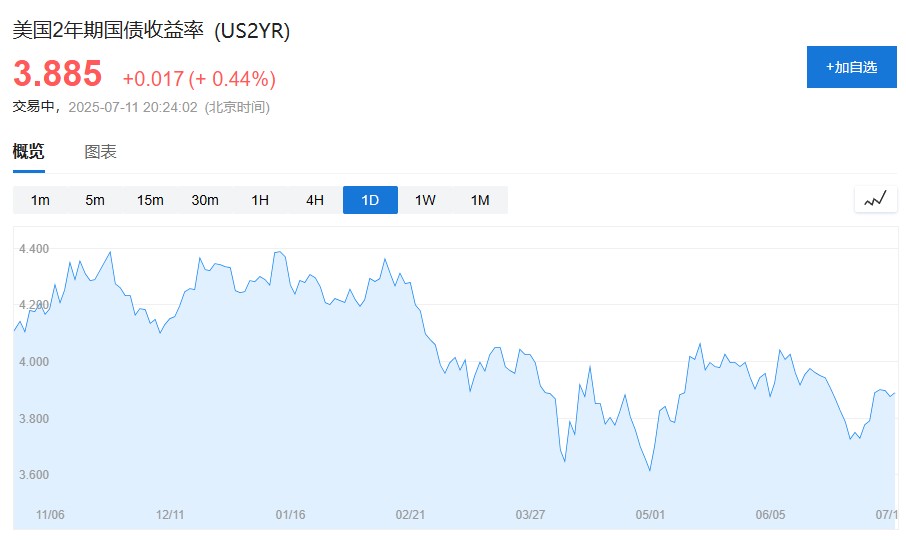
Standard Chartered believes that the market may respond positively to the appearance of dissenting votes, expecting more interest rate cuts in 2025 and 2026, leading to a steepening of the front end of the U.S. Treasury yield curve. According to data from May to date, there is a positive correlation between the U.S. dollar and short-term interest rates, and a decline in short-term rates may pose resistance to the dollar. The U.S. stock market has historically reacted positively to data that increases the likelihood of rate cuts, which may benefit from this.

Labor Market Data Supports Rate Cut Argument
The latest non-farm payroll data for June may not be sufficient to support the Federal Reserve's hawkish stance. Private sector hiring performance fell short of expectations, and although the unemployment rate has decreased, the labor force participation rate remains at a cyclical low. These data, combined with low inflation, provide reasonable but not overwhelming justification for a rate cut in July.
The main risk of dissenting votes is that this may be seen as Powell's failure to maintain the FOMC's unity on policy direction—especially considering the recent criticism of Powell and the Federal Reserve's decision to maintain current interest rates. This may also increase scrutiny of other FOMC voting members' speeches, particularly if they express a willingness to deviate from Powell's wait-and-see policy stance.
Notably, Powell recently acknowledged in congressional testimony that if it weren't for the risk of sustained inflation triggered by tariffs, the FOMC would have already cut rates. The debate between hawks and doves seems to focus more on the likelihood of sustained inflation rather than the response to persistent inflation overshooting