Trump claims the U.S. will impose a 25% tariff and "punishment" on India, pointing out that India is a major buyer of Russian energy

Wallstreetcn
2025.07.30 16:31
portai
I'm PortAI, I can summarize articles.

Trump stated that India's tariffs are among the highest in the world, and its non-tariff barriers are stricter and more objectionable than those of any other country. The trade deficit between the U.S. and India is enormous, and India has consistently purchased the vast majority of its military equipment from Russia, remaining one of Russia's largest energy buyers. India claims it will take necessary actions to ensure national interests. Trump's chief economic advisor expressed hope that India would open its market to the U.S. The Indian rupee hit a five-month low during trading

U.S. President Donald Trump seems increasingly dissatisfied with the lack of results from the ongoing trade negotiations with India, threatening to impose tariffs and other "punishments" on India starting next month, citing India's trade relations with Russia as a reason.

According to CCTV News, Trump announced via social media on July 30 that starting August 1, a 25% tariff would be imposed on goods imported from India. Trump complained in his post that India's tariff rates are too high and that non-tariff barriers are "heavier and more annoying" than those of any other country, resulting in a small scale of trade between the U.S. and India for many years. He later posted, "We have a huge trade deficit with India."

Trump's post stated that India's tariffs "rank among the highest in the world, and its non-monetary trade barriers are the strictest and most repugnant of all countries." He specifically pointed out that India "has always purchased the vast majority of its military equipment from Russia" and is also "one of Russia's largest energy buyers."

After Trump's new threat, Indian officials stated that the Indian government is still in contact with the U.S. to ensure a mutually beneficial trade agreement. Subsequently, India stated that the government has received Trump's statement and will take necessary actions to safeguard its national interests. They are currently studying the impact of the tariffs announced by Trump on India.

Trump's chief economic advisor and director of the White House National Economic Council, Kevin Hassett, expressed hope that India would open its market to the U.S. Trump is frustrated with the progress made between the U.S. and India. The 25% tariff will address and rectify the situation on India's side. He expects that India may lower prices for the U.S. and reconsider its approach.

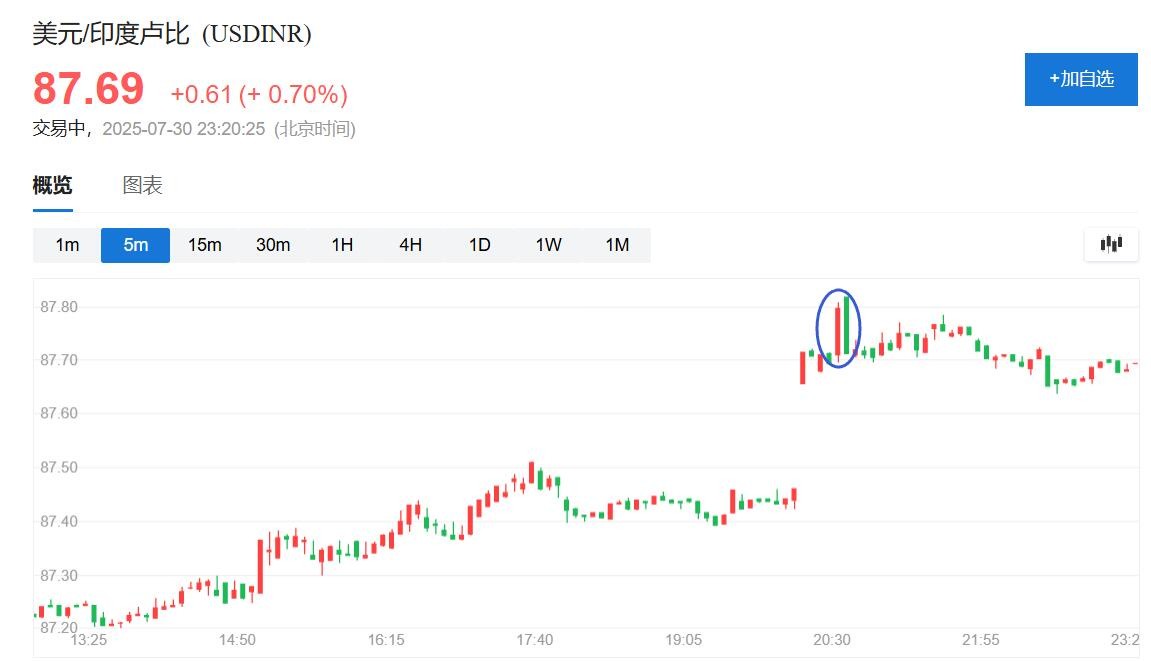
After Trump's announcement of tariffs and other "punishments," the Indian rupee's exchange rate accelerated its decline. In pre-market trading, the dollar against the rupee briefly fell to 87.87 in offshore trading, hitting a five-month low, down about 0.8% for the day. India's Nifty 50 futures erased gains, falling by 0.5%.

Trump's "punishment" decision marks the formal breakdown of months-long trade negotiations between the U.S. and India, with India failing to secure lower tariff treatment of 15%-20% like other trading partners such as Japan and the European Union. This tariff measure may further damage U.S.-India relations and undermine the U.S.'s previous efforts to cultivate India as a counterbalance to other major Asian powers.

Tariff Levels Higher Than Other Trading Partners

The 25% tariff imposed by Trump on India is significantly higher than the treatment received by other major trading partners. Media reports indicate that under the trade agreements announced so far by the Trump administration, the U.S. will impose a 20% tariff on Vietnam, a 19% tariff on Indonesia, and only a 15% tariff on Japan and the European Union, putting India at a clear disadvantage in competition.

Alexandra Hermann, an analyst at the Oxford Economics Institute in London, stated, "India's export prospects and investment attractiveness will be harmed, and the situation will worsen if exemptions for the smartphone and other electronics industries are gradually removed." Madhavi Arora, an economist at Emkay Global Financial Services, believes that although trade negotiations between the two countries seem to have broken down, "trade disputes and bargaining are not necessarily over." These trade negotiations involve not only pure economic aspects but also global geopolitical considerations.

The United States is India's largest trading partner and export market. According to Xinhua News Agency, data from the U.S. Department of Commerce shows that in 2024, the trade volume of goods between the U.S. and India is approximately $128.8 billion, with India's trade surplus with the U.S. at $45.8 billion.

Russian Energy Trade Becomes a Controversial Focus

The main reason for Trump's additional "punishment" against India is its continued purchase of energy and military equipment from Russia. According to Kpler data, more than one-third of India's oil imports this year came from Russia, and about 36% of its weapons were imported from Russia.

This "punishment" measure echoes Trump's earlier threat this month to impose a 100% secondary tariff on countries purchasing Russian oil and gas unless the Kremlin reaches a ceasefire agreement with Ukraine.

Wells Fargo emerging markets economist Brendan McKenna warned that India's dependence on Russian energy means that "turning to new suppliers could negatively impact India's current account and inflation expectations, and dampen sentiment in local markets."

Stalemate in Negotiations Over Agricultural Disputes

U.S.-India trade negotiations have stalled in key areas such as agriculture and dairy products. Media reports suggest that the U.S. has long pushed for greater access to India's agricultural sector, viewing it as a major undeveloped market, but India is firmly protecting this sector on the grounds of food security, livelihoods, and the interests of millions of small farmers.

Media reports on Wednesday cited officials saying that the recent trade agreements reached by the U.S. with Japan and the European Union just before the new reciprocal tariffs took effect on August 1 have emboldened Trump. In recent days, Trump has reviewed the draft U.S.-India agreement, ensuring that commitments for market access for U.S. producers become a focal point, which poses a significant obstacle to the prospects of the U.S.-India agreement. India is willing to compromise to some extent, while Trump seeks to eliminate trade barriers completely, or as close to completely as possible.

Indian Commerce Minister Piyush Goyal told the media last week that the agricultural sector is sensitive for India and will ensure that farmers' interests are "well protected." U.S. Trade Representative Katherine Tai recently acknowledged that the Indian government's trade policy has "long been protectionist," "predicated on strongly protecting its domestic market."

Despite India lowering tariffs on a range of goods, including bourbon whiskey and motorcycles, the U.S. still had a trade deficit of $45.8 billion with India last year, which Trump hopes to reduce. The two countries had previously set a goal of increasing bilateral trade from $190 billion to over $500 billion