


The "centrists" are beginning to waver, and "more and more" senior officials are "unwilling to further relax," the Federal Reserve may have "two options" in December
The Federal Reserve's "dovish" and "centrist" positions have shown signs of loosening, revealing hesitation towards further easing of monetary policy, which has caused the probability of a rate cut in December to drop from around 67% earlier this week to about 49%. According to Wall Street Journal reporter Nick Timiraos, the outcome of the December meeting seems to be leaning towards "two options": either maintaining the current interest rates or, while cutting rates, setting a higher threshold for future easing policies through guidance
The Federal Reserve's decision on whether to implement its third interest rate cut of the year in December is becoming uncertain. Due to concerns about inflation and some officials believing that the labor market remains robust, an increasing number of decision-makers are showing hesitation towards further easing of monetary policy, including some who were previously strong supporters.
The latest development is that Boston Fed President Susan Collins and San Francisco Fed President Mary Daly—both of whom voted in favor of rate cuts this year—have issued the clearest cautious signals to date. Collins stated that the "threshold for further easing is relatively high" in the near term, while Daly indicated that it is too early to draw conclusions about the December decision, maintaining an "open mindset."
The upcoming release of a large amount of data (which may bring more rather than less uncertainty), combined with recent intense hawkish statements, has pushed market bets on a rate cut in December back below 50%. In addition to Susan Collins' remarks, Cleveland Fed President Beth Hammack has joined St. Louis Fed President Alberto Musalem, Chicago Fed President Austan Goolsbee, and Kansas City Fed President Jeffrey Schmid in expressing a cautious attitude towards further easing of policy.
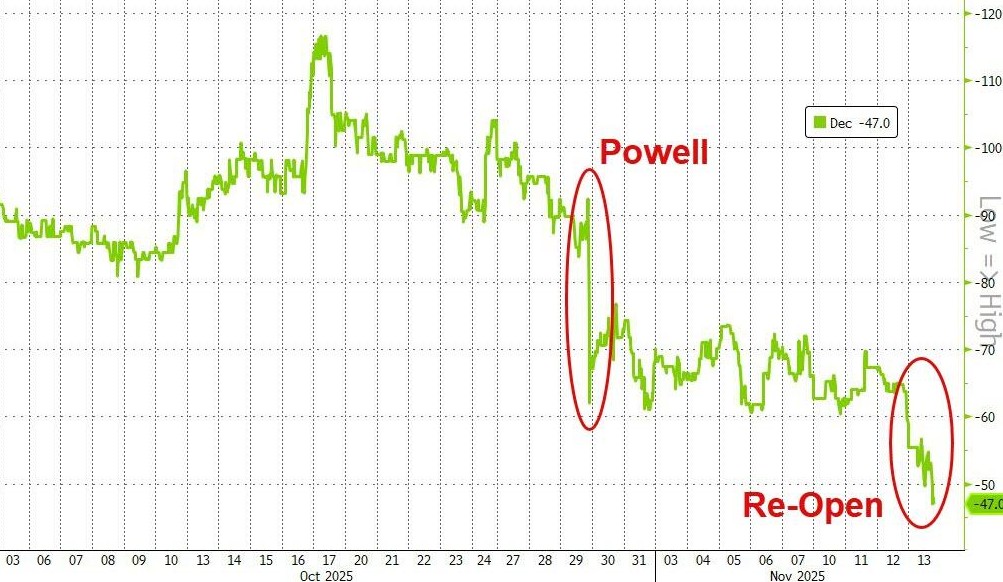
According to Wall Street Journal reporter Nick Timiraos, the outcome of the December meeting seems to be leaning towards "two options": either keep interest rates unchanged or set a higher threshold for future easing through policy guidance while implementing a rate cut.
Shifts in "Dovish" and "Centrist" Positions
The changes in the positions of some key figures within the Federal Reserve are the main catalyst for the market's reassessment of the likelihood of a rate cut in December.
Boston Fed President Susan Collins' remarks are particularly noteworthy. She told bankers on Wednesday that she would "hesitate to further ease policy unless there is evidence of significant deterioration in the labor market." According to Reuters, Collins' "unusually candid" comments indicate that this supporter of two rate cuts this year has clearly shifted towards a cautious stance.
Also noteworthy is San Francisco Fed President Mary Daly. She had previously been a strong supporter of rate cuts, but stated at an event in Dublin on Thursday that she is "open-minded but has not made a final decision."
According to earlier interpretations by Wall Street Journal reporter Nick Timiraos, the positions of centrist officials like Chicago Fed President Austan Goolsbee are also changing. Goolsbee stated in an interview that "the last thing we saw" before the government shutdown led to data interruptions was that inflation was moving in the wrong direction, which heightened his concerns about price pressures
Hawkish Stance Strengthened, Powell Balances Dilemma
While centrists waver, the stance of hawkish officials has become more resolute. Minneapolis Federal Reserve President Neel Kashkari stated on Thursday that he opposed last month's rate cut due to the resilience of the economy and is taking a wait-and-see approach regarding the December decision. St. Louis Federal Reserve President Alberto Musalem also reiterated that he believes monetary policy needs to "withstand" inflation.
According to Wall Street Journal reporter Nick Timiraos, the October policy meeting was "contentious," with hawks strongly challenging the idea of a third rate cut. Powell stated at the post-meeting press conference that a rate cut is "far from a done deal," a key reason being to "manage a committee that seems to have irreconcilable differences."
This divergence partly stems from the data vacuum caused by the government shutdown, which allows officials to cite private surveys or anecdotes that support their existing views. Hawks seized the opportunity to advocate for pausing rate cuts, pointing out stable consumer spending and concerns that businesses are preparing to pass on price increases related to tariffs.
Debating Three Core Issues
According to Wall Street Journal reporter Nick Timiraos, the divisions among Federal Reserve officials are rooted in differing judgments on three key issues that will determine the future policy path.
First, are tariff-driven price increases transitory or will they persist? Hawks worry that businesses will pass on more costs next year, sustaining price pressures. Doves, on the other hand, believe that businesses' reluctance to pass on tariff costs so far indicates that demand is too weak to support sustained inflation.
Second, is the slowdown in monthly wage growth due to weakened demand for workers from businesses, or is it a result of reduced supply due to immigration? If it is the former, maintaining high interest rates could pose a recession risk; if it is the latter, a rate cut could overly stimulate demand.
Third, are current interest rates still restrictive? Hawks argue that after a 50 basis point cut this year, rates are close to a "neutral level" that neither stimulates nor suppresses growth, and further cuts pose risks. Doves contend that rates remain restrictive, giving the Federal Reserve room to support the labor market without reigniting inflation.
Two Possibilities for the December Meeting
Looking ahead to the December meeting, the outcome seems to lean towards "two options": either maintain rates or cut them again by 25 basis points. According to Wall Street Journal reporter Nick Timiraos, another possibility is that the Federal Reserve could cut rates in December while setting a higher threshold for future easing through policy guidance.
Regardless of the final decision, Powell may face more dissenting votes than in the October meeting (where there were two dissenters). Evercore ISI Vice Chairman Krishna Guha wrote in a report on Thursday that Collins' clear opposition to a December rate cut "intensified our concerns about Powell's ability to manage internal divisions within the FOMC."
Guha analyzed that if the Federal Reserve decides to cut rates, Kansas City Federal Reserve President Jeffrey Schmid may receive support from Collins and Musalem, among others; If the Federal Reserve decides to hold steady, then Stephen Miran, who previously advocated for a larger rate cut, may cast a dissenting vote alongside fellow board members Christopher Waller and Michelle Bowman, who also support accommodative policies.
This further highlights the deep rifts within the committee, making the decision in December highly uncertain
