


"Powell's allies" have continuously voiced support for interest rate cuts, and market expectations for a Federal Reserve rate cut in December have surged to 80%
San Francisco Federal Reserve President Mary Daly, Federal Reserve Governor Christopher Waller, and other Federal Reserve officials have been vocal in supporting a rate cut in December, believing that the risks in the labor market have surpassed the threats of inflation. The market reacted swiftly, with bets on a rate cut soaring from 40% to 80%, and the yield on the 10-year U.S. Treasury bond hitting a new low for the month
Several core allies of Federal Reserve Chairman Jerome Powell have recently spoken out in support of another rate cut in December, believing that the risks facing the labor market have surpassed those of inflation. This series of statements has rapidly heightened market expectations for Federal Reserve easing.
The latest comments come from San Francisco Fed President Mary Daly and Federal Reserve Governor Christopher Waller. Wall Street Insight previously mentioned that Daly warned on Monday of the risk of "non-linear" deterioration in the labor market, while Waller also publicly supported a rate cut in December. Their views resonate with the dovish stance of New York Fed President John Williams last week, who emphasized the need to avoid "unnecessary risks" to the job market.
In response, the market quickly reacted. Traders in the interest rate swap market now expect the likelihood of a 25 basis point rate cut by the Federal Reserve at the December meeting to have surged from about 40% a week ago to 80%. U.S. Treasury bonds have risen for the third consecutive trading day, with the two-year Treasury yield, which is more sensitive to policy changes, significantly declining over the past two trading days, while the ten-year Treasury yield has dropped to its lowest point this month.
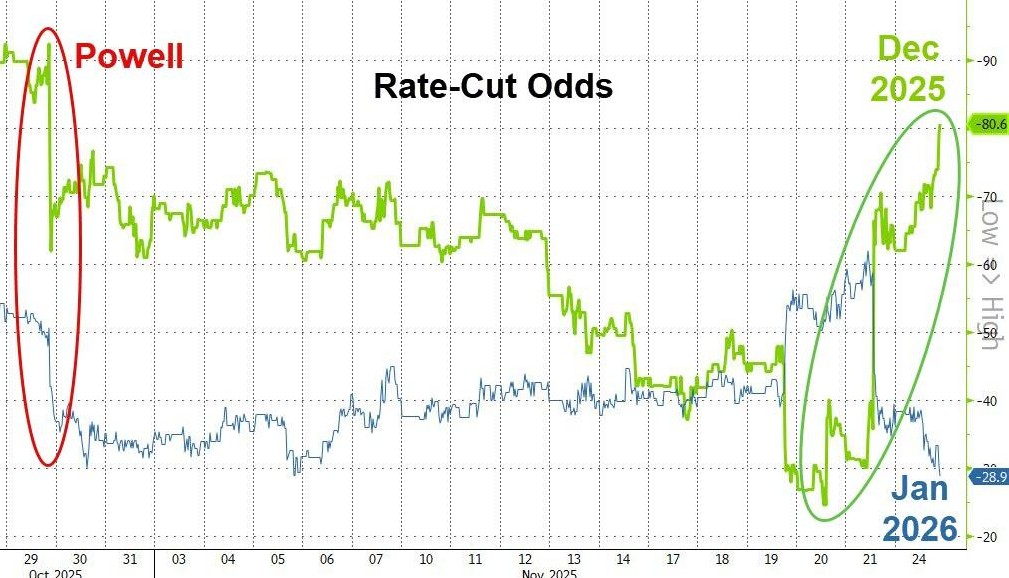
The complexity of this decision-making outlook lies in the fact that due to data release delays caused by the government shutdown, the Federal Reserve will not have access to key employment reports for October and November when it meets on December 10. This forces officials to make judgments in the absence of complete information, increasing the uncertainty of their decisions.
Powell's Allies Speak Out Intensively, Labor Market Risks Become the Focus
Some of the most influential officials within the Federal Reserve have shifted the focus of policy debate to the labor market.
San Francisco Fed President Mary Daly explicitly stated in a media interview that she supports a rate cut because managing a sudden deterioration in the labor market is more challenging than dealing with a rebound in inflation. She warned that the labor market has become "very fragile" and faces the risk of "non-linear changes." Notably, according to Nick Timiraos of the "New Federal Reserve News Agency," Daly's public views rarely deviate from Powell's stance.
Daly's views echo those of New York Fed President John Williams from last week. As the "third in command" at the Federal Reserve, Williams stated last Friday that as the labor market cools, the downside risks to employment have increased, while the upside risks to inflation have eased, indicating that the Federal Reserve still has room for further rate cuts "in the near term."
Similarly, Federal Reserve Governor Christopher Waller also expressed support for a rate cut in December on Monday and for adopting a more flexible policy starting in 2026.
These officials believe that although the inflation rate still hovers around 3%, above the 2% target, the cost pressures from tariffs have been milder than expected. Williams pointed out that there is no evidence that tariffs have triggered secondary effects or other price spillovers Therefore, preventing the risk of a sharp weakening in the labor market has become a priority.
Internal Divisions in the Committee Highlighted, December Decision Becomes a "Test of Judgment"
Despite the increasing dovish voices, significant divisions within the Federal Reserve Committee remain. Boston Fed President Susan Collins expressed a more cautious view. She believes that the current "moderately tight" policy stance is still appropriate, as resilient demand may continue to exert upward pressure on inflation. She stated that she would remain cautious at the next meeting.
Regarding the differing opinions within the committee, Daly believes this reflects the uncertainty of the real world rather than "groupthink." She described next month's decision as a "test of judgment," weighing the "risks of inaction" against the "risks of action." She indicated that she believes the risk of action (rate cuts) is lower, while the risk of inaction is higher.
When asked whether premature rate cuts would limit future policy space, Daly directly responded that the Fed should not be constrained by this. She emphasized that the Fed should retain the option to act, whether further rate cuts or hikes are needed in the future. In this context, Chairman Powell will play a key role in reconciling internal divisions at the meeting on December 9-10.
Market Reacts Quickly, Rate Cut Bets Heat Up
Driven by the dovish remarks from Fed officials, financial markets quickly repriced the policy path. According to Bloomberg, the overnight index swap (OIS) rates related to the December meeting have fallen sharply, with the market now pricing in an 80% probability of a 25 basis point rate cut.
The U.S. Treasury market reacted positively. The benchmark 10-year Treasury yield fell by 3 basis points to 4.03%, reaching a new low for the month. Andrew Brenner, Vice President of Natalliance Securities, wrote in a report that despite the absence of key employment data, "investors found comfort in the fact that senior members of the Fed still hope for a policy easing in December."
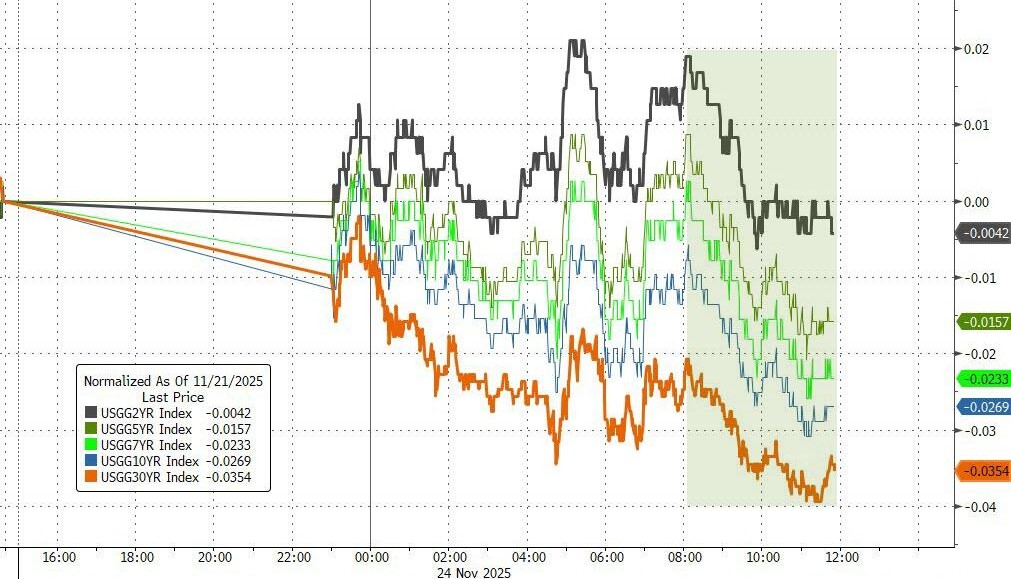
In addition to rate cut expectations, some technical factors also supported the bond market. According to Bloomberg, the market anticipates that the monthly index rebalancing this Friday will drive large funds to buy long-term bonds. Additionally, the demand for the $69 billion two-year Treasury auction held on Monday was strong, with a bid-to-cover ratio at its highest in three months.
John Canavan, Chief Analyst at Oxford Economics, pointed out that "the improvement in the tone of the front-end yield curve in the past few trading days" helped facilitate the smooth conduct of the auction. This week, there will also be $70 billion in five-year and $44 billion in seven-year Treasury auctions
