TradingKey 2025 Markets Recap & Outlook | Global Central Banks 2025 Recap and 2026 Outlook: Navigating Post-Easing Recovery and Diverging Paths

TradingKey
2025.12.25 07:00
portai
I'm PortAI, I can summarize articles.

In 2025, major central banks maintained an accommodative stance but slowed policy adjustments. The Federal Reserve initiated a mild rate-cutting cycle, lowering rates three times. For 2026, markets expect further easing, with major banks forecasting rate cuts. Internal divisions within the Fed highlight differing views on the timing and extent of cuts. The European Central Bank paused easing, maintaining rates at 2.15%.

TradingKey - In 2025, major central banks globally generally maintained an accommodative stance, but the pace of policy adjustment slowed significantly. As inflation gradually came under control and economic recovery showed initial resilience, most developed economies transitioned from substantial easing to a more cautious adjustment phase, with monetary conditions shifting from aggressive stimulus toward neutrality. Faced with a complex situation characterized by strengthening recovery momentum alongside external uncertainties, central banks worldwide focused more on the sustainability of their policy operations, striving to find a new balance between stabilizing growth and controlling inflation.

Standing at the crossroads at the end of 2025, market focus has shifted to 2026: As the easing cycle draws to a close, how will global monetary policy evolve? And how will central banks navigate the direction of interest rates in this new phase?

Federal Reserve Initiates Mild Rate-Cutting Cycle

By the end of the third quarter of 2025, the Federal Reserve finally concluded an eight-month period of policy observation, embarking on a gradual rate-cutting cycle. It lowered policy rates three consecutive times from September to December, each by 25 basis points.

Date

Adjustment (Basis Points)

New Target Range

Description

2025-12-10

↓ Rate Cut of 25 Basis Points

3.50% - 3.75%

Third consecutive rate cut; slowing employment and easing inflation prompted a cautious official stance

2025-10-29

↓ Rate Cut of 25 Basis Points

3.75% - 4.00%

Second rate cut; slowing economic growth plus government shutdown led to data gaps, increasing policy uncertainty

2025-09-17

↓ Rate Cut of 25 Basis Points

4.00% - 4.25%

First easing cycle initiated this year; weakening employment and slowing activity, yet inflation remained above target

At the December Federal Open Market Committee (FOMC) meeting, three of the 12 voting members dissented, marking the highest level of disagreement since 2019. Furthermore, the Fed's dot plot indicated a more dispersed range of forecasts among committee members regarding the path of rate cuts in 2026 compared to September.

Meanwhile, the Federal Reserve released several key signals in its latest statement:

Compared to the October statement which noted "unemployment rate rose slightly but remained low," the current statement was revised to "rose as of September," removing the prior remark "remained low."

The statement added important forward guidance on future interest rates, stating that given the uncertainties surrounding inflation and the economic outlook, the future policy rate target range will depend on the appropriate 'magnitude and timing.' This change is perceived as an indication of a higher hurdle for future rate cuts.

Concurrently, the Federal Reserve also announced that it would begin expanding its balance sheet in December by purchasing $40 billion in short-term Treasury securities each month. The pace of purchases is expected to remain elevated for several months before gradually tapering. This operation primarily targets liquidity pressures observed in the short-term overnight market.

Chairman Powell emphasized in the press conference that these balance sheet operations are primarily liquidity management tools and do not represent a return to quantitative easing (QE).

Outlook for 2026: Primarily Rate Cuts

Markets broadly anticipate further easing from the Federal Reserve in 2026.

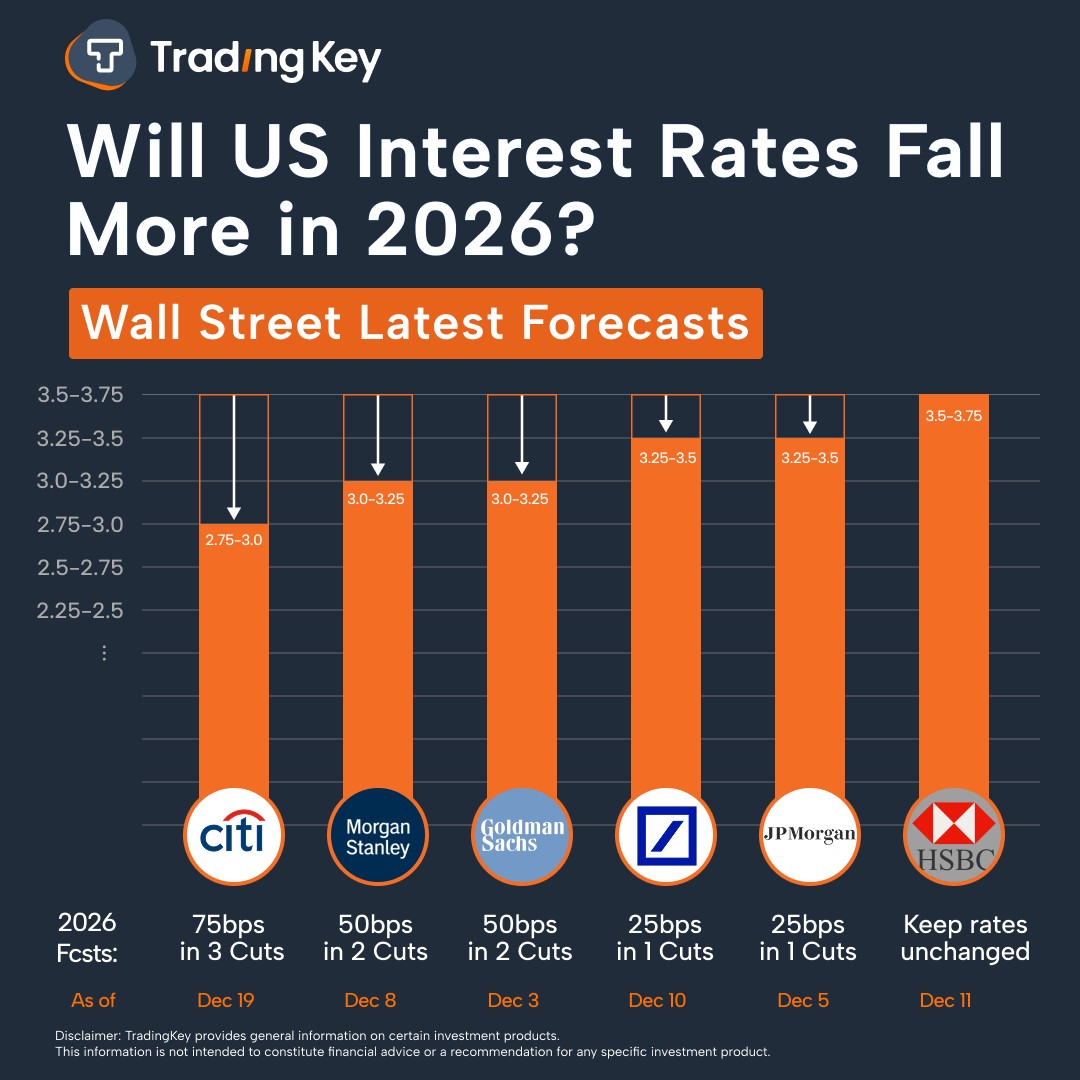
Major Wall Street investment banks' forecasts are relatively consistent, with Goldman Sachs, Morgan Stanley, Bank of America, Wells Fargo, Nomura Securities, and Barclays all projecting a 50 basis point rate cut by the Fed in 2026, lowering the target range to 3.00%-3.25%, with cuts concentrated in March and June.

Citi Research is more aggressive, forecasting a total of 75 basis points in rate cuts for the year, bringing rates down to the 2.75%-3.0% range.

JPMorgan Chase and Deutsche Bank are relatively conservative, expecting only a 25 basis point cut. HSBC and Standard Chartered anticipate the Federal Reserve will maintain current interest rates throughout 2026.

Macquarie Bank holds a unique view, anticipating a potential rate hike in the fourth quarter of 2026.

Internal Divisions within the Federal Reserve

Synthesizing statements from Federal Reserve officials, a clear conclusion emerges: the downward trend in interest rates appears largely established, but there are fierce internal divisions regarding the specific implementation path.

The hawkish camp, represented by Bostic and Goolsbee, leans towards delayed action, emphasizing that core inflation remains sticky and tariff policies present future uncertainties, thus making premature rate cuts ill-advised.

Conversely, the dovish faction, led by Miran and Waller, advocates for "front-loaded rate cuts," stressing that a weak labor market necessitates timely policy responses.

For markets, the focus has clearly shifted from 'whether to cut rates' to 'when to start, and by how much accumulated over the year.' The upcoming December jobs report is seen as a critical turning point; if the unemployment rate continues to climb, it will increase the probability of a rate-cutting cycle beginning in January or April. Conversely, if the data remains resilient, the easing window may be postponed until mid-2026 or even later.

European Central Bank: Easing Paused

Meeting Date

Adjustment (Basis Points)

New Rate (%)

2025-12-18

0

2.15%

2025-06-05

↓ Rate Cut of 25 Basis Points

2.15%

2025-04-17

↓ Rate Cut of 25 Basis Points

2.40%

2025-03-06

↓ Rate Cut of 25 Basis Points

2.65%

2025-01-30

↓ Rate Cut of 25 Basis Points

2.90%

At its recently concluded monetary policy meeting in December 2025, the European Central Bank decided to keep key interest rates unchanged, maintaining the deposit rate at 2.15% for the fourth consecutive time. This decision was not unexpected and aligned with widespread market expectations that current monetary policy is at an 'appropriate' level.

Although there is no urgent need for rate hikes in the short term, a growing number of analysts are noting that dual risks to both economic growth and inflation are accumulating in the Eurozone, creating scope for a gradual tightening of monetary policy in the future. With a recent series of Eurozone economic indicators showing strengthening underlying growth momentum and inflation stabilizing or even potentially rising, many experts believe the European Central Bank may abandon its accommodative bias and progressively shift towards a more neutral policy stance.

Outlook for 2026: Will Inaction Remain the Main Theme?

Looking ahead to next year, several international investment banks generally anticipate that, absent significant changes in key variables, the European Central Bank will maintain current interest rates for most of the period. Overall, the rate-cutting cycle is largely complete, entering what is termed an 'observation window.'

Goldman Sachs believes that the European Central Bank will maintain the deposit rate at 2% throughout 2026 unless inflation decelerates significantly.

Analysts at the firm noted: 'Considering that inflation is already near the target range and Germany has begun implementing fiscal expansion policies, we expect interest rates to remain at 2%, with further rate cuts only being considered if inflation cools significantly.'

Citibank holds a more conservative view, forecasting that the European Central Bank will maintain the 2% interest rate level until the end of 2027, reflecting its concerns about medium-term inflation stickiness.

Contrary to mainstream expectations, Morgan Stanley believes the market is significantly underestimating the rate-cutting pressure the European Central Bank will face. The bank identifies three key factors that will compel the ECB to return to an accommodative path: persistently weak Eurozone economic growth, inflation potentially remaining below the policy target for an extended period, and limited scope for fiscal stimulus. Based on this, Morgan Stanley projects that the ECB will lower the deposit rate to 1.50% in the first half of 2026 and maintain that level thereafter.

Synthesizing the above analysis reveals that the European Central Bank is currently at a delicate yet crucial juncture—on one hand, it has not entirely ruled out signaling easing in due course based on economic changes; on the other hand, it has notably heightened its vigilance regarding potential overheating risks and the uncertainty of fiscal expansion's impact on price trends.

Therefore, maintaining the current policy mix in the short term is the safest option for balancing growth and price stability. From a longer-term perspective, if subsequent data indicates a re-accumulation of price pressures, the ECB may not rule out gradually restarting a rate-hiking process in the medium term to address potentially re-emerging structural inflation challenges.

Bank of England: 'Cautious Signals' Emerge Amidst Gradual Rate Cuts

In 2025, the Bank of England pursued a monetary policy path dominated by 'gradual easing.' It cut rates four times throughout the year, totaling 100 basis points, lowering the benchmark interest rate from 4.75% at the start of the year to 3.75% by year-end. While the overall direction clearly pointed to easing, the pace and rhetoric displayed increasing caution.

Resolution Date

Adjustment (Basis Points)

New Rate (%)

2025-12-18

↓ Rate Cut of 25 Basis Points

3.75

2025-08-07

↓ Rate Cut of 25 Basis Points

4.00

2025-06-19

0

4.25

2025-05-08

↓ Rate Cut of 25 Basis Points

4.25

2025-03-20

↓ Rate Cut of 25 Basis Points

4.50

Looking at the full-year pace, the Bank of England adopted a strategy of 'two rate cuts in both the first and second halves of the year,' but the intervals between cuts notably lengthened: three months separated cuts between February and May in the first half, while four months elapsed from August to December in the second half.

Year-End Rate Cut: Dual Impact of Easing Inflation and Economic Weakness

The Bank of England announced its fourth rate cut in December, further lowering the interest rate to 3.75%, a new three-year low. Although November's CPI year-on-year growth remained above the 2% target, it had significantly moderated to 3.2%, the lowest level in eight months. The decline in food price inflation was a key factor in the rapid overall CPI deceleration.

Another major impetus supporting this easing decision was the sustained weakness in domestic economic fundamentals:

  • Fourth-quarter GDP growth forecast was sharply revised down from the previous 0.3% to zero growth;
  • The labor market continued to soften, with slower job creation;
  • Consumer and business investment confidence cooled;
  • Service sector activities, such as retail and catering, significantly declined.

Governor Andrew Bailey noted that the current pace of disinflation is faster than anticipated, providing further scope for monetary policy action; however, uncertainties persist, and future policy decisions will be dynamically assessed based on economic data.

Outlook for 2026: Policy Easing May Be More Cautious

Although most data indicate receding price pressures, the Bank of England emphasized in its latest statement: 'The question of whether further rate cuts are needed will become increasingly complex.' This phrasing suggests that monetary stimulus effects have, to date, approached their 'safe limits,' and the threshold for subsequent decisions is rising.

Furthermore, most committee members believe that inflation is more likely to return to its target path in the medium term, and additional easing could, conversely, undermine market stability. Therefore, they emphasized the need for heightened vigilance and balancing various risk potentials. Traders generally predict that the Bank of England will provide a maximum of 39 more basis points of easing by the end of next year, equating to approximately one to two small rate cuts.

Markets broadly expect the Bank of England to maintain a cautious easing pace in its 2026 policy path, though specific implementation will remain data-dependent.

Goldman Sachs predicts that if the macroeconomic environment remains stable, inflation continues to decline, and wage pressures are controllable, the Bank of England will implement three consecutive rate cuts of 25 basis points each before the third quarter of 2026, scheduled for March, June, and September. This would expand the cumulative annual rate reduction to 75 basis points, gradually lowering the benchmark rate to around 3%, and potentially even reaching the lower bound area of approximately 2.30%.

Deutsche Bank, meanwhile, emphasizes that following a significant deceleration in inflation, the persistently high real interest rates are now substantially curbing demand. Therefore, it anticipates further monetary easing space in 2026, potentially extending through multiple rounds of rate cuts.

Barclays believes that after the accelerated decline in inflation last November, the main obstacles to further policy adjustments have been removed, and it explicitly suggests that the reasonable mid-term interest rate range should lie between 2.8% and 3%, a level regarded as a 'new floor' consistent with the UK's current structural economic environment.

Concurrently, JPMorgan Chase Chief UK Economist Allan Monks stated that if the labor market remains sluggish and wage growth decelerates moderately, the Bank of England might intervene again in the coming months. His base case scenario involves small rate reductions at the end of March and June meetings, bringing the year-end rate closer to 3%.

Morgan Stanley, however, forecasts that the next policy action could occur as early as the February meeting, indicating that if unemployment further rises and wage growth retracts, it will drive monetary policy to continue its gradual decline. Its internal models suggest a maximum of two to three additional easing windows throughout the year, possibly accompanied by more conservative and cautious rhetoric to manage external expectations.

Bank of Japan: Historic Shift

In 2025, the Bank of Japan largely completed its historic transition from 'ultra-loose' monetary policy to 'gradual rate hikes and normalization.' By year-end, the policy rate reached 0.75%, the highest level in nearly 30 years, signifying Japan's definitive departure from the era of long-term zero interest rates.

While the overall tone remains one of 'cautious progress,' officials have explicitly emphasized that the rate-hiking path will be steadily pursued to address evolving structural inflation and wage growth trends.

Resolution Date

Adjustment (Basis Points)

New Rate (%)

2025-12-19

↑ Rate Hike of 25 Basis Points

0.75

2025-01-24

↑ Rate Hike of 25 Basis Points

0.50

After the Bank of Japan formally ended negative interest rates in January and raised the policy rate to approximately 0.50%, it remained on hold for most subsequent meetings, continuously assessing whether underlying inflation was sufficient to support a tightening cycle. The December meeting then saw another 25 basis point hike.

The Bank of Japan's assessment of the economic outlook reflects cautious optimism. The real GDP growth forecast for fiscal year 2025 was revised upward to around 0.7%, supported primarily by a sustained rebound in corporate capital expenditure, a moderate recovery in consumption, and robust performance in the service sector.

However, the central bank also explicitly noted the persistence of external risks, including global geopolitical tensions, slowing economic growth among major trading partners, and volatility in energy prices, among other uncertainties.

Regarding inflation, the Bank of Japan projects that core CPI will generally remain around its 2% target in the coming years, which is considered a significant indicator of Japan's successful achievement of its inflation objective.

However, the central bank simultaneously cautioned that inflation could still fall back below target if domestic demand significantly weakens or global commodity prices decline sharply.

Outlook for 2026: The Path of Gradual Rate Hikes to Continue

Regarding Japan's monetary policy trajectory for the next two years, several institutions believe the BoJ will proceed with subsequent small rate hikes at a 'semi-annual' pace. Demonstrating one of the strongest commitments among major global economies, its process may be slow, but the direction is almost without doubt.

Bank of America's analysis suggests that the Bank of Japan will hike rates again in June 2026, after confirming sustained price and wage increases, and will maintain a semi-annual action pattern, setting its ultimate interest rate target at 1%.

Analysts note that this cautious mechanism reflects the BoJ's many unknowns in balancing recovery momentum with financial stability, but this does not constitute a reason to halt the current tightening process. They anticipate that, at this pace, Tokyo will continue to implement three small rate hikes over the next two years, including actions in January and July 2027, reaching a target level of 1.5% by year-end, thereby completing an 'almost unprecedented' long-term easing reversal plan.

Goldman Sachs Chief Japan Economist Tomohiro Ota also holds a similar view. He stated that this tightening cycle is less about suppressing overheating inflation in the typical sense and more about a long-term structural restructuring strategy, aiming fundamentally to end the deflationary overhang and restore market signal transmission mechanisms.

He anticipates the next rate hike could be scheduled for July of next year, adding that the ultimate peak will also be around 1.5%. This assessment suggests that, within the foreseeable cycle, Japan may remain one of the few emerging examples globally capable of guiding a genuine nominal interest rate turning point driven by 'endogenous recovery.'

In summary, 2025 was a historic year for the Bank of Japan. Japanese monetary authorities are unprecedentedly advancing domestic monetary normalization reforms, with decoupling from ultra-loose policy having become a fundamental consensus.

For global investors, the normalization of Japan's monetary policy signifies the disappearance of the world's last major bastion of accommodative monetary policy. This will have profound implications for global capital flows, foreign exchange markets, and asset pricing. In particular, the Japanese Yen's status as a traditional funding currency may face restructuring, and global carry trade strategies will require re-evaluation.

Reserve Bank of Australia: Easing Cycle May Have Concluded

In the first three quarters of 2025, under the combined impact of decelerating inflation and a softening labor market, the Reserve Bank of Australia (RBA) initiated a mild easing cycle, progressively cutting rates three times by 25 basis points each, starting in February. This amounted to a cumulative reduction of 75 basis points, lowering the cash rate from 4.10% to 3.60%.

Resolution Date

Adjustment (Basis Points)

New Rate (%)

2025-12-09

0

3.60

2025-08-12

-25

3.60

2025-07-08

0

3.85

2025-05-20

-25

3.85

2025-02-18

-25

4.10

However, due to signs of inflation rebounding in the second half of the year, the Reserve Bank of Australia held fire and maintained interest rates at subsequent policy meetings. Market expectations for further rate cuts consequently cooled rapidly. The interest rate market and most economists now believe its easing cycle may have concluded.

In the December monetary policy decision, Governor Michele Bullock explicitly stated that due to higher-than-expected domestic price pressures and a persistently tight labor market, it is necessary to 'maintain the current interest rate level for a considerable period,' indicating a shift in monetary policy from stimulus to a wait-and-see approach.

2026 Outlook: Rate Hike Expectations Rising

The December RBA meeting minutes revealed that its rate-setting board members discussed the possibility of rate hikes in 2026, citing increasing risks posed by high inflation to the economy.

Also in mid-December, Commonwealth Bank of Australia (CBA) and National Australia Bank (NAB) successively released their latest forecast reports. Both of these domestic systemically important banks believe that the RBA will initiate a new rate-hiking cycle in February 2026 to counter persistent upward price pressures.

CBA economist Belinda Allen stated that the bank's current forecast is for 'one cash rate increase in 2026, from 3.60% to 3.85%.' She further added that if economic activity exceeds expectations and wage and services inflation remain robust, a more comprehensive rate-hiking cycle cannot be ruled out.

In contrast, NAB Chief Economist Sally Auld adopted a more hawkish stance. She anticipates the RBA will implement two separate 25 basis point rate hikes in February and May of next year, potentially bringing the target cash rate back to 4.10%.

This assessment aligns closely with recent views from Citigroup—Citi warns that if core prices remain sticky, the market may currently be significantly underestimating future tightening risks.

Conclusion

The divergence in global monetary policy reflects profound shifts in the global economic landscape. As central banks no longer act in concert but instead seek policy paths best suited to their domestic conditions, global financial market volatility may increase, yet this also creates more differentiated opportunities for prepared investors.

Whether on Wall Street or Tokyo Bay, in Frankfurt or the City of London, from the Bank of Japan to the Sydney Parliament House, no country possesses a 'perfect playbook.' Precisely because of this, a keen sense for shifts in trends and strong risk management capabilities will be the key to gaining an advantage in this volatile cycle.

Find out more