


Compared to Powell's "receiving subpoenas," next week's court hearing is "more important" for the independence of the Federal Reserve and has "significant implications" for the market
Next Tuesday, the U.S. Supreme Court hearing on Trump's dismissal of Federal Reserve Board member Lisa Cook will become a critical turning point in the defense of the Federal Reserve's independence. Analysts warn that if the White House wins, it will open a legal loophole for Trump to remove Powell. Once the independence of the Federal Reserve is compromised, it could trigger severe asset repricing and market turmoil. "This month could mark the beginning of the next bear market, or even a market crash."
Although Powell revealed on Sunday that the subpoena he received from the Department of Justice regarding the Federal Reserve headquarters renovation project caused a stir, several Wall Street analysts pointed out that the real eye of the storm will be the Supreme Court hearing scheduled for January 21.
At that time, the court will hear arguments regarding President Trump's attempt to dismiss Federal Reserve Governor Lisa Cook. The ruling in this case will establish a key legal precedent: whether the White House can bypass the protections of the Federal Reserve Act "for cause" to forcibly remove Federal Reserve officials.
Bank of America economist Aditya Bhave stated in a report: "If the court rules against Cook, it will significantly increase the likelihood of Powell being dismissed due to the Department of Justice investigation. We have always believed that the impact of the Cook case on the policy trajectory is more important than the choice of the next Federal Reserve chair. We now believe this point is even more certain." He emphasized that the ruling in this case will be a litmus test for whether the president can reshape the structure of the Federal Reserve.
The market is closely monitoring this dynamic, as once the independence barrier of the Federal Reserve is breached, the logic of monetary policy formulation may shift from "evidence-based" to "politically-based," posing a fundamental threat to long-term capital costs and asset pricing.
This development has directly impacted the financial markets. According to CME Group data, traders have significantly bet that the Federal Reserve will take no action at its policy meeting later this month, pushing expectations for the next rate cut to June. Kevin Gordon, head of macro research and strategy at Charles Schwab, pointed out that while the market's reaction to Powell's news has been limited, the direction is very clear—dollar down, stock market down, bonds down—indicating how the market will digest this long-term risk if the shock continues.
The "Key Battle" of the Supreme Court: The Ripple Effect of the Cook Case
For investors, next Tuesday (January 21) is a date that must be circled on the calendar.
The core of the hearing that day revolves around the Trump administration's accusation that Lisa Cook misreported her primary residence in mortgage applications, allegedly committing fraud. Although Trump previously attempted to dismiss her but was blocked by the court, if the White House wins this time, it will clear legal obstacles for the president to dismiss Federal Reserve officials "for cause."
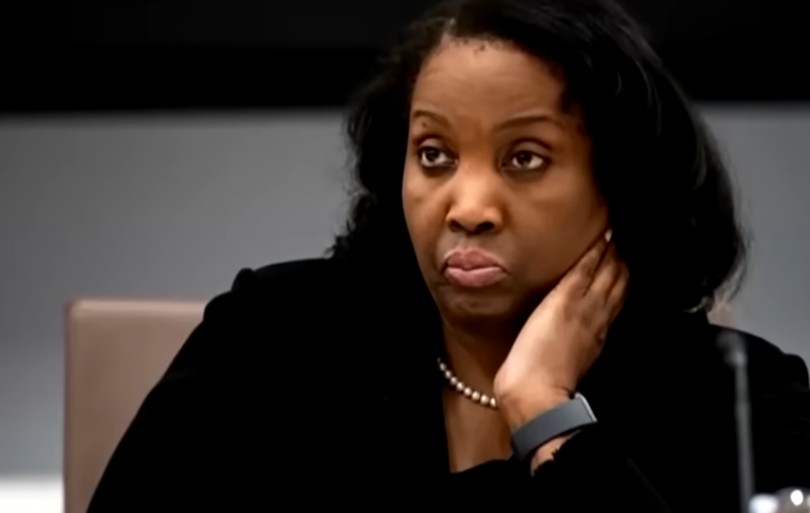
Screenshot of Lisa Cook
According to Axios, the Federal Reserve Act of 1913 stipulates that the president can only remove committee members "for cause." Jenny Breen, an associate professor of law at Syracuse University, pointed out that the Supreme Court has previously allowed the president broader dismissal powers in other agencies but has consistently sought to isolate and protect the Federal Reserve as a "structurally unique quasi-private entity." However, if the court supports Trump this time, it will mean further erosion of checks on executive power Barron's commentary warns that investors are currently too complacent. If the court allows the dismissal of Cook, Trump will find it easier to dismiss Powell under the pretext of the investigation results. The article points out: “If investors sense that Trump will gain broad powers to dismiss governors ‘for cause,’ this month could mark the beginning of the next bear market, or even a market crash.”
Long-term Structural Risks Facing the Market
The consequences of this legal battle extend far beyond short-term market fluctuations.
Barron's analysis indicates that if Trump wins the lawsuit and successfully "stuff" the Federal Reserve, the worst-case scenario is that the market tolerates a Federal Reserve composed of dovish loyalists cyclically, but when the economic cycle demands interest rate hikes and the new Federal Reserve refuses to execute, the market will pay a heavier structural price.
Kevin Gordon of Charles Schwab emphasizes that the ruling in the Cook case “will carry significant weight regarding any president's ability to shape the structure of the Federal Reserve.”
Jenny Breen believes that the investigation into Powell shows that the government feels “unconstrained by democratic norms,” thus any checks from the Supreme Court will be positive. However, if the court fails to clearly uphold the independence of the Federal Reserve, the only constraint left will be the market itself—namely, to prevent further presidential interference in the central bank through a severe market crash.
Powell's "Counterattack": May Stay on as Governor "to the Bitter End"
Ironically, the aggressive offensive from the Trump administration may backfire.
According to CNBC, the investigation into Powell—focusing on whether he lied about renovation projects during his congressional testimony—may actually motivate him to decide to remain on the Federal Reserve Board after his term as chairman ends in May.
Powell's term as chairman will end in May, but his term as a governor will last until 2028. This means he can continue to serve on the Federal Open Market Committee (FOMC), becoming an obstacle to Trump's attempts to push for “significant” interest rate cuts at the Federal Reserve.
Matthew Luzzetti, Chief U.S. Economist at Deutsche Bank, stated in a client report: “While this was never the baseline scenario, the events of this weekend may increase the likelihood that Powell chooses to stay at the Federal Reserve. In fact, if the government insists on criminally prosecuting Chairman Powell and Senate Republicans firmly refuse to advance the nomination of a Federal Reserve governor, the FOMC is likely to choose Powell to continue as chairman.”
According to Polymarket data, the probability of Powell remaining on the Federal Reserve Board after his term as chairman ends has exceeded 55%. Since last week, the likelihood of him leaving the board by the end of the year has dropped from 70% to below 60%.
Powell himself hinted at this in a statement on Sunday: “I will continue to fulfill the work for which the Senate confirmed me with integrity and a commitment to serving the American people.”
