


Has Trump turned his guns around for the election? Wall Street has fallen from being the former "darling" to a policy "punching bag."

Trump has introduced a series of restrictions targeting the financial industry, including preventing large investors from purchasing residential properties, calling for a cap on credit card interest rates, and announcing limits on executive compensation and stock buybacks. Now, the midterm elections are more important than bank profitability and market stability, as Trump shifts to prioritize the interests of ordinary consumers
The Trump administration is transforming Wall Street from an "ally" into an "adversary." The president, once viewed as a supporter by the financial community, is now rolling out a series of policies that have caught investors off guard, driven by concerns over midterm elections and voters' cost of living.
According to The Wall Street Journal on Wednesday, in the past week, Trump has introduced multiple restrictions targeting the financial industry, including blocking large investors from purchasing single-family homes, calling for a cap on credit card interest rates, and announcing limits on executive compensation and stock buybacks. These measures signify a clear shift in the White House's policy focus, moving from last year's pro-market policies of tax cuts, spending reductions, and tariff relaxations to prioritizing the interests of ordinary consumers.
The most shocking development is the Justice Department's criminal investigation into Federal Reserve Chairman Jerome Powell, which Powell described as an intimidation tactic aimed at forcing interest rate cuts. This action prompted bank executives, including JPMorgan CEO Jamie Dimon, to publicly defend the Federal Reserve, highlighting the tension between the government and the financial sector.
Treasury Secretary Mnuchin's remarks to bankers last April are now coming to fruition: "Wall Street has become unprecedentedly wealthy over the past forty years... it's Main Street's turn in the next four years." White House spokesperson Kush Desai stated in a statement that multiple record-high stock market peaks and rising real wages demonstrate that Trump can "release historic prosperity" for consumers and investors.
Financial stocks under pressure, market enters wait-and-see mode
Trump's call last Friday evening to temporarily cap credit card interest rates at 10% led to declines in the stock prices of major credit card issuers and network service providers on Monday and Tuesday. Shares of Citigroup, American Express, Capital One, Mastercard, and Visa fell between 4% and just over 7% during these two days.
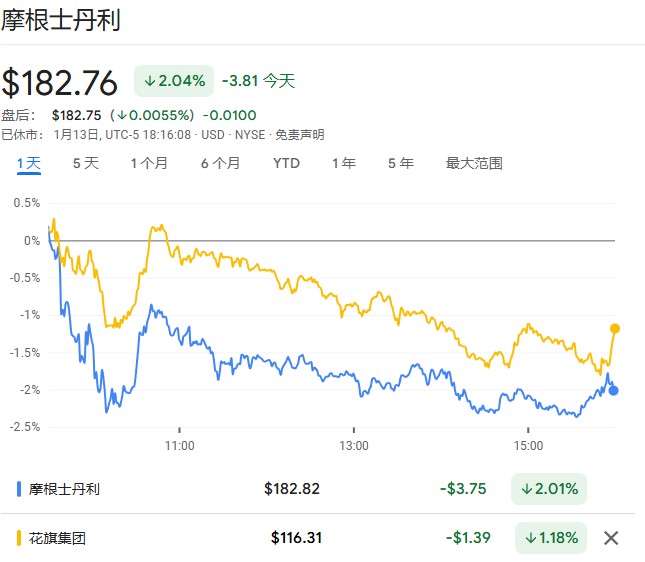
The plan to block large investors from purchasing single-family homes also impacted the stock prices of two major single-family home landlords and Blackstone Group, which owns a smaller competitor. However, these stocks have since recovered some ground.
Despite this, the overall stock indices have not reflected excessive concern. Investors have become accustomed to Trump's reversals on many ideas, and some proposals require congressional support. House Speaker Mike Johnson hinted on Tuesday that Trump's credit card interest rate proposal faces a tough outlook in Congress. Peter Boockvar, Chief Investment Officer at One Point BFG Wealth Partners, stated, "The credit card proposal may not happen—nor will the restriction on institutional home purchases. So the market is in a wait-and-see mode."
Dan Ivascyn, Chief Investment Officer at bond giant Pimco, suggested to "expect surprises and adjust portfolios accordingly." Pimco has adjusted its portfolio, including purchasing more bonds from non-U.S. issuers. Brad Golding, a fund manager at New York hedge fund Christofferson Robb & Co., remarked: **"Investors think that after the tariff event in April 2025, policy uncertainty will magically disappear." Now we see that the midterm elections are more important than bank profitability and market stability. "In November this year, the United States will hold midterm elections."
Unpredictable Policy Consequences, Industry Impact Spreads
The investigation into Powell immediately drew criticism from former Federal Reserve and Treasury officials as well as lawmakers, including Senate Banking Committee member and North Carolina Republican Senator Thom Tillis. This could hinder Trump's ability to confirm Powell's successor.
JP Morgan's Dimon and Bank of New York Mellon CEO Robin Vince both defended the Federal Reserve during a conference call discussing quarterly bank performance on Tuesday. Dimon stated that political interference with the Federal Reserve would lead to rising inflation and interest rates, rather than achieving Trump's established goal of lowering rates. This investigation could even encourage Powell to continue serving as a Federal Reserve governor after his term as chairman expires later this year.
Other proposals may also have unintended consequences, which may explain the market's mild reaction. Industry organizations have warned that cutting credit card rates could limit access to credit for low- and middle-income consumers. Boockvar noted, "Preventing institutional investors from buying rental homes sounds good, but it could negatively impact families who want to buy homes but can't afford them. Additionally, this could hinder home builders from increasing the supply of new homes to the market."
Trump's affordability push could impact industries beyond finance. The government has hinted at a desire to lower gasoline prices for American consumers by increasing Venezuelan oil supply to the market. Lower oil prices would help drivers but could affect the profits of energy companies. The government indicated that more affordability proposals might be announced when Trump attends the World Economic Forum next week.
Despite the unsettling news, Wall Street analysts are still looking for reasons to be optimistic. Morgan Stanley told clients on Monday that the Trump administration's focus on housing affordability efforts would benefit some consumer-related stocks. If the government provides incentives to home builders to encourage them to increase housing supply, it could boost the earnings of these companies
