Decoding the central bank press conference: Eight measures implemented, how far are we from a comprehensive reduction in reserve requirements and interest rates?

Wallstreetcn
2026.01.16 00:38
portai
I'm PortAI, I can summarize articles.

Yesterday, the central bank introduced eight structural monetary policy measures, sending a strong signal for stabilizing growth. The core measures include a 0.25 percentage point reduction in the interest rates of various structural monetary policy tools and an expansion of the total quota for structural tools by approximately 1.1 trillion yuan. The central bank clearly stated that there is "still some room" for further cuts in reserve requirement ratios and interest rates this year, with the statutory deposit reserve ratio at 6.3% still having room for reduction, and the constraints of exchange rates and net interest margins have weakened. Analysts believe this is a "structural interest rate cut" that balances both internal and external factors, with a 50 basis point reduction in the reserve requirement ratio expected to be implemented in the first quarter

At 3 PM on January 15, 2026, a press conference held by the State Council Information Office became the focus of attention in the capital market.

On the same day that financial data for December 2025 was released, the central bank launched a set of "combined measures." In response to the market's demand for liquidity, the central bank did not directly adjust the OMO (Open Market Operations) interest rate but chose a more precise path—structural interest rate cuts.

At the press conference, the People's Bank of China announced eight structural monetary policy measures and clearly stated: There is still room for interest rate cuts and reserve requirement ratio reductions this year.

Structural "Interest Rate Cuts" First

The most significant news at the press conference was the adjustment of "prices."

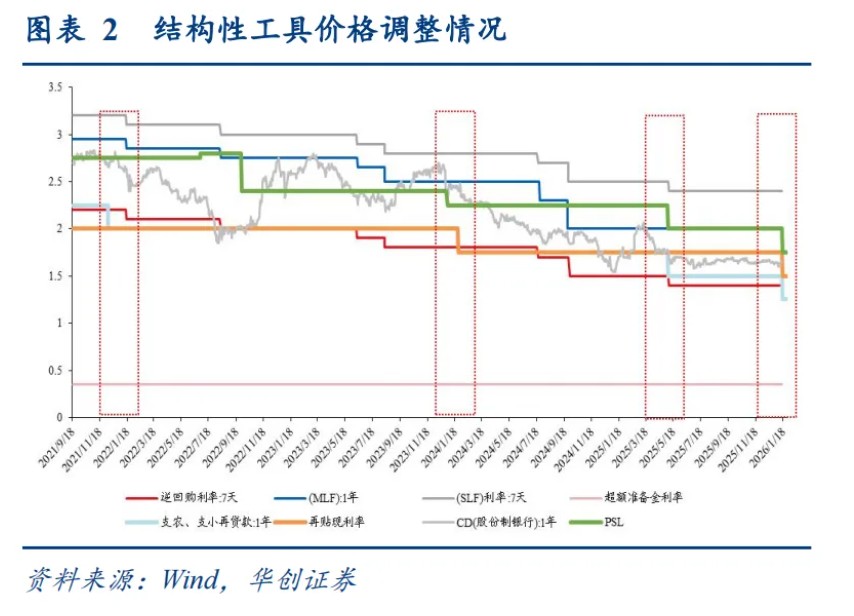
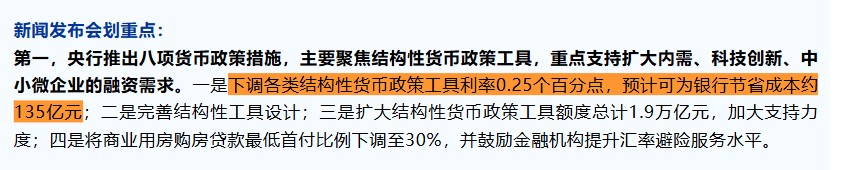
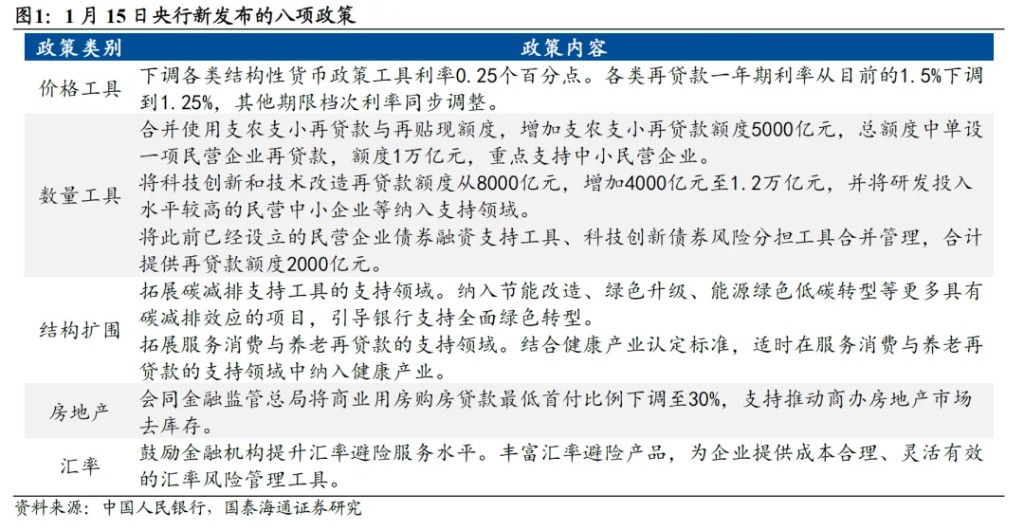
The central bank announced that the interest rates of various structural monetary policy tools would be lowered by 0.25 percentage points. Specifically, the one-year interest rate for various relending facilities would be reduced from the current 1.5% to 1.25%, with other term rates adjusted accordingly; the rediscount rate would be lowered from 1.75% to 1.5%.

This is not a comprehensive interest rate cut, but its signaling significance cannot be ignored in the current economic environment.

According to Huachuang Securities analysis, looking at historical situations, the interest rate cuts for structural tools in December 2021 and January 2024 were also separate adjustments when the OMO or MLF rates remained unchanged.

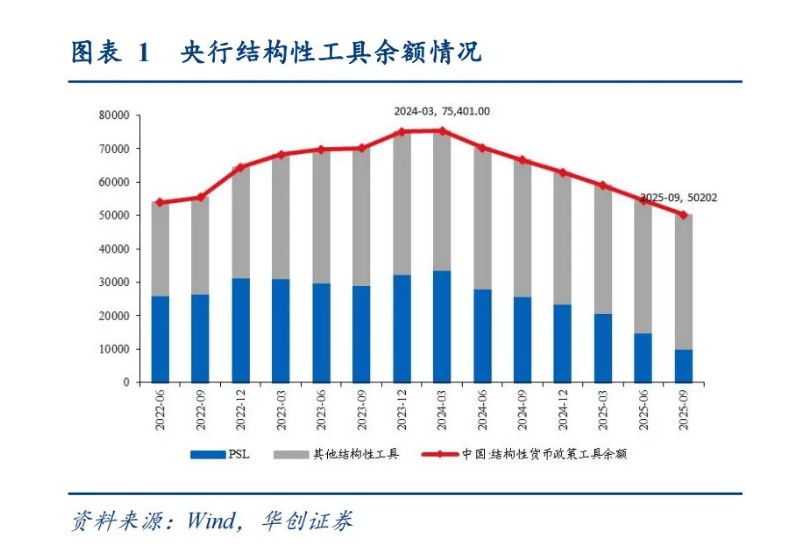
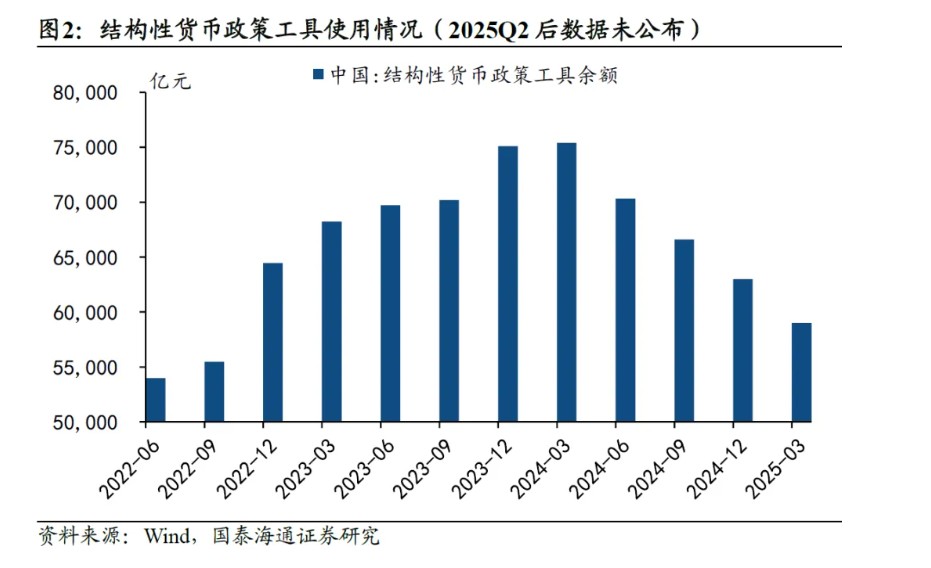
From the perspective of cost reduction, as of the end of the third quarter of 2025, the balance of structural monetary policy tools was about 5.4 trillion yuan. China Galaxy Macro estimates that this adjustment could save banks about 13.5 billion yuan in costs.

The Guotai Junan Macro Team believes that this is a "structural interest rate cut that balances both internal and external factors." Internally, prices related to domestic demand remain weak and require policy support; externally, the differentiation in the U.S. economy has led to persistently high U.S. Treasury yields. The central bank's use of structural interest rate cuts "effectively protects the resilience of the domestic economy while continuing the trend of renminbi appreciation."

Eight Measures Implemented

In addition to price declines, there is also an expansion in quantity. The central bank introduced eight specific measures at this press conference, focusing on expanding domestic demand, technological innovation, and small and micro enterprises.

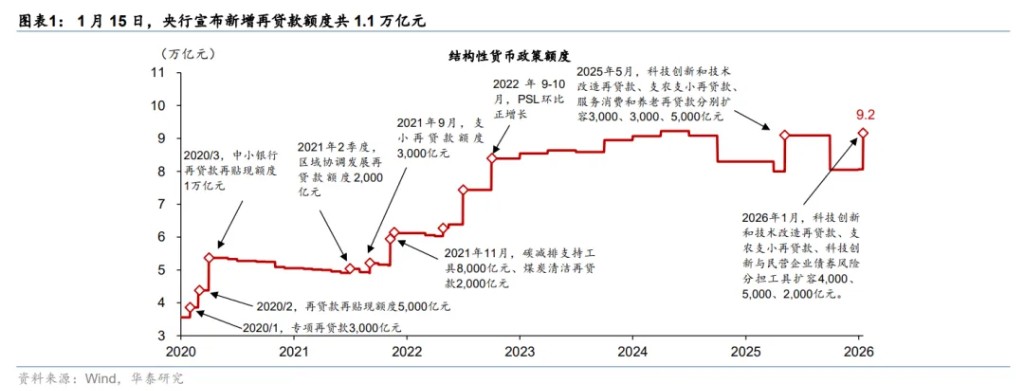
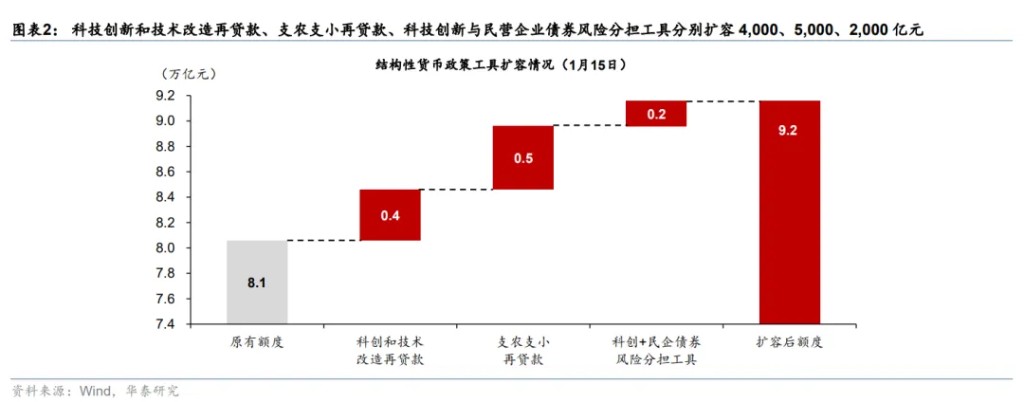
According to Huatai Securities' quantitative breakdown, the central bank has increased the relending quota by approximately 1.1 trillion yuan in total. How will this funding be allocated?

  1. Support for Agriculture, Small Enterprises, and Private Enterprises: The relending for agriculture and small enterprises will be integrated with rediscounting, increasing the quota by 500 billion yuan; at the same time, a separate quota for private enterprise relending will be established, with a quota of 1 trillion yuan (included in the original and newly added quota integration).

  2. Technological Innovation: The relending quota for technological innovation and technological transformation will be increased by 400 billion yuan, raising the total to 1.2 trillion yuan.

  3. Bond Support: A combined risk-sharing tool for bonds related to technological innovation and private enterprises will be established, providing a relending quota of 200 billion yuan.

Guangfa Macro's Zhong Linan pointed out that launching structural tool reforms during the peak of credit issuance in the first quarter helps maximize the structural adjustment function of monetary policy. The integration and use of tools aim to "reduce policy operation costs and avoid redundancy in policy resources."

It is noteworthy that in the real estate sector, policies have also been further relaxed. The central bank, together with the Financial Regulatory Administration, announced that the minimum down payment ratio for commercial property loans will be lowered to 30%. Huatai Securities analysis believes this will help marginally improve demand for commercial real estate and promote inventory reduction in the commercial property market.

How Far Are Comprehensive Reserve Requirement Ratio and Interest Rate Cuts?

Structural easing has been implemented, and the market is more concerned about when the total "big move" will come.

At the press conference, the central bank provided very clear expectations management. A relevant official from the central bank explicitly mentioned: "Regarding reserve requirement ratio and interest rate cuts, there is still some room this year."

China Galaxy Macro interprets this as a clear signal of monetary easing. The central bank pointed out that the average statutory deposit reserve ratio of financial institutions is currently 6.3%, "there is still room for reduction."

As for the constraints on interest rate cuts, they seem to be easing. The central bank noted that factors such as exchange rates and net interest margins that may restrict comprehensive interest rate cuts have shown improvement.

  • Regarding exchange rates: The RMB exchange rate is relatively stable, and the USD is in a rate-cutting cycle, so the exchange rate does not pose a strong constraint
  • Interest Rate Spread: Since 2025, the bank's net interest margin has shown signs of stabilization, and there will be a significant amount of long-term deposits maturing and repricing in 2026.

In this regard, Guangfa Macro has provided a rational forecast: the constraints of reserve requirement ratio cuts and interest rate reductions are indeed decreasing, but from a practical operational perspective, it is estimated that the conditions for interest rate cuts and reserve requirement ratio reductions in 2026 can refer to 2025, namely “reserved for when necessary”, and it is not advisable to overly bet on short-term speculation.

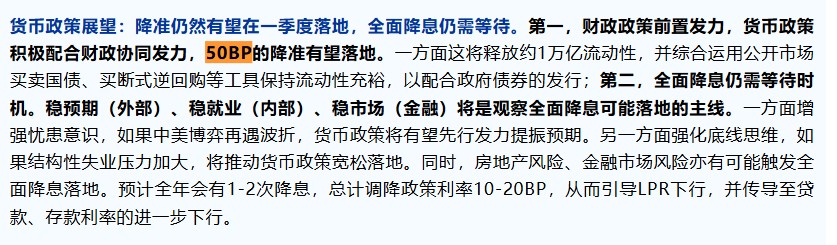
China Galaxy Macro has made a more specific prediction: “A 50 basis point reserve requirement ratio cut in the first quarter is still expected to be implemented” to maintain ample liquidity in conjunction with government bond issuance; while a comprehensive interest rate cut still needs to wait for the right timing, it is expected that there will be 1-2 interest rate cuts throughout the year, totaling a reduction of 10-20 basis points in policy interest rates.

New Policy Direction: Is DR001 Becoming the New Benchmark?

There was another detail in the press conference that is easily overlooked but has significant professional value.

Guangfa Macro keenly captured that this meeting explicitly proposed for the first time “to guide the overnight interest rate to operate near the policy interest rate level.”

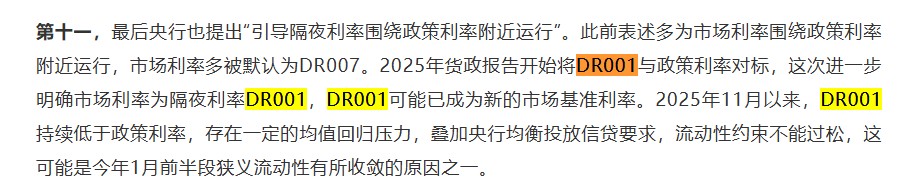
Previously, the central bank's statements often referred to “guiding market interest rates to operate around the policy interest rate,” and the market typically assumed that this “market interest rate” referred to DR007 (7-day repo rate). However, this time, the central bank further clarified its focus on DR001 (overnight rate).

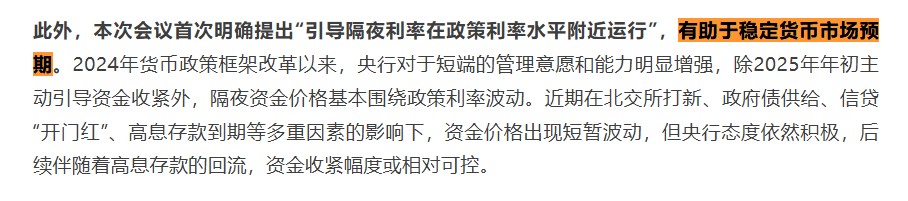
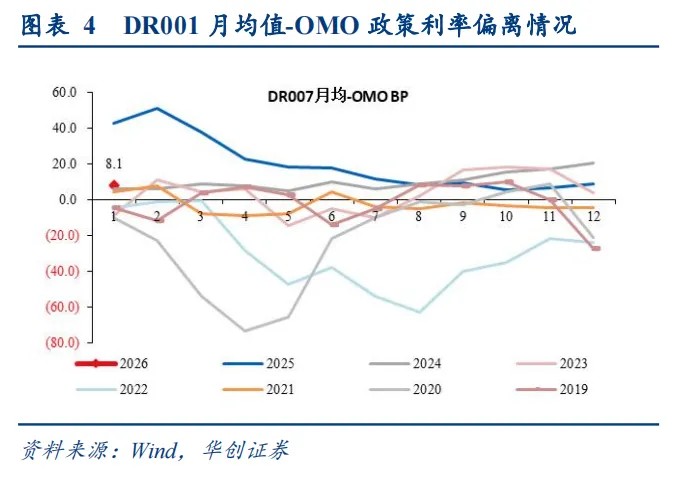
What does this mean? Huachuang Securities analysis pointed out that since the reform of the monetary policy framework in 2024, the central bank's willingness and ability to manage the short end have significantly increased. Clearly guiding the overnight interest rate “helps stabilize monetary market expectations.” Subsequently, with the return of high-interest deposits, the tightening of funds may be relatively controllable.

"Spring Fever" in the Bond and Stock Markets

What does the warm wind of policy mean for various assets?

  • Bond Market: Huachuang Securities pointed out that the meeting mentioned that the yield on 10-year government bonds has recently stabilized around 1.8%-1.9%, and the central bank believes that “the bond market is operating smoothly and healthily.” This indicates that the regulatory recognized trading range has shifted upward, and the central bank's “acceptable range” may dynamically adjust with market conditions. China Galaxy expects that the yield on 10-year government bonds will remain between 1.6% and 1.9%, with an overall trend of high first and low later

  • Stock Market: China Galaxy Macro believes that investing in the Chinese stock market is expected to yield excess returns, emphasizing the investment opportunities of the "spring surge." The reasons are: the central bank has once again signaled a loose monetary policy; the appreciation of the RMB is driving down asset risk premiums; and the capital market will lead to a relocation of household deposits.

  • Exchange Rate: According to data from Morning FX, the December settlement data "exploded," reaching a historic high, and the RMB CFETS index rose. China Galaxy predicts that the RMB exchange rate will show a steady and moderate appreciation by 2026, approaching 6.9 by the end of the year.

The Subsequent Economic "Good Start" is Worth Looking Forward To

The monetary policy for 2026 kicks off with a "structural interest rate cut."

As Guotai Junan stated, this is an operation that "balances both internal and external factors." The central bank is taking the lead in stabilizing growth and adjusting the structure by lowering the interest rates of structural tools and expanding quotas; at the same time, it has clearly reserved space for overall reserve requirement ratio cuts and interest rate reductions, leaving enough ammunition to cope with future uncertainties.

In the context of proactive fiscal policy and highly coordinated monetary policy, the "good start" of China's economy in 2026 is worth looking forward to