


"AI Darling" Quickly Becomes a "Spendthrift", Can Meta Make a Comeback?
These days, it's rare to see trillion-dollar giants fluctuate by 10% or 20% in a single day, but Meta might be the exception. It took Meta just one quarter to fall from grace. After the third-quarter earnings report was released, investors' panic seemed to have just been digested. Recently, with the rise in interest rate cut expectations, $Meta Platforms(META.US) rebounded 10% from the bottom.
In terms of narrative, first, Meta was seen as having the broadest application scenarios, with the "AI darling" narrative accompanying accelerated revenue during the AI investment process. Then, the third quarter's combination of increased investment and slowed revenue growth guidance directly turned it into a "AI spendthrift" asset.
But can Meta really be assured of moving upward? The capital expenditure "notably larger than 2025" is not just talk, and the company reiterated in a small meeting that the future depreciation expense surge will be very significant.
Therefore, in 2026, how should we view the opportunities or risks for Meta, a contradiction of a strong social moat versus reckless spending? Dolphin Research starts with Meta's recent two debt financings to discuss our latest judgment on Meta.
I. Cash Flow Impact: Significant but not the key factor in valuation destruction
After the Q3 earnings report, Meta's successive financing operations attracted market attention. One was a direct issuance of $30 billion in bonds, and the other was a much-discussed $27.3 billion "off-balance-sheet financing." Clearly, Meta's short-term cash flow has encountered problems.
Dolphin Research roughly estimates that if the $120 billion+ capital expenditure in 2026 is entirely supported by the operating cash flow of that year, then Meta, with a market value of trillions, would see its operating cash flow nearly wiped out in a year.
Of course, giants won't wait for their cash flow to be wiped out; they have ways to solve cash flow problems. Besides reducing shareholder returns, which is equivalent to implicit equity financing, bond financing both on and off the balance sheet is almost "basic operation."
1. No need to expect shareholder returns
In "Tencent: Starting from stingy buybacks, is Super AI a blatant conspiracy?", we previously analyzed the differences in cash flow management between Meta and Tencent. Meta adopts a "Cash Neutral" management approach, spending as much as it earns—cash inflows come from main business profits, and cash outflows are mainly for business investments (including software and hardware, fixed asset investments), shareholder returns (buybacks + dividends), and external investments, among others (such as withholding and paying taxes).
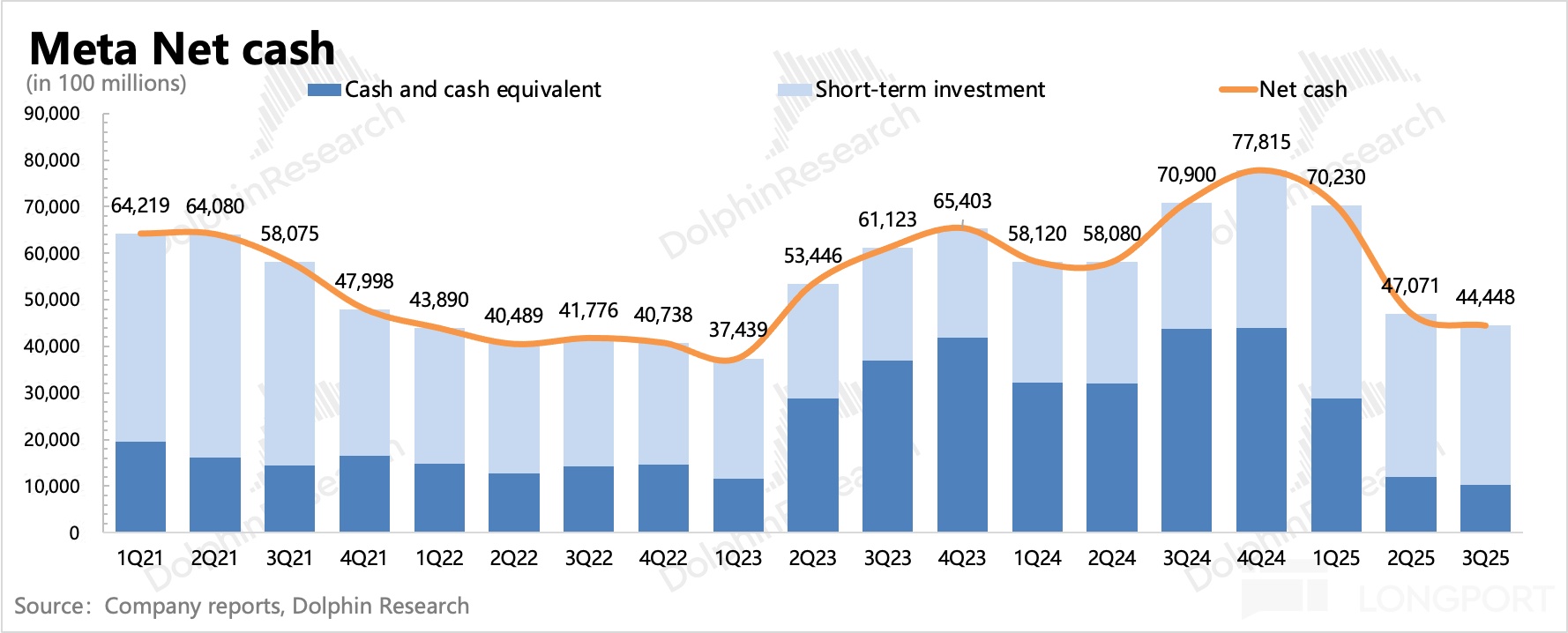
Since the second half of last year, the continuously rising Capex outflow has led to a sharp reduction in Meta's cash on hand. As of the end of Q3, the balance of cash + short-term investments (mainly available-for-sale securities) was only $44 billion, directly down nearly 40% compared to the same period last year.
In other words, this year's $70 billion capital expenditure not only consumed newly generated cash flow from operating activities but also additionally used over $30 billion of existing cash (including Q4, the total usage will be even more).
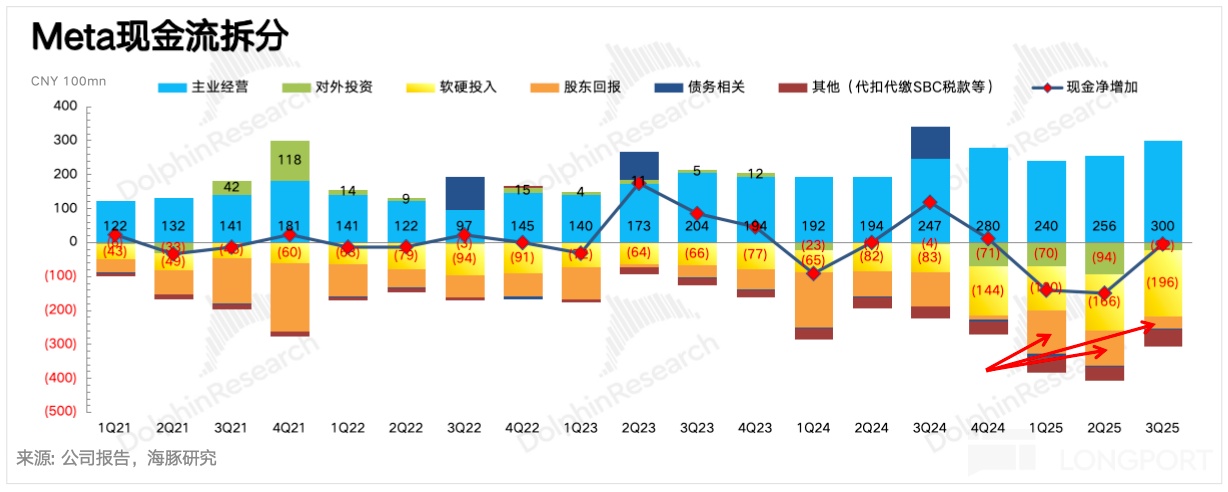
Let's directly look at the cash flow breakdown chart below. In the first and second quarters, the net cash flow for the period showed negative values, reflecting the situation of using existing cash. As "soft and hard investments" including Capex increase quarter by quarter, the main compression is on shareholder returns and external investments. In the third quarter, these two parts were already very low, with little room left for further compression.
Therefore, if next year's Capex increases by another $50 billion on top of this year's $70 billion, how can the current $40 billion+ cash deposits be enough?
2. Actually relying on Meta-guaranteed "off-balance-sheet financing"
Therefore, we see that after the Q3 earnings report was released, Meta immediately issued $30 billion in corporate bonds (issued in six tranches, with interest rates ranging from 4.2% to 5.8%), which is three times the scale of unsecured note issuance in Q3 last year.

In addition to direct bond issuance, before the Q3 earnings report was released, Meta also conducted a special financing by partnering with financial institution Blue Owl to set up a project enterprise outside, transferring the financing for data center infrastructure construction off the balance sheet.
Moreover, in the design of the joint venture company, Meta only holds 20% of the joint venture company's equity, so it will not consolidate the joint venture's financial statements but only record this equity asset as "long-term equity investment."
But essentially, Meta, as a "lessee," signed a lease contract with the "second landlord" (Laidley first leases the data center campus and then subleases it to Meta—see the figure below).
Although the lease object mainly appears to be cabinets, it also includes subsequent chip deployment, campus property management, and long-term power maintenance, which are all Meta's own tasks. Blue Owl essentially acts as an intermediary to help find money and organize the deal.
See the specific operation in the figure below:
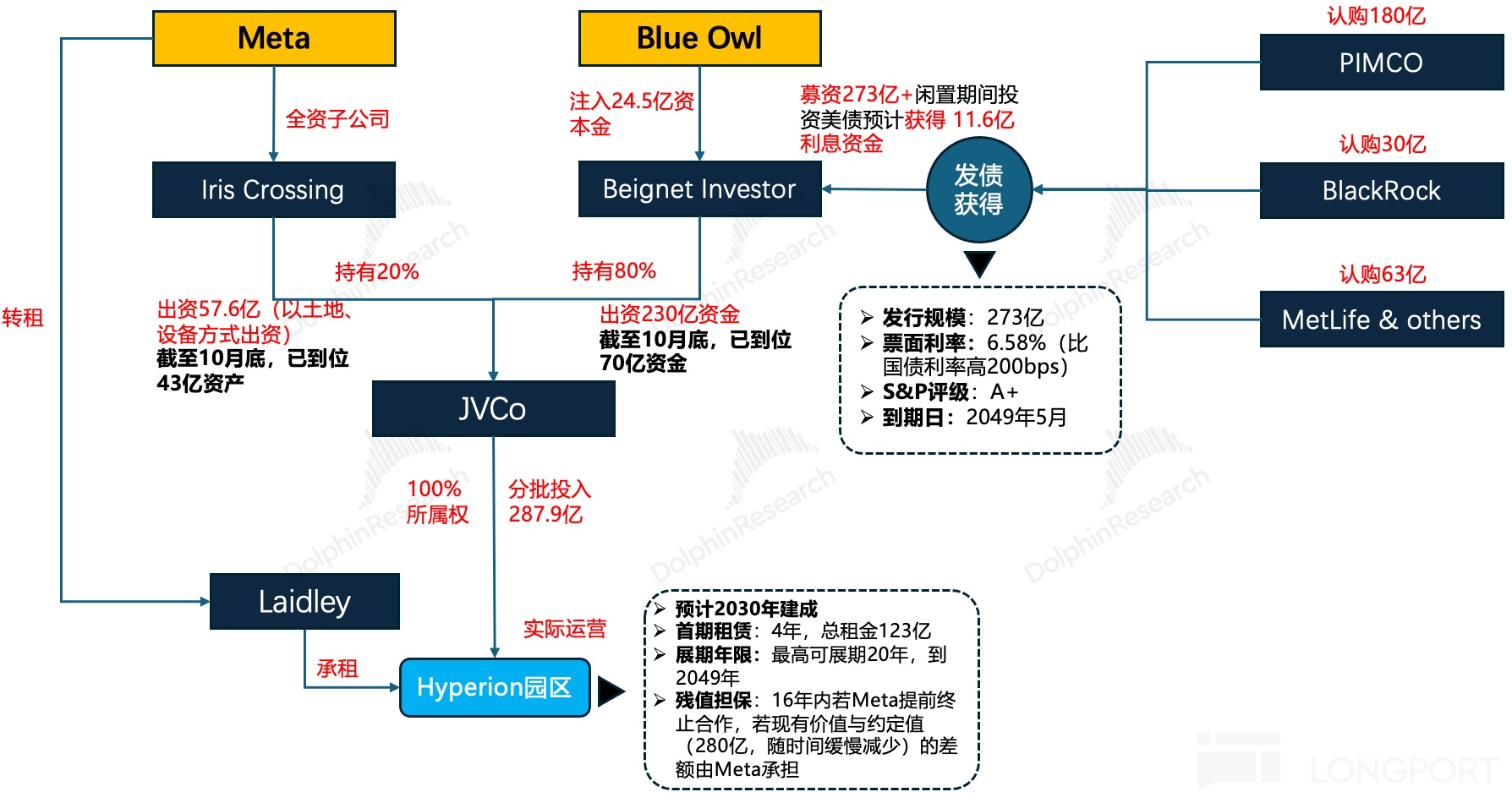

(1) Meta's Perspective: High Financing Cost = Off-balance-sheet Liability + Reduced Short-term Cash Flow Pressure
On the surface, the property rights of the data center do not belong to Meta, and the issuer of the $27.3 billion notes is not Meta either.
But as a tenant, Meta provided residual value guarantees in this transaction—during the first 16 years of operation, if Meta terminates the lease early, it needs to make up the difference between the remaining value of the data center and the agreed value (initially $28 billion).
Therefore, the above operation seems to have gone in circles, but it is essentially equivalent to:
Within the first 16 years, Meta issued a $28 billion corporate bond to Blue Owl for the construction of the data center, with interest payments equivalent to annual rent. For example, according to the lease contract for the first four years, the annual rent is about $3 billion, implying a coupon rate of 30/280=10.7%.
Although this coupon rate seems high, far exceeding Meta's corporate bond rate level from half a month ago, Meta exchanged future cash flow for:
1) Mismatched Rights and Obligations Cycle: Money can be obtained immediately to start construction, but the first $3.1 billion interest payment will not be due until 2029, with Blue Owl covering the note interest for the first four years.
2) Reduced Current Accounting Profit Pressure: Although Meta is the main operator of the data center from the actual responsibility division, through rigidly unequal equity division and not setting Meta to reclaim property rights, this is still recognized as an operating lease rather than a finance lease in accounting.
Although finance leases can also alleviate current cash flow pressure, under GAAP accounting standards, finance leases often have interest expense recognition (including depreciation expense + interest expense) significantly higher than actual rent payments in the early stages.
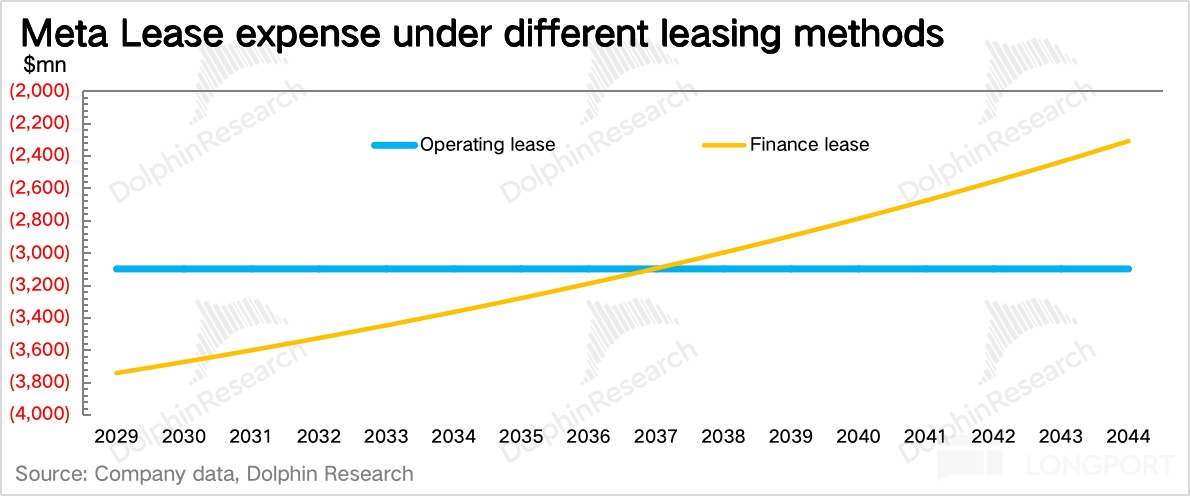
As shown in the figure below, we estimate that assuming rent remains unchanged and the discount rate is calculated at 4.5%, during the period from 2029 to 2036, using the operating lease recognition method, the expense recorded in Opex will always be less than finance lease, potentially reducing Meta's short-term profit pressure.
(2) Blue Owl and Creditors' Perspective: A Profitable Deal
Meta aims to embellish its financial statements, while Blue Owl, a pure financial institution, aims to earn money effortlessly. In this cooperative financing, Blue Owl does not undertake the dirty work of campus operation management, and apart from covering $1.8 billion in interest for the first four years, it bears almost no risk or additional costs.
After 2029, Blue Owl receives $3.1 billion in rent from Meta with one hand and pays $1.8 billion in interest with the other, netting a $1.3 billion "interest spread." If Meta calls it quits midway, the $27.3 billion bond principal is guaranteed by Meta.
Using a 4.5% risk-free interest rate as the discount rate, for Blue Owl, assuming 2044, the last year of Meta's promised 16-year residual value guarantee period, Meta chooses to end (though this would be a loss for Meta, rationally it wouldn't do so, but here it's used to calculate Blue Owl's investment return):
Then for Blue Owl, Meta's $28 billion principal guarantee is directly used to redeem the $27.3 billion corporate bond, and during this period (19 years), the net interest spread received, discounted and summed, is $7.1 billion, with an investment net return of 1.4%/year (=71/273/19), but in reality, it's a "white wolf with empty hands," as this investment did not occupy any funds from Blue Owl.
For PIMCO and BlackRock, it's even better, locking in a high yield of 6.58% annually for over 20 years, which is 1-2 points higher than directly buying Meta's bonds, making it a good investment in a rate-cutting cycle.
II. Declining Profit Efficiency: The Real Cause of Valuation Suppression
Besides cash flow, the difference between operating leases and finance leases also shows that Meta is equally concerned about the impact of AI investments on profits. Dolphin Research believes this is precisely the key to suppressing Meta's valuation performance in 2026!
1. Depreciation Cost Pressure is Cumulative
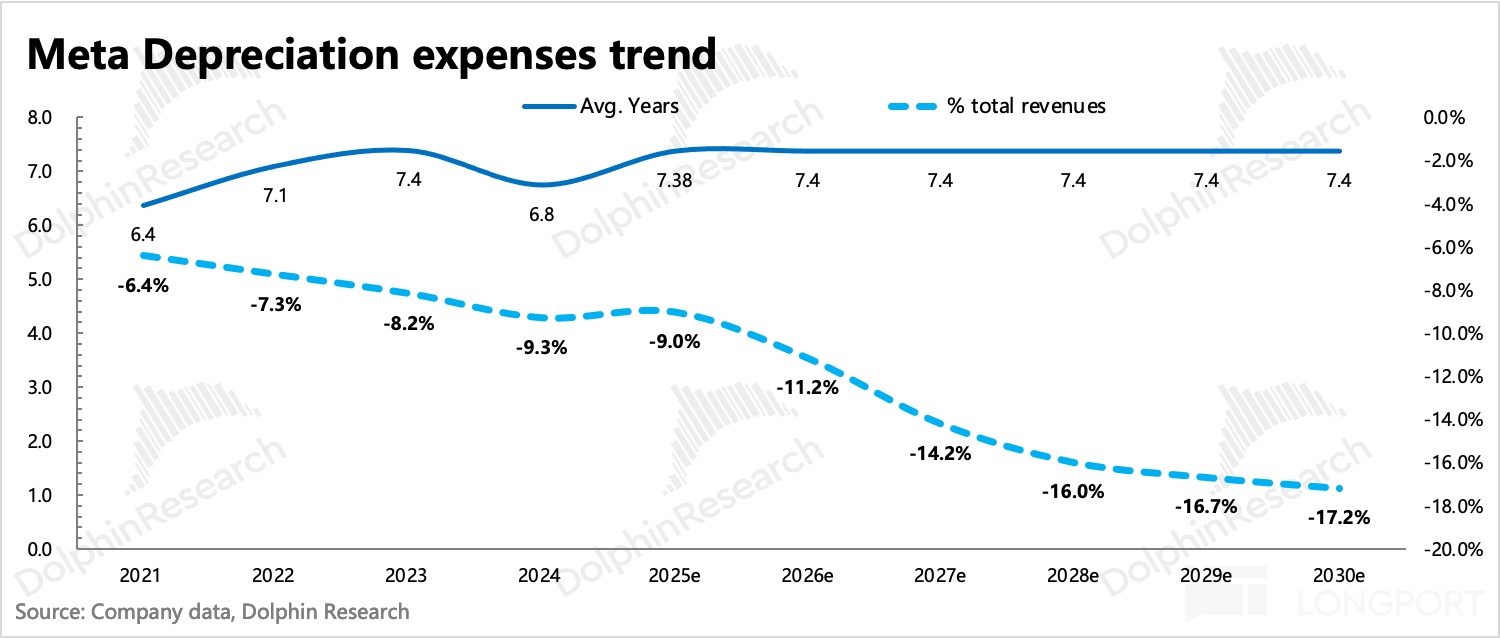
As of the third quarter, Meta's capital expenditure has accounted for 38% of the revenue for the period, with a very fast increase. Roughly calculated, if this investment ratio is maintained for the next year (actually likely higher, with market expectations for Capex to reach 50% of revenue), assuming the increment is mainly server investment, then according to Meta's current average server depreciation cycle of 5.5 years, it also means that this investment will exert a pressure of up to 7 percentage points on profit margins in subsequent years! (=38%/5.5, assuming revenue cannot effectively amortize the depreciation amount).
Even if there is replacement of old equipment, compared to the previous investment scale of less than 20% of revenue, it would still have to bear at least an additional 3 percentage points of profit margin impact. But in reality, the value of replaced old servers is far from matching the continuous new investments, and the book value of Meta's "Property and equipment" has been rising steadily for four years.
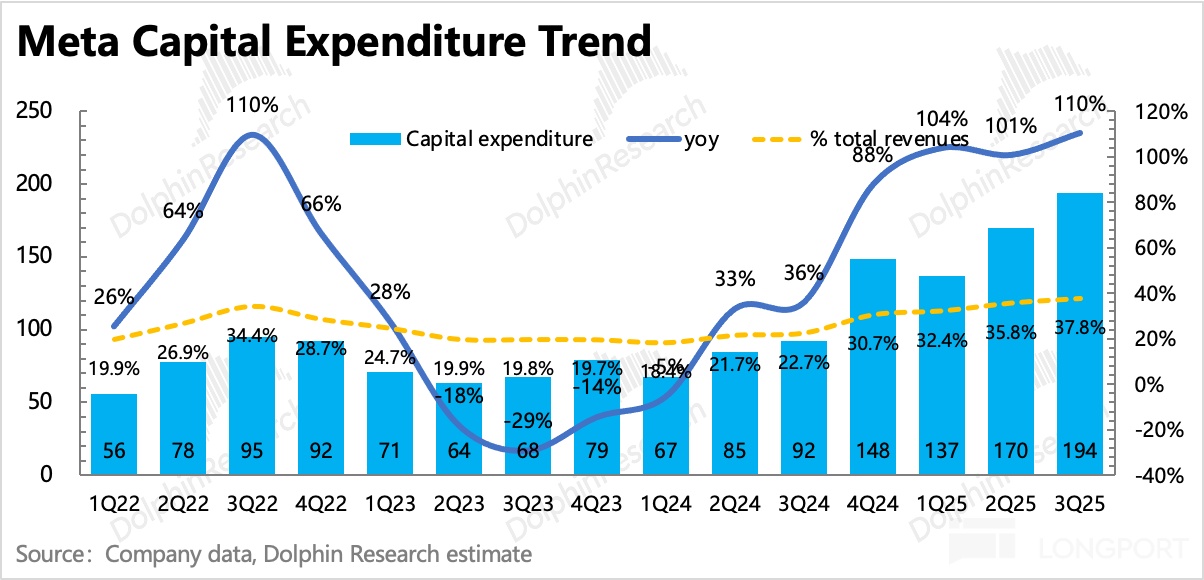
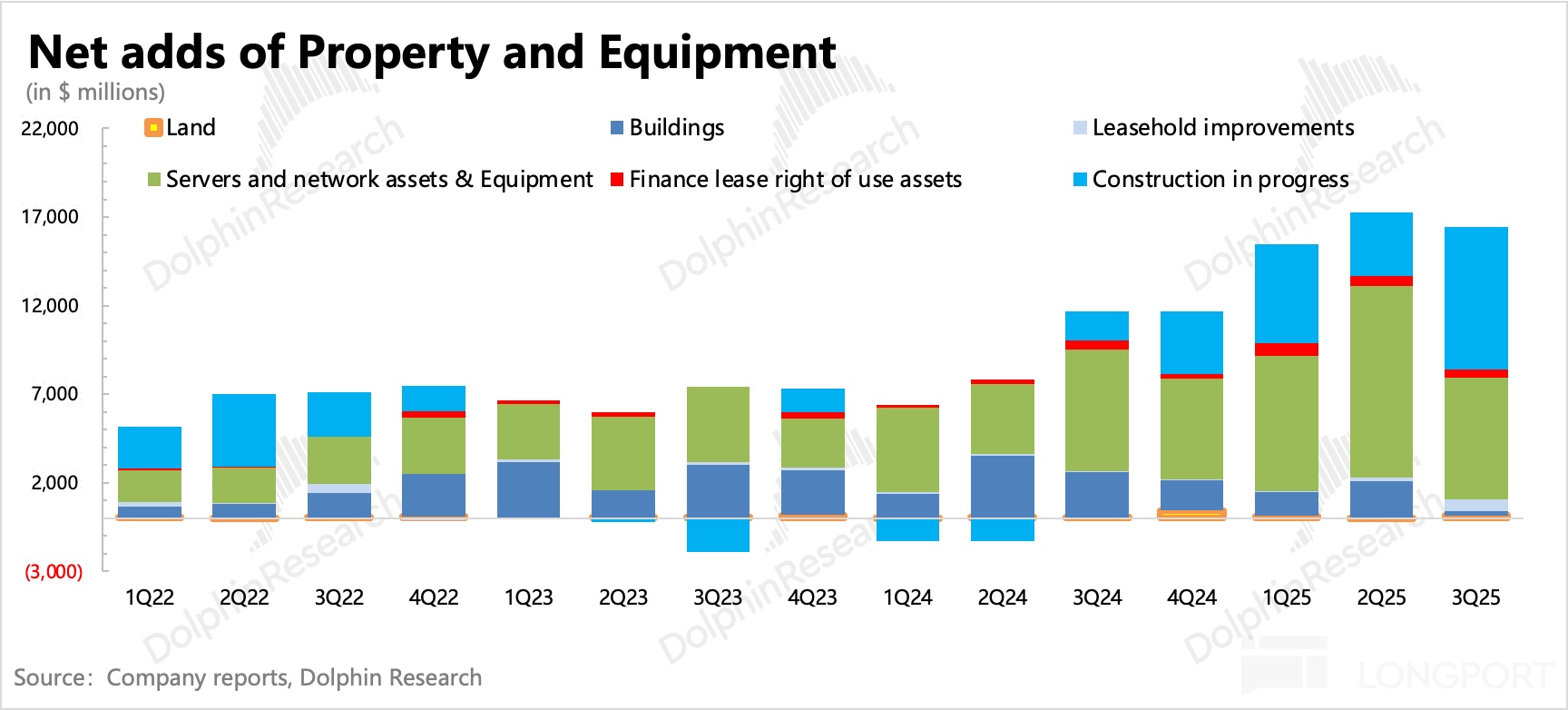
Moreover, each year's new investment will bring cumulative depreciation cost pressure. Combining market expectations, Dolphin Research makes the following simple projections:
1) Assuming 2026 revenue growth rate of 18%, AI-enabled revenue CAGR growth rate from 2025 to 2030 is 15%;
2) According to the current data center construction plan, Meta's investment cost pressure will peak in 2026—expected to add 4GW of computing power by 2028, half of which will come from 2026. According to Nvidia's total deployment cost of about $50 billion/GW, on the surface, 2026 alone would require an additional $100 billion investment.
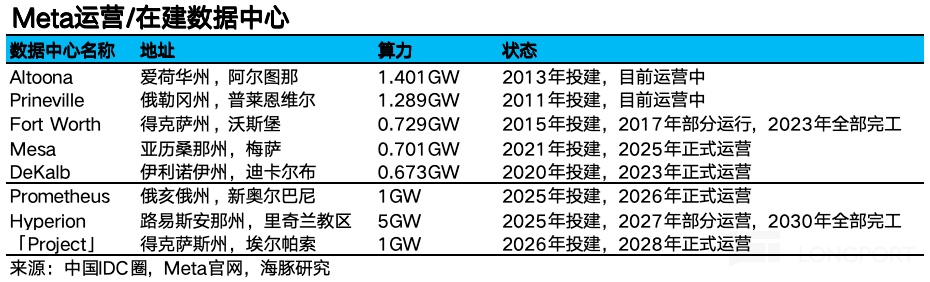
But considering the current computing power competition environment, assuming Meta partially adopts TPU, as rumors suggest, renting Google's TPU cloud service in 2026 and directly purchasing TPU chips for deployment in its own data center in 2027, would cause significant changes in short-term capital expenditure.
Another possibility is that Meta negotiates a discount price of 80% with Nvidia, reducing the cost to $160 billion. Considering the less information on TPU cooperation and the technical adaptation issues involved, Dolphin Research first calculates based on the discounted Nvidia GPU cost.
After deducting the $29 billion provided by Blue Owl from Hyperion's off-balance-sheet financing, $130 billion is still needed, with an additional investment of $50 to $60 billion required annually.
For other parts, including external computing power, land, buildings, etc., we assume a stable growth rate of 15-40% (based on the data center deployment pace, high first and then low, slightly higher than the long-term CAGR growth rate of 15% for revenue), then the expected capital expenditure changes are as follows: (Note, the chart below does not include Meta's sudden new data center deployment plans, but there may be a shortage of computing power in the middle)
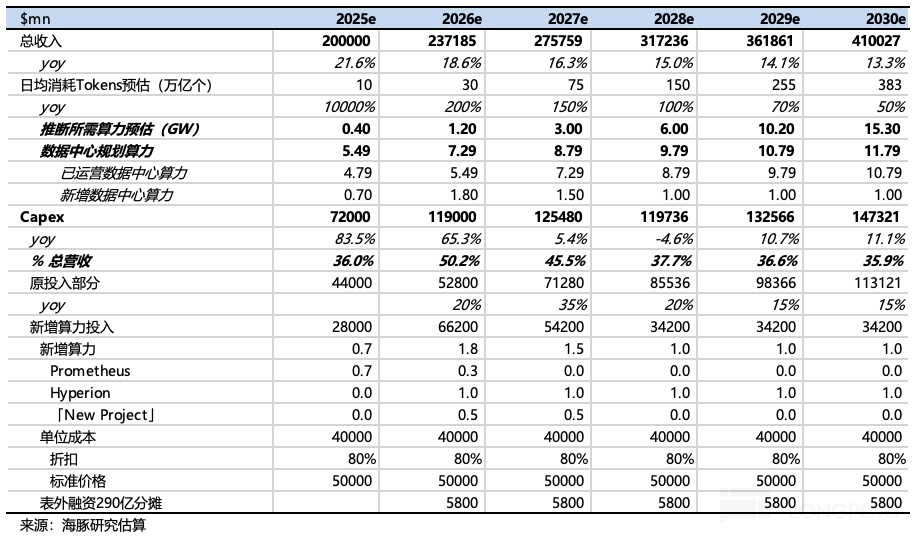
It can be seen that in Dolphin Research's assumptions, regardless of how subsequent plans (after 2028) change, at least in 2026 and 2027, the dual pressure of AI investment on profits will be very obvious. It is estimated that the proportion of Capex to total revenue will rise to 50% in 2026, and then gradually decrease.
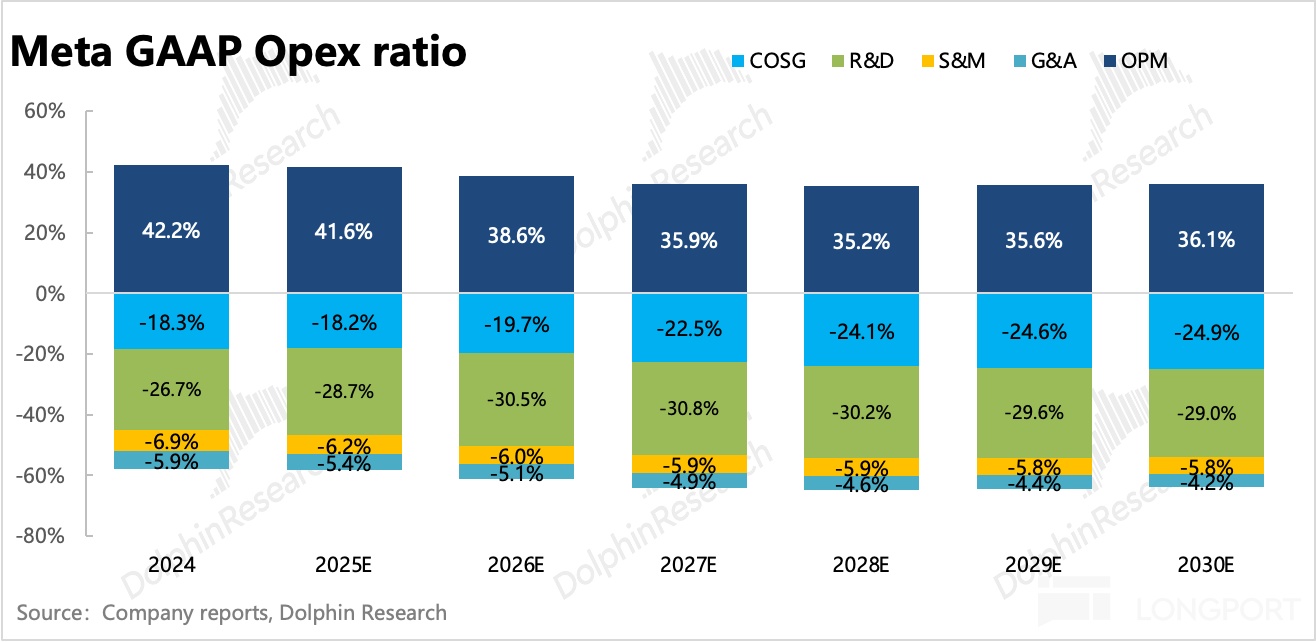
The impact of the above depreciation expenses on profit margin decline will peak in 2027, dropping by 3 points in a year, and will gradually ease after 2028. The possibility of exceeding expectations is either a significant reduction in computing power costs or Meta making more concessions in operating expenses, such as optimizing personnel, etc., with the profit margin decline expected to bottom out earlier than Dolphin Research's expectations, but obviously the former's effect is more efficient.
Conversely, if cost-saving measures cannot be implemented, then the only hope is to increase revenue—for example, Meta AI's general agent making a miraculous move. However, the competition for general agents is very fierce, and although Zuckerberg frequently announced cost-no-object talent acquisition in the first half of the year, it must be admitted that Meta's Llama series of large models are somewhat lagging behind.
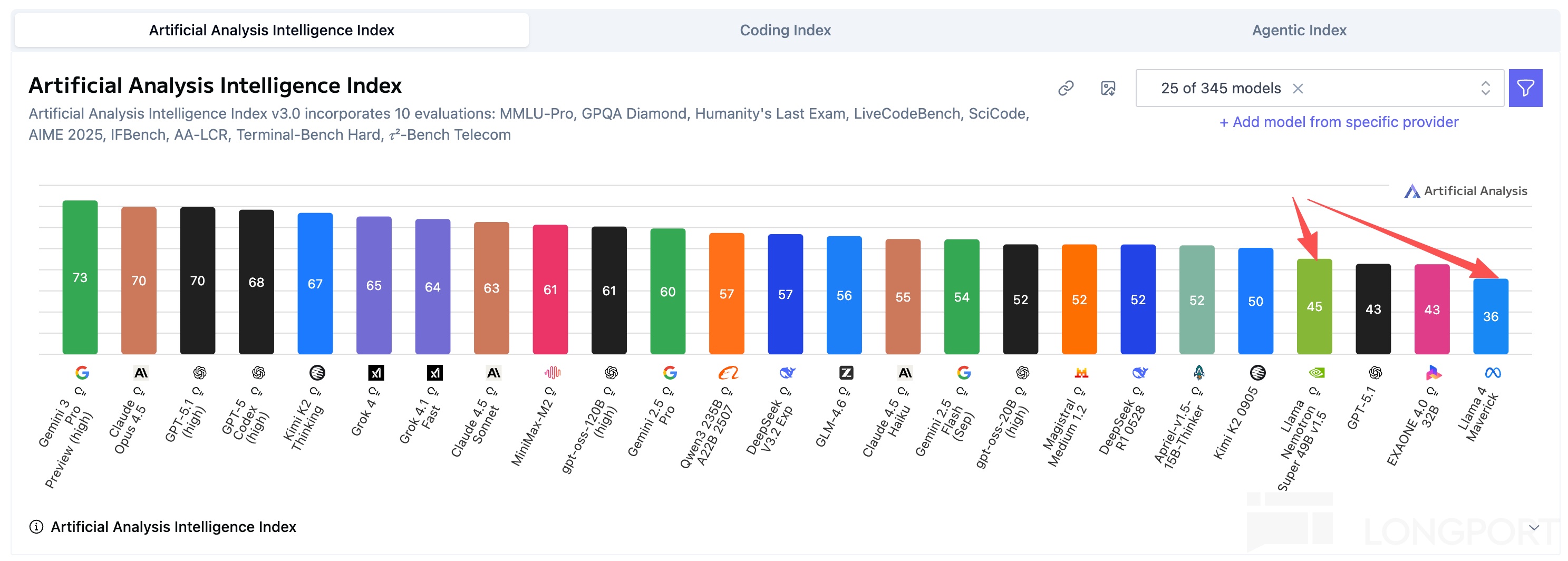
AI's empowerment of advertising, although it can indeed help improve ROI and attract merchants to increase their advertising budgets (essentially squeezing the share of small platforms), from the perspective of monetization efficiency, the "water, electricity, and coal" costs of the AI era cannot quickly become "cabbage prices."
Meanwhile, AI has infinitely expanded the scope of user interaction, causing the platform's operating costs to increase exponentially, and the marginal cost reduction effect of the internet is very small in the AI era. With only a single advertising model, Meta's monetization efficiency is difficult to return to its former level.
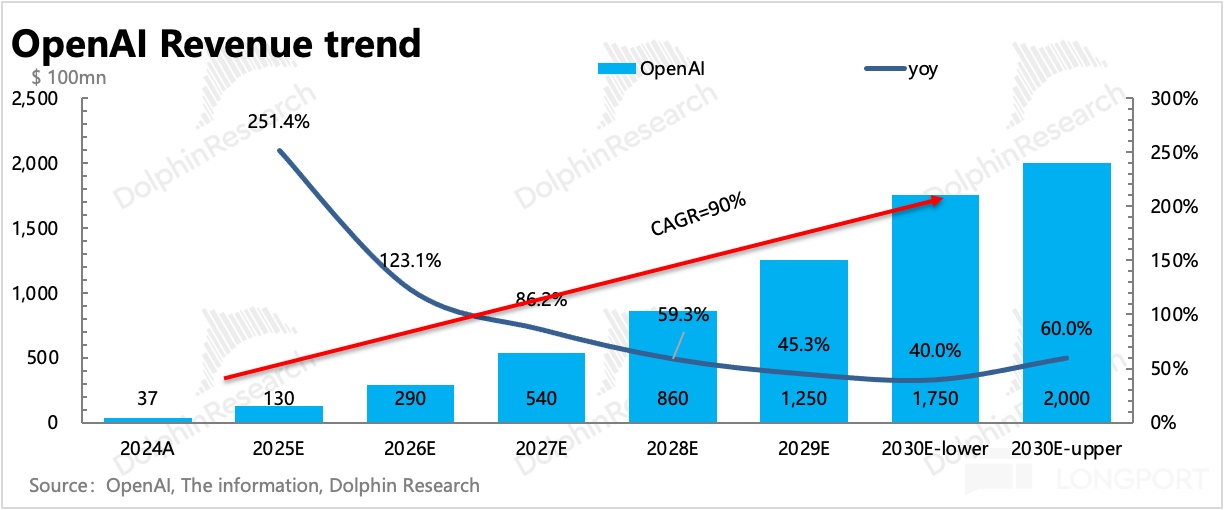
At least in our model, Meta's data center's new computing power in 2030 is only 1GW, but the depreciation cost still has a growth rate of 17%. To pull the OPM from 36% in 2027 back to over 40% in 2025, revenue in 2030 needs to reach $436 billion, directly requiring more than double the revenue level of less than $200 billion in 2025! Interestingly, this additional $200 billion is also OpenAI's revenue growth target for 2030.
III. Meta's Spending? Not a Fatal Flaw if Competition Isn't an Issue
After the short-term profit margin collapse, Meta suddenly fell from the consensus bullish view at the beginning of the year, being the AI darling with the strongest social moat, to now dreaming back to 2022 as the bottom of the "Seven Sisters." Meanwhile, Google, which was ignored at 19x P/E at the beginning of the year, has replaced the once more attractive $900 Meta and Nvidia, which has risen to the world's largest market capitalization, becoming the "AI new king" with the most logical narrative.
In the AI era, where narratives can swing from one extreme to another, it precisely indicates that more changes are on the way. Let's watch the performances of tech giants without jumping to conclusions.
For Meta, currently at 21x P/E, although lower than the historical valuation median, and the stock price has recently rebounded with the warming of interest rate cut expectations and cooperation with Google's TPU, alleviating concerns about falling into the AI bubble of vicious investment, it has found support and rebounded around 20x P/E.
However, considering the profit collapse issue discussed above, at least in 2026, Dolphin Research believes it's not yet time for mindless bullishness. Looking back at history, Meta's absolute bottom was 7x P/E in 2022, and although Dolphin Research's operating profit expectations for 2026 also fall to single-digit growth, as we mentioned in the Q3 earnings report commentary, the current situation is not a "2022 nightmare revisited," the key is that Meta's core competitive logic has not shown any hard flaws.
Although OpenAI seems to be coming on strong, Google's search has proven the importance and underlying value of ecosystem and entry mindshare. To form a high-stickiness C-end entry, OpenAI still needs to lower the threshold and cultivate users.
But the market has been calm for a while, and the AI dream that cannot be realized is starting to lose its charm. Even if capital is willing to dream, industry leaders will not allow risks to be transferred to them. Among them, electricity and TSMC's production capacity hold the lifeline of AI.
Without stable cash flow, the natural bug, how can it win the favor of industry leaders for production scheduling? This makes OpenAI's more important task now to find a "big leg" to provide unlimited backing for the trillion-dollar interstellar gate.
Therefore, Meta still has time, but there is also the risk of trial and error. Therefore, if the collapsed performance in 2026, combined with a 16x bottom valuation of $1.3 trillion (also the implicit belief valuation of maintaining 15% long-term growth), can be considered the absolute bottom for bold positioning in the coming year.
But if there is not enough systemic risk to create opportunities, then 18x PE in 2026 ($1.45 trillion) or waiting until the second half of 2026, corresponding to a slightly repaired 16x PE in 2027 ($1.57 trillion) also provides a certain safety cushion.
Finally, Dolphin Research emphasizes once again that Meta's path to recovery requires more patience. In 2026, Meta's opportunity lies only in the repair of breaking below the bottom value, not in the emotional climax of a breakthrough.
<End here>
Dolphin Research "Meta" Historical Articles:
Earnings Season (Past Year)
October 30, 2025 Conference Call "Meta (Minutes): Computing power is ready to use, no worries about excess"
October 30, 2025 Earnings Commentary "Meta: AI investment "reckless driving," faith in funding is about to be exhausted?"
July 31, 2025 Conference Call "Meta (Minutes): Investing in AI without hesitation, planning to invest $100 billion next year"
July 31, 2025 Earnings Commentary "Meta "defying the odds" with a wild surge"
May 1, 2025 Conference Call "Meta (Minutes): Creating a personalized Meta AI for everyone"
May 1, 2025 Earnings Commentary "TikTok crisis, Meta thrives, Zuckerberg's AI ambitions expand"
January 30, 2025 Conference Call "Meta (Minutes including small meeting): Every year is a "critical year," this year not just Meta AI"
January 30, 2025 Earnings Commentary "Meta: Once again, Zuckerberg excitedly spends money, why is the market not panicking this time?"
October 31, 2024 Conference Call "Meta: Q4 Capex surge has seasonal disturbances (3Q24 Minutes)"
October 31, 2024 Earnings Commentary "Meta: Completely becoming an "AI fanatic," can high growth withstand high investment?"
August 1, 2024 Conference Call "Meta: What drives high ad growth in Q3? (2Q24 Minutes)"
August 1, 2024 Earnings Commentary "Mag 7 thunder rolls, can "clear stream" Meta really hold up?"
April 25, 2024 Conference Call "Meta: Planning years of AI investment, not overly concerned about short-term profitability (1Q24 Earnings Call Minutes)"
April 25, 2024 Earnings Commentary "Meta: Nightmare of a crash again? More fright than horror"
February 2, 2024 Conference Call "Meta: Ads remain strong, continuous investment, striving to be the next-generation computing platform (4Q23 Conference Call Minutes)"
February 2, 2024 Earnings Commentary ""Surging" Meta: Chinese overseas expansion booms, Zuckerberg generously "gives big gifts""
In-depth
December 8, 2023 "Meta and Chinese concept stocks' "love-hate relationship": TikTok challenges, Temu delivers treasures"
June 27, 2023 "TikTok falls, Meta feasts"
February 21, 2023 "US stock ads: After TikTok, will ChatGPT spark a new "revolution"?"
July 1, 2022 "TikTok wants to teach "big brothers" how to do things, Google and Meta are about to change"
February 17, 2022 "Internet advertising overview—Meta: Low combat effectiveness is the original sin"
September 24, 2021 "Apple draws the sword, the first "bleeding" giant is Facebook?"
August 6, 2021 "Facebook: Digging deep into the "business gold content" of the world's top netizen harvester"
November 23, 2021 "Facebook: Heavy investment turns "Meta," the turning point is not far after double pressure"
Risk Disclosure and Statement of this Article:Dolphin Research Disclaimer and General Disclosure
The copyright of this article belongs to the original author/organization.
The views expressed herein are solely those of the author and do not reflect the stance of the platform. The content is intended for investment reference purposes only and shall not be considered as investment advice. Please contact us if you have any questions or suggestions regarding the content services provided by the platform.
